Today I finished reading Kim Stanley Robinson’s trilogy Three Californias. Written in the 1980s and set in the 2060s, each book imagines a different future for Orange County. The first, which reads like a period piece, is the future after nuclear holocaust. After being bombed back to a low-technology state, the US is kept there by the other countries of the world, who felt it had gotten out of hand. The second, which reads like today’s news, is the future of greed and technology run amok. Most humans toil for enormous military and energy corporations, live media-saturated lives in tiny apartments stuck under freeways, race around in automated vehicles that occasionally crash spectacularly, and generate any needed emotional state from designer drugs administered via eyedropper. We are almost there.
In the third book, humans and governments join forces to dismantle corporations and create worldwide income ranges and company size limits, with energy, water, and land becoming common property. War disappears, apparently having been driven by multinational profit-making. Everyone has a fulfilling job, since economies are designed with the primary goal of full employment, and time to play-exercise; technology is both beautiful and enabling; people live in small clusters and know their neighbors; and, in contrast to the other two books, the main characters end up unhappy, having made poor personal choices. A truly terrible ending.
The point perhaps is that utopia is less a system than a process, and that human nature will preclude perfection or even happiness in many cases.
My husband and I enjoy each other’s company, spend time on hobbies we love, stay in contact with friends and family near and far, reside in a quiet complex, and are able to live within our means. Although there are some changes we would like, most of the time it’s our own little pocket utopia. Not only do most humans not live this way, our being able to do so may rely on that imbalance.
I read about a tribe of natives, one of many in California, who existed for seven thousand years without ruining their environment. Their lives were culturally rich, safe, and free from hunger. Then the Europeans arrived. Since those natives were living in a form of utopia, one might think the intruders would adopt it. But their religious beliefs dictated that they were superior to heathens, and some of them were greedy.
The modern domination of superstition and greed over reason and altruism is why I am predicting a dystopian future for us, while living a utopian present.
=============================================
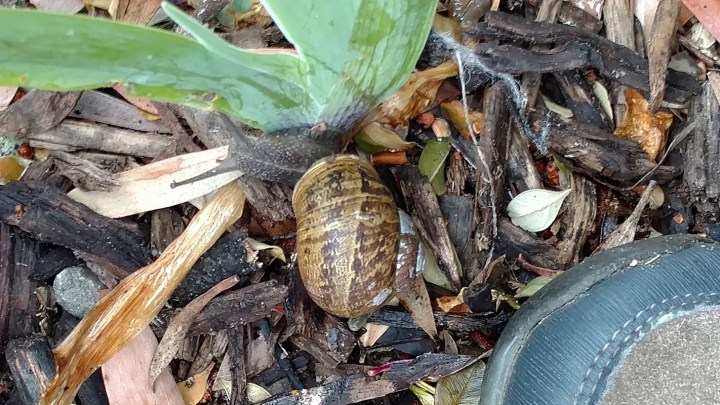
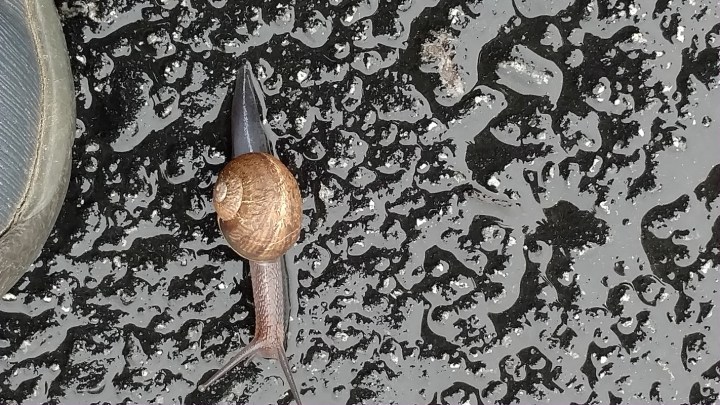
Californians are startled by June rain, even light rain of short duration. It brought out the snails. My toe is included for scale. I subsequently rescued the one on pavement.
 Culminating Triad