A bioblitz is an intense period of biological surveying in an attempt to record all the living species within a designated area. Groups of scientists, naturalists and volunteers conduct an intensive field study over a continuous time period. *
Marine biologists are having a weeklong bioblitz in California, and yesterday I participated in a group tidepool sampling. All of our pictures are collected at the site iNaturalist.org, which despite its leading lower case i is not an Apple trademark. Our Davenport bioblitz was an official project, but anyone can submit an observation of any living thing, or any evidence of a living thing, such as a shell. To contribute, simply enter an observation–usually a photograph–using something from the dropdown menu as species/taxon name, or your own placeholder name. Then in the description add details to help identify it.
Expert users use the data from iNaturalist for all sorts of studies and surveys. If your description interests anyone, within hours you will have a confirmation on the identity of your animal, plant, fungus, or alga. I’m not sure whether it works for microbes, but if you have a picture of some, try it!
You can also browse anyone’s data, because everything on iNaturalist is public. That’s sort of the point. It’s one of many citizen science projects now available. You can count frog calls or feeding birds or exoplanets, or play games to help map retinal neurons or unfold proteins. A lot of the game-like citizen science projects are collected on zooniverse.org, another fun site that has spawned more than 100 scientific papers.
Although I am contributing to the bioblitz on my own, it was useful to go with the group. I learned that to tidepool effectively takes a lot of time, much of it spent sitting or kneeling by the pool and examining it closely for tiny creatures, often waiting for them to move. A picture of a hermit crab, for example, is easier to to identify if its claws are extended, and most nudibranchs are too small to see from a standing or bent over position. As far as posting, if you see one octopus, that’s one observation, but if you see hundreds of mussels, its ok to post multiple observations as long as the pictures are taken at different locations.
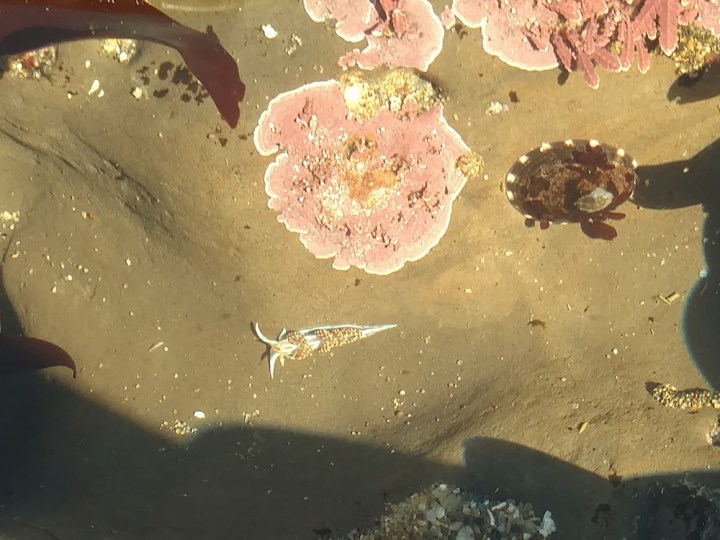
This is pink coralline algae with an oval limpet at the right and an inch-long nudibranch crawling right to left below. I submitted it three times, once for each of those three lifeforms.
Citizen science is a use of big data that benefits scientists and citizens. This week I was also contacted by a potential employer who found me on the web. As someone concerned about privacy who tries to maintain a low-profile online, I may need to reevaluate.
==================================================
* From Wikipedia.
 Culminating Triad