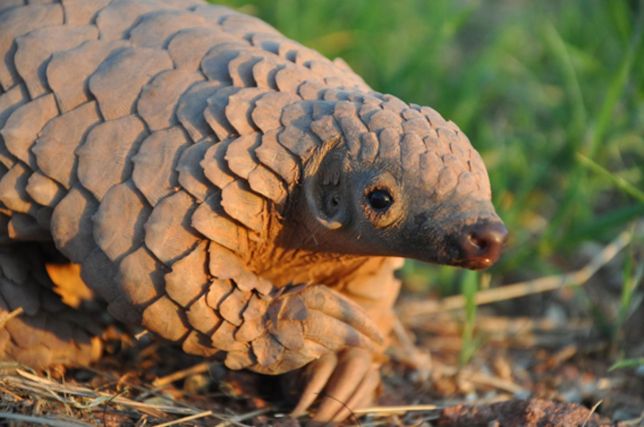
It’s a mammal, up to three feet long including a long flat tail, completely covered by keratin scales except for its belly. It sometimes walks on four legs and sometimes on two, hunching over with its front paws dangling just above the ground. Its claws can dig through concrete. Its scales can deflect a lion bite. It eats termites and ants, up to 90 million per night. When threatened, it rolls into a ball.
Sadly, that means it can easily be picked up and tossed into a bag.
I renewed my acquaintance with pangolins via a Nature episode, The World’s Most Wanted Animal. Marie Diekmann, a Californian who now lives in Namibia, having dedicated her life to conserving endangered species, is the focus of the show. Diekmann adopted an abandoned newborn pangolin, Honey Bun, and there’s lots of adorable footage of Honey Bun messing up the house, Honey Bun and Diekmann cuddling, and Honey Bun bonding with Diekmann’s dedicated assistant Steven Mandja. Honey Bun will be released back into the wild when she is an adult. Meanwhile, Diekmann and Mandja take turns following Honey Bun as she feeds more or less all night long, both for scientific observation and to keep her safe. They have found poaching traps on their land.
Why are all eight species of pangolin endangered? For the same reason some species of rhinos, tigers, seahorses, turtles, manta rays, sharks, and antelopes are: Traditional Chinese Medicine. Though Westerners often believe these animal parts are sought to increase sexual prowess, most of them are believed to cure diseases. Pangolin scales, for example, are used for some cancers and for lactation issues. Most of these treatments haven’t been scientifically tested, so we don’t know whether they are effective.
What we do know is that that animal populations are simply too small to support the human demand. When humans aren’t hunting pangolins for medicine or meat, we are reducing their habitat due to our own expansion. Raising pangolins in captivity is nearly impossible, and even if it were, farming animals for medicines is a cruel alternative. Thousands of black bears in China are confined in crush cages with a permanent hole in their abdomens leading to their gall bladders so their bile can be collected, a state so painful, according to Wikipedia, that some bears try to kill themselves.
Chinese people are divided on these issues. Pangolins in particular have a great ambassador fighting their cause, Chinese superstar Angelababy. With over one billion Chinese people, though, even if most of them abstain, there is still plenty of demand. Chinese laws prohibit sale of most endangered animal parts, but high prices keep the market alive.
The obvious solution is to eliminate demand, but not many people from any country will value animal lives over their own family’s health. Demand for traditional medicines might drop if effective health care were readily available to everyone, worldwide, or if there were no diseases.
Global universal health care? Elimination of disease vectors? I don’t think I am close to a solution here. Enjoy the pangolins while you may.
=======================
Photo from Metro News, metro.co.uk
 Culminating Triad