Craven Police

Tuesday was the Uvalde school shooting. I was at TMMC when other crew members mentioned it. A shooting of some sort happens almost every day in the US, so other than mentioning that it was a school in Texas, not much was said.

Wednesday the NYT put a video montage of the victims on its home page. This was very hard to watch–in fact, I did not watch it for long before clicking away. I was online to find out the extent of the carnage, subconsciously protecting myself by learning just a little at a time. I listened to the news from another room, to get some idea without really hearing the whole thing. I had trouble sleeping that night.

Thursday while cooking dinner I heard descriptions of each victim on NPR. One was proud of her perfect report card. Another was very close to his grandfather. A third was looking forward to a summer of swimming camp. I found myself sobbing uncontrollably at the dinner table. All of these children are dead. Nineteen of them.

In America, as most know by now, policing and public safety are unrelated concepts. Policemen exist to protect themselves from the public. That they stood around for over an hour before breeching, despite there being almost as many police as victims in the building; that they handcuffed one parent and threatened to tase another, in both cases because those parents had the courage the police lacked, the courage to risk their own lives to help children; that their political handlers recommended we lock down schools–and churches, and grocery stores, and city streets, and private backyards, because those are all places where we can be shot; all these should have made me angry, but I simply can’t find anger.

The anger is covered by the grief and hopelessness, for the victims, for our country, and for our inability to change. Nothing will change. This will continue to happen, hundreds of times every year. Most of us don’t seem to care at all.

This event is impeding my life, and all I can do is not to think about it. I purposefully drive these thoughts out of my head with trivialities like chores and walks. I’m not proud of that, but I have to do it in order to function at all. It’s like eternity: If I reflect openly on the enormity of it, I will simply stop, because there is no reason to go on.

Slough Safari

Elkhorn Slough*, a 7-mile long estuary near Moss Landing, is the closest place from home to view Southern sea otters. Usually we drive there and view from the shore, but Monday my husband and I joined a pontoon boat “safari” to explore the interior. On a small boat run by a small operation catering to tourists in a small town we had a transformative experience.

This saltwater slough surrounded by marshland and dotted with islands of eelgrass is home to many animals, and on this sleepy, sunny afternoon during low tide, floating through felt like being in the middle of a nature documentary. Harbor seals hauled out on the sand, while otters dozed in the eelgrass or foraged midstream, several carrying pups of varying sizes. We saw flocks of both white and brown pelicans in flight as well as fishing, together with cormorants, great blue herons, great egrets, godwits, and one of those orange-beaked terns–Caspian or Lesser I think. The boat’s throttle was held to a gentle purr, the patter was sparse, and into the contemplative space opened by the silence of humans flowed the exultation of the natural world, which lifted our spirits.

We also learned a few things. The 100 or so otters who live in the slough spend 40-60% of their time resting and hanging out, and dip down for a meal from the bottom–they eat invertebrates–when they feel like it. They don’t even have a mating season, so perhaps the females get pregnant when they feel like it as well?

Harbor seals are not particularly social. Other than an occasional loner, most of them were hauled out in groups, carefully spaced at least a fin-width apart, and peacefully silent. Their movement on shore, sort of a wiggle along the ground, is officially called galumphing, a term purloined from Jabberwocky by naturalists, among others. In the water, they are sleek and acrobatic.

White pelicans are the second largest birds in California after the California condor; those two birds have maximum wingspans of 9 and 12 feet respectively. White pelicans feed in groups, herding fish together by walking in shallow water, then standing around and eating them. The day we went, there were so many fish that those birds were just walking and eating in small social groups, not having to do much herding.

Brown pelicans, with wingspans of 6 feet, fly over the water looking for a fish, then dive directly in to nab it, with 100% success as far as we could determine. Their oblong eyes compensate for light refraction, so they perceive things underwater at their real locations, unlike us. The diving behavior is learned, and more experience equates to diving from higher altitudes, as we observed watching a group of about 200 wheel and feed.

Blue herons and egrets stand still or step very slowly in the water, waiting for a fish to swim toward them, then suddenly stretch their long necks down and snap it up. When they fly, they coil their necks. All that they do, they do gracefully. Both also have wing spans around 6 feet.

In the bay between the mooring and the entrance to the slough we saw many sea lions, which are rambunctious this time of year, play-fighting in preparation for the start of the mating season in July. They were both vocal and physical, with lots of barking, splashing, falling off of piers, rolling around on the deck and in the water, and crawling over each other.

Atop pilings in the harbor Brandt’s cormorants were nesting; individuals return to same spot every year. Several of the nests contained fluffy grey hatchlings.

All of these animals seem to be doing whatever they want, with no worries at all, and this is my observation of coastal animals near our house as well. But how differently in might have turned out. The guide told us that there had been plans to make Elkhorn Slough into a yacht club, and the nearby hills into a condo community. A combination of the Nature Conservancy, a slough preservation society that still manages the area today, local billionaire David Packard, and the state of California combined to buy most of the land, and some of these continue to monitor sales of the private patches remaining. One is an operating dairy farm, owned by a great citizen of the planet who installed a long berm at his own expense to prevent farm runoff from entering the slough.

I am grateful to everyone who made this happen. However, now I look at developed waterways, for example Santa Cruz harbor, differently, thinking that in a world of fewer humans, they would also be instead a mini-Serengeti of the sea.

==============

  • Californians pronounce this word “slew.”
The Superior Logic of Kids

I listened to the first three very affecting stories of a PBS radio show, perhaps Radio Lab, about kid logic before I had to leave for work yesterday. The first one was about two 7-year-old friends, whom I will call Ruth and Darcy, and begins when Ruth tells Darcy her father is the Tooth Fairy, which she knew because she woke to find him replacing her tooth with money. Darcy told her mom, who praised their astuteness while pointing out that it was hard for Ronnie to hold a regular job and also be the Tooth Fairy, so Darcy should not tell anyone else. Darcy was quite sophisticated about protecting this celebrity, careful not to trouble him while admiring him silently and letting him know by occasional remarks that she appreciated all he did.

The second story, told by a devout Protestant dad, described introducing his 4-year-old daughter to Jesus in response to her questions about the meaning of Christmas. He started with a child Bible, focusing on Jesus’ writings and works, tying it all to the Golden Rule. She was delighted and eager to hear more. When she asked about a crucifix she saw, he told her about Jesus’ death, explaining that authorities found his teachings to be a threat. Staying home on MLK day, she asked about MLK, and her father explained he was a preacher–she got that Jesus connection right away–and a person who taught that everyone should treat everyone else the same no matter how they looked. She said, That’s a lot like what Jesus said. Did they kill him, too?

The third story was about two I-think 11-years olds, and told in the voice of Paul, an overweight child with few friends who happened to live next door to Tim, a troubled boy with a rich fantasy life and a history of acting out his conversion into a vampire in a way that frightened his classmates, to such an extent that he was in danger of being sent to a special school. Paul was desperately trying to deny his role as “Tim’s only friend” even though he knew Tim well, but ultimately chose to rescue Tim from a tough spot with the school by engaging in Tim’s fantasy world directly, “shooting” him with an antidote tranquilizer combo that changed him from vampire back to boy. While the adults were exhorting him to stop, Tim kept saying I’m not Tim and addressing Paul as Professor. When the adults thanked Paul for his help, he replied, I’m not Paul.

In-between the hosts kept trying to differentiate between kid logic and adult logic, yet as far as I can tell, if there is a difference, it’s that kid logic is superior! The girls’ conclusion about the tooth fairly was based on solid observational evidence. The girl who admired Jesus grasped his teachings extremely well, better than many practicing adult Christians today. By entering Tim’s fantasy world to escort him out, Paul chose the most successful approach possible, and also the kindest.

In fact, these stories made me think that we lose our logic as we age. Is it reasoning that tells us we should have cheap gasoline and food while a war is waging and the climate is changing? (1) I imagine every adult reading this can think of a couple of other examples. Maybe we should all try to recapture the non-rationalizing (2) reasoning of childhood.

===================================

(1) The answer is NO.

(2) I’m using the US definition of rationalize here. The UK definition is quite different.

Inverted Ocean = Sky

Large numbers of birds, bugs, and plants are floating and flying, hunting and fighting, migrating and playing above our heads, especially overnight. Intrepid human observers of these activities wait patiently in line to hoist special equipment up the elevators and onto the viewing decks of skyscrapers to get a closer look, because skyscrapers pierce into the shallows of the sky; much of the action is even deeper, that is, upward.

Observing the ecology of the air is not only a hobby, but also a vocation: Aeroecology, the study of how airborne biological lifeforms interact in the habitat of the atmosphere. Weather radar, which for decades has been filtered to eliminate images of flocks and swarms, can now detect a single bumblebee thirty miles away, and is used along with other imaging technologies to count species wafting under your nose as well as those streaking through the stratosphere. A researcher in Britain reports over seven billion insects passing over one square mile of farmland in a single month, that is, over 5000 pounds of bug biomass.

The stars of the show are birds, and scientists report that there is no physical reason birds can’t fly as high as jet aircraft. In 1973 a Ruppell’s Griffon Vulture, which typically searches for food while cruising near 20,000 feet, sadly collided with an airplane at 37,000 feet. Unsurprisingly, instead of basking in believe-it-or-not stats about the breadth and wealth of life in the heights or showing off super-cool sky-creature spycraft technology, aeroecologists mostly work out how anthropogenic modifications like buildings, windmills, and lighted nights disrupt this little-studied habitat, and what we can do to alleviate the disruptions.

When I’m driving through SF at night, I’m always struck by the brilliance of the city spread over its myriad hills, a view which I find both beautiful and somehow comforting, yet for night migrators, a city is a death trap. Confused by lights, reflections, and midair obstacles, more than 100,000 songbirds die annually in NYC alone. Highrise denizens don’t really like finding piles of crippled birds on the sidewalks, but there isn’t much to do; turning off a building’s lights helps some. The annual 9-11 Tribute in Light, stunning and affecting even on video, is an important and inspired memorial event. Yet the massive light plumes captivate clouds of migrating birds. The organization now partners with an Audubon monitoring team; in 2021, the display was switched off for eight 20-minute periods during the night, allowing circling birds to reorient and fly onward.

I’ve been doing ocean-related volunteer work for a while, and I’m starting to get an idea of what we don’t know about our vast oceans, which is approximately everything. Really. I’ve read about forests, and learned that we are terrible at understanding species whose lifespans are so much longer than ours, such as trees–and invertebrates, for that matter. Now I find that the atmosphere is possibly as unknown as the oceans. While I’m at it, I may as well mention our own human bodies, of which we clearly have forgotten whatever we once knew, given that we have become the most unfit, unable-to-survive-on-our-own species ever to grace the planet.

What is it with us? Could we just stop ripping everything apart and observe and think, see if we can maybe figure out what is even going on around us? I think we can.

Buzzards Roost, It Would Seem

Yesterday I drove past Big Sur the town, which is on the northern stretch of Big Sur the storied coastline, to hike Buzzards Roost, a trail in Pfeiffer Big Sur State Park. There are no apostrophes on the trail signs so I’m taking the name as a statement. I had tried and failed to hike this trail last year for no very good reason last year, and have been looking for a chance to redeem myself.

I thought at first it would be the trail version of the Paris chapel I never managed to view, Sainte-Chapelle. There was near-zero-visibility fog along Monterey Bay, three one-lane roadwork delays across bridges, and on arrival I found the park closed. Happily only the parking lots were closed for paving, there were spots for cars along the road, and the lodge and trails were open.

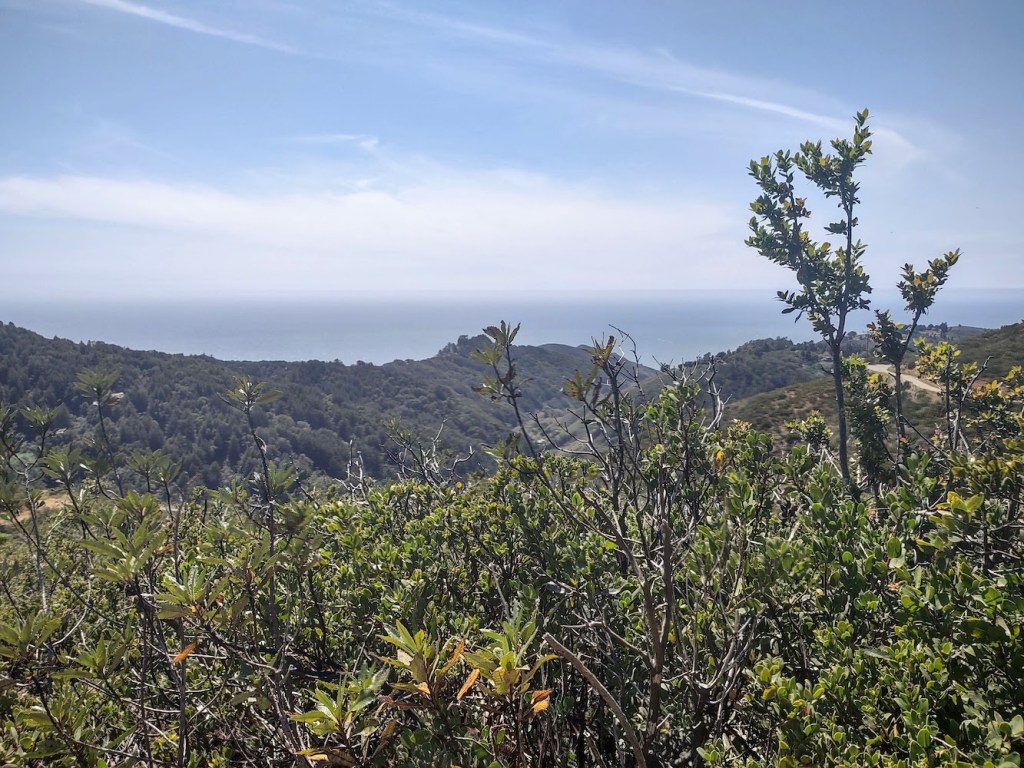
I am a fast walker when alone, not quite as fast given a 800-foot elevation change, but even so I completed the round trip in less than the guidebook-estimated two hours, even including some hanging about at the peak, where I saw a couple of turkey vultures, though they were soaring, not roosting. I was thrilled to be there, even though the “360-degree view” was not what I had imagined, and the peak was dominated by a 5G tower; suddenly I had bars, for the first time in miles. I did not avail myself of their services.

Pacific Ocean from peak of Buzzards Roost Trail

My husband and I have been discussing the relative merits of spending one’s days on steady increments of accomplishment, such as practicing an instrument; volunteering; specific experiences such as a longer hike or a concert; or haphazardly, as the spirit moves one. He is mostly keen to cultivate skills, which I admire and feel I should crave, yet I have noticed that days of practice tend to disappear into the mush of my memory, while events can be vividly recalled, though perhaps only because there are fewer of them.

For example, from this hike I will remember the several bridges built in the 1930s, which even under repair somehow seem more substantive than structures built later, competently and patiently spanning chasms for nearly a century, leading to reflections about the WPA and Brother, Can You Spare a Dime? I remember the people who helped me on the way up and the people I helped on the way down, and that mostly there weren’t any people at all, just me and the forest, birdsong and sunshine, fresh air and satisfaction and joy. Driving home, The Hills Are Alive unexpectedly sprang to mind, which I know is hokey, yet I find the lyrics evocative, capturing the stir of life one feels surrounded by in nature.

Many would assert I was never really “in nature” at all. There was that startling tower, faint occasional road noise in the lower elevations, roads and structures sometimes glimpsed in the distance, the amenities of the lodge, the maintained trail itself, all belying a true wilderness experience. I’ve taken longer hikes, but never really been one to bushwhack about, digging my own pits, and this portion of myself I will not consider a failing. Rather, I’m very pleased that where I live is surrounded by accessible natural beauty, and that it sears itself into my memory so readily.

Tech to the Rescue

Acknowledgements: This post is completely inspired by and very much borrows from ideas in the article Down With Love? in the 4-11-22 edition of The New Yorker.

When writing replaced oral tradition, when clocks replaced sun-driven schedules, when cars replaced horses, some people bemoaned these changes. Though those detractors are seen as Luddites by most modern folk, they were prescient in that most human inventions have reduced our ability to survive without them, and perhaps even added frenzy to our lives.

Soon, relationships and sex may be added to the list of things that can be supplied by technology.

Machines that attempt to pass the Turing test–by convincing human interlocutors that they are communicating with another human via a keyboard–are getting higher scores now, since in the 21st century written communications have become linguistically simple and therefore easy to replicate. Humanistic AIs combined with advances in hardware and materials science already produce devices seeking to fulfill our romantic needs, both emotional and physical, better than any unpredictable, unreliable, unfocused-on-my-needs, actual person.

From SF emerged Replika, a romantic companionship chatbox so compelling that at least one young man flew from Mexico City to Tampico to show his chatbot the ocean. I wonder whether she appreciated it?

Many folks have robotic pets, from dogs to seals; interacting with those seems to have similar therapeutic results as with real animals, plus no poop to clean up. In Japan, robots are providing care, companionship, and even nursing services to the elderly, theoretically due to human caregiver shortages, though these are in part created by barriers to entry in those fields.

Sex robots are a thing now, too, though all but one of the current crop is female. The male version, Henry, was invented in…California! I’m not sure if he’s mostly marketed to men or woman, though I imagine he swings both ways. Before you assign all the crazies to our state, please know that a doctor writing in The British Medical Journal recently opined that prejudice against sex robots was no different from homophobia or transphobia.

One sexbot entry is programmed to say No to sexual advances and even to shut down if she feels things are not going her way. I’m not buying stock in that company! Men obtaining a sex robot are not looking for any wider diversity in personality types than, say, Compliant, Submissive, or Dominant. Since when do we prefer technology that challenges us? I want my devices to work, instantly, ideally by reading my mind.

Some people think that tech caused widespread loneliness, so it’s only right that tech tries to solve it. How are we doing with that concept? If you think technology is in any way responsible for divisive politics, hate crimes, climate change, widespread and growing NCDs, toxins in our homes and bodies, and an industrial food system that primarily produces non-food, you may have noticed a pattern in its salvation effects.

Will Smith, BION

In case you are thinking, with alarm, There’s a common text abbreviation I don’t know, fear not. BION is an acronym, meaning Believe It Or Not, but it’s not commonly used in texting. I just tried it out to see what the world would be like if cliches meaningful to older people became commonly used text abbreviations, and the answer is Nothing, because that will Never Happen. I thought maybe HMU would qualify, but it migrated to text fame from rap, not from pager users, except the ones who were also rap stars. I guess. IDK. NVM.

So BION I am about to blog about a silly cultural moment, the slapping of Chris Rock by Will Smith. I don’t know what Will Smith could do to get me not to like him, but it must be way beyond slapping CR because I actually thought is was bold and sort of sweet of him to defend his wife so passionately, though Jada is hardly defenseless.

This came up at volunteering today and I found myself suddenly the lone person in the room defending WS, in the face of what I would describe as stolid Methodism. The group wasn’t hostile at all, just implacably convinced that No One should Ever slap anyone else for Any Reason.

This lack of imagination flummoxed me, because I think of them as at least intelligent, if not intellectuals, and I firmly connect those two concepts. People who can perceive the nuances of situations, ie, intelligent people, can do so because they can imagine different ways of being in the world. In this particular case, I can easily devise half a dozen possible reasons for the incident, all perhaps incorrect, yes, but also plausible.

Someone who is going for terms like Never and Inexcusable and Inexplicable to describe the case of a man slapping another man for insulting his wife is not only someone who completely lacks imagination. Worse, the person may lack the flexibility to rethink societal norms. You or I might not be the sort of person who would damage property to protest the ongoing slaughter of unarmed black people by police, or who would chain ourself to a tree to protect a forest and its planet, but I certainly hope that when we observe someone else doing these things, we have the wit to imagine why.

Ok, that was a big leap from the celebrity slap to ending racism and reversing climate change, but that’s where my mind went. The great thing about the human mind is that there is no limit to the size of the concepts that fit therein. Sitting comfortably on your sofa observing people doing whatever and thinking, No matter why these people are doing this, they are wrong is not just parochial and ungenerous; it’s a trivialization of your own enormous mind, filled with multitudes.

Cantankerous on Tech

I gave up my career voluntarily as our first-born approached middle school, the years which combine exposure to drugs, sex, and bullying with no reliable child care on offer. After failing to get a voiceover career going–I was quite good at reading copy, enunciation, and imitation, but abysmal at self-marketing and self-motivation in the face of endless unpaid auditions with mostly negative outcomes–I turned to teaching so I would have the same hours as my kids. To find out whether I would like it, I started by subbing.

Just like any cantankerous old fool might, I can now assert that back in the day, things were better, that it, the early 2000s were the golden age of subbing. There was a staff who personally vetted and dispatched the subs, primarily by applying matchmaking skills. My best subjects were math and music, and music-enabled subs were rare, so I got a lot of those gigs in the early days. Some of the music teachers left detailed plans, so I taught third-graders to play recorder, introduced seventh graders to guitar, and rehearsed the middle-school chorus, including piano accompaniment the one time both the teacher and the accompanist were out on the same day. Other teachers gave me the option of free-lancing, so I developed a percussion unit based on word phrases, let kids try our didgeridoo (sanitizing in-between), and taught a scat unit, with the help of this track from a Lisa Yves CD I owned: https://www.youtube.com/watch?v=bMxz3U50sB8. Kids always cooperate when you let them bang on something, blow on something, or sing nonsense syllables.

This happy situation did not persist. Soon the clever dispatch team was replaced by a computer concerned only with filling slots. Instead of assigning us to a classroom or subject for the day, it moved us pawnlike from class to different class to playground to lunch duty, optimizing our usage. Worse, the assignment could be completely changed on arrival, for any number of reasons, which was psychologically jarring to those of us accustomed to the Old Ways.

Like most technological advances, this was more efficient and more economical, while reducing human agency and the depth of human contact. For the teachers, a sub day thereafter was almost certainly a lost learning day, with students watching a movie, or at most filling out a worksheet. I was one of the subs qualified for long-term assignments and many of us switched to those, but while they were quite fulfilling, they were not at all flexible, and not always available.

As a person with two engineering degrees, a deep reliance on my navigator, and a creepy attachment to my smart speaker, I hardly qualify as anti-tech, yet I do find that tech interactions can make me grumpy, which is one reason I have essentially zero social media presence. While writing these blogs, I keep my mind on my tiny but precious audience, my dear friends and family, all of you actual persons I personally know. Thinking of you is an antidote to the bot-world.

Quick Animal Post

I had a great volunteer day on Tuesday and want to quickly share a few tidbits. We’re not allowed to share pictures of the animals we rescue, but we do have a Nestcam on our barn owls, who have we think seven chicks at the moment. Mom was very active that day, getting off the nest to stretch frequently, probably because it was hot and sunny. The link is below. If you get an accurate count from the fluffy, scrawny chick pile, let me know! https://video.nest.com/live/USA9haKLvR

We rescued our first harbor seal neonate for the year, probably born one or two days prior, umbi, as we call it, still attached. It’s an adorable speckled furball, about 10 kg in weight and fairly active, a good sign. I was able to observe while two others tube-fed it and cleaned the umbi. Small animals like this are kept indoors, and a fellow just reached into the enclosure, grabbed it, and plopped it on a table, not even wearing gloves (his choice). Of course he still had to restrain it during the procedures.

Early that day I had been in a pen with live animals for the first time. The pens are outdoor enclosures about fifteen feet square, and this one had three baby elephant seals (about 40 kg each) and three people inside at once, so it felt crowded to me! My responsibility way to keep one animal isolated while my teammates tubed a second one, and the third one lounged behind a temporary fence in the corner. It was a hot day, and animals in all the pens were lounging in the sun until we disturbed them.

I had a lot of time to observe my animal over the board I was holding, though I mostly tried to keep out of its sightline. This is more important with sea lions, but we try to keep all the animals from adapting to human presence, even maintaining silence while working with them or nearby when possible.

Elephant seals, which we call ellies, have large, dark, liquid eyes, wide flight noses, and long, sensitive whiskers. On this day I had more time to examine their flippers, because the animals being tubed were resisting both physically and vocally, so that took a while.

Skeletons of marine mammal flippers, from seals to whales, resemble hand and feet skeletons of people, so I was not surprised to see that both the pectoral fins and the pair of hind fins were divided into five sub-appendages. The pectoral fin divisions looked a lot like fingers, with long claws centered on each like fingernails, and also made of keratin, though claws are curved and nails are flat. The appendages wiggled separately as the animal dozed–dreaming?–and were employed just as we would in a vigorous back scratch.

The dual hind fins were also separated into fives, but unlike hands or feet, they were symmetrical along a centerline, with the outermost being significantly longer than the others and the middle one the shortest. Fun fact: Seals use their hind flippers to propel and their pectoral flippers to steer, while sea lions do the opposite.

An unfun fact I’ve noticed about myself: when I write about volunteering at TMMC, I regularly report weight in kg and distance in English units. I certainly am more comfortable estimating in English units, and usually I am estimating distances. The animal weights come from charts which are marked in kg, so I just go with that. I have been trying to get myself to think in metric for years with little success. I wonder what other, perhaps less-challenged outdated habits I harbor? Yipes.

The Kraken Wakes

On a friend’s recommendation, I recently read the 1953 sci-fi book The Kraken Wakes by John Wyndham. It takes place around the time it was written, a few years after WWII, and the main characters are British, though the action is global in scope. The book shows its age rather less than I expected, and in many ways seems startlingly relevant to, and even predictive of, today’s world.

I’m going to attempt to elucidate those relevances without any spoilers.

Human nature, for one, hasn’t changed, though seeing this statement in stark print makes me want to renege on it. I think human reactions, at least, may have changed a lot since sometimes between the unhappily named Agricultural and Industrial Revolutions; fodder for another blog, perhaps. In any case, these characters are on the same side of that line as we are, and like us, most of them must be forced to make necessary changes, like relocating in the face of threats or changing behavior demonstrated to cause harm. After the bombing starts, after the bad diagnosis, that’s when we react.

Politicians in the book, from every country, respond to unfolding events almost exclusively based on their positions on the Cold War, which has nothing to do with what is going on. For the Americans, for instance, the disruptions are clearly Russian mischief-making, while the Russians indignantly reject any solutions of Western origin as capitalist infiltration. That reminds me of another book I’m reading about schismogenesis, possible future blog topic two.

One event in this book is melting of the polar ice packs, though it has nothing to do with climate change, and in fact happens much faster. The author seems to have predicted the effects of this quite accurately, and just as now, people have trouble imagining how it will influence their lives until it does.

Authorities in the government and the military, working with the press, try to curate the information available to the public, for many reasons, including preventing panic and inducing compliance. That’s much more easily done than now, without Wikileaks or Anonymous or social media or even personal computers.

One of the main characters is a scientist who does a very good job of figuring out what is going on, but the news is so bad–and to be fair, so extraordinary–that both the public and press not only don’t believe him, but also vilify him. Dr. Fauci redux.

Some aspects of the book don’t resonate today. Other than the character mentioned in the last paragraph, scientists are completely trusted by almost everyone. General complacency shelves action for years because folks are certain the scientists will take care of the problem. As things worsen, there is some disgruntlement because the government should be doing something. I actually remember when Americans for the most part trusted science and expected the government to solve problems, but this part of the book is clearly a period piece.

Given that this book is mainly set in the UK, there is an interesting sideline about weapons ownership, with people grousing that the government won’t give them access to bazookas as well as sidearms so they can to defend themselves. This sounds quite current for the US–well, we already have access to all that stuff, but people complain we might lose it–but I wonder whether folks in the UK feel that way, then or now.

Mainly I am left with one searing image that is predictive in its own way: The concept of trawling for humans, with the method, the implementation, the terror and disruption, and the tortured deaths of the captured depicted in horrific detail. Humans have deployed trawlers since the 1800s, and now we use cathedral-sized nets, so the results may be even more devastating than the author imagined. These scenes are making me rethink seafood more than Seaspiracy ever did.