Virgin Plastic

I haven’t been blogging much, not only because I haven’t chosen to prioritize blogging above some other things in my life, but also because I can’t seem to think of many positive topics, and I hate to be Downer Girl too often. Today I have another entry in the Unintended Consequences of SARS-CoV-2 category, which is mostly, though not always, negative. Warning: This one is negative.

In January 2018, China, which for the previous 25 years had been processing half of the world’s recycling, stopped doing so for most plastics and mixed paper. Since then plastics other than 1 and 2, which I think of as Pete and High-Def Pete, have mostly been stockpiled in hope of a solution or landfilled. Mostly landfilled, actually. Landfills are filling up, and landfill charges are increasing.

All of that happened pre-Covid 19.

Now we have the perfect storm of few plastic recycling options, low petroleum prices, and a dramatically increasing demand for plastics. That is, it is now cheaper to make new plastics directly from petroleum than to recycle plastics, and worldwide virgin plastic production is rising.

The medical profession has become a huge consumer of disposable plastics, and now we need disposable masks and gloves more than ever. Not to mention all those tubes and syringes and gowns. Home hemodialysis, a process I have witnessed, takes place 5-7 times per week, and each time generates plastic waste that overflows a 13-gallon trash bag. Plastic never dies, so all of it will end up in the landfill or the ocean.

Sliver of hope: bacteria that eat plastic? Maybe. Since modern building materials, including plumbing, are made of it, be careful what you wish for. There are a couple of organisms in this category already, but none that consume plastic anywhere near the rate at which we create it.

We’re very clever about extending our lifespans, yet somehow not very good at grasping how the systems of the planet work. The most hopeful thing I’ve seen in a while is the new Netflix movie Kiss the Dirt, a documentary outlining what appears to be a relatively easy and fast-acting solution to climate change, though the solution will only work if most of us participate.

The other thing humans aren’t that great at is working together. Wait, did I end on a Down note? Ok, watch the movie for a lift. We Can Do It!
Nuance

The away-team batter seemed to get a hit. The ball dribbled through the grass just inside of the 3rd base line, the fielder skipping gleefully alongside. His patience was rewarded when the ball crossed over into foul territory just before reaching the base.

I was watching the game on TV, this being The Days Weeks Years of Covid, and the announcers credited the skill of the groundsman with influencing the trajectory of the ball. I exclaimed to my husband, Why doesn’t everyone love baseball, a game with so much depth, detail, nuance? He replied, People don’t like nuance.

Maybe that’s true during leisure time, but we seem obsessed by it in our professions and avocations. Carpenters apparently need hundreds of different screws. Gardeners have mastered subtle details of sprouting, budding, flowering, and ripening for thousands of plants, and they are happy to explain those to you. Morris dancers can spend the better portion of practice analyzing the angle of a hankie flip. Chesley Sullenberger was able to land an airliner in the Hudson River in part because of the hours he spent experimenting with the plane’s responses during the long descent from the High Sierras into SFO.

The danger of not mastering nuance is we make decisions that have the opposite effect from our intentions. I would propose that most cases of unintended consequences could have been avoided with deeper attention to the details of the situation being changed.

Yet mastering nuance can be paralyzing. Especially in emergencies, it is important to take some mitigating action before all the details are clear. Ideally, deep study can proceed in parallel. For Covid-19, for example, on could have started social distancing or quarantining immediately while also gathering data from testing and contact tracing and studying it in the lab. I’ve heard some countries may have done that.

Panic and fear definitely enhance neither our ability nor our proclivity to perceive nuance.

Now for a shoutout to my favorite person who uses observation of nuance in nature to change the world: Jake Fiennes. He noticed things like the same birds sitting on the same poles every day, and by just thinking about things and observing things for a long time before trying things, he became one of the leaders changing the course of modern agriculture, an activity that dumps tons of pollutants and ‘cides into an environment from which it subsequently produces “food.”

Nuanced it’s not.

Modernity

I work at a lovely place. It’s five blocks from my house, so I can walk to work most days and come home for lunch; it’s an all-women company; and the vast majority of patients are very satisfied when they leave. It does have what we call in California a woo-woo component, which while not necessarily pejorative here, certainly is not really me, but no job is perfect.

Occasionally though, there are rough spots. I had a conversation recently with a lovely therapist whose treatment I have experienced and found transformative, who authoritatively notified me that people with type A blood shouldn’t eat meat. That’s a third of all people! Blood type is one of the few human genetically-determined characteristics, and I couldn’t help thinking, That statement is so genetic! Which to me means, outdated, as opposed to epigenetic, which is au courant.

The tipping point is exemplified in the 1997 movie Gattaca, a vision of a future society anchored in genetics, while the triumph of the main character is to excel beyond the expectation of his genetic code, which to a 21st-century viewer makes sense, because of course his real abilities are based on epigentics. It’s a terrific movie, so I will take this moment to recommend it, along with the completely unrelated 2019 movie The Good Liar, which my husband and I happened to see last weekend, and which is also has much more depth than one would expect from either its plot description or its trailer.

Musing about our misguided obsession about the human genome set me to thinking about other mistakes of the 20th century, which is starting to seem like the worst century ever, at least for Western society, which is different from Chinese, Indian, South American, hunter-gatherer, and other societies. The discoveries seemed good at the time, and those in physics still seem valid, but for biology, not so much.

The germ theory of disease was a huge turning point, and helped curb a lot of infectious diseases, but it shaped our thought processes so much that we not only did not notice but even exacerbated all the non-germ-based diseases, which include most of the nutrition-deficit diseases plaguing us (Westerners) today, and led to a huge overuse of antibiotics and a peculiarly symptom-based, as opposed to cure- or prevention-based, medical system. Industrial farming took all the healthful foods off our tables and led to said diseases. We filled our homes and air and water and soil with toxins, and our environment and bodies with microplastics. We learned to fear outdoor air pollution while missing the very likely more damaging indoor air pollution. We way overused petrochemicals, so are now suffering climate vengeance.

The twenty-first century is not covering itself with glory either, mostly due to the demise of democracy, which was well-analyzed in Science last week, and the miniaturization of technology, which heroicizes pettiness. I choose to be optimistic however. The rough spots we all face now, the sacrifices we personally have to make, the struggles others endure to benefit all of us, and the hardships forced on others we only read about, all will surely make us reflect more deeply, resist more strongly, and react more kindly.

Utopia of Scolding

I’m borrowing the title phrase from Bill Maher, who may have originated it. The instant I heard that phrase I felt it applies to pretty much every frequent poster on Nextdoor in my neighborhood, Pleasure Point. Although anyone can be a scold, Maher applies the term to a group he has christened “Whole Foodies,” people who have the resources and sensibilities to shop at/get deliveries from WF or its competitors, and who spend much of their copious spare time scolding people who aren’t Doing the Right Thing.

Full disclosure: I shop at WF and New Leaf. Also, I’m not a particular fan of Bill Maher. In fact, I would characterize him as a scold.

From the beginning of this pandemic I have expressed disappointment in my cohort, Baby Boomers, but that wasn’t fair. A lot of BBs are working in retail jobs in their 70s, or living in RVs and working seasonally in Amazon warehouses. Some are choosing between medications and food, and some are homeless. Many, including most of my friends, are very sympathetic to the majority of people who are forced to work in questionable settings, are laid off and therefore in danger of losing their financial security or even their domiciles, or are suffering from untreated illnesses ranging from depression to cancer due to pandemic care redirection.

The ones who disappoint me are well-heeled, although they would not say so; mostly retired, or working at home-based computer jobs; and, primarily, scolding everyone else for not taking Covid restrictions seriously, without considering others’ situations.

In advance of the Labor Day weekend, local headlines read, Beaches Closed for Labor Day. If you read the copy, you learned that the restriction extended from 5 am Saturday to 5 pm Monday, excepting 4 pm to 8 pm on Saturday and Sunday, and that crossing the beaches to participate in water sports was never prohibited. Utopia members nonetheless flooded Nextdoor with complaints about people doing things that people were allowed to do. We went to the beach Sunday afternoon ourselves and observed everyone conforming to social distancing rules.

Even worse, to me, are those who complain about ongoing social justice protests. Should we just let some more Black people be shot while we cower at home? It’s possible to take precautions while protesting, and most do. Black Lives Matter. If white BBs had been being shot by police at the same rate for the last several decades, well, that’s actually not possible, because it would have stopped a long time ago.

I’m finally reading Barry’s 2004 book The Great Influenza, about the flu pandemic in 1918-1919. I wanted to find out why transmission-reducing restrictions weren’t imposed on society for this disease that was much, much more contagious and deadly than Covid-19. The main reason was WWI. The US was among the governments running shockingly authoritarian propaganda campaigns to keep everyone focused on prosecuting the war at the highest level. That flu is known as Spanish flu here because Spain, being neutral, was the only country whose papers were accurately reporting it. It most likely started in the US.

US papers would not even publish appeals to take precautions, despite pleas from high-ranking public health officials and some municipal government leaders, because federal retaliation was so severe. I found it mildly comforting that we had another authoritarian administration so recently; perhaps that at least is a recoverable disease.

The 1918 flu had multiple forms, at least one of which was of Station Eleven level lethality: get infected in the morning and die before the day is out. Sadly, it co-opted the strong immune systems of younger people, turning them against their own bodies. For this form, most victims were between 20 and 40.

This single disease was responsible for 47% of deaths during that period, and on its own reduced the US life-expectancy by ten years.

Maybe the scolders are worried that Covid will take a lethal turn, or even if doesn’t, that something worse will come about. I can be sympathetic toward people who are filled with fear, which is surely a stressful way to live. As shaming scolders, though, they are not persuasive. Utopia for scolders is dystopia for the rest of us.

Yosemite II: Echos of Europe

While planning our Yosemite trip, our first goal was a hike to the top of Vernal Fall, on to Nevada Fall, and back by a loop route, a 5.4 mile trip with an elevation gain of 2000 feet, including a quarter-mile-long granite staircase as part of the ascent. It was an ambitious plan, but hundreds do it every year, a friend older than us recommended it as challenging but worthwhile, and we did the strenuous High Cliffs trail in Pinnacles two years ago, a similar distance with an elevation gain of 1300 feet.

Admittedly, after the Pinnacles trail I thought, So worth it, but never again. That was more due to my fear of heights than to exhaustion, though exhausting it was. The worth it part had to do with the condors.

Once we got to Yosemite, between the hot days and late nights at the meteor shower, we kept shortening and delaying our plan. The second day we thought, We’ll go to the top of Vernal Fall and back, though that would have meant taking the granite staircase both directions, but we couldn’t fit in even that much after a late start and some driving time lost to erroneous sign-reading. On our last day we were determined to walk just to the bottom of Vernal Fall, but rangers were turning people back from the full parking area, so we opted for their recommendation, Mirror Lake.

That is to say, Vernal Fall is, for me, the Ste. Chapelle of Yosemite: I keep trying to get there but can’t quite seem to do it.

In the late 1800s, Mirror Lake was described by European-Americans as a clear, perfectly still, gem nestled in a canyon whose dramatic vistas it reflected precisely. Travelers describe visiting it as a profound experience, one leading to deep introspection as well as respect for a formidable example of nature’s grandeur.

Soon enough entrepreneurs widened the trail into a stagecoach road, added a roadhouse, dancehall, and pier, and offered entertainment and boat rides to visitors. I could hardly believe this, yet there were pictures. Today the coach road is a paved bike trail, and the lake is becoming a meadow; most of it you can walk across, some paths not even soggy. Its setting is still stunning, but is no longer reflected in water. It’s also only about one mile from the main camping areas, so there were a fair number of visitors as well as plumbed facilities.

Mirror Lake was not what I expected, which reminded me of the Mona Lisa. Before visiting the Mona Lisa, you imagine drinking in the depths of a sophisticated work by a master craftsman, a work that has enchanted humans almost since its creation. Perhaps you will be inspired to reflect on its history, including years of wandering while an impostor held its spot. Or perhaps you will be unexpectedly moved by some ineffable attribute of the original, even though you (me) are not well-versed in art appreciation.

What happens instead is you wait in line for your turn to stand three feet from a surprisingly small canvas, encased in thick bulletproof glass and a sort of lockbox, for a surprisingly short time before the two guards indicate that it is someone else’s turn.

In both cases, I handled the change of expectations well, embracing the actual experience as both enjoyable and genuine. I am a member of my species and a product of my times.

Yosemite I

I’m juggling lethargy, which keeps me from doing anything productive during my rare free time, with a plethora of events and ideas to report, which keep me up nights ruminating on how I let another day go by without recording them. Today I am determined to use my mental cattle prod to get a blog out, even if it means I don’t get to grocery store before the lines form.

In mid-August we took a microvacation to Yosemite that we had reserved a year prior, a lead time required if you wish to visit during any season except winter. At the time–such an innocent time it was!–we thought 2020 would be a year of normal everything, including traveling, so we set aside only three midweek days for this relatively local jaunt. I remember choosing the dates to avoid payroll entry week at work, but I don’t remember choosing them for the peak of the Perseids meteor shower, yet there it was.

We left shortly after 8 AM on a Tuesday, and around 1 PM we had were heading up–a word I choose with intent–the Mariposa Grove trail. It’s fairly short when the free shuttle takes you to the trailhead, but the shuttles were victims of Covid this year, so we hiked 5 vertical miles round trip hike during a heat wave in the middle of the afternoon. It took almost four hours, including some rest time at the top, where we saw lots of sequoias and a handful of deer who missed the We’re A Crepuscular Species memo.

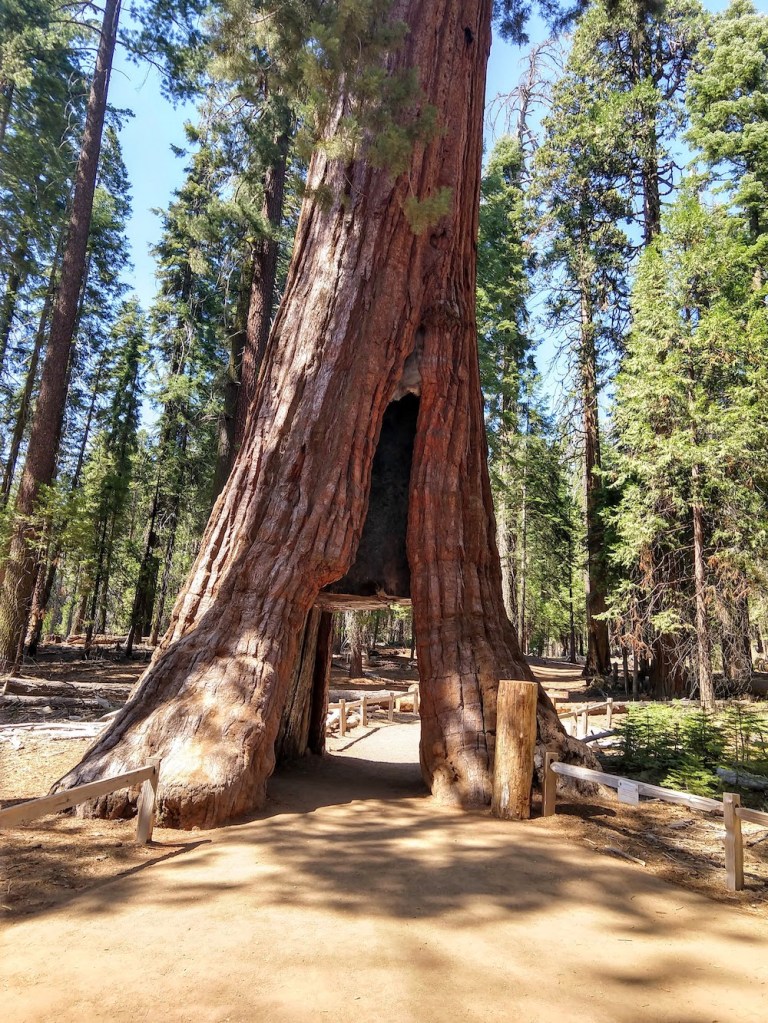
The California Tunnel Tree was created in the 1890s for stagecoach traffic.

We had plenty of water but no food, so back at the car we had a tailgate snack before driving along a winding road through a Ponderosa pine forest perched on a cliff above the Merced River. This took about an hour at the posted speed of 35 mph, which we were not tempted to exceed. Yosemite is a mostly wooded park famous for huge rocks, and these icons emerge abruptly as one enters the Valley from a tunnel, this one through a mountain instead of a tree.

Really a paragraph like that merits a picture, but my husband has most of them and he has a critical honey-do going today. I will post more on this topic after he finds time to share them.

After unpacking our gear in our tent cabin and grabbing a meal, we headed to a nearby meadow for the first night of star-watching. Arriving at twilight, we were pleased to see a young bear scamper across the meadow then turn onto the path on which we were stationed, the pleasing part including its turning away from us. I did not use lumber to describe the animal’s gait because while we think of bears as moving slowly, they don’t, even the large ones.

There must be the same number of stars over every part of Earth, but it’s rarely that people like us get to see them. The meteor shower was almost a sideshow amid the glorious–my husband’s word–sparkling heavens, with the Milky Way winding through half the sky. The meadow display, while gorgeous, was slightly marred by occasional headlights sweeping through and kids shining white flashlights around the meadow, so the second night we went 3200 feet higher to a rocky overlook, joining 30-40 enthusiastic amateurs, serious star-gazers, and night sky photographers, all of whom (including us) sported red flashlights.

At home we can sometimes view a few stars, using our eyes, a telescope we fumble with, and powerful binoculars that are surprisingly helpful, turning, for example, the Pleiades from a fuzzy clump into distinct stars and nebulae. We used those binoculars in Yosemite the second night and were astounded to find that among the spilled-glitter naked eye view were many, many more stars, maybe ten times as many. So many stars!

We last saw stars like this in Yellowstone a decade ago, and we have not forgotten it. This time there were meteors too. Some streaked across half the sky, some seemed to explode, some were languid and silky. I’m not skilled enough to describe it. I don’t even want to describe it. Any description pales beside the memory.

We could have, probably should have, and my husband would have stayed longer, but we failed to bring sufficient warm weather clothing, and by 11 I was shivering so much I could not hold the flashlight steady while walking to the car.

Lessons learned, and very, very much worth the minor discomfort.

Lightning Strikes Twice, Thrice, More

We were awakened by lightning during the wee hours last Sunday. Thunderstorms are very common in our childhood homes of Houston and St. Louis, and although more rare in our chosen home of Boston, certainly not unusual. On California’s Central Coast, though, one a year seems about the most one can expect. They aren’t earth-stabbing, ear-splitting torrents here either, just remote rumbling interspersed with bright flashes.

Still, we enjoyed it.

Last week we took a mini-vacation to Yosemite which involved quite a bit of driving, and after so much exposure to signs warning of Extreme Fire Danger, it might seem logical than lightning would spark some concern, but it did not occur to us. Newbie Californian Indication Uno.

This single storm sparked several fires, one notably near to us, and this morning we found our cars were covered with ash, so I took mine to the car wash at lunch, and by the end of work it was again covered with ash. Newbie Indication Dos.

In addition to ash raining from above, the sun is reduced to a deep orange circle about the size of the full moon, the sky is overcast in a sort of dull yellowish haze, and deep breathing is not very satisfactory, with or without a mask. We closed all the windows in our house for the first time since “cold” weather, months ago.

Over 20,000 people in our county and the adjacent one to the north have been asked to evacuate already, and the county is asking for donation or loan of family-sized tents. We separately contacted friends to offer our single guest room, even though they don’t know each other at all and there is no way it could sleep more than two people. NI Tres.

At work, patients called to cancel all day, mostly because they were evacuating or preparing for that possibility. One woman had her adult children move in two dogs, three rats, and a handful of chickens, which spent the night in the bathroom. One couple moved into their camper, parking it in the driveway at a friend’s house, even though Covid fears mean they won’t be able to go inside to shower there. One fellow left his street as fire encroached, and was convinced his home was lost, though he hadn’t been able to get any info since leaving.

The local paper suggested that everyone should have an evacuation plan. I was finding it hard to imagine a city of 65,000 being evacuated, then I remembered a few of the hurricanes I had lived through while growing up in the much larger metropolis of Houston. Fires just don’t seem as globe-spanning as hurricanes, though the one nearby is burning 25,000 acres at the moment, and is zero percent contained. Plus they move more quickly, so that must be NI Cuatro, or perhaps just a Hubris indicator.

We spent some time, by which I mean about five minutes, making an evacuation plan tonight. We’ve been thinking of improving the storage options in our garage to open up more space indoors, so we decided to put that plan into action tomorrow, with the inaugural storage items being the things we want to save, mostly memorabilia and musical instruments. Then if we are Called we will load both cars with the new boxes and strike out in a two-car convoy toward Las Vegas. Newbie plan?

If it turns out to be more than a philosophical exercise, I’ll let you know how it works out.

Chances, Lost (Last)

I think I have one more chance to see the comet Neowise tonight, before it leaves human sight for 7000 years, but the odds are low, as the moon is waxing and the fog is persistent. I was eager to see the comet, so I did some research, concluding that we would not be able to see it from our house while it was low on the northwest horizon, and that it was only viewable from 10:30 pm until some wee morning hour. I got out the map and a ruler and plotted a viewpoint. About the third day of seven, we finally had the time and the wherewithal to drive to that location, a spot about 20 miles north of us on Route 1, whence we arrived around 10:45.

The fog was already there.

The next day I went walking with a local friend, who happened to mention that she had stepped outside of her house each night of the previous three between 9:00 and 9:30 and gotten a great view of the comet each time, it being easy to spot with binoculars. So if instead of researching I had thought, Hey, there’s a comet out now, let’s go out and take a look, I would have seen it.

For the ensuing three nights, we have done just that, but each time the sky was just a little too overcast for viewing. Frustratingly, the afternoons have been beautiful, with stunning blue skies, every dinner eaten outdoors. Ok, that’s not frustrating in and of itself, but rather because I kept thinking, Tonight we’ll see it for sure, but we didn’t.

Today I can practically hear the comet streaking away, and Sainte-Chapelle is on my mind. As you may know, that is the courtyard of a royal palace in Paris built by King Louis IX, completed in 1248. Its royal chapel, built directly over the commoners’ chapel, has been praised over the centuries as the most beautiful structure in Paris for many features, not least its arched walls filled with shimmering stained glass. I have been to visit it three times, and missed it each time.

Clearly it was not streaking away, so how did I manage this? The first time is the best: my traveling companion and I were admitted to the lower chapel, which has arched walls and Moorish designs on the ceiling, and which we thought were quite interesting, but certainly did not live up to the hype. We did not discover the staircase up.

Having realized our error on our return, we made another trip the next year. Sadly, the chapel was closed for reconstruction. Research, albeit badly done, led me to miss the comet, but it might have been helpful for the chapel, though these trips were both pre-Internet. I think we did have a way to do research back then, though I can hardly remember it.

In 1999 our family went to Paris for the millennial celebration, yet somehow did not manage to find time to visit the chapel, a combination of its distance from our hotel, our full itinerary, and winter. The beauty of the chapel is said to be much reduced sans sunlight, so we ultimately decided not to make the effort to fit it in.

I must trust that Sainte-Chapelle will persist, not be destroyed by fire or another disaster, and that we will someday have the time and funds to travel to Paris, including any quarantine requirements. At least those lost chances were not last chances. Neowise, I suspect, I will only ever experience as pixels.

Passive or Purposeful?

I heard a radio story today about people accommodating to the London blitz. In the long history of London, being bombed daily is hardy a normal condition, and the blitz itself only lasted for 57 days. Nonetheless, a significant number of people adjusted their lives to the situation, incorporating its rhythms, rituals, and losses as their new normal.

Thinking of daily bombardment as something to simply accept and endure seems extraordinary to me, yet it illustrates the enormous adaptability of our species, an adaptability that has allowed us to dominate our planet and other creatures thereon, for better or not.

Do I have this trait? I’m living in California because I thought, I don’t have to adapt to snow, I can leave it. I lived there for 30 years first though, so I’m hardly a poster girl for change. Nonetheless, taking charge of one’s life by making a change seems better to me, probably because I like to think that I can control what Darth Vader would call DESsss – tin – ee. Gavin Newsom spoke eloquently on this topic today, saying something about the future not being something out there waiting for us, but rather something we are creating today.

The trouble is, in order to create “our” future, we have to agree on the future we want, and perhaps even on the present we have. Here in extreme-leaning America, it’s hard for people to see nuances, or to combine conflicting views. For years I have thought of America’s major political parties as representing Justice and Mercy, two positive traits that often conflict. Instead of choosing one or the other, we have to devise nuanced ways of combining them in order to optimize results.

If we can agree on what is optimal.

Adaptation and Control are both positive traits as well. The adapters in the blitz were fearless, showing the world what bucking up and getting on with things really looks like. Yet if we mindlessly adapt to new rules, we may simply accept our collective future, rather than shape it.

Recently I have been heartened by a smattering of relatively lucid conversations about re-opening schools, nestled among much screaming. Yes, we have a goal of keeping the spread of Covid-19 to a manageable level, but we also want to educate and socialize our children. One goal does not subsume another, just as applying justice doesn’t abrogate the transformative effects of mercy. Maybe we can adapt mindfully, while simultaneously devising future-shaping change.

Oh, Baby!

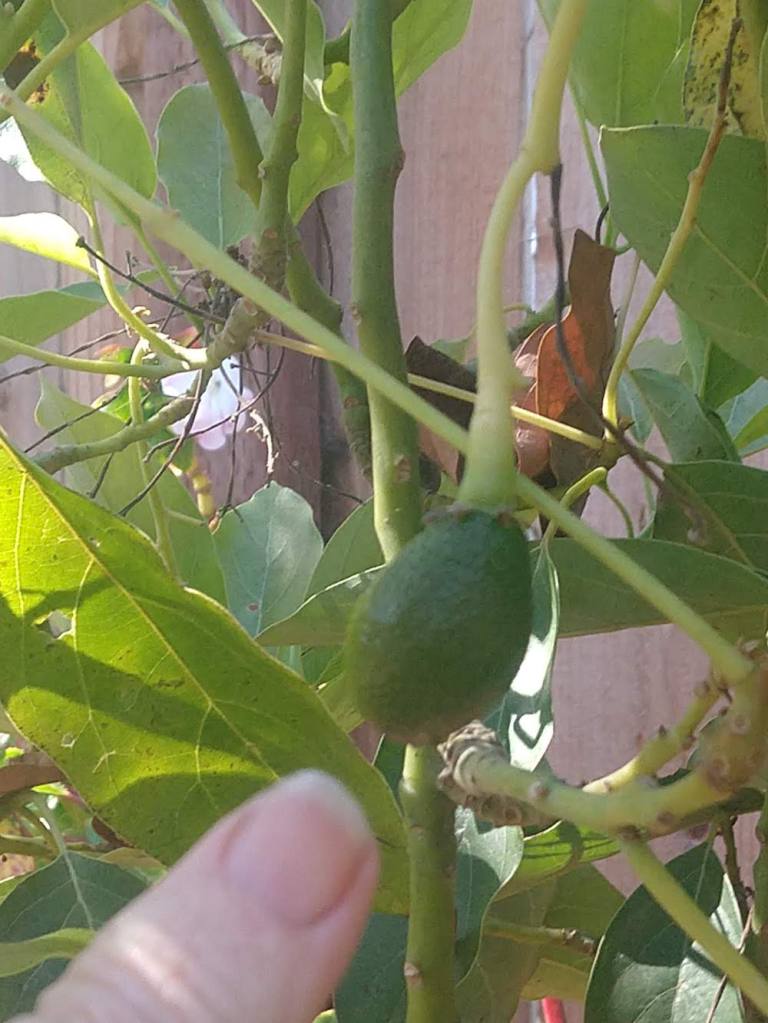
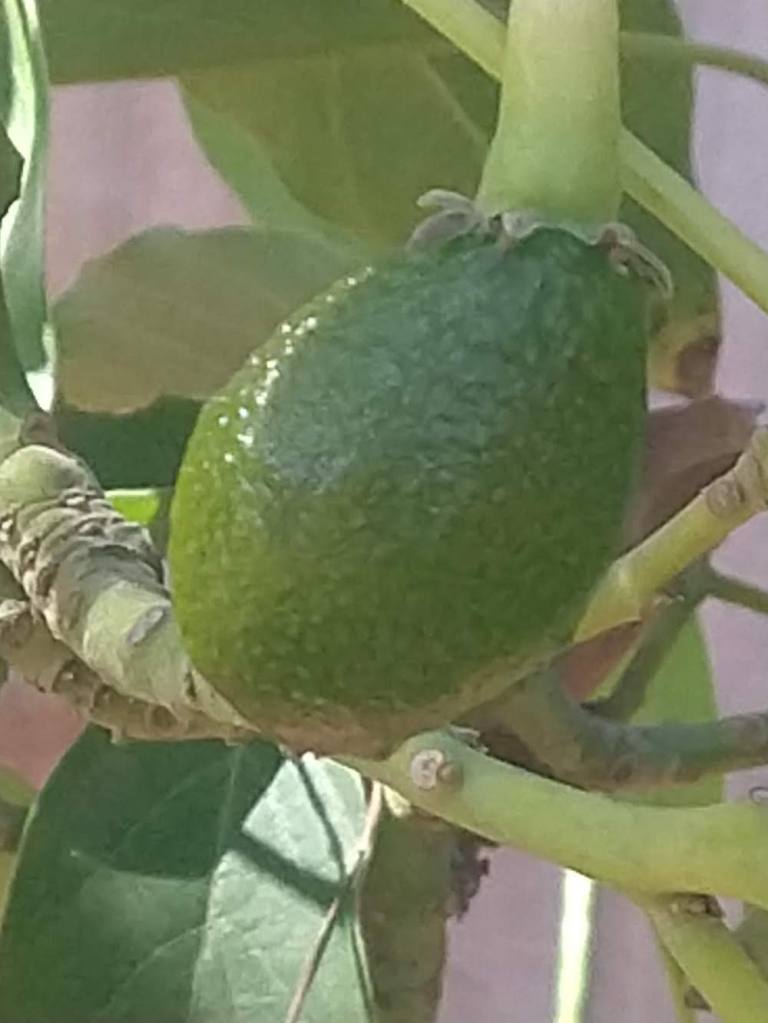
There it is, our very first baby avocado! You may remember our adventures pollinating our avocado tree by hand. Well, it worked. We are proud parents of at least one baby avocado, which will possibly become one larger, edible avocado.

This is the best thing that has happened in 2020, By Far. Really the only good thing I can remember. Well, our younger son got his Master’s degree in Vocal Performance, and we are really proud of him. Now he needs to think of a career he can ply in the post-Covid age. Our older son sheltered with us by choice for twelve weeks, and spending that sort of casual time with him was a treat. But the precipitating factor for that event also brought the end of performing arts, folk dance, and dating.

My life feels completely beyond my control, so the fact that I was able to pollinate an avocado tree by hand is very fulfilling. I’ve never really understood plants, which usually do the opposite of flourish when they find themselves under my care. I inadvertently set up an experiment proving this last year, when I acquired two dudleya plants from the Seymour Center and gave one to my botanist friend Barbara, who gave me advice on where and how to plant the one I kept. Six months later, hers had transformed into a completely different shape, doubled in size, and sprouted two 2-foot long reproductive stalks. Mine was unchanged. Later that year, she put hers in a pot for me when she moved to a different gardening zone. I planted hers near mine, having read about plants communicating underground, and since then both plants have been mostly quiescent, with the larger one actually shrinking a bit.

Our tiny back yard in California delights us because it seems to self-maintain, at least well enough for our standards, which are quite low in this area.

  • Of four rose bushes, two large ones bloom riotously much of the year; one tiny one blooms but never grows, perhaps due to location; and one medium one was too close to the slider so we removed it. The large rose bushes are very woody. Is that bad?
  • We have a calla lily that blooms vigorously in season, then begs for deadheading the rest of the year.
  • We have four flowering bushes I can’t name that bloom most of the year. One is getting quite large, peeking through the window over the kitchen sink. All of them are much more straggly than when we arrived. We may replace some of them with Bird of Paradise, which my husband likes.
  • We have two trees, one which we call The Pollinator because it attracts all sorts of flower-visiting creatures, including hummingbirds. It seems to naturally maintain a pleasing umbrella shape. The other is a smoke tree, which grows so voraciously every spring and summer that we have to have it severely trimmed in the winter. Well, we did that once, anyway.
  • We had a jasmine, but its trellis rotted away and fell over, so we got rid of it. It was blooming and scenting the yard very nicely each spring until that happened.
  • We have some 7-8 foot tall flowering stalks that sprout big red blooms at the top every year, than die off and lie on the ground. If we leave them lie (Yardwork? Us?), mourning doves seem to find the browning fronds useful. At least they spend a lot of time pecking and scratching in them.
  • My husband had some luck with tomato plants one year, which was fun for both of us, and a fair bit of work for him. We skipped one year then tried a short-cut method this year, resulting in fewer but still yummy tomatoes.

We purposefully killed all the grass, shortly after we arrived. Grass is a desert in terms of species diversification. A literary desert, not a real one; I think a natural desert supports many more life forms than a lawn. We unintentionally killed several pepper plants and two cilantro plants. People tell me cilantro “grows like a weed.” I wish our weeds would grow like that cilantro did.

Our avocado tree, though, is the one permanent plant we have added. The three dreams we had for California were a hot tub, a Mustang convertible, and an avocado tree. The items we could buy were easily obtained. We bought the tree too, but of course the dream was that it would produce. Now it does! Here’s one more look, with my left thumb added for scale.

I can’t wait until next spring, when I will implement several improvements I have already devised for my pollinating technique. If next year is similar to this one, perhaps we will have more avocados to comfort us. Though I would chop the whole tree down in exchange for live symphonic and operatic music performances.