Covid-19, The Book: ©2030

After repeatedly saying I can’t wait to read the book in ten years, it occurs to me it would be bolder to write that book right now. That is, I will make some predictions, and these will predictably fall close to my confirmation bias curve on this topic, although I do sincerely believe at least some are science-based.

Origin. At least two zoonotic respiratory coronaviruses made the jump from animal hosts to humans in the 21st century before Covid-19: SARS-CoV in 2003-2004 and MERS-CoV in 2012. By 2020, SARS-CoV had disappeared, but MERS was still occasionally contracted, most often from camels or in healthcare settings. While both had much higher virulence than SARS-CoV-2, 9% and 34% respectively, they were much harder to transmit among humans. In 2020 just as now, neither had a treatment or a vaccine.

Given this history, the appearance of a new zoonotic novel coronavirus in 2020 should not have shocked the world as it did. Happily, SARS-CoV-2 at the time of emergence had an average virulence of 2%, varying from < 1% to ~ 3.4 % depending on age, treatment, and pre-contraction health. In its current globally endemic form its virulence is closer to that of seasonal flu, ie < 0.1%.

Transmission. In the early days, the speed of the spread of Covid-19 globally seemed startling, especially given that it was less contagious than measles or even flu, and not particularly hardy outside the body. This gave rise to rumors that asymptomatic carriers were a major vector of transmission, though not a single case was ever documented, and positive-testing asymptomatic “carriers” did not shed virus. Later, the already-known but poorly-studied cluster transmission model was understood to be the cause, with 10% of the affected, the “superspreaders,” responsible for 80% of transmission, usually within a period of only 2-4 days. 70% of human carriers transmitted the disease zero times.

Additionally, the virus was not able to survive in sunlight or wind; was not persistent on indoor surfaces for more than two hours; did not persist in the atmosphere; did not surround humans like a miasma; did not aerosolize without medical intervention (eg, intubation); did not escape from a foreign lab; was not a bioweapon; and did not arise from the implementation of 5G cellular networks. All of these things were believed by significant numbers of people in 2020.

Findings. Most deaths occurred among persons who were hospitalized, which was never more than 5% of persons treated, though significant number of those ended up on ventilators. These disproportionately were males over 65 years of age with underlying medical conditions. An early observation was micro blood clots, particularly in the lungs, leading to preventive doses of heparin on admission. The most extreme cases ended as many diseases do, with a cytokine storm as the overtaxed immune system starts attacking everything, including its host. In these cases, anti-immune treatments were shown to reduce death. Unfortunately this led some to apply these treatments too early, suppressing the immune response when it was most needed. Another contraindicated treatment was ibuprofen, a common home remedy; acetaminophen was recommended instead for fever relief.

Treatments. For the most extreme stages of disease, monoclonal antibodies and blood plasma transfers from recovered patients proved to be effective, in addition to the treaments mentioned above. For the majority of people with milder cases, mainly to keep mild cases from burgeoning, the eventual winner in the antiviral treatment race was Merck/Ridgeback’s EIDD-2801 (developmental name). Aiming specifically for the broader market of the non-hospitalized infected, they focused on a pill-based, broad-spectrum antiviral, rather than an intravenous one with a narrower target. This project longer to reach fruition, but by the end of 2020, significant numbers of infected people were benefiting from it, and the knowledge that an available medication ameliorated the course of Covid-19 had significant impact on boosting economic activities of all sorts around the world.

Vaccines. The polio vaccine, a safe and widely-available vaccine, had in previous years been shown to provide wide immune-system benefits for multiple diseases, and was being given as subsequent doses for such in a number of countries. Studies showed it had preventative advantages for Covid-19 as well, and by the end of the summer of 2020, it was being widely administered, as billions of doses were already available.

The seasonal Covid-19 vaccine in use now was also developed by Merck, using a traditional modified-virus model. None of the newer approaches, including the nucleic-acid based vaccines, did well enough in trials to merit production. The conventional vaccine approach took longer, of course, and the first version only became available to most of the world in late 2022, although this still made it the fastest vaccine ever developed by far, the previous record being four years from concept to production.

Adaptation. Much of the world quickly moved to distribute both the pill-based antiviral and the polio vaccine, as well as the seasonal Covid-19 vaccine when it became available, but the US was a notable exception. Even today, at least 25% of the population of the US has not taken the Covid-19 vaccine. As a result, most governments provide passport stamps for those who do receive the vaccine, and most countries require a 2-week quarantine period for travelers whose passports do not have a current stamp. This is a great improvement over travel conditions in the early 2020s, when each country had different rules about who could enter, using bans, quarantines, activity limits, and various other measures, sometimes based simply on country of residency, sometimes on medical statements or even personal affidavits.

Postscript: Animals. SARS-CoV-2 first jumped to humans from pangolins, though this was not discovered until well after the vaccine was widely in use. In the other direction, humans spread the virus to several animal species, including cats and dogs, ferrets, mink, lions and tigers. Laboratory experiments also purposefully infected various species of primates. All of the animals seemed able to transmit to others of their species, but not back to humans.
We are Not Gorillas

While exercising, I was listening to a blog interview with a vitamin C proponent–not Linus Pauling of course, but someone perhaps as obsessive. I often do not attend closely to podcasts while exercising, so I had lost the drift when I heard the guest say something like, I’ll tell you what’s unnatural: Humans lost their ability to synthesize vitamin C eons ago, though animals still can!

So many things are wrong with this statement.

Though it’s surprisingly hard to pin down, the ancestors of humans, previous to hominids or even primates, lost that ability about 61 million years ago. The ability to synthesize vitamin C, or lack thereof, has been lost and gained multiple times in different lines, leading one site to label it a neutral trait, one without obvious benefit or detriment. Sort of like my stubbornness, which sometimes helps, sometimes not so much.

Most animals can synthesize vit C, but plenty can’t, including us and most great apes. Or maybe all of the great apes. I couldn’t find a definite answer on bonobos.

Although still a topic of research, this is possibly because synthesizing vit C takes a lot of energy. Also, it may be that animals that have to acquire external vit C also recycle it, so they need less overall. Anyway, it’s a tradeoff, not a deficit.

Those who don’t think vit C is the ultimate micronutrient may also have noticed that there are lots of things we need to eat for optimal living, including nine essential amino acids one must consume every day. Really? How are we all alive? Sugar is not a source.

I also object to pegging something in nature as unnatural. Unclear on the concept.

Nutrition celebrity scientists do have a way of using odd evidence. A prominent vegan proponent points out that gorillas mostly eat plants, which is true, although they eat insects as well. His point is that if gorillas do that, so can we. What?! We are not gorillas!

Even those of us who look or act like gorillas are not gorillas. Also, just to clarify, guerrillas are not gorillas.

Gorillas also laze around most of the day, should we do that, too? If you’ve tried it for any length of time, you are probably not a prime physical specimen, and this will give you a hint as to the answer. Our cells actually cannot perform optimally if we don’t exercise. Great apes don’t have this concern, though they have plenty of other problems, mostly us-related.

Having written all this, I fear I am contributing to a glut of information. You might think I mostly object to incorrect information, and I do, but sometimes I think there is too much of all kinds, and honestly true stuff changes to false on occasion, and even the reverse. At some point, it’s paralyzing. You can’t absorb it, you can’t rate it, you can’t debate it, you can’t ignore it.

Sort of like choosing mustard in the very large grocery store. Who needs mustard anyway? I’m going home to listen to some music.

Measure by Ants

A radio host used an amazing metaphor to give a sense of how small a nanometer is:

If Texas were a meter wide, an ant would be a nanometer long.

I immediately concluded, Texas is a billion ants wide.

When you live in Texas, it certainly seems to have billions of ants, or even billions of types of ants, some of which are really scary, such as fire ants, that swarm up the unlucky leg that stumbled into their nest and cover its owner with venomous bites, an attack that occasionally proves fatal.

All the ants are different sizes too, begging the question, which species is the billion-wide ant? A quick calculation, using the Internet-generated value of 790 miles as the width of Texas, yields a value of 0.05 inch, which is 1/20 inch or 1.27 mm, for the ant length. That seems like one tiny ant, especially considering that this is the state with big hair, huge belt buckles, and Texas toast.

Sure enough, there’s no ant that small in Texas. I found a list of native Texas ants and patiently checked the size of each. The Pharoah ant seems to be the smallest, with a minimum size of 1/16 inch, or just under 2 mm, while the fire ant also has a minimum near 2 mm.

Random thought: So many scientists measuring so many ants…

Maybe the person wasn’t using Texas ants to measure Texas. It’s a mental exercise; no need to line up one billion ants to confirm the supposition. Maybe the person is familiar with smaller ants from a different state, country, or continent. I couldn’t find any smaller ants on the Internet, but there are surely plenty of undiscovered ones, some of which we may catalog before extinction. Alternatively, maybe the person was a little sloppy, deciding to use the width of Texas in inches, dividing by a billion since there are a billion nanometers in a meter, then thinking, What is a twentieth-inch long? and erroneously concluding, An ant.

To give this person a break, it’s hard to find a good example of something 1.27 mm long. The only thing I easily found was a single species of parasitic copepod with which few are familiar. A credit card is about 1 mm thick, not only is that about a fifth too small, it’s not nearly as fun to imagine credit cards marching across Texas.

Maybe Texas was, for once, too small for this thought process. If you use the continental US, for example, you get a billion items that are 0.1774 inches long, or 4.5 mm. That’s about as long as a small paper clip. The red imported fire ant also suits, but it ranges from 2.4 to 6 mm long, so you might picture the wrong one. Plus, it’s very scary to picture red imported fire ants spanning the continental US, at least for those of us who spent our childhoods in Texas.

I did not listen to the entire piece, so I don’t know why the presenter wished us to understand the size of a nanometer. If it was related to the size of SAR-CoV-2, I think the example was overstated. As viruses go, that one is a porker, to use another Texas term, at 120 nm diameter, and even the smallest known virus of any type is 17 nm. Maybe she was discussing something else though. Realizing that there is an enormous world of things we cannot see, scales at which human skin has the topography of the High Sierras and woven fabric is a gaping array of wide passages, is useful to resetting one’s perspective.

This is how my mind works. Nothing is at all obvious. I can always think of another question.

It can be exhausting.

Living In Parallel with History

I’m struck by the contrast between my life and the times in which I live, a contrast not in my favor.

Many times during the past few days my attention has been riveted on the massive surge of popular protest against ongoing police practices recently highlighted by the daytime murder of George Floyd by one of American’s Men in Blue. This feels like the possibility of a moment of real change for the better. Over my lifetime, our police force has become increasingly militarized, monetized, and focused on protection of its own over protection of its country’s citizens, with black citizens in particular singled out for victimhood or extortion. Before I was born, the foundation of white wealth on black slavery or underpaid labor was already well established, and continues today. Could these huge trends be close to being reversed?

In this age of bluster, prevarication, corruption, and incompetence, it’s hard to be hopeful, yet I feel hope.

Other than following this on the news and talking about it with family and friends, however, I am not participating. We had a huge peace rally in Santa Cruz, and I was not there. I have not sent money to any organization, nor have I written a letter of support, or even signed an online petition, not that those accomplish anything.

So what have I been doing? Several things I had not done since March.

Friday night we ate at a restaurant ! We sat at an outdoor table–although indoors was also available–and had waitstaff, and cocktails, and great food, and no dishes to wash. I could not have anticipated a trip to Paris more keenly, nor enjoyed a meal at Chez Panisse more. Every table was full, and everyone appeared to be having a fabulous time, because we were.

Saturday morning I got a hair cut! I no longer look like a Cave Woman. I had to wait about 20 minutes, even though I had a reservation, and the other three people in line had all driven over from Santa Clara County, where haircuts are predicted to be available in two months. I was so giddy my tip doubled the cost.

Saturday afternoon we had a live Morris team practice in Palo Alto! Four musicians and three dancers came, with two other dancers Zooming in. Taking over the quad of a closed school, we danced 2-meter wide sets, did not touch hands, and carried two sticks each so we could auto-clash. All four of the musicians played at the same time and could hear each other. It was 73 degrees and breezy. The public restrooms in the adjacent park were open. We drove over and back in the Mustang with the top down.

The contrast between my petty but pleasing pursuits and the serious work of turning the ship of state off of its course of racism is sharp. Worse, I don’t know how to motivate myself to be, well, more serious. The specter of Covid resurgence post-opening does seem to motivate me, though; I just made a brewpub reservation for Tuesday night.


Classical Music On Covid Hold

Music critic Alex Ross, whose evocative and nuanced writing is welcome at any time, is outdoing himself during the Covid crisis. This week in the New Yorker he is once again writing about online performances, but prefaces the article by saying,

Any discussion of this activity…must take into account that it unfolds against a backdrop of misery. The livelihood of thousands of musicians has been shattered overnight….There should be no talk–I have seen some–of classical music “thriving” on the Internet. No one is thriving. No one is making money. No one is free from fear. 

I’m feeling this stress and grief myself, on behalf of my son and all the established and nascent performers I know and admire. When I hear anyone talk about the new normal, say social isolation is not so bad, say “anything” is worth slowing the (inevitable) viral spread, it’s as if a knife has been again stabbed into a festering would. Where can I go, where can I find people who oppose letting a virus undermine our humanity? I am ready to move there.

Sweden?

A co-worker’s private elementary school has already decided to re-open in September for only two days a week and then to close again in November because of flu season. We never closed for flu season before. Instead of the new normal, let’s call it the new fearful.

I’m pretty much foregoing MSNBC, because I feel they they are fanning this flame. I understand Covid-19 is a cluster-spreader, but why do they focus on nursing homes so much more than other risky clusters, such as meat-packing facilities or prisons? I certainly don’t agree with Dan Patrick, but one could point out that the people dying in those latter two clusters are much younger and more likely to be family breadwinners than are those in the former. Answering my own question, I suspect MSNBC is focusing on situations of interest to their viewers, who are often in nursing homes or visiting same, while having no contact whatsoever with meatpacking workers or the incarcerated.

That’s marketing, not news.

I’ve decided to get my virus-related updates primarily from the AAAS and the WHO; I find the dull, fact-oriented style of information transmission calming. Walking by the ocean helps, too. If I need emotional release, usually through tears, I can always stream some of the music that may never be performed live again.


Overtired

Dr. Ellen Vora, a psychiatrist specializing in sleep disorders, was the guest on a podcast I heard recently, during which she explained that overtired is not equivalent to exhausted or wicked tired. It’s a thing unto itself.

When you are tired, you may find yourself dozing off unexpectedly. Your eyes droop, and you don’t feel like doing much. If this happens in the evening as the sun is falling, it’s a perfectly healthy reaction. As our day winds down, and light changes from blue to red, our bodies prepare for sleep, producing melatonin. For most of our existence, when we got tired, we slept.

Even on the savanna, though, there are times when you have to stay awake. Maybe you’re giving birth, or helping someone else do so. Maybe it’s your night to guard the tribe from a man-eating tiger lurking about. Maybe you’re a soldier preparing for a night battle. In those cases, you will have to fight the urge to sleep, and your body is happy to help. As you raise your activity level, or expose yourself to brighter light, preparation for sleep is not only halted but reversed, and your body prepares instead for action.

That is, our bodies evolved not only to help us sleep at night, but also to support us when we choose not to.

Since the invention of electricity, we have chosen to stay awake a lot more often than we bear children or fight predators or enemies. The condition of tiredness that we reach after reversing our natural pre-sleep chemistry then staying up for a while is characterized by exhaustion combined with inability to fall asleep, sometimes for the rest of the night, ie, being overtired, and as a regular occurrence, it’s not very good for us.

As well as being a sleep doctor, Dr. Vora is a married woman with a 4-year-old so her house goes “full Game of Thrones” at sunset. It’s not the violence or sex she’s talking about, but rather the presence of electric lights and light-producing screens. That is, there are none.  Her family lives by candlelight–or maybe torchlight, which seems more GOT. She likens their bedrooms to caves, with room-darkening shades that prevent one from seeing one’s own hand in front of one’s face.

She practices in NYC, and notably saw a day’s worth of patients after a blackout, each of whom was both overjoyed by their sleep quality the previous night and disgruntled about the boredom and inconvenience of the blackout. Sometimes we humans miss the obvious.


Shelter, American Style

Americans know what is right and true, not just for ourselves, but for everyone, and when it comes to sex education, a lot of us would say that is Abstinence. Abstinence sex-ed informs teens, correctly, that the only way to ensure one will avoid the negative consequences of sex is to abstain.

In Brookline, Massachusetts, where our kids grew up, sex-ed is pretty much the opposite of this. Teens study and label detailed anatomical drawings of each gender’s genitalia, and learn the biological details of intercourse, conception, pregnancy, as well as topics such as homosexuality and transsexuality. They read about, enact, and discuss real-life situations, and condoms are distributed freely, to both boys and girls. There are lots of rules about respectful interaction so all will feel free to speak if they wish, and when the sex-educator is absent, there is no sub.

They also learn about abstinence. Brookline’s approach is conventionally known as Comprehensive sex ed.

In the simplified version of the sex-ed debate, Pro-Abstinence folk say Comprehensive leads to sexual experimentation, but somehow teens with Abstinence training occasionally get pregnant or catch STDs, while some of the Comprehensively-trained manage to graduate HS as virgins.

The loudest voices on Nextdoor in Pleasure Point are shelter-in-place abstainers. They correctly note that the only way to completely avoid Covid-19 is to stay inside all the time, to ban all visitors, and to sanitize every container that is delivered. On those of us unable to quell our normal human drives for sunlight, nature, movement, and social interaction, these beings of superior control rain not only disdain but vitriol.

Just as with teenage sex, the problem is that not everyone is going to make the optimal choice 100% of the time. Since we know some people are going to be breaking the rules, shouldn’t those people have the information they need to avoid the worst outcomes?

Here’s where the metaphor breaks down, because, unlike in sex ed, the facts around virus transmission are not well-understood. Lots of clinicians, politicians, pastors, random PhDs, moms, victims, dictators, clowns, cults, and Personalities have bullhorns on the Internet, while scientists leak meager findings of small studies to the public in real time. But no one knows much of anything yet, including the effective distance for social distancing, whether masks block or transmit the disease, whether/how the virus is aerosolized, the most common transmission method(s), the existence or prevalence of asymptomatic transmission, and the level of immunity afforded to the recovered.

Too bad no reputable health authority in the US is allowed to provide us with best-guess guidelines. I’m certainly not that, but I’m taking my chances with frequent hand-washing, 6′ separation where possible, mask-wearing indoors in public, and no touching people other than my shelter-mates.

It’s the best I can do and I hope it’s enough. I’m constitutionally unable to abstain from walking by the ocean in the sunshine with my well-spaced friends.

Comedy Movie Night

It’s Mother’s Day, that passive/aggressive holiday, as Sharon Brody once called it, though I’ve made my peace with it. Our main plan was to use it as an excuse to get take-out for dinner, but our son is out of town for the day so we moved that to tomorrow.  After spending much of the day trying and failing to pollinate our avocado tree by hand–tomorrow is another day–my husband and I decided to watch a romantic comedy, Down With Love, starring Renee Zellweger and Ewen McGregor.

I loved the movie!

It’s set in 1962, when the Mad Men era starts bumping up against the women’s movement. The protagonists represent either side and predictably segue from spite to sparks, except not exactly, because there are more than a few twists, some of them after the romantic situation seems to be resolved. It’s filmed in a very stylized way, yet the characters come across as real people rather than stereotypes. It also has more than a few LOL moments.

I really, really dislike finding myself sitting in front of the TV with two or three other people, even people I like very much, going through screen after screen of choices looking for something to watch, a situation which often ends by deciding not to watch anything, so I try to keep a short list of pre-vetted movies to use to preclude that activity, which sometimes works. I got this one from the Atlantic article Unexpected Movie Masterpieces to Watch in Quarantine, as well as another we watched previously, Kiss Kiss Bang Bang with Robert Downey Jr, which was also quirky, hard to characterize with one genre, and fun.

Shorter fun things to watch during quarantine are covid-related parodies on youtube, though there are So Many this quickly gets either old or addictive, depending on your susceptibility to Internet wiles. I listened to a few today and became something of a critic; I will not tolerate lyrics that don’t scan. My two favorites, Coronavirus Rhapsody by Raúl Irabién and Dana Jay Bein and A Spoonful of Clorox by Randy Rainbow, both scan, I assure you.

Meanwhile we are opening up a little in California. We can go to the florist, which I am not racing to do, and get a colonoscopy, which I am actively avoiding. At least it’s progress? Talking to our son in NJ today, we were struck by how much more serious the mood is there, even to someone (our son) who is relatively unaffected, well, except that his entire career is on hold for two years. Even so, he would strongly oppose relaxation of the rules any time soon.

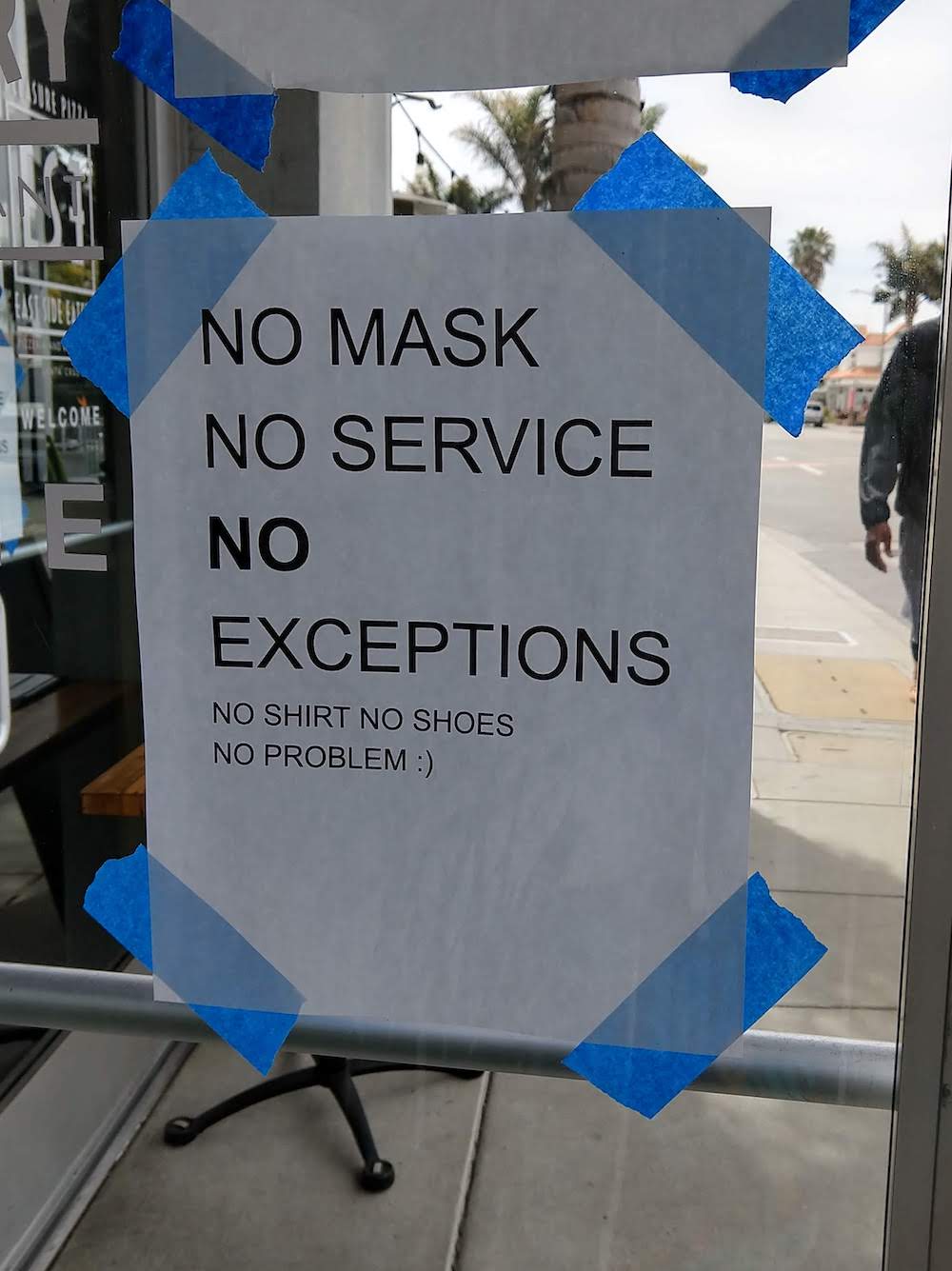
For your final entertainment this post, a representative sign from Pleasure Point.

ESE Sign

Sanity Slowly Surfacing

I feel hopeful despite some insane things still happening, like yesterday, when a fellow at the True Olive Connection yelled at me for bringing a refillable oil bottle, seething that I would EVEN CONSIDER such an activity during a PANDEMIC. After picking up my order, I drove to New Leaf and returned my refillable milk bottles, as I do every week.

I know fear is the enemy of reason, and if he had said, I’m sorry, I just don’t feel comfortable dealing with returnable bottles in this situation, I would have felt sympathetic rather than attacked. I’m surrounded by fearful people, many of them attacking others, and I try to be sympathetic, but sometimes I am weak.

Unreasonable Central has been the subtitle of Nextdoor since the shelter started, but this week a long posting by a nurse named Michelle is not only trending Most Read but also garnering slightly more agreement than pushback. Slightly reasonable is high marks for Nextdoor.

Michelle explained how masks spread virus as often as they contain it, in a much folksier way than did the WHO document I read on the same topic, and urged folks not to be lulled into complacency by wearing a mask, especially a cloth one, which she said is 10-30% effective.

Mostly we should rely on social distancing and hand washing.

Michelle reminded us that the purpose of flattening the curve is not to avoid contracting the virus, but rather to allow it to move through the population slowly enough that everyone who needs medical care can get it and that herd immunity can be established without the most susceptible folks be exposed. That’s actually what we were told at the beginning, that Covid-19 will eventually become endemic to the population, and milder at the same time, as it learns not to kill its hosts, a quick lesson for such a contagious virus. It is a cousin to the common cold after all.

I think it is important to wrap our minds around living with this virus rather than isolating until it is as rare as smallpox, or controlled by a vaccine. My understanding is that there has never been a successful coronavirus vaccine, and that other successful vaccines have taken 4-20 years to be created and introduced. I know Science is roaring along in its determination to best Nature, and I hope it will succeed, but just sayin’.

Back to Michelle, she made a touchingly personal appeal to the susceptible population, of which she is a member on a least three counts, to take personal responsibility for their safety, rather than denouncing others for endangering them. She is able to work as a Covid-19 healthcare provider and to do her own shopping without feeling endangered because she knows how to protect herself, and feels this not only possible for everyone, but imperative, because we are a social species, creatures who need contact to thrive.

It was a message of empowerment and joy.


Democrat Death Wish

My husband has felt the Democrats have a death wish for a while, but the first time I agreed with him was during the 2016 US Presidential election.

I wasn’t focused on the orange reality show celeb–no way that would happen–but rather on the strange dichotomy of the Democratic primaries. On the one hand, voters were clearly choosing Bernie. Instead of observing and analyzing this, the media and the party leaders seemed to purposefully disparage his ideas and his followers, implying both had neither the gravitas nor the pragmatism of Hillary’s.

It was Hillary’s turn, after all. She had been such a good girl, raising all that money, keeping the big donors forking out, and after she was out-primaried by Barack in 2008, she patiently built her leaderly establishment cred as Secretary of State so she could definitively claim her crown. It was just time for a Historic Outcome.* Which, by insisting on choosing a candidate with very high negatives and little charisma, the Dems pretty much insured.

The establishment leaders insist that Democracy Itself is on the ballot in 2020, and although Bernie gets even wider primary support, the establishment again undermines him and this time selects, from a broad base, a candidate with #MeToo issues, and not just this week. For time immemorial, Biden has had two issues: a rambling, confused speaking style that invokes dementia, and a hands-on, mouth-on approach to women.

I don’t disagree that democracy could be threatened, but what I think we need is the passionate participation of the Millennials, and we aren’t going to ever get that with Biden. Even the ones who don’t know Biden created the unforgivable student loans preventing them from wealth accumulation are going to look at their choices and see two womanizing old white guys. Why even get out of bed on election day?

Rumors are flying that Hillary may pull a phoenix, but her recent posturing indicates she’s more undead than reborn. Please, Michelle?

==============================================================

* Actually, another Historic Outcome, since electing a black President was pretty historic. The other odd thing about the Dems was the way they never really embraced that.