Carnivore Bias

My very favorite salad contains three types of greens–let’s say butter lettuce, arugula, and baby bok choi–tomatoes, avocado, at least one variety of radish, artichoke hearts, sugar snap beans, and dry-roasted pumpkin seeds. Of course, every ingredient is organic, making it a micronutrient feast. I dress it with an emulsion of EVOO, balsamic vinegar from Modena, some variety of mustard, and spices. I eat it, or something similar, five times a week. I love it.

According to proponents of the increasingly popular carnivore diet, it’s poison.

Over the last several years I have stopped believing a lot of things about food and eating. I don’t think grains, even organic whole ones, offer much in the way of nutrition or gut health, so I eat them sparingly. I don’t believe calorie reduction diets work. I think every oil other than EVOO, avocado, and coconut is inflammatory to the human body, so I avoid them completely. I think my brain needs lots of the substances found in the good oils as well as in grass-fed beef and butter, wild fish, and eggs, so I eat those copiously. I fast at least 12 and preferably 16 hours most days.

These things are working very well for me, and I wish I could enlist others to try them, but most people have a lot of trouble reworking their models of eating, changing their habits, or giving up their favorite foods. I have never criticized anyone for these reactions, but now I can empathize, because I have the same reaction to the carnivore diet.

Eat nothing but animal products? What kind of crazy is that?

Carnivores, as they style themselves, will tell you that

  • all the studies that show vegetarians live longer actually measured health habits such as exercise rather than diet;
  • while animal use hooves and claws to avoid being eaten, plants contain antinutrients that actively block absorption;
  • the carnivore diet puts you into ketosis, great for your brain and body;
  • since it’s clearly an elimination diet, you will recover from all symptoms possibly related to food reactions; and
  • protein is so filling, you will only need to eat once or twice daily, thereby saving time, regaining insulin sensitivity and reducing inflammation.

Being a big fan of epigenetics, I keep coming back to micronutrients. Carnivores insist their diet creates no symptoms of micronutrient deficiency. Maybe the body just operates differently on this diet. Maybe most micronutrients are used to metabolize carbs. One micronutrient in particular, vitamin C, prevents scurvy, but carnivores aren’t getting that so they may need less. There is vitamin C in fresh, grass-fed beef, though not as much as in leafy greens.

Here’s the tiny elephant in the room: the microbiome. The gut MB only eats fiber. Not much fiber in meat. Starving the MB seems like a bad idea. On the other hand, how much does it need? Maybe my MB is awash in Too Much Food.

My go-to for resolving diet question is, What did we evolve to eat? Intriguingly, there is some evidence it may have been mostly meat. There are many micronutrients we absorb more readily from meat than plant sources, including iron, B12, and omega-3s.

Mostly meat, but surely not only meat. I just can’t overcome my bias on this one.
Unsustainable

The older, sicker patients who visit the naturopath whose office I manage often bring questions about the latest treatment options from the Internet, and one recent favorite is krill. Krill oil for humans is already widely available. As a docent whose tour includes a blue whale presentation, I wonder whether krill can be harvested for humans without impinging on the animal supply.

Last year for a short time the trendy treatment was colostrum. A precursor to breast milk produced by all lactating female mammals for a short time after giving birth, colostrum is indeed a superfood. It doesn’t take much imagination to realize that there is no cruelty-free way to procure this substance in any meaningful amounts, despite the army of people with various states of liver, kidney, heart, and lung ailments who are desperate to limp, crawl, cough, ache, medicate, supplement, bypass, and -ectomy their way to a few more weeks or months of health-free lifespan.

Not to mention their similarly-afflicted and -treated pets.

Today I am not only thinking about krill, I am seeking a Kindle book to download for travel reading, and I lit upon The Curious Life of Krill. Based on the sample I read, the scientist-author is an upbeat fellow, and feels that there are so many krill that even humans won’t be able to overfish them, though he does allow that we might disturb certain populations, and in turn the local food chains that rely on those populations.

Of course we will!

The good news here is that we have already put many restrictions on krill fishing in the Southern Ocean, well before any collapse, though not before evidence of strain and measurably reduced populations. But while people, especially people who might die some day, want krill and can pay for it, I think Capitalism, that boon to all, will find a way to circumvent restrictions, especially in an international treaty area.

Maybe Nature will rise up. Sadly, I don’t think an Avatar-level natural revolt is possible, but some response is not unheard of. For instance, since poachers take large-tusk animals preferentially, the gene pool for large tusks has been drastically cut, and many fewer African elephants are developing tusks, while those that do, develop smaller ones. If the poachers, who are definitely going for the smaller tusks now, manage to eliminate tusks from the gene pool, the tuskless elephant may actually survive.

Unnatural selection.

Of course, we can’t always eliminate the desired goody. Sharks, for example, can’t really exist without fins, and over 200,000 sharks are killed each day for shark fin soup alone. I know a little about sharks, from that same docent gig, and they play a huge role in ocean ecosystems. So please don’t eat shark fin soup! Better yet, convince your Chinese friend not to serve it at the wedding.

You can probably also find organizations helping elephants, sharks, pangolins, and other creatures we are targeting for extinction. Yes, targeting. Perhaps inadvertently, but no less inexorably.

Back to blue whales: We already reduced their populations by 90% in the twentieth century, and while they aren’t reducing any more, they aren’t recovering  since the moratorium on blue whale hunting imposed in 1967. That’s fifty years, and we don’t know what the issue is. Are there just too few for them to find each other? Are they too discouraged by the genocide to mate? Is the depleted gene pool insufficiently robust? Are they facing other stressors, possibly ocean noise, too many tankers, climate change? Huge animals who roam globally, have no set migration patterns, and communicate across hundreds of miles are hard to study.

Speaking of climate change, whales in general not only sequester huge amounts of carbon due to their size, they positively impact atmospheric carbon because they have behaviors that product both more phytoplankton and more marine plants. Killing over 300,000 blue whales in about eighty years was not a very smart move.

I vote we use the Precautionary Principle in the case of krill.

Fly Blog

What a gorgeous day for a flight!

We started with a slow, ascending loop around San Jose, 360 degrees of glory. At first I was distracted by how few private swimming pools there are in SJ, then by the clusters of neighborhoods that bravely start up into the foothills then quickly give way to wilderness. The southern tip of SF Bay came into view, then the eastern hills, then we spun toward Monterey Bay. By this time we were high enough to see it in its entirety, over the Santa Cruz Mountains. Finally we came around into the payoff view: the Pacific Ocean, the full span of SF Bay, and the entire peninsula, including the city itself lodged at its knob. Golden Gate park was prominent in its dark angularity, surrounded by gleaming civilization. Both bridges were clearly on offer, as well as the Marin Headlands and beyond.

It looked like a map. Or perhaps I should say, the map is a very decent representation of how this actually looks from above, though never a breathtaking one.

This survey course of where I live most of my life now took at most 15 minutes, then we headed east, or perhaps northeast. I could see what might be the Sacramento River heading northward, then quickly the signs of human inhabitance disappeared and the land started to crumple. Shortly there were snow dusted peaks, just one narrow strip of them, followed by dry valleys dotted with occasional large lakes, and perhaps some salt flats. Just like that, I had no idea where I was. Over California obviously, but where?

I decided to do some more observing since I was bereft of Internet and, more important, it was a beautiful day. Why was I bereft of Internet on a continental US flight, you might wonder? Well, for a person with two engineering degrees, I have extraordinarily feeble Internet skills. Yes, I realize those groups of dots and squiggly figures mean stuff, and if I scrutinize the screen long enough I will likely discover something to click on skulking in a corner that will boot Fly-Fi. But it’s all so mind-numbingly picayune. I want something in my mind that will fill it up with neuron crunching questions, not nit-picky mental plaque! Can we discuss the conflict between human pets and wild animals, the probability of any one person witnessing a supernova, the evidence that vegetarianism is unhealthy?

Or we could just admire the Earth from the Sky. Both of those are pretty big.

In any case, over the next hour the view progressed through several stages, including

  • sparse roads with an occasional lonely building, grey, crumpled land, dry riverbeds interspersed with low mountain ranges, all running north-south;
  • pointier and again snow-encrusted peaks, still separated by dry, bare valleys;
  • what I believe was the High Sierras, the highest-and-rising mountain range in the US, characterized by sharp peaks on which the snow is not dusted but piled, packing the peaks and filling the bowls; and
  • soon thereafter, a glimpse of the Rockies from afar, interposed by the salt flats of Nevada, or maybe Utah, including a lonely set of square catchments for water showing the presence of Man, some partially wet riverbeds, then, a river that is full, and a huge lake.

We’re over an hour in. Still all this time, virtually no sign of people.

But now we are over the Rockies in all their glory. They may not be the tallest, but they are overwhelming in their numbers. Not a line of peaks but a sea of them, a vast sea filling the view in every direction, surely hundreds of miles wide east-to-west, many more north-south. A vast, elevated wilderness perhaps not fully mapped even today, unless by satellite. Some low clouds hugging the horizon blend with the extended snowy peaks to create an impression of mountains forever. The all-mountains-every-which-way view takes up at least 20 minutes of the flight.

Twice I saw another plane! Considering how many hundreds are in the air at once, I continue to be amazed by how few I ever see. Both were considerably below us, heading in the opposite direction, seemingly at a higher speed, almost as if merrily schussing on a downhill slope, having crossed the country’s rocky spine. Next stop, the beach, baby!

Back to my View. As the mountains sink into the land, it seems colder. Ice and melting snow packs dot the rivers beside the peaks, and even the rocky ground itself. Though the nearby peaks are much gentler, the snow cover is becoming more consistent, and soon I am treated to a new ocean, an ocean of blinding whiteness.

I can personally attest this is a large country, having driven across it in 2016. While there were some mostly-cow interludes, one does not get the impression of a humanity-free wilderness from a vehicle traveling on a US Interstate highway. From the air, that is exactly the impression I get. Is that a ribbony road? If so, nothing is visibly traveling on it. I wonder if Africa has more wilderness.

Movie Review: “Parasite”

Unlike Donald Trump, I was eager to see the first foreign language film to win the Best Picture Oscar, though my own mother opined that there should be a dubbed version so “Americans can see it.” Parasite realistically depicts the woes of a poor family living in a frequently flooded basement-apartment in Seoul, dispelling my view that South Korea is a rich country that takes care of everyone. Are there any such countries left in the world? The college-age son gets a chance to tutor a wealthy middle school girl and gradually his entire family insinuates their way into the employment of hers, without revealing that they are related. They are smart, the wealthy family is gullible, and the situation at first seems more or less workable, perhaps a benign parasite offering a small benefit to its host. Shouldn’t the wealthy support the less fortunate?

In order to get the housekeeper position for the mom, the family frames the current housekeeper, which reveals a completely unanticipated situation, a parasite already in place as it were, a situation that could have been handled with working class solidarity, but the temptation of money to be made clearly overmatches any fellow-feeling toward strangers. If everyone had kept his or her wits about them instead of reacting…

…it would have made no sense, because the key difference between the wealthy and the poor is depicted in the way they react to situations and think about solutions, with some breathtakingly bad judgment and self-defeating choices on offer right through the bloody denouement.

The third parasite in this movie is the wealthy family itself, who are clueless as to why someone would not debase themselves or forego sleep if paid enough. Don’t they deserve to be exploited? Yet the poor family, smart as they are, can’t halt their rush to self-destruction. Is there the possibility of partial recovery? The justice system in South Korea tends toward mercy, and the ending is ambiguous. Do they deserve to recover?

This movie unpacks a lot of ideas which are still roaming about my head. As a bonus, Morse code plays a role. Maybe a side effect will be a revival of Morse code, which will be useful if our society collapses in an ultimate bloody battle between rich and poor, red and blue, secular and religious, this religion and that religion, autocrats and democrats, and so many other fault lines.

White Ocean Noise

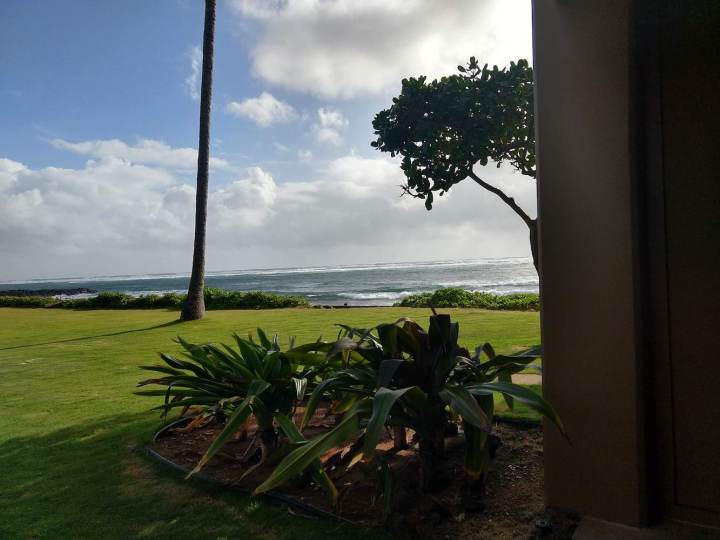
I’m easing back into the blog world with a travelogue post about our 30th anniversary trip to Kaua’i in January. The ocean was running strong during our trip, or maybe it always does so there, and living beside it for a week made a lasting impression. It roared and crashed, splashed and clicked, slammed and screamed, hissed and hummed, nonstop, night and day. Loudly. We were able to sleep with our slider open, and use it as a superlative white noise generator. I live a quarter mile from that same ocean, yet it isn’t the same at all.

We paid a bit extra for a room close to the water and were glad of it. Below is a photo from our lanai. If you want to see a short video of the hotel grounds with me narrating, use this link: https://photos.app.goo.gl/nkZVpoCzjWY571sP8saas5

ISO Lanai View

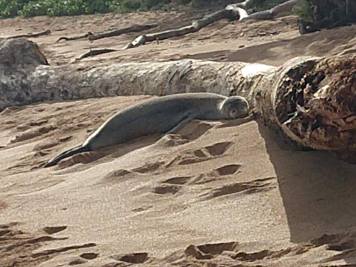
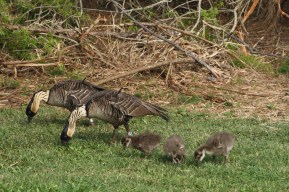
We were surprised by the relative lack of wildlife compared to California, but we did see a few interesting animals. The island is overrun by wild chickens, which run really very fast, fly occasionally, and have lots of progeny of various ages flocking about. I’m not sure I had seen an adolescent chicken before this trip. We felt lucky to get a close look at a family of nenes, familiar to all crossword solvers, and even luckier to find ourselves amid a superpod of about 200 spinner dolphins during a boat trip. We saw them spin, but weren’t able to capture it on video. A highlight for me was an endangered monk seal hauled out on the beach. There is one in the lab of the aquarium where I volunteer.

Monk Seal Kauai   Kauai Rooster                          Spinner Dolphins                   Family of Nenes            

Ok, I can’t figure out how to arrange these pictures on the page, so I will leave it as an exercise to the reader to figure out which animal is which.

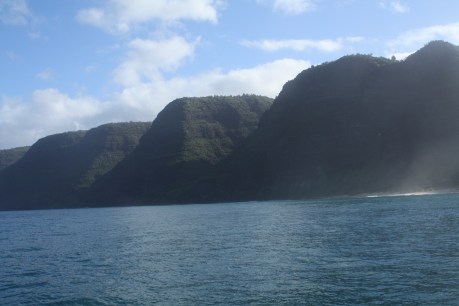
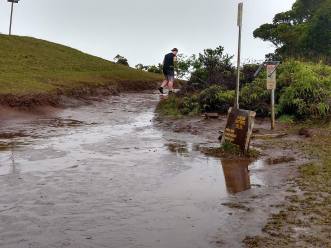
The main thing Kaua’i is known for today is scenery. We didn’t delve deeply into its history, but it seems to have moved to a mostly tourist-based economy, meaning a lot of the island is protected. The western shore, aka Na Pali Coast, consists of crater-rim mountains plunging to the sea, interior of which is a large canyon and then a large swamp. It is so rugged that there are no through roads between the north and south shores on that side. We took a boat tour to see the mountains and we wanted to take a hike to see the canyons, but we had to settle for a drive due to the weather.

Pre NaPali   Soggy Hiker    Canyon1

Hmmm. It appears we did not get any pictures of the most dramatic part of Na Pali Coast! Well, if you’ve seen movies, you’ve seen it. Kaua’i has been featured in quite a few movies. One example, for the older crowd: Bali Hai in South Pacific.

I mentioned weather, and it does rain there, over 40 inches a year. It didn’t slow us down, other than discouraging  us from hiking down that one soggy trailhead, because the rain starts and stops quickly. By the time you get your raincoat on–yes, we brought those–it’s over.

It wouldn’t be The Garden Island without rain. I wouldn’t have experienced my first outdoor rain forest. When it rains, waterfalls sprout. Rain is followed by rainbows.

Rainbow

First Read

A first read, by which I mean the first time I read a book by an author new to me, has much in common with a first date, to the extent that I can remember what that is like, having been married thirty years. But of course, I do remember, since I fall in love with my husband again every single day.

Truly!

I am about 40%, according to Kindle, through my first Haruki Murakami book, 1Q84. I was introduced to Murakami by a mutual acquaintance, or at least someone whose career I follow, Seiji Ozawa, who served the longest stint as artistic director of the BSO while I lived in Boston. Murakami and Ozawa had a series of conversations about music, the edited transcriptions of which were released as a book. Although this book claims Murakami as its author, it is hardly an example of his novel-writing. It was a gentle and supportive paean to Ozawa, spearheaded and curated by a person who is admirably well-versed in both classical and jazz music performances. It would seem Murakami listens to both recordings and concerts, often repeatedly, whenever he is not writing.

Often I read a new author because of a book review or a recommendation from a friend, but in this case, I simply decided to try one of his novels, so I had to choose one. In that case, I usually choose the most well-known, so the author will have the best chance to make a good first impression, and if I don’t like the book, it will really be because we are not suited to one another.

Having read more than a third of this quite long book, I am fairly well pleased with M., and intend to finish it. I find the characters intriguing, the format appealing, and the writing affective. There’s a whiff of fantasy/sci-fi to it, and those imaginings support and enhance the story.

As with most novels, there is some tension, and some situations to resolve, and it is still in the tangling portion, not really doing much untangling yet. So the tension for me is, will M. make the right decisions when resolving the loose ends? There are some characters who should not die, and two I hope will find each other. There is some violence perpetrated against the innocent, and some threatening bullies; will there be justice, or at least redemption?

Worrying about these resolutions can make me a bit nervous at times, but there’s nothing for it but to read. By the end of the book I will know if M. and I will be continuing our relationship, or if it was just one of those things.

Perfect Attendance

The last time I got sick was in February of this year. My husband and I attended an annual serial potluck Morris event in Berkeley, amusingly called Wassail, though no veteran of East Coast Wassails would recognize it, as I imagine Brits might not recognize our East Coast version. After the third house I started to feel queasy, and after the fourth house I asked my husband to drive me home, a trip of a bit more than an hour. I curled up in the bucket seat all the way, and when I arrived, I vomited, then slept. The next day I was fine.

Probably food poisoning. These potlucks often include items best for those with iron stomachs.

That is the sickest I have been in a while. I can’t even remember the previous time I was sick enough to abort an event large or small, much less forego one. The rest of my family is the same. Though as parents we tried to demonstrate that we felt school was important, we did not hesitate to remove our children from it for family events, most commonly May Morning. None of us went to school or work on May Morning for a decade. Even so, one year our kids got perfect attendance awards, awards we did not even know existed. We weren’t trying for it, but clearly May Morning was on a weekend that year and nothing else had come up.

Certainly, our kids were never home sick.

Giving such natural resilience, I grew to  view people who get sick as, shall we say, less stalwart representatives of the species. These days, acquaintances in my age cohort seem to excuse themselves due to sickness frequently, and I worry about them possibly having an undiagnosed acute illness. What else could cause them to bow out of plans so regularly?

Not that the over-60 set has a monopoly on sick day. This past weekend, one of the younger members of our docent team called in sick, though with teens there is always the possibility that he got a better offer. We didn’t begrudge him for it, as the rest of the public seemed to notice the beautiful weather as well, leaving the volunteers to watch the whelk repeatedly reach out toward, then reject, a perhaps stale white fish morsel, or spend time searching for some of the more likely-to-hide creatures like the red octopus and the sand star.

I know a lot of mostly young, naturopathic healers from work, and those seem to call in sick quite often as well. One of them explained to me that healers take on the negative energy of their patients as part of the healing process, so if they aren’t careful to rejuvenate between treatments, they succumb to the accumulation.

I do not have a strong opinion on that.

What would it be like, I wonder, to have sickness looming as a daily possibility, to have every plan be subject to sudden cancellation, to wake up to learn you will be missing work? I’ve not lived in that manner, nor have I lived with people who do. I imagine one’s outlook of life would be very different.

I have experienced the analogous experience of rain. For most of my life, rain was a very real possibility as a last-minute event ruiner, leading to the setting of Rain Dates or the making of Alternate Plans. That’s no longer true, now that I live on the Central Coast.

Smooth sailing from here on out? I feel like I might be jinxing myself with this blog post.

Secret Singing

The first day back after our quick trip to Houston, today, is my usual day off from work, and I am spending it on reading and errands, despite a temperature of 75 degrees and a deep cerulean sky. From my seat at our dining table, I can see into the back yard, and earlier, while listening to WHRB,* I noticed a hummingbird perched on a branch, seemingly dancing. It twisted all three inches of its body side to side, stretching vigorously at the apex of each move. Like all movements of hummingbirds, it was quite rapid.

The slider was open and the program was classical. I idly wondered whether the bird might be responding to the music, then returned to my dull computer cares. WHRB often mentions local performances in lieu of advertising, and during the afternoon it repeatedly touted an upcoming performance of Rachmaninoff’s All-Night Vigil, which some mistakenly refer to as Vespers. Perhaps because I just spent a weekend with our sons, which often includes singing and/or discussions of music; perhaps because I feel the lack of high-quality classical performances in this casual small town; or perhaps because I have fond memories of a particular performance of that piece, each mention made me feel more regretful that I could not attend, and finally I turned the radio off.

I could hear a lot of hummingbird calls, so I decided to walk outside to stand under the tree we call The Pollinator, which the hummingbirds favor. Hummingbirds are easy to hear but harder to see, and I often locate them first by looking down. I was shortly rewarded with a hovering shadow on the grass followed by the rapid whirr of wings.  This one eventually alit about two feet from my face and proceeded to enthusiastically produce its characteristic high, chirpy-buzzy sound. As it did so, it executed dance moves identical to those I had observed when the radio was on.

Somehow I’ve never associated a movement with hummingbird song. Maybe this was the only one who does that? On the other hand, I was struck by how natural the movement seemed when viewed with the audio turned up. It felt like something familiar was suddenly revealing a new aspect.

I imagine the world is filled with everyday items I don’t genuinely notice or fully experience. I imagine that will continue to be the case.

==========================================================

* Yes, that’s an East Coast radio station. There are a couple I still listen to via the Internet.

Opera Gopher

A couple of months ago, we attended Opera in the Park, the public season kickoff for Opera San Francisco that is held in Golden Gate Park, for our second time. Last year we weren’t prepared to fully enjoy the event, but this time we did better, with picnic accoutrements, champagne, and a better parking plan. We could still make some improvements, so I started a Keep Notes entry for next year.

Keep Notes: The App of Remembrance for the Forgetful.

Although it’s a far cry from July Fourth with the Boston Pops, this is a fairly crowded event, and our blanket was only fifteen or so feet from a pretty busy walkway. There were multiple blankets whose boundaries were within a stretched leg from ours, some occupied by dogs as well as humans. As it happened, one blanket-sized spot nearby didn’t get grabbed, and thence appeared Opera Gopher.

All gophers are vegetarians that eat pretty constantly to keep up energy for burrowing underground and shaping the ecosystem of grasslands. A cursory inspection of the venue would lead one to conclude that gophers are a massive presence in the Robin Williams Meadow section of GG Park, which is where we were, but most of them were staying underground, voting an emphatic No Thanks to the excessive people, more-or-less restrained domesticated pets, and amplified music.

All except Opera Gopher.

Opera Gopher was perfectly happy to participate in events, which is to say, having its* own picnic in the grass and, one must assume, listening to the music, since that was pretty much unavoidable by any creature aboveground within half a mile possessing operational ears. It was spotted and filmed by my alert husband. I hope this link works.

https://photos.app.goo.gl/oMNVCJ8B8tFwNMGJ7

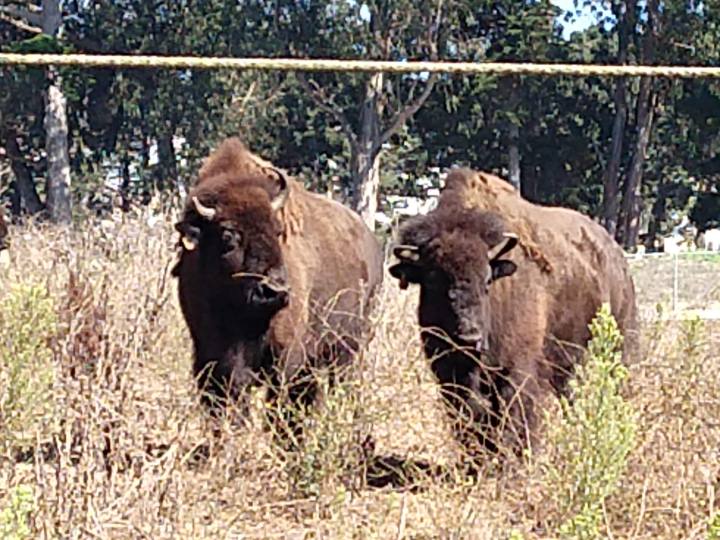
GG Park is so big–about 25% bigger than Central Park, although much of the excess is assigned to roads and parking, items mostly missing from CP–that you can go there many times and never see the bison, but we made an effort this trip.  They all clustered together near the fence waiting to be fed so we were able to get pretty close.

Bison in GGP

I’ve been yammering on about the animals, but the singing was very good too, although during the last third there was a bit of pandering, perhaps a gambit to snare new subscribers? At the low point, or some might call it the high point, they performed Queen’s Somebody to Love. The opera singers had a great time, especially the one channeling Freddy Mercury, baritone Lucas Meachem, but the orchestral percussion section caught my attention. They were really getting into it.

Between the sun and the champagne and the fun, so were we all. Even OG.


* The gender of Opera Gopher was never established.

People Not Like Us

Even though I can’t seem to find time to blog, I did make it to a local brewpub last weekend to hear a jazz ensemble. The venue is a neighborhood hangout, with largish tables one shares with potential new friends. Since we live nearby and the band included some instructors from my husband’s school, we soon had a table mostly full of folks we knew, plus a couple we did not know, with two dogs.

The dogs were calmly lying on the floor, and would have stayed out of sight and mind under the table, except for their peculiar odor. One by one, the non-dog-owning folks at that end of the table moved their chairs to the other end, spilling out into aisles.

The dog-owning couple seemed unaware of the growing empty space around them, but my kind husband nonetheless felt compelled to move to that end and engage them. Talk soon turned to the dogs, and the couple told him he was welcome to pet them but might not want to, since they rolled in something nasty on the way over.

Carrion would be my guess, based on the odor.

So this is a great example of a reason to both love and hate California.  Clueless people–Can I call them clueless? Does that make me a hater?–bring carrion-scented animals into a drinking and eating establishment, and people paying to eat and drink don’t mention it to them or alert the manager. They just move as far away as possible. It’s ok to do whatever you want here as long as it doesn’t stop someone else from doing whatever they want, and for Californians, this behavior did not cross that line.

California does not, of course, have a monopoly on clueless dog owners. I spent most of my life living with dogs, and my husband and I owned two sequentially for 20 years. I have little patience for people whose dogs jump on or bark at strangers, since all my dogs have easily learned not to do these things. I also sometimes troubled by dog owners’ inability to see how incompatible dogs are with wild animals. The scent of dogs, even well-behaved dogs on leashes, limits the habitat choices of  wild animals, most of which are threatened by the burgeoning presence of humans and our domestic herds.

In this case, the dogs were of course blameless. Dogs likely consider carrion an appetite enhancer.

Things to unequivocally love about California: September and October! On Central Coast, we call these months the time for the locals: Deep blue, cloudless skies all day, brisk mornings giving way to afternoons in the 70s, hummingbirds everywhere. Yesterday we were in the convertible waiting at a traffic signal when a swarm of butterflies fluttered all around us. I wouldn’t be shocked to see a unicorn.