Stream of Blogiousness

I can’t track time well while I sleep. During my nights of insomnia, telling time is one of the games at which I excel. In-between counting stairs and creating sets of words that link in circles, I’ll think, I’ve been lying awake for 45 minutes so it must be 3:15 am, and often I’m within 5 minutes of the correct time, even it if I’ve spent an hour or more failing to succumb to the Sandman.* But when I do sleep, time’s passage eludes my reckoning. On awakening I thought, It’s probably not even 5:00 yet, but it was 7:48. Proof positive I was asleep, and sometimes the only way I know for sure.

What awakened me at 7:48 was an unidentifiable noise that must have been loud if one were nearby, though clearly its source was quite far away. My best guess was an elephant trumpeting through a slide whistle. Perhaps two elephants, because one could hardly both trumpet and manipulate the pull rod, that also being a job for a trunk. Or maybe the owner of the elephant was helping; there must be an owner, as there are no wild elephants in California. One might wish that in the early morning of a national holiday others could keep their elephants quiet until a bit later.

This explanation seemed so apt I had trouble dislodging it, but eventually I reluctantly  concluded the noise must emanate from some sort of construction activity, though I have no idea which. Labor Day is of course a day on which one does not labor, or it used to be, back when so many Americans weren’t forced to work multiple jobs to make ends meet, and so many other-class Americans weren’t in such a hurry to have things built, or delivered, or released to the masses, who now yearn for shipping free rather than breathing free.

I guess I’m old enough to have achieved Full Curmudgeon status, but that’s a trap. When I was a kid things really were different, and there’s plenty of Big Data to document the change. I may have grown up in the very best time America will ever have, a time one might call the post-WWII equality era, a time when opportunity really was universal. It wasn’t a perfect time, though. It was the time we stopped eating food and started eating “food,” embracing TV dinners, Hamburger Helper, fast “food,” vegetables in cans, and sugar in everything. Unlike actual food, “food” contains few nutrients.

Oh snap, my thoughts have returned to diet yet again. Time to get up!

=================================

* The traditional Scandinavian folk character, not the creation of Neil Gaiman.
Peanuts and Crackerjack

My spousal compendium of remote facts, who continues to surprise even after 29 years of matrimony, notified me that this song has verses, and he is correct, there are two, in which baseball fanatic Katie Casey disdains a date to the show for one to the game, knows all the home team players’ names, and revs the crowd up to sing the chorus to encourage the players. The lyricist was not a baseball fan, but he recognized the potential in fandom, and dashed off the lyrics in a quarter hour. He wrote over 2500 songs including Shine On, Harvest Moon, but this one is by far the best known.

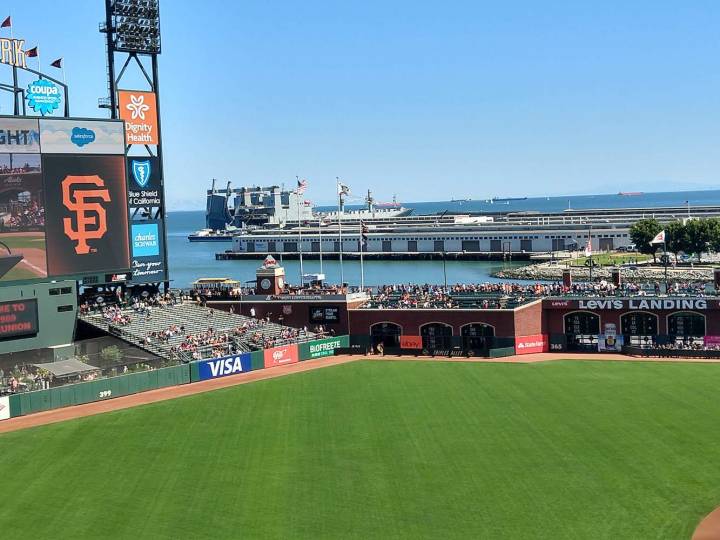
We went to our first Giants game last weekend. The successor to Candlestick Park, now called Oracle Park, was built in 2000 and affords beautiful views of the Bay from many of the seats and public areas; the upper region where we sat is actually called the View Level, and here is just one of our Views, which includes the left field foul pole.

Oracle Park Bay Left of Jumbotron

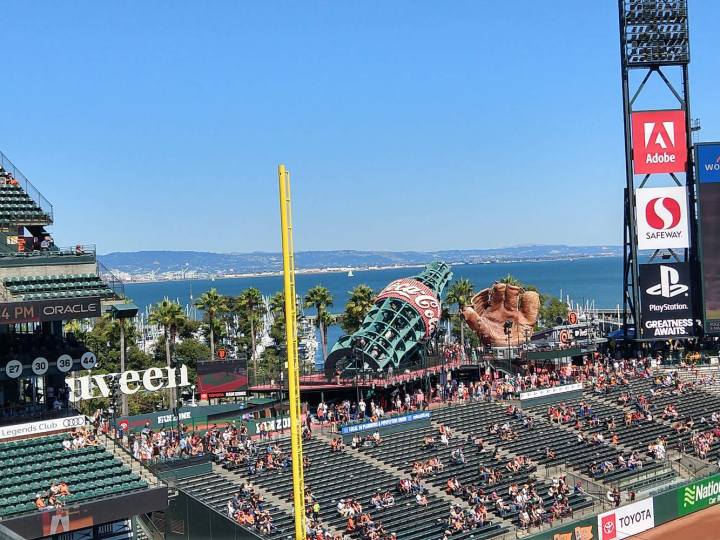
When a Giants player smashes a ball into the portion of the bay just over the right field wall, which is known as China Basin, a counter records a Splash Hit, and we were lucky enough to see one, the 80th since the park opened, and the 45th not hit by Barry Bonds. People in kayaks hang out hoping to retrieve balls, just as people do on Landsdown Street behind Fenway’s Green Monster, except sans kayaks. We had a view of that, too.

Oracle Park Right of Jumbtron

At $35 per ticket, Oracle Park compares favorably to Fenway in terms of cost, plus fans are allowed to bring our own food. Also in terms of diversion. If you get bored by baseball, you can watch the tankers lining up to load, or maybe unload. Each one seems to be computer controlled to react to current, perhaps, as they slowly change orientation in synchronicity while waiting, a long wait, longer than it takes to play a ball game at least. There was also a brief fire in East Bay, billowing smoke until it was extinguished.

Oracle Park is a lot farther than 1.7 miles from our house, so we left our car at Millbrae and took a train in, then made the mistake of stopping for a coffee on the way back to the station. By the time we got there, perhaps 40 minutes after the last play of the game–Giants won, lots of action, lead changed multiple times–the train station was not only empty, the police were moving people along since the next train was 90 minutes away. Seriously? We had to take an Uber three stations to our car park. Later we realized that this wasn’t a subway, rather a commuter train that was running Sunday schedule other than one special just after the game.

Lesson learned, at some cost. Still a great day.

Forests without Trees

I’ve been thinking of three forest metaphors lately, firstly the Forest Primeval. That one does have trees, actually. In fact, I had mistakenly thought of it as a symbolic original forest, a complex, natural ecosystem sheltering tribes that use it gently. Now I know that it is specifically associated with the Acadians as popularized in Longfellow’s Evangeline, which, together with The Ride of Paul Revere and The Song of Hiawatha, cement Longfellow’s Factoid legacy. I love dactylic hexameter as much as as the next fellow, but New England had a dark role untouched in that epic tale of expulsion, just as William Dawes was robbed of fame by Revere, albeit in different meter.

I do think of myself as living By the shining Big-Sea-Water.

Metaphorically superior is Liu Cixin’s Dark Forest, from his Three-Body Problem trilogy. In this chilling view, the entire universe teems with alien lifeforms, but we haven’t met any because they aren’t Friendly. This is Goldilocks’ forest, not Bambi’s. Each civilization is either hunters or prey, and those beaming We Are Here messages into the void are inviting a smackdown of solar system proportions.

Definitely more Independence Day than Contact.

My current favorite forest metaphor is that of Cate Shanahan, MD and author of Deep Nutrition. The human brain is a forest. A healthy human brain is a lush forest with lots of natural water. If a fire breaks out, it won’t burn too long, or be able to spread widely. An unhealthy human brain is like a forest in drought. It’s alive, but much less resilient in fighting off fires. A human brain on the American Standard Diet is like a forest in drought that also houses an abandoned meth lab filled with pails of nasty substances that act as accelerants when the fire arrives.

The fire is usually some form of dementia, but the unhealthy brain travels many symptomatic pathways, and the effects emerge in younger people with each nutrient-deprived generation.

Nurture your forest!

Orthorexia and Orthosomnia

These two new anxiety afflictions sound similar, but they aren’t.

Orthosomnia refers to the possibly-insomnia-provoking anxiety induced by concern over less-than-optimal results from one’s sleep tracker. In one of his books, David Sedaris describes his obsession with his step-counter; he achieves 90,000 steps most days because the app makes him hyper-competitive. This would be a big problem for anyone who is not an independently wealthy celebrity who has hours most days in which to walk. Apparently, some people have a similar dynamic with their sleep trackers, but unfortunately for them, you can’t Just Sleep the way you can Just Walk.

Sleep is not forceable.

A sleep tracker that keeps you up at night is a joke, though orthosomniacs may not realize this, because lack of humor is one result of sleep deprivation.

Orthorexia refers to anxiety and anti-social behavior induced by concern over deviating from one’s preferred diet. If you suffer from some of its more extreme symptoms, such as inability to eat sub-optimal food when you’re literally* starving, anxiety or depression induced by minor deviation from your regimen, or inability to be in the same room with disdained foods, you may need help. But some of the other defined symptoms indicate wise choices, not pathology.

One symptom is Eliminating entire food groups. As the UK has recently become the first government to acknowledge, as fat-studying scientists have known for decades, and as epigeneticists are learning every day, there are complete categories of food that are degrading our species’ gene pool and health. If you aren’t avoiding processed vegetable oils (though you should be slurping lots of EVOO), processed foods that resemble nothing in nature, and excess sugar, you are courting serious disease, reducing your body’s ability to fight unavoidable toxins, accelerating aging, and possibly, depending on your age, depleting the gene pool of your future children. It’s true that you shouldn’t obsess about occasional lapses, but the key word is occasional. Less is more here.

Another symptom is Fixation over the quality of food. Our lives are filled with toxins we cannot avoid, from indoor air pollution to plastics. Our bodies have evolved to eliminate toxins, but the modern toxic load is so high, and modern nutrient levels so low, that we aren’t keeping up. High quality food–whole, organic foods–have nutrients and lack toxins. Maybe fixation is too strong, but being determined to get most of your calories from those is not mental illness.

Anyone who thinks that the idea of food causing sickness or diseases is mostly unfounded is, well, I’m going with Wrong. Good food is medicine, in the sense that it can prevent or heal disease. Also, it tastes great!

If you disagree, you can call me orthorexic, and it won’t bother me at all.

===================================================================

* I’m using literally in its actual meaning, literally, not its modern meaning, figuratively.

On the Boardwalk

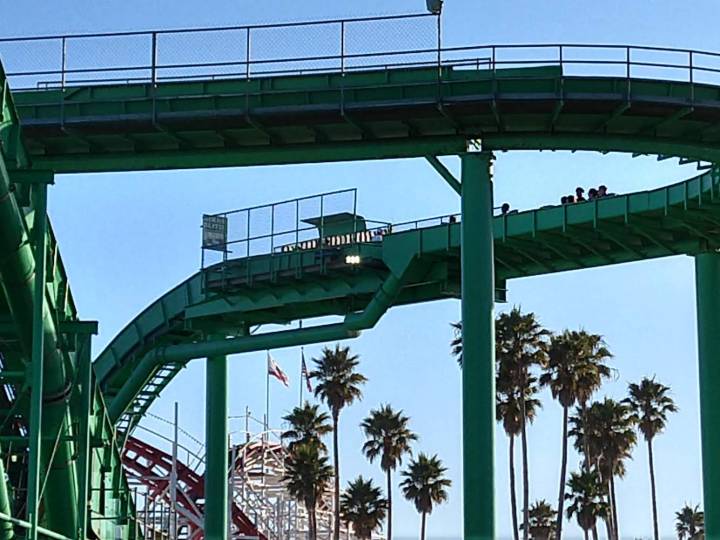
Saturdays during the summer I volunteer on the Municipal Wharf, from which I have a panoramic view of the rides on the Santa Cruz Boardwalk, including the log ride. It was one of my favorites while growing up almost in the shadow of Astroworld, largely because it provided a refreshing splash on those 90/90 days.* America’s massive heat wave hasn’t reached Central Coast, but still, the log ride called to me from across the water. Since I don’t work on Tuesdays, and my husband is not taking classes during the summer, we take outings, and last Tuesday evening we headed for the amusement park.

The log ride is ubiquitous, so you probably have a memory of your own. Early in the ride a conveyor belt takes you Up, then you slosh around a curvy, elevated sluice for a while, then you return to your original level via a fast slide, which is where the splash comes in, especially for the person in front, which was me. The curvy part is relaxing, in this instantiation offering lovely views of Monterey Bay, the beach, and the wharf.

Tuesday night is $1.50 ride night so the park was a little busy, but we enjoyed sharing the crowd’s schedule-free, we’re-hear-for-fun attitude, an attitude we encounter a lot since we live in a Vacation Destination. We avoided traffic congestion by parking in a neighborhood and walking across a bridge over the San Lorenzo River. We rode the wooden roller coaster, walked around considering other rides, and watched some beach volley ball.

As we headed back toward the bridge, we passed the log ride again, and noticed two logs were stranded on the conveyor belt, and at least four bunched up waiting for the final drop. 

Logride stuck 2019

Under that awning you can see in the photo is an attendant, and clearly there is some control stopping the logs from plunging when the ride is off, so the riders should be safe, but ouch! I was stuck on a ride once before, and it made me very uncomfortable, psychologically speaking.

Something can go wrong at any time. You can twist an ankle on a hike, or get a speeding ticket while driving, or drop and break your glasses, or catch the flu, or step off a cliff while taking a selfie. Stuck on the log ride isn’t so bad, but not getting stuck is better.

Most days, nothing bad happens.

=====================================

* On a 90/90 day in Houston, ie, most days during the summer, both the temperature and the humidity are in the 90s, usually the high 90s.

World View Reinforced

Although working nearly full time, I still try to read, and now I’m reading, slowly and intermittently, the 2016 version of Deep Nutrition by Catherine Shanahan, which I love, because I am very simpatico with the author, at least in the way we view the world. At work I  spend time with a wide variety of people, several of whom have quite different world views from mine, and reading this book feels like having a lively discussion with a knowledgeable friend.

The discussion part is in my mind, since obviously she’s doing all the talking.

In this post, I am will share two examples of scientific research corrupteded by corporate funding. Both involve the author, an MD, sharing contradictory findings or hypotheses with working research scientists at UCLA.

In scenario uno,* an epidemiologist funded by Big Ag consistently finds that eating fruit is healthy. He is “surprised” to learn that excess fruit consumption can lead to health problems, including elevated triglycerides, due to fruits’ high sugar/nutrient ratio. He is “fascinated” by a study in which pregnant women following US healthy diet guidelines give birth to babies with deficiencies of vitamin A, associated with eye, skeleton, and organ defects. He nonetheless “admitted” that not only did his funding depend on continuing to produce pro-fruit results, neither he nor any of his colleagues would be able to pursue these findings without large industry support.

Scenario dos involves a researcher working under state-funded grants for medical clinics serving Hispanic immigrants to investigate an aspect of the Hispanic paradox, specifically why recent immigrants from Latin American countries have healthier babies than their Caucasian counterparts. The author proposes that might be due to the benefits of the healthier homeland diets they had enjoyed through their pre-immigration lives. The researcher had not considered that possibility, instead hypothesizing that stronger networks of social support somehow lead to fewer premature births and birth defects, social support networks that are reinforced by community medical clinics.

Should we even call these examples research? I think these are marketing.

When I encounter material that concords so well with my own views, I feel the need to challenge myself. I want this to be correct, but is it? This is a big book with a lot of ideas, and I will be seeking both corroborating and contesting evidence for a while. Since it’s a nutrition book that largely supports the nutrition plan I have been following with good success for eight months now, I already have some real-world evidence in its favor. The complexity level behooves me to keep digging, though.

Both fact-digging and consideration of opposing views are surely brain builders, though we are unlikely to prove or disprove that assertion from industry-funded research.

=======================

* I’m still studying Spanish, and need to practice.

Exclusive Inclusion

My last post was poorly thought out. A fully inclusive group can never exist unless it is extremely general, such as the group containing all humans. Human is not a social group though, it’s a collective noun. In order to be welcoming to some, any social group has to bar others.

This conflict, lurking in my subconscious, was brought to the fore by news of Ravelry, a knitting social website that for some reason was taken over by Trump supporters, in particular white supremacy advocates. Why would that happen? Have Facebook and Reddit become both vigilant about banning hate speak and effective in doing so, to the extent that the haters have to appropriate existing outlets that are less scrutinized?

I’ll guess No. Perceived virtue is not triumphing over real greed in the corporate world.

Whatever the reason, the knitters decided Enough, already! with the hater postings and not only banned them, but done so successfully enough to make the news and the late night talk show rounds. Based on my previous post, I should feel this is unfair for those who were banned, but I realize that I was wrong about that. Knitters have a right to keep Ravelry for knitting.

The High Sierras Back Country Hiking group can’t include the wheelchair-bound. The Ban Biocides in Groceries PAC can’t admit the glyphosate spokesperson. The Game Developers Meetup won’t get much done if a Luddite is contributing to their discussion.

My late father had something to say about this, mostly when I was complaining about a rule or punishment: Life is not fair.

Making life fairer is a worthy goal. Making life fair is impossible.

Politically Correct Bullying

This post is completely based on hearsay, so feel free to disbelieve it, as opposed to my other posts, which I’m sure are greeted as oracular pronouncements. It’s probably about fourth-hand to any reader.

Last night the board of a local contra dance met to decide whether to ban a dancer who had been found to be a registered sex offender. He had not threatened anyone, nor had he misbehaved in any way since reforming. Someone had, however, noticed that he was in the registry, and when the news circulated, some members of the community felt unsafe.

Unsafe is not being used with its dictionary definition here, rather, it is a keyword for a wide variety of people who feel they are frequently mistreated, often bullied, due to their differences. Some are members of the LGBTQ community, some have mental illnesses, and there are countless others. Unsafe is never ok in the PC universe. The key thing is for everyone to feel safe, which is the opposite of unsafe.

I can see why this word was selected by these groups, but it implies a level of threat I feel is often exaggerated, and worse, implies those feeling unsafe will be either protected or victimized by everyone else. In other words, it implies they have no power to enact change, and no way to move through the many parts of the world that aren’t officially safe.

Worse, there is a very limited set of activities and experiences available to someone who insists on feeing safe all of the time. Existing inside a cocoon is not conducive to growth, connection, or understanding.

The reason spaces should be safe is so they will be inclusive. Even folks who have never felt a moment of unsafeness in their lives will be safe in a safe space, so why not make every space safe so no one has to worry? Answer: There is literally no place in which everyone is safe.

Yes, I tired of using italics. You can work it out.

This sex offender is such a case. The person’s completely unverified story is that he was abused as a child and became an abuser as an adult because he thought it was normal behavior, just as childhood victims of corporal punishment or bullying often similarly torment others. The person in question found out that his behavior was criminal and turned himself in, rather than being charged and tried, and this demonstration of integrity and repentance has now led to him being ousted from a safe space.

It seems sad. How lonely he must feel!

It seems wrong. Who are the bullies now?


Health Care We Deserve

A short pieces by David Freedman in The Atlantic this month posits that none of the health care systems of our peer countries, systems that currently provide health care for everyone with significantly better outcomes and lower costs than our own, would work in the US because the citizenry is too unruly.

Unruly is my word, not the author’s.

One obvious difference he mentions is Americans’ unhealthy lifestyles: we are sedentary and like to eat items most of the world would not identify as food. In the most successful countries health-wise, getting exercise and eating healthfully are shared community values, and in the US, counties in which that is true tend to have healthier residents.

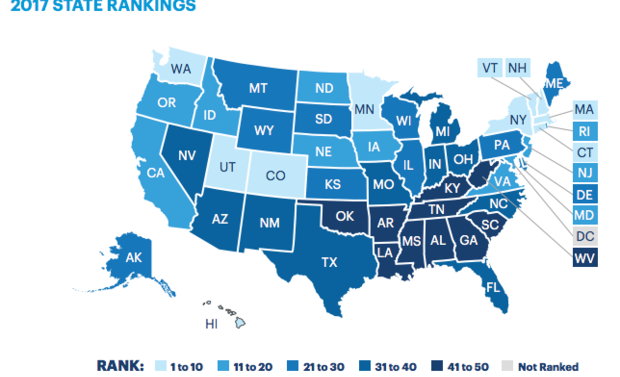
Check out this map* from a couple of years ago:

screen-shot-2017-12-12-at-5-06-52-pm.png


Being the healthiest state (Hawaii) in a country of bad health may not be saying much, but I could make a case for most of the healthier states having more of an outdoor lifestyle, farmer’s market vibe. I’m not sure how California slipped into the second quintile, probably because we are just so big, harboring 10% of the US population, so pretty much every lifestyle is represented.

Side note: According to Wikipedia, California became the world’s 5th largest economy in 2018, surpassing the UK and approaching Germany.

Americans are not interested in preventative health care. We are interested is taking a pill that allows us to live long on a diet of Freedom Fries and ice cream, and getting replacement parts when ours erode. Routine checkups are so, well, routine; specialists make us feel special, and the ER is always there for us. Death is something to be deferred for even the shortest time at any cost, and I do mean any cost.

I don’t disagree with these observations, and to write a short piece, you have to defend a limited thesis, but I think the main reason for our ineffective health care system is that it is the only one that is for-profit, as in, 10-20% of the spending is siphoned off for shareholders, and value growth arises from selling increasing amounts of expensive drugs and procedures. Preventative medicine is particularly bad for profit, since people who aren’t sick don’t spend a lot on health treatments, though the burgeoning supplement industry is working to address this. Even “eating right” has enemies in the processed food and big-Ag sectors.

As a group, Americans also deserve this. We consistently celebrate both rich individuals and massive companies, and oppose limits on accumulation of wealth. After all, though it’s likelier I will have to sell my house to pay for my major illness, it’s possible I will win the hundred-million dollar lottery!

=============================

* Credit to United Health Foundation via CBS

Last Fourth Before Our Next Constitutional Crisis

Looking at the title, I think it is true every year, though this year the next crisis seems close.

Once again in 2019 we viewed the fireworks in San Jose, and once again the display did not disappoint. There were several new colors in the yellow/orange spectrum, including maize, mustard, peach, and amber. Each spark seemed extra bright, as though colorful light bulbs were exploding in the sky. The coolest new action was a spiral, or corkscrew, or pinwheel, sort of a curled-up spring spinning madly and unwinding. Most of the individual shots made huge displays, yet a lot of the time there were multiples shot at once, and both the ground and air displays were generous in both son et lumiere.

Good thing too, since it was preceded by at least an hour of terrible live music spewing out over a low-quality, badly-balanced, deafening sound system. One fellow in our party so battered he decamped to watch the display from a few blocks away. The rest of us were trying to remember why we forgot about the bad music last year, and therefore didn’t warn him, and of course the reason was obvious once the pyrotechnics started: the quality of that display drove the pregame blather from our minds.

This event, like most things in our lives, was in a safe location, so we left our stuff for repeated long intervals during the wait for sunset, thereby avoiding exposure to most of the three hours of various sorts of audio assault. We ate Mexican food in San Pedro Square then took a walk through Plaza de Cesar Chavez, which includes an array of person-sized fountains one can walk among, or through, depending on one’s desired wetness level. Folks who waited in the field played card games, read, or picnicked. Many people, at least fifty of them, danced.

So the dancing people were having a good time, and clearly thought the music was great. Are we wrong? Are we snobs? Are we aging out of enjoyment outside of our comfort zones? Are we unable to appreciate new things? Are we evolutionarily weak, because the sound system made our ears ache? Are we cultural dinosaurs, venting a last gasp of vitriol as we are cleared away by an asteroid of New Sound?

I meant volcano. I subscribe to the volcano theory of dinosaur extinction. But you get the idea.

This large crowd event somehow highlighted our differences, even as we gathered for a common purpose. Everything seems to do that in America now. I can’t remember, though, whether it was always that way, just like I can’t remember how we contacted people before cell phones. Perhaps when there aren’t differences, it’s because some groups of people aren’t even in attendance. That was also true of these fireworks: Despite being in the heart of Silicon Valley, this is not predominantly a geek event like, say, the March for Science was, but much more of a working class and family gathering, and quite diverse.

Except for the mainstream music.