All-American Fun?

My husband and I watched Skyscraper last night, an unabashed American action film starring Dwayne Johnson. It was an impulse decision, and tons of fun.

For action movie fans, what’s not to like? Impossible feats of strength and stamina, don’t-we-wish technology, really nasty bad guys who threaten children, adorable children who survive, ex-military married couple good guys, a 220-story building that contains a 60-story park, and family values. Someone operates a tower crane, my personal favorite construction machine since I read truck books to my toddlers. A detachable prosthetic advances the “plot” more than once. Duct tape has significant product placement, if a non-registered product can have that.

Although I know these movies are popular worldwide, the day after watching one, it seems like something no non-American could appreciate, much less revel in. Or maybe I’m just thinking of all my friends, most of whom are Americans, yet I don’t think they like action movies.

I know I’m in some sort of out-group here. I just feel it.

Enjoyment aside, I could not make a case for supporting this example of the genre. There was copious gratuitous violence; even I felt a twinge of compassion for the scads of HVAC techs and IT guys killed for wrong place, wrong time. Bad things shown as cool included ridiculously rich people and their toys, a hot female killer, and thugs wielding power through weapons and threats. Set in Hong Kong, the movie was packed with gadgets and glitz, devoid of Nature. The stunts were pretty much 100% in-denial-of-physics: Do Not try any of this at home.

We have 20 or so Nature and Nova episodes recorded, a long list of documentaries and critically-acclaimed movies we want to watch, books to read, and lots of Things we Should do (one word, starts with P),* yet somehow we just got into that mood. And even though I am feeling this compulsion to confess, I don’t regret it.

After all, it’s probably too late to save the planet anyway.

==============================

* Any musician can answer this one: Practice!


Jolly Green SP Day

Despite having blessed our children with Irish names, my husband and I aren’t of Hibernian descent, and on St. Patrick’s Day our main goal is usually to avoid pubs advertising green beer. We are aware of it though, and this year it was especially pleasant.

It was Sunday, so we didn’t have any morning obligations. The sky was unmarred ultramarine, with balmy temps topping off around 70° F. My husband purchased and planted one pepper and five tomato plants in a smiling arc around our thriving avocado tree. All the trees in the garden display dramatically thrusting shoots, though one rose bush seems to be marooned in winter drab.

There was a minus tide at 3:00 pm, so I put on sandals and pedal pushers for the first time this year and headed out about ten of two. Here’s how our beach looked from the cliff.

Beach 2019 March 17

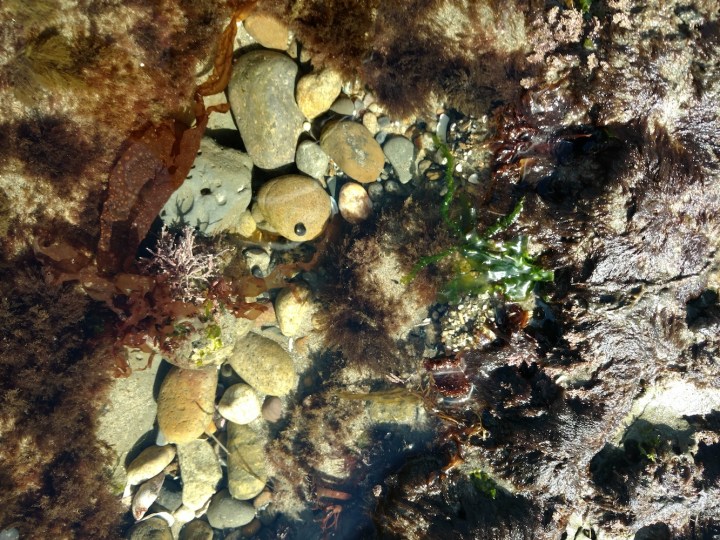
Most of those people are wearing either skimpy swimsuits or wetsuits, and those black dots in the water are surfers. I spent a lot of time in the tide pool but I didn’t have much luck, at least not in terms of seeing rarer sea life. I enjoyed being outside, listening to and watching waves and shorebirds, bathing my feet and hands in healing seawater, and checking out the copious numbers of anemones and hermit crabs. I also saw the smallest snail ever, can you spot it? It’s dark purple.

Tiny Snail in rock jumble

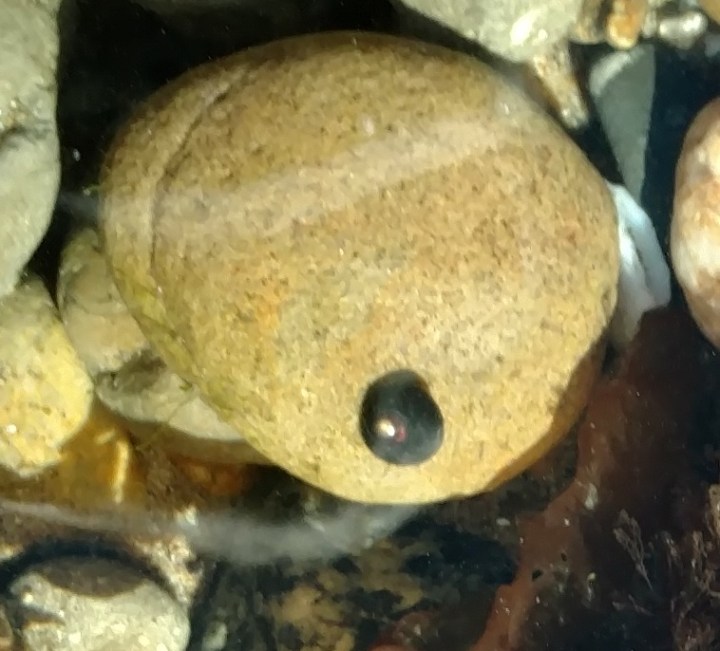
I wanted a closeup shot so I picked up the rock it was on but I couldn’t hold it and shoot, so I put it down and zoomed my camera, then when I looked down again it had moved on. Clever! So the best I can offer is a crop of the previous image. I think its shell is about the size of my pinkie finger.

Tiny Snail

We decided to go downtown to hear the band of a schoolmate of my husband’s, and found them busking on the main drag, having been re-scheduled from 7:00 to 9:00 pm at the Catalyst. Too late for us on a school night! Bill ran into another schoolmate while we were listening. Running into someone you know is typical in SC.

We checked out the Catalyst, which is funky and cheap, and after encountering a young fellow who assured us he would be taking off his shirt soon but didn’t, we opted for craft cocktails in a more sedate atmosphere at Front and Cooper. Mine included cognac marinated with bananas, cardamom, and rosemary smoke. It was exquisite. We got a demonstration of the smoke infuser as well as stories about the first mayor of SC in 1876, William Cooper, whose portrait showed him with a lush, snowy beard.

We drove to and from in the Mustang, with the top down. I carried a sweater, but didn’t don it.

One other thing that could be SPD-related but isn’t: Three days ago I decided to revert to my auburn hair color, but I slightly overdid it. This is not really an Irish look, unless it’s Irish Goth. Here I am photographed in white light that same night, which makes the hair look lighter.

Jo Copper Hair

What could make this day better? A soak in the hot tub. Perfect.

Madness or Genius?

I watch a lot of health-related series online, or perhaps I should say I start watching a lot of them, because the quality varies widely, and sometimes claims therein raise my skepticism hackles enough to make me click the X.

I recently watched all 120 minutes of GMOs Revealed: Dementia in the Water with all my alarms blinking because the two guests were so far out in the ether they were mesmerizing. Both have theories that purport to explain every disease in America’s current pantheon of epidemics.

First up was Gerry Curatola, a dentist who claims fluoride makes bones as well as teeth harder but also brittle, and that long-time exposure to fluoridated water is responsible for a dramatic rise in hip fractures among older people, plus all those other diseases I alluded to. He also thinks the bacteria that cause both tooth decay and gingivitis are actually helpful in a healthy mouth, and that toothpaste is bad for you. Just keep your oral microbiome in balance and you will not only be disease-free, you will have sweet breath on waking.

The second guest, Stephanie Seneff, is a MIT researcher with a PhD in comp sci and a BS in biology who uses data search algorithms to find truth in science. Although she didn’t lead with this, she believes that vaccines may cause autism. First scientist on that team! The culprit is aluminum, and it’s one of the three things she thinks everyone should avoid being exposed to: the others are statins and glyphosate. Her primary contention is that our blood is starved for sulfates, mostly because of exposure to these three substances. Sulfates enable our blood to do its basic bloody things, like flow. She loves cholesterol, and claims heart disease, and especially thrombosis, is all due to sulfate starvation. She goes farther. Our bodies can produce sulfate from its parts if necessary, and that leads to other conditions: dementia if the brain is used, arthritis if the joints are used, and so on. She says flu is actually good for us, and helps the body produce sulfates.

Her work is under review but has not yet been accepted for publication.

I’m very open to long-standing beliefs turning out to be Bad Ideas. Antibiotics For All led to resistant diseases and dysbiosis. The food pyramid recommending 11 servings of grain per day, may as well have recommended a side of diabetes with IBD on top. And science never, ever claimed we need to drink 8 cups of water daily.

I even have read recently about the serious side effects of statins, not a habit to adopt casually. Nonetheless, parsing the number of extreme claims in this two-hour show felt like being subjected to a mental battering ram. Could any of these ideas prevail, and end up changing common practice?

A safe prediction: Not in my lifetime.

Safety Tip: Avoid Volcanos

Somehow I am now on the receiving end of numerous “health tips” which are mostly incorrect in that following their advice would not improve my health. I do know about Unsubscribe, but some of these come from sources I have to unblock, such as my health insurance provider. I often click the Not helpful button.

Some tips are straightforward though, for example: When flowing lava or hot ash comes your way, flee. 

Recently I watched a show, probably Nova, about the summer volcanos in Hawaii, by which I of course mean the Big Island in that eponymous archipelago, the only one which will be getting bigger during our lifetimes. Last summer a slow lava flow emerged right in the middle of a neighborhood, followed by a faster one, then another in a different neighborhood. Ultimately a quick-flowing lava river carved a path to the sea, much of it through populated areas.

Though Kilauea does have a conventional mountain and crater, these eruptions came from lava flowing underground away from the mountain then popping out at unexpected spots. The monitors were alerted to the situation when lava levels in two craters dramatically dropped, because the lava was spreading out.

California is a geologically exciting state, but volcanos we have only in the far north, where the end of the Cascade range, which is mostly the problem of Oregon and Washington, sneaks into our state. I am glad I live far from volcanos. Humans can adapt to anything though, and when the neighborhoods of Hawaii were threatened by underground and eventually aboveground lava streams, the humans tried to manage the situation. The evacuation was precise, street-by-street, and limited in time, as in, people were reluctant to leave then clamoring to return even as lava continued to flow, while authorities, instead of saying, Do you want to die, fools?, were trying to accommodate them by predicting flow directions in real time. Striking footage showed one family trying to get a final few possessions and pets into a car as a slow flow seeped through their fence, perhaps 15 feet away.

I grew up in Houston, where people sometimes die because they don’t flee floods, and I totaled a car once while trying to drive through a flood; when the back seat filled, I abandoned it and took my chances in waist-deep water. That was foolish. Yet with water you have a chance of swimming or wading or holding your breath or holding onto something while the flood flows around you, which in my case was my brother, who is much taller. Flowing lava measures 1200 degrees C on average, and when it contacts combustible material, such as a human, combustion occurs.

Fire is the visible effect of combustion.

I am simply exposing myself as a provincial. If I had more erudition in the way of lava, I would regard it with the insouciance it deserves. One such Reddit contributor reports wearing special lava gloves that allow him to grab some fresh lava for various fun experiments and games, and assures us one can walk safely on it ten minutes after it stops flowing.

Living near a volcano must be sort of like having a pet dragon.


Surprises, Including a Fabulous Creature

I finished The Library Book and there were no dark surprises. What is surprising is the number of holds it has in the Santa Cruz library system–91 at the time my turn came up. It’s a perfectly decent book, but not what I would consider exemplary of my adopted home, though I am surely no expert on SC.

There was one surprise in the penultimate chapter, in which the author stated that there were more libraries in the US than McDonald’s. I’m not an expert on that either, and I understand that data beats intuition when one seeks something simple like a physical count, but that statistic feels so far off. As it turns out, it depends on how one counts libraries. There are 14,000 Mickey Ds and 9000 public libraries, just as I would have guessed, but if you add 3000 academic libraries and 98,000 school libraries, the hamburlars lose.

Except in SC, where we have two McDonald’s restaurants and four branches of the public library. I definitely want to get to know SC better.

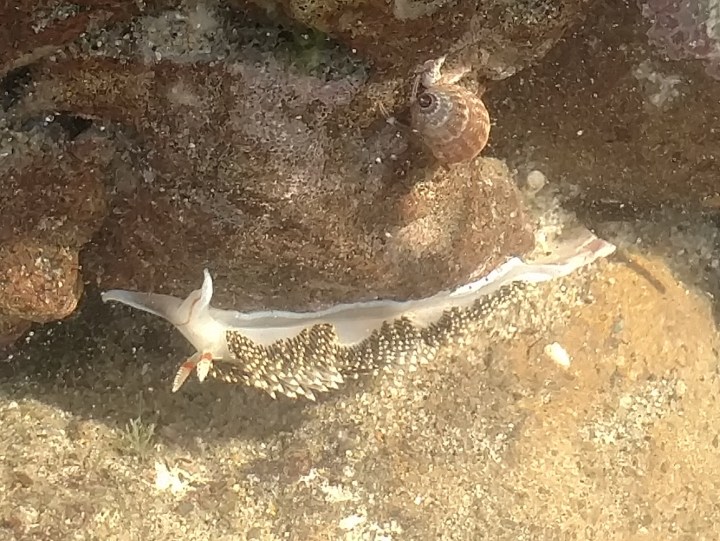
One feature I appreciate is the minus tide, a great tidepooling opportunity when it is both more than a foot below average (MLLW) and happens during sunlight, which it did last weekend, for the last time until October. I spent an hour looking at creatures, mostly hermit crabs and anemones, plus a single sea star. While I appreciate our common creatures, like anyone I was hoping for a sea hare, or a sea urchin, or the bonus round, an octopus. At one point I said to myself, If I could just find a nudibranch, I would be happy. Right after that, I found one!

Nudibranch2019Feb

Nudibranchs are sea slugs that come in all sorts of interesting colors and shapes. This one is close to three inches long in this position. It was hanging below a rock, so I stretched my phone out over the water then pointed it back to get this angle.

On Monday, my husband and I walked to Capitola on the sand, something we can only do during a minus tide. The weather was brisk and sunny, a perfect mid-February day. No surprise there, either.

The Book is In the Fire

I’m reading The Library Book by Susan Orlean, and although I’m not done yet, I’m ready to blog about it, which I know is annoying, because the book could turn on me completely before the end. After reading Ladder of Years, I refused to read anything else by Anne Tyler because the ending was so wrong, and even after an intellectual acquaintance gave me a plausible explanation for the ending being perfect, I still rejected it, and resolved to avoid reading books in which the author runs roughshod over her own creations.

The Library Book is not a work of fiction though, more like an extended New Yorker article, or a series of those, so it is unlikely to run aground. While many libraries are discussed, the focus is on LA’s Central Library, with a large portion addressing its huge fire in the 80s, which many of us do not remember, since it closely followed the Chernobyl disaster.

Writing the long, detailed descriptions of books and manuscripts and maps and media flaming, smoldering, and melting, becoming ash or sludge or vapor, sparked in Orlean the desire to burn a book herself, and she did so. It was quite a long process for her to resolve to do this, to choose a victim, and to devise a method, especially as she was living in LA during a high Wildfire Alert, when her neighbors might rightly wonder at someone setting something alight in a field.

This act of daring fired my imagination. How I would electrify the conversation in my circle if I engaged in book burning! It sounds dangerous, and more important, difficult. Could I convince myself to do that? Usually people I know looking for a challenge take up hot yoga, or travel to Machu Picchu.

Book burning is so forbidden, it’s hard to even think about it, at least for those of us living normatively. Dictators, armies, censors, and arsonists have burned books and other cultural materials for centuries, as is well-chronicled by Orlean. The huge troves of original, unique material destroyed by the Nazis alone is astounding.

Then again, once Susan Orlean burned a book, the act became derivative. For now I’ll continue to get my bucking norms kicks by occasionally writing in library books. I always use erasable pens!


Dull Dudleya

Dudleyas are native to my region, and though they don’t like much rain, Central Coast is within normal climate variation so, I feel like I should leave mine, which was legally acquired, I should quickly point out, outdoors during our spate of storms, especially since I have recently been reminded of the toxic content of indoor air.

Yet it seems so sad, not budding, not really even growing, looking just as it did when I planted it in the fall. Dudleyas, which word I realize is grammatically questionable, but that’s what we say here in California, are the opposite of dull, are in fact know for fabulously colorful and eccentric natural morphs.

Perhaps it regrets being in a pot, from which it can’t reach out its roots to nuzzle with the roots of plants both familial and strange, encounter a friendly or fiendish soil creature, or extend to boundless depth. Perhaps, because the pot is overly large for it, it feels lonely, like a widow whose children live abroad dining at a mahogany banquet table, or an only child with her own bedroom plus a toy room but no nearby companions.

On the other hand, perhaps it is perfectly content, expanding underground while demurely delaying its above-ground flamboyance until the torrent season ends. My gardener friend, to whom I gave a second legal dudleya, says it looks healthy, yet also mentions that hers is blooming. Housewives in Korea and Japan covet dudleyas to showcase their gardening chops, chops I definitely do not share, so perhaps I should tamp my expectations.

Perhaps it feels nothing, being a plant? Yet trees have complex lives, allowing them to engage in long-term planning, group communications, pest control, and even migration, as we know due to years of study and observation by some of the most patient humans among us, the only sort who are suited to study organisms with such enormous lifespans.

Dudleyas live 50-100 years.

Some marine invertebrates and fish live longer than humans, perhaps 100 years, or 300 years, or more? Humans find those creatures’ lifespans much harder to pinpoint than those of trees, since they are underwater and we have more trouble discerning individuals, and perhaps individuals are hard to discern, such as with aggregating anemones.

As you all know, the largest living organism on Earth may be a fungus, but did you know a fungus may be oldest as well, perhaps over 8000 years old? I doubt anyone has studied its feelings, since humans only discovered it a few decades ago.

Creatures with subhuman lifespans may also have more self-awareness than humans thought, or such is the conclusion of a wide range of ethologists. Two examples came to my attention recently. One is a female fish who, when she dislikes the male attempting to mate with her, fakes her ultimate egg-spewing wiggle in order to invoke his ejaculation uselessly, after which he leaves, oblivious, and she seeks a hotter prospect. Another is a male fruit fly who, on realizing he has low prospects of successful mating, gets drunk on fermented nectar in wildflowers.

That fruit fly also may be sad, though also smart. Drunkenness is not a good way to attract a mate.


Grand Experiment

In this time of reduced funding for basic science combined with vast progress in data manipulation, many researchers use data from previous scientific studies, or big databases collected over time on items such as weather, pollution, diseases, voting patterns, and crime, to elicit new predictions and hypotheses.  I imagine that’s how this conclusion was derived:

Scientists at University College London released a study concluding that the Little Ice Age, a period of global cooling that began in the late 1500s, was a direct consequence of the colonization of the Americas, in which approximately 10 percent of the world’s population died and an area the size of France was reforested. “This is useful; it shows us what reforestation can do,” said coauthor Chris Brierley. “That kind of reduction is worth perhaps just two years of fossil fuel emissions at the present rate.” 

During my docent-led tours at the Seymour Center I have occasion to discuss the UC Natural Reserve system, comprised of 39 reserves totaling over 700,000 acres. Each university manages some of the reserves, with UCSC responsible for four. Most are not open to the public, though a few allow occasional guided access.

The reserves were set aside to ensure undisturbed ecosystems would be available for training and research in a time of steady ecosystem destruction. These sites are where the next generation of ecologists is trained to use spotting scopes and take samples in the wild. Experiments on ecosystems may extend through seasons or even years, and setting them up in the reserves ensures the results aren’t skewed by inadvertent tampering.

The excerpt above describes an experiment beyond the wildest dreams of any UC researcher, both for its scale and because it would be completely unethical. Imagine the summary line of the grant application:  Infect two continents with disease vectors with a high mortality rate, then slowly repopulate them, allowing time for forests to regrow, while monitoring the global climate.

Today the six billion of us experiment on a grand scale, destroying rain forests, eating processed food, and getting most of our information through social media, and no one is even slightly surprised to think that there are enough of us to create global natural and cultural changes. It’s a little more impressive (terrifying?) that only 500 million of us caused an Ice Age, even a Little one.

A lot of viruses  helped.


Ah, Chuck It

I listened to a podcast about endocrine disrupters today, and my summary is: No Hope. I think this is it for me as far as the health beat goes–time to chuck it.

I usually do some fact checking for my blog but today I am going with memory because I really don’t want to know more about this. The expert spoke a lot about bisphenol A, aka BPA. It is a lab-created product, by which she meant not hydrocarbon-based, which she implied was rare. So when we run out of hydrocarbons, we won’t lack just energy sources and plastics, we will also lack some meds. Because BPA is an estrogen replacement.

Estrogen is a hormone. But while the scientists were checking out their new discovery, they realized, Hey, this stuff makes a great plastic bottle! Chemistry is weird.

Our sons had exposure to BPA, because those bottles were so cute and colorful and convenient! “They” wouldn’t make baby bottles that harm babies here in America, right? That’s a third-world thing.

Between the time we were poisoning our sons and now, FDA did ban certain levels of BPA, but not down to zero. The problem is, hormones affect the systems of our bodies, and they do so at very small doses, measured in micrograms. To create a microgram,

  • Start with a tablespoon, which is half an ounce.
  • Divide that into 14 parts, each of which is a gram. I know, it’s hard, take your time.
  • Divide each gram into 1000 parts, each of which is a milligram. This may take most of the afternoon.
  • Challenge level: Divide each milligram into 1000 parts, each of which is a microgram.

It’s a small amount.

While the evidence mounted against BPA–Does it cause cancer? Developmental delays? Appendages to drop off?–ordinary humans noticed, and started to vote with their pocketbooks for non-BPA products, sending industry scientists back into the lab. Like smart, schedule-pressured engineers everywhere, they decided not to re-invent the wheel, and found bisphenol S, which worked just as well.

A few years later, you will be shocked to hear, BPS was found to cause similar problems. It also has a useful marketing property: The label “BPA Free!” can be emblazoned on items containing it.

Science discovers something, we use it everywhere, we find out it hurts us, scientists replace it with something else. Rinse and repeat.

BPA and BPS are far from the only things to worry about, although they are pretty ubiquitous still–lining almost all vegetable cans, for instance. Any personal product with a scent has some sort of chemical that extends its duration as well as melts our brains, or something. Good news for the wealthy: Safe products are available, for about four times the cost of common brands such as Revlon.

Another rule: If the label doesn’t promise No Bad Ingredients, then there are some.

Most of the threats, however are inside our homes. Unless everything you own is made from fabrics and wood untreated by any modern method, all of it is outgassing. For those of you who don’t live beside a superhighway, moving ten feet from the breakfast nook onto the patio will reduce your exposure to toxins 100 times.

So happy I can get Wifi out here.

Counting Animals

A couple of days ago, random thoughts led me to a hypothesis: There are more humans than any single species of any animal larger than a gull.

I chose a gull because many people think of gulls as pests, and because they are small, but not too small. My husband clicked onto the pest concept though, and immediately proposed that there were more rats than humans. Rats are smaller than gulls, but I checked it out: rats and humans have almost exactly the same population. I was surprised to learn that there are four times as many rats as humans in Paris, and four times as many humans as rats in NYC.

It was fairly easy to coax the Internet to tell me how many rats there are, but for other animals, I had a lot of trouble, especially trying to count by species. Someone writing in  Smithsonian Magazine in 2014 postulated that there were “surely” more house sparrows than people “by now,” with zero science support for this statement. Sparrows are also smaller than gulls, so my hypothesis is not disproven.

Nor is it proven. I have not found any larger animals with a population larger than that of humans, or really anywhere near it, but I have not been able to get global population counts for very many common animals at all. I think humans mostly count endangered animals.

I did find a site claiming there are 900 million dogs in the world, most of them “free range,” and 600 million “small cats” in the world, at least 100 million of which are “wild.”

Part of what prompted my original musing was a visit to the SF Symphony last Thursday. Speaking of which, I would particularly recommend Lutoslawski’s Cello Concerto, and if the performer is Johannes Moser, you’ll get a large dollop of acting along with the playing, and a few moments that are LOL funny.

San Francisco is striking by day or night, its many hills crammed with dwellings side-by-side-by-side-by-side-by-side, continuing for miles and miles and miles. All those people, or rather implied people, extending as far as you can see in every direction, right up to the water line. SF is just a single people hive, and not even one of the larger ones.

The largest flock of gulls I’ve ever seen could hardly populate a city block on Russian Hill.

I think about animals vs humans a lot when I read my neighborhood social network. People are sympathetic to the skunks and coyotes and opossums in our midst, so long as they don’t dig up lawns, or attack pets, or destroy ornamental plants, or disturb a patio party, or live under the porch, or reduce property values, or leave their corpses strewn about the streets in an unsightly manor.

There are a lot of us, but fortunately, we are very reasonable.