Giant Airplanes

As you may have heard, factional disputes in the US have reached the point in which significant portions of our population and leadership have no problem with relying on unpaid air traffic controllers. I very much hope this blog won’t become an evil portent after a tragic crash, but hope is about all I can do. To illustrate the issue, a news program displayed the following graphic from flightaware.com. There are approximately 10,600 planes represented.

download

At first glance, I loved it. Look at all those planes! Boy, are we asking for it!

Then I thought about it. While flying, it is rare to spot another plane between airports, as in, it nearly never happens. Even realizing that these planes are flying at various altitudes, I couldn’t square that with this congestion.

Then I measured it. These flat plane icons are enormous: my very rough estimate is that each one covers about 1786 square miles. That’s a little bigger than a real plane! Even the largest Dreamliner extends across a viewed-from-above 2D area of only 44,000 square feet, or 0.00158 square miles.

That is, these plane icons are over a million times larger than a real plane.

Mentally reduce these icons to dots a millionth of their original size and you’ll be able to see a lot more of the underlying map. Not sure? Just think about each icon being half-sized, then a tenth, then a hundredth. At a hundredth I think each one of them could be replaced by a small dot, like the period at the end of this sentence, and that’s not nearly small enough for a realistic representation, even if all 10,600 were Dreamliners.

Can you see the map now? If you did it right, there is a lot of space and only a few planes, with the only clustering near major airports.

This misleading graphic is induced fear in action, and it came from a liberal show, proving neither side has a monopoly on truth manipulation. Unpaid ATCs are not a good thing for many reasons, but swarming-bee-level clumps of airplanes is not one of them. Because that’s not a Thing.

So much of our lives are spent worrying about phantoms. What’s real in America right now is hundreds of thousands of government employees forced to work with no pay, struggling with their bills, facing disastrous short-term financial decisions, with no end in sight. That said, I confess that I would not encourage the Dems to fund the Wall, mostly because I was once the mother of a toddler. When the child decides to scream until his wish is fulfilled, that is one time we can guarantee the wish will continue unmet. We negotiate only when the screaming stops.

That leads to less screaming in the future.

Happily, toddlers are relatively powerless in the overall scheme of ruining innocent people’s lives. Why can’t that real harm and unfairness loom larger in our thoughts than giant airplanes?

Another Reason to Exercise, Unless You’re a Chimp

Plenty of us wish we shared the daily schedule of chimps: Eat, nap, groom, socialize, repeat twice, then sleep for 9-10 hours. If chimps wore Fitbits, each would log about 1900 steps per day. Gorillas, orangutans, and bonobos have similar activity levels.

In humans, taking fewer than 10,000 steps per day is a ticket to increased risk for CVD, diabetes, and reduced lifespan, yet apes are healthy. But why? Don’t we share 97% of our genes with chimps?

According to an article in the January 2019 Scientific American, hominids split off from the ape lineage over six million years ago and did some evolving of our own, eventually becoming far-traveling hunter-gatherers, a lifestyle that requires a lot of intelligence, including the ability to cooperate, and results in higher daily caloric intake and better odds of reproduction. The Hadza of Tanzania, modern HGs, log 11,000 to 17,000 step-equivalents a day–they don’t wear Fitbits either–and they use bows and arrows. Early humans running down our prey may have moved even more.

Physiology adapts to behavior, eventually. Most mammals manufacture vitamin C, but apes and  humans don’t, because our ancient ancestors ate so many fruits packed with vitamin C that our bodies stopped making it. Now we can get scurvy. Ram ventilation in some fish, including many sharks, led to those creatures losing their gill pumps. Now they have to move or die.

Similarly, millennia of excessive exercise led our bodies to incorporate it into our organs and cells:

  • We need only seven hours of sleep daily.
  • Our brains produce endocannabinoids that create a “runner’s high” in response to aerobic exercise.
  • Exercise releases neurotrophic molecules that promote neuron creation and brain growth.
  • Our maximum oxygen uptake is 4X that of chimps, and our leg muscles are 50% bigger with more fatigue-resistant muscle fibers.
  • Exercising muscles release hundreds of signaling molecules into the body, which reduce chronic inflammation; reduce insulin resistance; shuttle glucose into muscle stores instead of fat stores; cause muscles to produce enzymes that clear fat from blood; improve the our ability to resist infections; lower resting levels of steroid hormones, reducing reproductive cancers; and blunt the morning rise of the stress hormone cortisol.

That last bullet item is new news, a few examples of findings in this relatively new area of research. It also explains why exercise doesn’t do the one thing we wish it would: reduce weight. Since our bodies evolved to require exercise, it doesn’t make them work more, it makes them work better.

The studies also show that volume counts more than intensity. If you don’t want to run, walk, and if you don’t want to walk, stand. Just do it a lot, every day.

My mother at 79 suffers from end-stage renal disease and is bedridden, requiring 24-hour care. Her healthspan was much shorter than her lifespan. Move now for longer health!


Please Don’t “EAT-Lancet”

The new diet recently featured in the Lancet is dubbed “The Planetary Health Diet.” Increase the health of ecosystems it may, but increase the health of humans it most certainly will not. How many years did it take for us to recover from the bad science, obfuscation, and data suppression of Ancel Keys? Unknown, because apparently we are still in that era fourteen years after his death.

I’m dubbing this new diet the AYKM Diet. Surely you don’t need to Google that!

The AYKM Diet reminds me of a series of terrible US food pyramids starting in 1992, mostly because it recommends that the largest portion, 32%, of our daily calories come from whole grains. Grains, whole or no, are not only low-nutrient compared to other whole foods, but also harmful.

Gluten (in wheat, rye, and barley) in particular has been linked to metabolic syndrome, inflammation, and insulin resistance. Even in 1992, the grain bias in the bad pyramid was reported to be a result of food industry lobbying rather than nutrition science. By encouraging us to eat grains and avoid fats, the Bad Pyramid was a key actor in accelerating our NCD epidemic, as everyone knows now…

Or maybe not.

The next largest calorie bucket is “unsaturated oils” at 14%. Not terrible, because monounsaturated oils from EVOO, avocados, and tree nuts are very good. Please eat those.* As far as the polyunsaturated oils, though, you need to separate out omega-3s, which are anti-inflammatory, and omega-6s, which are inflammatory. These useful substances arrive in whole foods in a ratio of 1:1, then heat and chemicals destroy Threes but not Sixes, so processed food is hugely inflammatory. To fight the unnatural imbalance of omegas in the Western diet,  you need to eat wild fatty fish, grass fed beef, and eggs more often than AYKM recommends, and to avoid every processed oil you’ve ever heard of other than EVOO, avocado, and coconut.

Grapeseed is the cyanide of processed oils. But please also avoid organic, expeller-pressed canola oil, and all the oils in-between except EVOO, avocado, and coconut.

Maybe that should be a T-shirt. Not a top-seller, I fear.

Finally, I would also mention that we need to be feeding our microbiomes, ie, eating vegetable fiber. The AYKM-recommended 5% fruits and 3% veggies seems low. I’d drop most of the dairy (6%) and added sugar (5%) and move all those calories to the veggie side.

Beans do not count as veggies for the MB. I’m not sure why AYKM loves legumes–probably because it is taking away all our healthy meat-based protein–but I can’t keep critiquing this diet all day.

If you consult your doctor about this, start by asking her if she has followed research in nutrition during the last thirty years. I get the impression many doctors have not.

====================================

* The AYKM Diet actually recommends that 11.5% of your calories come from nuts. Please choose monounsaturated fat-containing tree nuts, raw or dry-roasted. Nuts roasted in processed oils are inflammatory!


Magnetic North on the Move

Magnetic North seems to be a bit disturbed by the modern age. This map, from the World Data Center for Geomagnetism at Kyoto University, shows its location from 1900 to 2020. Notice how much more active it became starting in 1980.

Related image


The good news is, it’s getting closer to the geographic North Pole, and in fact the declination is predicted to reach zero in 2050. The bad news is, everyone from cell phone users to nuclear submarine navigators relies on a program that adjusts location by calculating the difference between magnetic and actual North, and that program is falling behind.

Usually updated every five years, the program has become inaccurate enough that the US government was planning to release an update after three years, on Jan. 15, 2019. Except the US government is not open, so that didn’t happen.

The release has been re-scheduled for Jan. 30. I don’t know if that’s because someone expects the government to re-open by then, or because people are working more slowly since they aren’t being paid.

I would definitely work more slowly if I weren’t paid. I mean, that’s slavery, right? Slaves work under threat of violence, and I suppose the 21st-century equivalent is the threat of losing your government job/pension forever, on the premise that it is worth keeping and will actually pay out at some point. Stress, anyone?

The moving magnetic pole affects everyone in the world of course, in fact, the program is called the World Magnetic Model. For whatever reason, NATO and the UK and US Defense/Defence Department/Ministry and WHO as well as Android and iOS rely on WMM, jointly produced by US and Brits.

The Brits may have other things on their minds at the moment.

The calculation is not as straightforward as you might expect. The deviation varies not only by measurement of the angle between magnetic and geographic north with you at its vertex, but also due to local deposits of iron and magnetite and by deep Earth flows of liquid iron. And it varies widely, ranging from +15 degrees to -4 degrees across the continental US.

  • Entertainment potential : A few drivers who are overly reliant on navigation ending up in lakes.
  • Grave risk: Mislaying a nuclear sub.
  • Notable: Most modern humans have no idea how our critical tools work, and no recognition of the legions of folks who support us.
  • Conclusion: Anyone not living off-grid is the opposite of independent.

Out of the Blue

For once, I was excited about the condo board meeting: the paint committee was scheduled to reveal the choices of paint colors for our complex, currently a drab greenish-grey with ho-hum white trim, after which the residents would vote. The committee, however, could only come up with a single recommendation, a simple greyish-grey with white trim, and the rest of the board agreed to tell, not ask, the other residents about the decision.

Naturally, I voted No on both the paint and the telling. Good thing our complex has location-cubed to somewhat counter its meh appearance.

The committee hired a consultant who specializes in paint colors that increase property value, supposedly. In funky SC, it’s hard to believe that most folks are looking for drab; the houses along the nearest cross street certainly aren’t. This does possibly pre-select future residents.

Disregarding the fabulous colors of nature, from brilliant sunsets and glowing tropical flowers to misty mountain glens and shifting desert landscapes, as well as the fabulous colors of mankind, from the luminous paintings of Sargeant to the sinuous patterns of saris, certainly makes this consultant’s job easy. I don’t know whether she even proffered a single happy color. If so, this is another example of why compromise always produces a dumbed-down result.

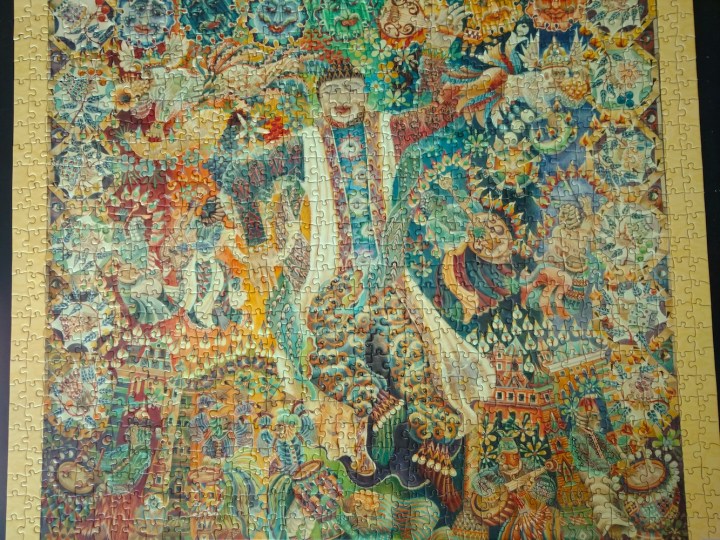
I recently finished my annual jigsaw puzzle, an activity which alerts me to the enormous variety of colors in my attempts to match minute splotches. I am sure there are more than one hundred colors in this reproduction of a painting.* Very few are in the grey family.

puzzle 2019

Our family is fairly colorful. When our children were given their choices of room color, one choose black with red trim while the other chose lime green with orange polka dots. We did not blink. Happily, our neighbors in the duplex were also up for the challenge when we painted the exterior of our combined house, moving from brown/brown to red/blue. Others on the street were dubious when they heard about it, but most loved the result. There were a total of five adults and five children living in the house when we painted it, and the kids had a lot of input, though we rejected the shiny-steel look. Maybe kid-joy keeps the drab out.

64 griggs road

I should mention that we have one concession to color in our new condo scheme: Our doors will change from red to blue.

========================================

* Based on a painting by Sarsyn and Joah Trebeth.

Pour It On

Our local shantey sing relocated to a downtown tap room named Pour, and since we want to support our host, I went off the no-grain portion of my diet for the evening. Pour is fun, with about 70 taps, all self serve.

taps at pour

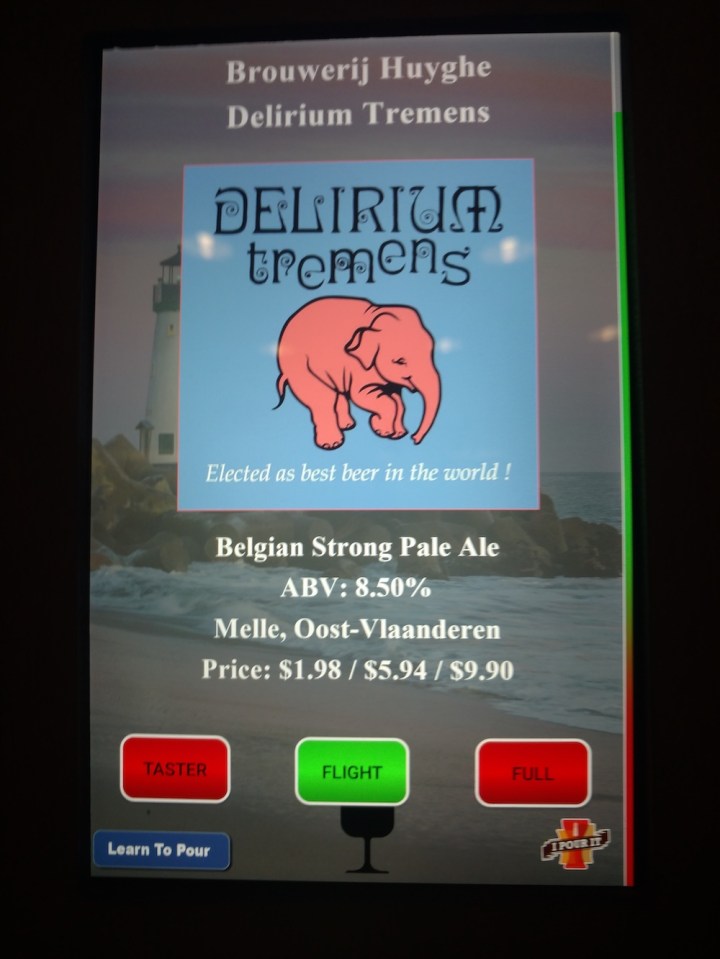
In exchange for a credit card you get a wrist band and a glass. Let the Pouring Begin! You choose a beer, choose a size, scan your wrist band, and pour. The three size choices are 2, 4, and 10 ounces. The machine dispenses the amount you selected. I didn’t try the one below, but I liked the picture. No idea who voted.

belgian screenshot

I tried Tastes of a few different sours, then Flights of a few other types I’m more confident about. There was a decent selection of local beers, and lots of beers from all over, including Weihenstephaner, which is going to be the oldest brewery in the world forever because it is available absolutely everywhere.

Beer purists will have complaints. As you can see on the screen, you don’t have much info about the beer, though I did not seek written info. You are reusing the same glass for every beer type you try. You can’t get a proper pint at one go. A few taps were wasted on wine, cider, and even water.

The bill was a bit of a surprise, too, because it is super easy to go overboard here. Most of the Taster choices were closer to one dollar than two, and it totally seemed worth it for a  taste. But fun! It was definitely fun! So much fun we had trouble keeping our attention on the singing.

In fact, as a folk singing purist, I prefer the no-drinking shantey sing we often attend in San Francisco. The singing at this one diverged wildly from shanteys, and when, in the final half-hour, they started a naughty song in the style of B I NGO, I fled, lest they devolve to Five Constipated Men (in the Bible), a song I have actually heard adults sing in this state. Even while drinking, Massachusetts folk singers sing in harmony, sing in rounds, sing in Latin, sing tricky rhythms and lyrics and melodies.

Shantey singers in California can do some of those things, sans Pours.

Welcome to Marwen

My husband and I loved this movie. I can hardly believe it’s getting mixed reviews and low numbers of viewers.

All the reviewers agree it’s beautifully acted, but many complain about the writing, which I thought was pitch perfect. The movie is centered around a former successful illustrator suffering from TBI due to a vicious beating that destroyed his memory of his past life as well as his ability to draw. Although he feels alone, there are people who care about him and try to protect and help him. He talks to them, and they to him, exactly as one would, as one must, in the face of that injury.

Although the studio is Dreamworks, Marwen reminds me of a European movie because most of the background and plot are inferred rather than explicit, a quality I always seek and rarely find in American movies, in which the characters love to announce the plot and explain the background verbally.  Just in case the audience isn’t too smart?

Most striking about the movie, especially since it’s based on a true story, is the incredible resilience of the victim, which I found emotionally affecting. He creates an entire world of dolls, each based on a real person, who rescue him when he is terrified, and he channels his artistic talent into photographing the scenes he sets up. That’s a tremendous support system; a psychologist could hardly do better. From a viewing standpoint, the staged scenes also provide humor and action to what could be a very sad and slow story.

The victim is in pain and he has painkillers, and we know where that leads, sadly. His addiction is personified in a way that lends unexpected insight into the nature of addiction. I can’t say much more without a spoiler.

While I highly recommend this movie, I should point out that many of the spectator reviewers who dislike this film are people with experience of TBI, either their own or that of loved ones, who advise us to watch a documentary, most commonly the specific documentary Every 21 Seconds. Perhaps I will watch that, but probably not. My wanna-watch documentary list is much longer than my wanna-watch feature film list. I think a lot of people don’t watch documentaries, so maybe Marwen can reach those people, or even lead them (us?) to investigate more.

The Evolution (or Creation) of Food

Homo sapiens has existed for 150,000 to 200,000 years, changing from hunting and foraging to agriculture during the Neolithic Revolution (NR) 10,000-15,000 years ago. So at one extreme, we have been farmers for 15,000 of our 150,000 years, or 10% of our existence, and at the other,  we have been farmers for 10,000 of our 200,000 years, or 5% of our existence.

Ok, the math portion of this post is over.

All the history, civilizations, literature, music, science, language, technology, and memes we know today were created during the 5-10% period. What the heck were we doing for most of our existence? Hunting, foraging, grilling, singing, drawing, making tools, making clothes, butchering, grinding, dancing, collecting, dreaming, making weapons, burying our dead, gathering around the fire, reproducing, socializing, and sharing food.

I mostly want to talk about food, my current obsession. Nutrition is just as complex as rocket science and less well-understood. Researchers are now starting to notice how perfectly whole foods match our needs. Foods that provide free radicals also include anti-oxidants. Fructose in fruit is enclosed by fibrous cell walls. Healthy soils provide foods with a wide variety of micronutrients we require in tiny but crucial doses.

That’s because our food evolved with us.

Having to search for food for every meal sounds horrific to those of us raised near a grocery, but it is not a problem for people who understand their environment thoroughly, including seasonal and multi-year cycling and occasional extreme events. Trees and wild animals deal with such, so certainly humans can.

So for 90-95% of our existence, we had to pay attention to a lot of details about finding and preparing food, as well as be alert to opportunities–beehive? lone eland? schooling fish? We ate a wide variety of foods. We ate what we needed but no more.

We also moved more and lifted more. The average prehistoric adult had strength and endurance comparable to those of a high school cross-country runner today. *

Post NR, we became farmers, millers, bakers, specialists with limited skills; started eating only what we could cultivate or domesticate; and become drastically more sedentary. Today 60% of global human caloric intake comes from wheat, rice, and corn, far from the most nutritious foods on the block. Our brain size has shrunk by approximately the size of a tennis ball. ** Our fitness–well, you know.

When we eat whole foods, our omega-3 to omega-6 ratio stays in balance, near 1:1. When we eat grapeseed oil, made from processing grape seeds left over from winemaking, the ration is 1:700. Dried fruit contains sulfur. Non-organic produce comes from sterile soils and therefore lacks micronutrients. Organic expeller-pressed canola oil has up to 5% trans fat.

Industrial food processing did not evolve, nor was it created, to preserve our health.

I’m religious about spreading this Word because giving up most grains and processed oils, eating only two or three times daily, and fasting 12-16 hours a day has produced amazing results for me in only three months. Speaking of religion, if you don’t believe our whole foods evolved with us, then please believe whole foods were Designed to make us healthy. Just eat them.

=================================

* https://www.outsideonline.com/1923776/how-far-fitness-has-fallen

** https://phys.org/news/2011-06-farming-blame-size-brains.html


Year of the Vegan?!

Year of the Vegan is sweeping the media, but 2019 is much too late. Why is it that dietary trends engage the public only after science has passed them by?

It’s not impossible to maintain health with a vegan diet, but it’s not easy either. Here are just a few examples.

  • Certain nutrients in vegetables aren’t absorbed without the presence of fats, so you need a healthy fat source combined with all salads and veggies. As far as oils go, that’s extra virgin olive oil (EVOO), avocado oil, and occasionally coconut oil. Every other seed- and grain-based oil is effectively poison,  and many of those are in vegan foods. Try finding EVOO-based hummus, for example. Fortunately, it’s easy to make at home.
  • You need three servings of wild fatty fish per week or else a fish oil supplement. Happily, vegans can substitute an algae oil supplement.
  • Creatinine is a necessity for producing the cell’s energy source, ATP, yet most vegetarians and vegans (V&V) have lower blood levels of it than omnivores do since it mainly comes from red meat and fish. So vegans should take a creatinine supplement.
  • The major dietary precursor to acetylcholine, the memory and learning neurotransmitter, is choline, which is also a key component of cell membranes. It’s found in seafood and poultry, but the best source is eggs. No more than 10% of people in the US reach the recommended level of 425-550 mg per day (women-men), including the omnivores. But it’s harder for V&Vs, who have to eat two cups of broccoli or Brussels sprouts to get the amount of choline found in one egg yolk.

V&V diets are also protective in many way, and if you eat organic produce–avoiding fungicides, pesticides, and herbicides–it’s fantastic for the microbiome. And the human body is pretty adaptable, with healthy native populations thriving on diets ranging from almost all marine meat (Inuit) to vegan (Brokpa in Himalayas).  Devil’s in the details though. Inuits get enough carbs because they eat fresh or even raw meat, and the Brokpa diet includes walnuts.

I admire and respect all who become vegan to oppose cruelty to animals, or to reduce antibiotics in the environment or destruction of soil. I also think V&V would be an improvement for almost everyone on a standard Western diet. To achieve excellent health though, it must be an informed choice executed with attention.

Just like pretty much everything that is meaningful and effective.

Tribute to Jen

I just learned that Jen, a social worker at the Winthrop House alternative school in Brookline, recently died after a struggle with cancer. The last time I interacted with her, in 2016, she had been diagnosed and was starting treatment. Although that is never good news, many of us thought she had a good chance to survive. I never followed up to find out what happened.

She was not a friend, and I don’t keep up with any of my sons’ or nephew’s former teachers or educational professionals. Yet hearing of Jen’s passing has affected me much more than I would have guessed. She was a person of warmth and caring whose depth is hard to overstate. She had such genuine love and such deep respect for the vulnerable teens she worked with that even the hardest cases responded to her. She was fiercely determined to save every one of them, and spared no effort toward that end.

For the most part, they were saved. The first priority of WH is to prevent suicide, and it had a perfect record on that during the time my family was involved. Most of the students, who were admitted because they were in danger of not graduating from high school, did so, and many were able to attend college.

Jen provided a refuge, her door always open for a student too stressed to stay in class, recovering from tough conditions at home, or working out confusing relationship dynamics. She also reached out to the adults, helping us help the kids, in part by teaching us the actual effects of things like anxiety attacks, things with which many of us had no experience. She was gentle yet firm, a good person for reconciliation, a persuader.

A very good person has left the world too soon, once again. Still makes me sad.

Perhaps in the years since I have been involved, WH has updated their methods to reflect changes in treatment, changes that I have only become aware of recently. Many WH students have diagnoses such as major depression or general anxiety disorder, and they are encouraged to focus on and embrace their mental health conditions, protected from even the most minor stress, fed copious amounts of sugar, and heavily medicated, all approaches that are contraindicated by current studies. I wish I had known about these new findings when my nephew was there. I did the best I could with the knowledge I had; Jen did the best anyone could have done with that knowledge.