Messy Messiah

I own a score of Handel’s Messiah, inscribed to me from my parents on my thirteenth birthday. This indicates to me that it was something I wanted, and that I had sung in the Messiah before then, because when singing in a Messiah, one needs a score. I know I have done so for as long as I can remember.

Through all these decades, I have experienced multiple varieties of Messiah Sings. Sometimes there is a trained choir, and the audience sings along. More often, there is a trained orchestra and soloists, with the audience acting as the chorus. Sometimes the orchestra or soloists are paid professionals, sometimes volunteers. Often, only portions of the complete oratorio are performed.

Until I moved to California, Messiah Sings and professional performances of the Messiah shared one characteristic: Applause happened only before intermission and at the end. The Messiah is sacred music, and sacred music is meant to–and usually does–inspire contemplation, reference, wonder, or awe. One does not have to be religious to be moved, to ponder eternity, to feel humility or gratitude. For me, these feelings often emerge during a heartfelt solo, or a choral crescendo, or the silence between the pieces.

Now I have encountered an entire state full of people who don’t feel this way. All the Messiah Sings I can find, two of which I have attended, involve hooray-we-did-it applause after each piece, including the recitatives and arias, which are handled in mass Morris dance fashion, For all who will. Volunteer instrumentalists and amateur solos are forgivable, even touching, in a group making an honest offering to heaven, but I have little patience for the versions combining self-congratulations, self-celebration, and poor musical execution.

In fact, I find it painful. It’s sort of like feeling hungry after eating, or tired after sleep. I expected my soul to be restored, but it wasn’t.

We are having similar trouble finding sufficiently solemn church services on Christmas, though we haven’t tried as hard. We want to lift candles into the darkness as we sing songs of wonder, as we did when we lived in Brookline. Could it be that solemnity, or contemplative moments, are incompatible with the West Coast zeitgeist?

Shaping Happenstance

I took advantage of a sunny break between welcomed rains this morning to run outdoors. I am now alternating quarter-mile “sprints”–running as fast as I can while maintaining good form, which is approximately jogging for a true runner–with brisk walks, both because I have been convinced I need more anaerobic workout time and because the body is so durn adaptable; if I don’t change my routine, it loses efficacy.

You can perhaps imagine my route from its description: sprint from home to the ocean; walk to the Point; sprint to the eucalyptus grove; walk around Moran Lake; sprint from the end of that path to the ocean; walk along the shore to the end of my street; sprint home. Post rain, a clot of egrets found a buffet in the rehydrated bottom of that lake, which is more like a swampy lagoon. Mostly the route was filled with surfers and dog-walkers.

Adding anaerobic exercise is one of a long list of changes associated with my ongoing conversion to Max Lugavere’s Genius Plan, a “diet” optimized for brain function which specifies much more than food. Not only do I need a certain amount and a certain type of exercise to achieve results, but I also have to sleep properly and fast regularly.

Had I visited Delphi a few months ago and learned that before the end of the year I would have given up most grains and all oils other than olive and avocado, and would be fasting 12 to 16 hours each day, my smug dismissal of the usefulness of Oracles would have remained intact. Yet here I am.

My husband would credit, or blame, depending on how he is feeling about how these changes affect his life, a 30%-off promotion by our local independent bookseller. The promotion was limited to one non-fiction book, so I arrived with two choices in mind, neither of which had yet been released. This is a common problem for book review readers. I browsed the nonfiction section and chose Lugavere’s Genius Foods.

Mere happenstance?

For the past couple of years I have been making lifestyle changes based on reading books about the microbiome, and the first thing I did when I picked up Genius Foods was to check the index to ensure the MB was mentioned. Recently I had been tiring of the brain fog creeping through my head: groping-for-a-noun gaps, missing-the-obvious moments, careful procedures to ensure the range is turned off and the door locked. Physiology has always been a keen interest, and this book delves into blood chemistry and metabolism quite deeply for a work hoping to appeal widely. In short, I have been preparing to read this book since before it was written.

That many of my life choices, even the trivial ones, were a direct result of my prior interests and pursuits may seem less than insightful, but I certainly made some impulsive decisions as well. More notably, some choices I declined–study abroad, public-speaker for non-profit, VP of manufacturing–were rejected because they did not fit into my self-image. I’m not the sort of person who does that. 

Though pursuing one’s interests can be limiting, one of the tenets of the Genius Plan is regularly stepping out of one’s comfort zone in ways large and small. Try it! It’s a health booster!


Pouring Rain

The title is metaphorical. There are cloudless skies over the Central Coast at the moment, without even much smoke haze. We do have a “100% chance” of rain tomorrow.

When I chose the title, I was thinking about the Morton Salt Company tag line, When it rains, it pours, indicating that the days of clumpy salt were at an end, at least for Morton customers. It was based on an older English proverb, It never rains but it pours, suggesting bad things come in groups. Marketeers obviously meant for the upgrade to be viewed as positive, but to the extent that it is in common use today, it can tilt either way.

Good things and bad things come in groups. Or so we perceive.

It’s on my mind because, after eight months of searching for a job, I now have two, with the possibility of a third.

One is a gig economy editing job that ebbs and flows from my life, so while I am grateful for it and especially its pay rate, it’s perhaps slightly less predictable than the weather, at least the weather here.

Another is the possibility of becoming a notary public/loan signing agent, presuming I passed the NP test, which I will find out within the next two weeks. This career requires hundreds of dollars in upfront investment as well as ongoing self-marketing, in which I have a poor track record. It exposes all my assets to legal forfeiture should I mislead or even err, and requires me to behave as an agent of the state, including locked storage and constant tracking of at least one inconveniently-sized ledger and two seals, with disposition of same in my will.  I haven’t decided whether I will follow through on this.

On the positive side it is flexible work, and relatively lucrative–$200-$500 per signing. Also, I would be able to administer oaths of office.

The main news is I have accepted a permanent job. It started yesterday, so I am a little superstitious about announcing it, although I am happy and hopeful. I will be performing a variety of tasks for a small alternative medical office not too far from my home. The advantages include an all-female staff, variety, building expertise in a new area, helping people feel better, convenient location, and no weekend duties. I will still have a benefit gap, but I’m tired of waiting for the full-benefit job, and especially tired of repeated rejection. This group seems eager to have me on their team. The interview process was creative and fun.

If things go well for the first six months, maybe I will update LinkedIn.

Meanwhile, the pouring: Suddenly I am having trouble finding time for my workout or grocery shopping; asking my husband to prepare dinner, if we have any food; falling asleep early; and leaving the house in the morning with an inventory of items for the day, at least one of which I seem to have forgotten each day so far. The hours start low and ramp up, so I’m not even full time yet–good thing!

I will figure it all out. Very happy to be employed at last.

California Burning

We’ve all heard and many have seen that California is burning now. This interactive video, which I can’t seem to isolate from its enclosing article, shows smoke stretching both east across the continent and west across the ocean. The video is the second graphic in the article.

We are experiencing some poor air quality in Santa Cruz, though less than in SF. Only a few folks here are wearing masks.

I’m reading the late Hans Rosling’s Factfulness, and between it and the news, I’ve been thinking a lot about why we have forest fires. If you are familiar with Rosling’s work, perhaps from TED talks, you will know he would assert the causes are complex and systemic.

My first thought: Well, it hasn’t rained since April. Which is true where I live.

Other possible causes include prevention of natural burning in forests, settlements near and in forests, poor choices of construction materials, drought, climate change, lack or disregard of campfire regulations, carelessness with burning and sparking objects of all sorts, lightning, and power lines.

Our SC-based Morris team is meeting in Boulder Creek now, at a large home on 4 acres of mostly forested land, surrounded by forests. To get there, we drive about 40 minutes into the SC mountains, at least 25 of those spent on one of the only two evacuation routes in the area, both two-lane roads winding through forest. The drive experience has significantly more menace recently, due to three small fires in that area within the last two or three weeks, including one official evacuation of a neighborhood of 200 small homes and cabins.

Having a wildfire is one thing, and fighting it is another. Humans often don’t fight the ones that don’t affect people. Perhaps California should follow the lead of New Jersey and Texas, which are considering buyout instead of rebuilding for frequently flooded homes.

Many people living in the SC mountains are middle-income folks who feel they have no choice due to high prices in town, and would strongly object to this option being removed. There are also wealthy people who live there for the views, and statewide, rich people are just as likely to live in fire-prone areas.

According to US Today, Malibu has averaged two fires per decade since 1929, with more than 100 homes destroyed in each. All so far have been rebuilt, usually in grander style. The average cost of defending a home against fire is $82,000, although as Rosling would point out, this lonely number is meaningless. Is that per all homes per year, per saved home in each fire, or what?

In the US, the federal firefighting budget has tripled since the 90s, and now firefighting consumes almost 50% of the US Forestry Service budget. Seems like a trend worth discussing, but perhaps not while the fires still rage. The human cost, which I’ve intentionally not mentioned until now, is severe and growing. One idea that is being discussed here: Fire relief donations in lieu of holiday gift-giving this season.

November 6, 2018

Surely a historic day, for the United States or even the world, one way or another.

If you are reading this on the titular date, live in the US, are eligible to vote, and have not done so, please stop reading and Go Vote!

California has fantastic suffrage laws. Anyone can vote by mail, so many of us do. Eligible voters can register through voting day, including at the polls, by simply asking for a provisional ballot and providing some information. If you like to plan things a little more in advance, you can register online, or when you obtain or renew your driving license. Released felons can vote once they have served parole, though they have to re-register. Felons on probation can vote. Persons held in county jail on misdemeanor charges can vote. Mentally ill persons can vote unless confined to a facility by court order, and are eligible again on release.

I’m not quite immodest enough to assert the US is the greatest country in the world, but it dominates in many areas, and I think its main strength historically is its inclusiveness, not just inclusive suffrage, but also inclusive and humane immigration policies, which allow the most daring and determined souls to join us.

Jus soli, aka birthright citizenship, is also an advantage to the country, although it is common in the Western Hemisphere, where the largest countries of North America and most countries of South America practice it. There are some exclusions. The US, for example, does not offer birthright citizenship to children of diplomats or enemy combatants. I’m good with that.

My husband was Voter One at the polls this morning. He would have been voter two, which is not worth capitalizing, but the woman in front of him needed a provisional ballot. As Voter One, he got to

  • Verify the voter list was empty, then enter his name on the first line,
  • Verify the vote count was 0,
  • Verify the ballot box was empty,
  • Observe the empty ballot box being closed and locked, and
  • Observe the count advance to 1 when he submitted his ballot.

I never realized Voter One was a Thing. Coolio!

During the past few days of early voting, as well as today, I’ve loved watching the footage of blocks-long lines of people patiently waiting to vote, most with a tablet or phone or ebook, or maybe even a newspaper or magazine or actual book. I hope that everyone’s vote counts.

Tonight I will either be happy that most Americans want to revert to the inclusive policies of our past, or sad that we have chosen fear and hate. It’s a historic question: Who Are We?

Changing History

I’m reading White Savage, a book about William Johnson by Fintan O’Toole, the first history book I’ve read in a while. One advantage of technology is the way it allows us to learn more about historic events, even while those events recede farther from us in time.

William Johnson was an Irishman who converted to Protestantism and came to America in the early 1700s to manage an estate in what is now northern New York, an estate very much entwined with the homeland of the Mohawks, the easternmost tribe of the Five Nations, or Iroquois Confederacy. While Johnson was largely a man of his times, he treated the natives more fairly than most of the other traders, which gave him a competitive edge. Eventually he became fluent in the Iroquois language and participated in and even led some of their rituals.

I’ve just started this book, and already I’ve learned a lot about the Iroquois that I did not know, where I refers to a person who is very interested in, and an avid lay reader of information about, native Americans. The Iroquois thought the Europeans were naive traders–Willing to give ten knives for a beaver skin!–which is why they were happy to hunt and skin animals they previously had little use for in the tens of thousands. They were early adapters of new technology, thrilled to replace many items of bone, clay, and stone with items made of iron, and to use woolen fabric for blankets and clothes. They were the vanguard of the now-ubiquitous consumer society, in which all people, as opposed to only the elites, participate.

The natives could not create or even repair these items of course, and though they repeatedly requested the Europeans to teach them how, the industrial centers of production could not easily be transported to such a different society; I won’t call it more primitive, since it was much healthier and equitable for its people as well as less destructive of nature than pretty much any “civilized” society I can think of.

A darker reason for keeping the natives non-producers was a European fear of being overmatched. At least those Europeans who worked closely with the natives knew them to be intelligent and dexterous, as well as completely exposed in terms of alcohol consumption, having never tried any substance stronger than tobacco. All the traders, including Johnson, were careful to have alcohol on hand, viewing it as another way to deter possible competition.

Ultimately, as we know, the natives were unable to function independently, and forced to capitulate to the demands of the newcomers. Technology may be helping us unravel the past now, but it is as much bane as boon for people, and essentially a bane for Nature in all her guises.

Disclaimer

I applied for a job at an organization called Friends of something–Parks? Libraries? Lapdogs? I’ve applied for so many jobs I’m not even sure which one it was. I retained a copy of the disclaimer.

Friends does not discriminate in employment opportunities or practices on the basis of race, color, religion, sex (including breastfeeding and conditions related to breastfeeding), gender (including gender identity and gender expression), national origin, ancestry, age, mental or physical disability, medical condition, genetic characteristics and information, marital status, registered domestic partner status, military and veteran status, sexual orientation or any other characteristic protected by law. In addition, in accordance with California law, Friends does not discriminate on the basis of the following categories: possessing a California driver’s license issued to an undocumented person; a lawful change of name, Social Security Number or federal employment authorization document; or receipt of public assistance in the form of Medi-Cal coverage.

I can’t decide whether this is a symphony of diverse inclusiveness or an omnibus of what is wrong with identity politics.

California, like my home state of Texas, is associated with a lot of stereotypes, many unfounded as one would expect, though my husband, having seen the Houston Livestock Show and Rodeo, would say all the stereotyping about Texas is true. There are plenty of conservatives here, as well as people who have no interest in weed and people who never learned to surf. On the other hand, almost everyone seems to have some interest in the environment, perhaps because people spend a lot of time outdoors, and even on the balmy Central Coast, most are obsessed by weather.

The lack of weather changes turns out to be as engrossing as extreme weather changes.

The disclaimer above seems almost a parody of what non-Californians would expect of the Bay Area, but rather than arising from politics, I would guess it bubbles up from a pervasive and, to me, admirable quality of Golden Staters: They are extraordinarily non-judgmental. This is so striking I have probably mentioned it before. You can do whatever you want on the street of NYC, but the New Yorkers who may seem to be ignoring you are thinking, Lint licker. Californians don’t even think, I would never do that.

More imports arrive from judgmental states every day, of which I am an example, so judging does happen here. For my part, I’m trying to adopt the local attitude on this. It feels great to be treated that way, and I want to give back.

Sciences Surprises

Science is the latest thing to turn out to be not what I thought it was, a recurring theme that keeps my life interesting during unemployment, together with learning Spanish, memorizing Mozart, watching whales, hiking, and influencing my blood chemistry through diet.

During my recent greenhouse tour, our host kept emphasizing that science is reductionist. The expensive machines that maintain precise temperature, water, and light for the experimental plants do so in order to establish baselines, then precisely vary one parameter. If we vary only one parameter, he assured us, we can be certain that any changes are due to that alteration.

Yet this only works for the simplest cause/effect couplings. Any complicated system may well react to a change in one parameter, but that may not be the sole way to create that change, or even a reliable way.

It’s especially hard to do reductionist science on biological systems, even with cloned mice. Statistician Nassim Taleb says, “It is impossible, because of the curse of dimensionality, to produce information about a complex system from the reduction of conventional experimental methods in science.”

He’s right. That’s why SSRIs don’t eliminating depression and statins don’t eliminate heart attacks and strokes, and both of those classes of meds have damaging side effects. It’s why doctors keep changing their minds about whether we should eat eggs or drink red wine, convincing many non-scientists that scientists are arrogant know-nothings.

Though reductionist science plays a role in the widespread application of science “results” that don’t work, some even more human factors share the blame:

  • Greater influence of the opinions of persons who are attractive, forceful, or ubiquitous.
  • Tendency to believe what we want to be true.
  • Tendency to believe what our friends and family believe.
  • Effectiveness of advertising, which promotes lucrative solutions even when harmful.
  • Well-meaning efforts to quickly implement perceived solutions for people who are suffering.

Psychologically, humans may be biased toward easy, socially-rewarding solutions, but we can understand complex systems if we try. There is a lot of groundbreaking work being done right now, particularly in the biomedical sciences, as reductionist-science failures inspire more scientists to find new ways to explore human/animal biology and Earth ecology.

Happily, I have a lot of time to read.


Plant Poaching

Yesterday I took a behind-the-scenes tour of the plant lab and greenhouses on UCSC’s Coastal Science Campus. An energetic and enthusiastic self-styled “grower” showed us plants grown in huge machines that precisely control temperature, light, and moisture, and a large autoclave used to sterilize soil. Inside the greenhouses were various experiments. One released a group of moths among hybridized and homogeneous plants to find out which the moths preferred, by counting the encounters–how?! One paired Douglas tree seedlings with Scotch broom to find out exactly how the latter is impeding restoration of the former–a study funded by lumber companies. Another greenhouse had just been emptied after a lizard study. A series of pools contained mosquito fish, readying for a study to find out how they effect native species other than mosquitos.

Although I’ve mentioned a lot of animals, there were mostly plants! USCS is responsible for a lot of native habitat restoration on their campus and on their reserve lands, and as the season was almost over, tour members were offered up to six each of leftover sprouted plants to take home. Since all plants have a good chance of being killed by black-thumbed me, I took only two, one for me and one for a friend. I chose a type I had read about in the news: Dudleya.

Dudleya is a succulent native to the West Coast that is ridiculously popular in Korea, China, and Japan, so much so that plants are being dug from unattended California hillsides and remote areas of parks for shipment to those countries, where the plants sell for $40-$50 each, sometimes in football-stadium-sized arenas. Dudleya can be grown of course, but stealing them is faster, and demand is enormous. Authorities have confiscated thousands this year, and California communities are organizing volunteer re-planting events.

Unlike pangolin scales and shark fins, dudleyas are not credited with healing or epicurean properties. They’re cute. They require some understanding in order to make them thrive, so successful cultivation indicates knowledge and attention to detail, characteristics prized in east Asia. They resemble lotus plants. They are a sign of middle class status. Some people become obsessed by them, amassing quite large home collections.

Whether based on style, status, health, or pleasure, our demands are too great for Nature to supply. There are just too many of us. I wonder what I am using too much of? No need to wonder, I have a chart:

https://www.scientificamerican.com/article/can-humans-live-well-without-pillaging-the-planet/

Look at the circles near the bottom. For Americans, the answer appears to be Materials, Land, whatever causes nitrogen and phosphorus use (food?) and whatever causes CO2 emissions (fossil fuels!). That gives me some goals.

Fin de Dos Semanas Recap

Guess what? I’ve been taking Spanish. The recreation department is not offering the next level though, so I guess I’ll try self-learning using some of the books we have in the language section of our home library, books covering nineteen different languages, of which Spanish is the second-best represented. Esperanto is first.

Saturday we had two folk dance events in the Valley: our usual Molly Morris team meeting at a bar in Sunnyvale, followed by a Scottish country dance party in Mountain View. We brought what we needed for both events, but when the time came to change into Scottish garb, my husband found he had grabbed a white tuxedo shirt by mistake. Since he doesn’t typically carry shirt studs about, he had to wear his casual shirt with his kilt. Those who weren’t blinded by the outfit thought it was de rigueur for a Santa Cruz dancer.

SC Scottish Garb

Sunday we went to a Santa Cruz symphony concert, not in Santa Cruz, where it plays in a venue which has the acoustics of a basketball court, because it is one, but in Watsonville, even though that’s farther away and has No Parking, something we learned after we got there. Down to a choice between missing the first piece and parking near a sign reading, Private, No Public Parking, 24/7, Violators Will Be Towed, we parked. SCS sounded like a completely new ensemble with reasonable acoustics. Our car wasn’t towed, either.

Sunday night there were fireworks in Capitola, an annual event whose purpose I have yet to discern. I left my house, walking, at 7:30 pm for an 8:00 pm show, and got a front-row seat–looking over the ocean at the wharf containing the fireworks–by 8:50. The show started on time and ran for 20 minutes. I was wearing the sleeveless cotton dress I had worn to the symphony since the night was so balmy. Breakers crashed onto the cliff below me between every boom. Little lighted boats dotted the bay. The show was pretty spectacular, especially for a town with a population of 10,000. The crowd was friendly and happy. I was home by 8:45.

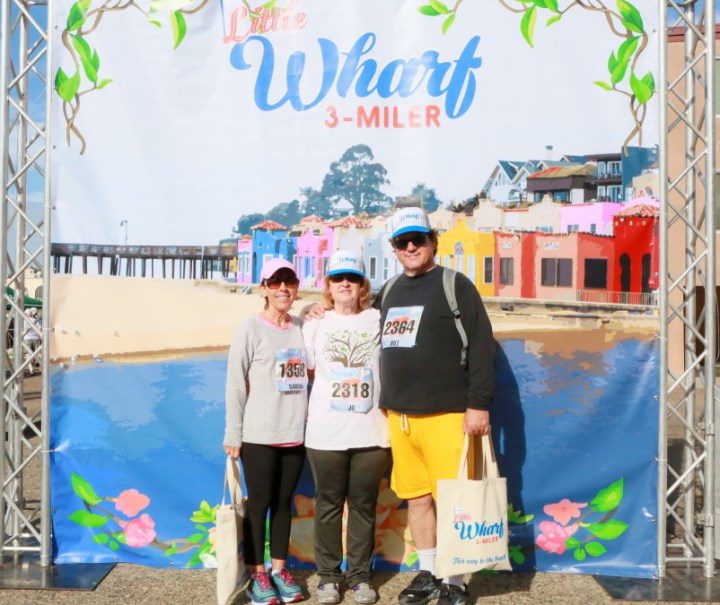
Last weekend I participated in the Little Wharf race, walking most of the way. Though Little Wharf is half as long as Wharf-to-Wharf, my foot injury precluded the latter this year, so I was happy to help inaugurate the new one, along with some boon companions.

Little Wharf

That same night we went to San Francisco to hear SF symphony play an all-Stravinsky concert which included my favorite violinist, Leonidas Kavakos. This was in Davis Symphony Hall, so everything about it was superlative, as always. Parking is easy and not ridiculously expensive in the nearby Civic Center, which once again had an interesting art installation.

SF Art Army

This event involved two hours of driving each way, and we got home near midnight. We are thrilled to be able to experience the City, the Coast, and the Valley, as we are able and inclined.