Live, or Life?

I’ve been recording the National Geographic series Yellowstone Live, which I realize is not what the creators had in mind. I don’t feel too bad about time shifting the show since it isn’t really live–it has commercials. I did have high hopes for it, though. Due to a couple of long family vacations in Yellowstone, I have fond memories of live wild animal encounters, and I was hoping to ignite some of those feelings.

I have watched only the first episode so far. The show does have live segments, which typically consist of our base team contacting field naturalists in various locations throughout the Yellowstone ecosystem, who mostly seem to be viewing landscape and describing what we just missed: The beavers were eating, but they just entered their lodge! Those black dots are bison, who were rutting right here, but have now moved downrange! Then we will see some recorded footage of the animals doing the things we just missed. Very recently recorded footage, presumably; I’ll call it not-quite-live.

The helicopter-borne naturalist did not find any wolves, but she was able to share some spectacular aerial shots of the Grand Prismatic Spring and the Upper Falls of the Grand Canyon of the Yellowstone. Wolves I would quite impressed to see, since there are just over 100 in the entire ecosystem, which is much larger than the Park itself, which has an area of almost 3500 square miles.

Fun fact: the Monterey Bay National Marine Sanctuary is larger than Yellowstone and Yosemite combined.

Back to the show. The goofiest live shot we nearly missed was of the geyser Old Faithful. Note to the uninitiated: That geyser gets its name from its completely predictable eruption schedule. Our team showed it not erupting, and expressed some speculation about whether it would do so during the show. Huh? Spoiler alert: It did.

Good effort, though! The show is trying to catch something live, and without cheating. I enjoyed seeing a lot of my favorite Yellowstone spots. There were pre-filmed bits of interest as well, including a hiker being rescued from rough terrain, and grizzly bears thoroughly trashing a clueless camper site set up inside a bear recovery area–including eating burgers left on the grill.

The most shocking parts of the show were the not-quite-live shots featuring humans doing super stupid things. Crawling close to a feeding bear to get a picture. Crossing a tiny bridge within a few feet of a snorting, stamping bison standing. The Most Likely Darwin Winner award though, goes to the fellow who incited a bison to charge at him in a torero sort of way, multiple times. Wow.

Bison are apparently the most dangerous animals in the park, probably because a lot of them are close to crowds of people, people who often don’t view them as dangerous. There are other ways to die or get injured there, including falling into a hot spring and getting lost on a long hike.

On average, about 160 people per year die while visiting national parks, a death rate of less than one in 1 million. I probably won’t see that happen on Yellowstone Live.

Geological Dustup

One of our newer science tropes, the dinosaur-killing asteroid, is found in school textbooks and featured on shows ranging from Nova to This American Life. Despite this being one of the few science “facts” that most Americans seem to know, according to the current Atlantic Monthly, it’s controversial among scientists. I don’t usually credit the Atlantic as a science source so I did some research, and this controversy is indeed a Thing.

No one questions that the asteroid happened–there’s a huge crater, after all. The question is whether it was large enough or even in time to create the K-T extinction. The other candidate is a truly awesome collection of rift volcanos in India known as the Deccan traps, happily inactive now.

You may have heard of Laki, an Icelandic rift volcano that erupted for eight months in 1783-84. It killed over 20% of humans and 50% of livestock on Iceland, and caused crop failures, drought, and seasonal climate extremes worldwide. That volcano released 3.3 cubic tons of material. Unhappily, it’s still quite active.

During the 300,000 years prior to the K-T extinction, the Deccan traps released 720,000 cubic tons of material. That averages to 2.4 cubic tons per year, or almost three-quarters of a Laki. The average is misleading, because the 40,000 years before the extinction were the most intense.

Either way, the Earth must have been a mess for millennia. During the Cretaceous, lava from the Deccan traps covered an area the size of modern Europe. Today, after 70 or so million years of erosion, basalt mountains over a mile high cover a region the size of France.

Those hoping humanity’s ultimate end would be a quick explosion into flame should perhaps instead contemplate centuries of choking air under gloomy skies, dying animals and plants, and poisoned water. I think this out-Mordors the Trump administration.

Reading this got me curious about our five previous mass extinctions, or perhaps I should say, the current scientific beliefs about previous mass extinctions. Here they are in millions of years ago and percent of extant species that became extinct:

  1. 444 mya, 60-70%
  2. 372 mya, >70%
  3. 252 mya, 90-96%
  4. 201 mya, 70-75%
  5. 66 mya, >75%

Remember, these percentages represent extinct species, not absolute numbers of animals. So if your island, where “you” are some sort of minor deity as opposed to a species on the list, contained kangaroos, koalas, sweet gum trees, monitor lizards, kookaburras, eucalyptus, dingos, sugar gliders, king-parrots, and bottlebrush, and along came an 80% extinction event, you would cross eight of those organisms off the list of life permanently. All gone.

Among the creatures that survived extinction five are gingko trees, magnolias, roaches, crocodiles, and tortoises. One scientist in the article keeps a pet tortoise as a reminder. Well, roaches are hard to train and crocodiles are hard to feed.

The fact that most species get wiped out periodically does put all environmental concerns, including climate change, into perspective. The same sort of perspective that might make one think, Everyone is going to die anyway, so I may as well kill someone. 

Dickensian Times

I finally read Little Dorrit, and I found it surprisingly resonant. The wheel of Fate spins violently for many of the characters; I could practically hear the 100-voice choir singing O Fortuna.

As always, confidently asserts a person who hasn’t read a Dickens book in decades, Dickens portrays 19th century Britain as a hugely inequitable society, one without institutional sympathy, and driven by greed. That is, in striking contrast to the UK today, while quite similar to the US. The title character, a person of infinite self-sacrifice, always forgiving, kind, and helpful, with no interest in worldly possessions, has no modern equivalent to my knowledge. Dickens explicitly paints her as a follower of Jesus, and contrasts her with another character who is cruel, controlling, and deceptive, yet considers herself very religious.

People claiming Christian moral superiority while doing unchristian things are rife today. So are people who commit crimes without compunction, as does a murderer/extorter in this book. He presages the narcissism of California Representative Duncan Hunter, who called his indictment for using $250,000 of campaign funds for personal pleasure then writing it off as charitable giving a witch hunt.

Witches are getting almost as much bad press as Nazis lately.

Then there’s the Bernie Madoff subplot, in which the character Mr. Merdle does for 19th-century investors exactly what Madoff did for 21st-century investors, though the fictional version has the grace to commit suicide instead of being turned in. Both cases have identical legions of investors rich and less so who marvel at their remarkable gains without asking any questions, such as, Why is his name so similar to the French word merde?

Dickens hates bureaucracy almost as much as Kafka does–I think I’ve read Kafka slightly more recently–and introduces the Circumlocution Office, employer of many shallow-end-of-the-gene-pool nobles and their hangers-on, with its expertise in how not to do it. Occasionally challenged by Parliament, its employees justify their existence by pointing to the staggering number of forms that have been filled out by petitioners trying to do something. Many US citizens view our government just so.

Poor people who become sick or injured in Dickens’ Britain do not fare well, another harbinger of USA 2018. As of September 1, I will be covered by Obamacare, characterized by the current Administration as a popular welfare program, the use of which may soon be an excuse to expel millions of legal immigrants.  I’m not sure about those immigrants, but there is no welfare aspect to ACA for me; it costs more and covers less than the employer health insurance I am losing. For the moment, it covers preventative care sans copay, and cannot exclude for pre-existing conditions, though aforementioned Administration is working hard to eliminate those requirements, from both ACA and employer-sponsored health insurance.

Is my life Dickensian? Hardly. But there are strengthening whiffs of it.

Person Not Like Me

The latest hook from LinkedIn drew my attention to a recent article by Tyler Cohen, a Bloomberg Opinion writer. Besides finding out that Bloomberg Opinion is a thing, I learned that at least one person is worried because Americans are acquiring less stuff.

Really? Too many wildfires, too few blue whales, white supremacists, no health care, and you are kept awake by a decline in consumerism? I feel like TC must belong to another species.

John Oliver’s show this week put a name to the nasty practice of pretending to be your opposite: Astroturfing. Think of it as artificial grass roots. A corporation spends money creating a fake uprising of people who support what it wants, with a misleading name. A group supporting fracking might be called Consortium for Renewable Energy That Doesn’t Create Earthquakes, for example. If that sounds crazy, check out the real examples in the latest episode of Last Week Tonight.

I hint a whiff of Astroturfing in this Bloomberg piece, because unless this author is the love child of Jack Donaghy and Avery Jessup, he surely can’t really believe what he is saying. The gist is, we don’t own books, we have Kindles. We don’t own CDs, we have Spotify. We don’t own DVDs, we have Netflix. We don’t own cars, we have Uber. We don’t own homes, we rent. This is Bad.

Sounds great to me! Having recently downsized in a big way, I can attest that less stuff to wade through is liberating; our dwelling looks so open and neat, and the remaining items are easy to find. Folks with less stuff can more easily take advantage of an opportunity that requires a move. Or perhaps people are prioritizing experiences–adventure travel, for example–over things, as one commenter opined.

There is no world view in which First World people have too few items, right? Wrong. We now have TC’s world view. Some great quotes, and my response:

  • The nation was based on the notion that property ownership gives individuals a stake in the system. Certainly families who owned  property in the form of slaves created multi-generational wealth.
  • [Property ownership] set Americans apart from feudal peasants, taught us how property rights and incentives operate, and was a kind of training for future entrepreneurship. Property ownership creates feudal peasants, while entrepreneurship creates jobs long on hours and short on wages and benefits.
  • Perhaps we are becoming more communal and caring in positive ways, but it also seems to be more conformist and to generate fewer empire builders and entrepreneurs. I actually prefer communal, caring persons to wannabe emperor-entrepreneurs; those latter are the ones forcing us to conform.

At one point, TC refers to the more commonsensical, broad libertarian intuitions of the American public. I can only hope that Bloomberg Opinion is considered a wild outlier of hate-thy-neighbor and biggering-is-better. Not my values.

Making these faux-factual statements seems like a form of astroturfing, though on second thought, perhaps not, since this is in the opinion section. We’ll find out soon enough if most Americans choose the narcissistic, I mean libertarian, social contract. Register to vote!

Natural Skeptic about Everything

Scientific American had a great piece in the June issue by a young doctor who entered medical school in 1996. She must be a member of the generation I lost by delaying child-bearing until I was 34. My own mother was 18 when I was born. If I had followed her lead, my grandkids would be almost to middle school, instead of aspirations.

Other things about my life would be different, too.

1996 was nearly coincident with the appearance of “oxy” and other opioid-based prescriptions, and during this doctor’s seven years in medical school, it became the pain-killer of choice. She describes herself as a natural skeptic, which I think is aspirational for all of us. She did not see any reason for this significant change in practice.

The doctor envisioned a long-term, randomized, controlled trial to compare opioids with non-opioids in patients with serious chronic pain. It took years to fund, but she finally managed to run it starting in 2012, and published her results last March. Patients given non-opioids not only fared as well in terms of pain interfering with their daily lives, they also reported less pain and had fewer side effects.

Why had no one else thought to seek data before writing the Rx? Marketing.

Her opposite-of-evil twin in the dental profession, which is a huge user of opioids, created a mandatory protocol at the UMN School of Dentistry requiring NSAIDs for pain relief in most cases, with minimal-dose opioids reserved for the most difficult surgeries. In 15 months the school cut opioid prescriptions in half, with no increase in after-hours calls or return visits related to pain.

Sometimes Obvious Man is just waiting for someone to notice him.

How great it is that an individual can make such a difference. How sad it is that thousands of addicts are dying each year because clinicians bowed to their corporate overlords rather than engaging their brains.

What wrong trope is mucking about with your own life? Be a skeptic!

Gendered Language

English stands out among Indo-European languages because it does not have gendered nouns, a feature it lost between the 11th and 13th centuries. About a quarter of the world’s languages, including most of the ones in our language tree, assign an intrinsic gender to nouns. Usually there are two choices, such as masculine and feminine or animate and inanimate. Sometimes there are more than two genders, such as masculine-feminine-neutral or human-animal-inanimate. The split can even be countable-uncountable or rational-irrational.

Though the assigned gender of any noun often seems arbitrary–in French, war is feminine–I’m intrigued by societies that may expect their citizens to think about things being countable or irrational.

Thinking about things being masculine or feminine is pretty natural, though, unless you’re a moon jelly polyp, dividing yourself into boy and girl baby jellies willy-nilly. And when your language includes grammatical gender, the article, pronoun, adverb, adjective, and verb you use may be modified to agree with the gender of the noun, so if you don’t use the right one, you will sound like an idiot, or a child, or, some would say, an American.

In French, feather duster and candlestick are masculine, while clock and teapot are feminine, so Beauty and the Beast got those characters 50% right. German is the same, though some varieties of timing devices can be masculine, feminine, or neutral.

Horse is masculine in French, so if you say, The horse is old, the other parts of the sentence use masculine forms. But what if you say, My horse, Ellie, is old? My online translator kept all the masculinity for that one as well as for My female horse is old, but it could be wrong. I know that Spanish uses gato and gata for male and female cat respectively.

Yes, the Internet can be wrong.

So what’s the point? A lot of the world’s people are thinking about gender every time they talk, whereas in the US it’s Extremely Uncool to even mention it. Ok, maybe just here on the Left Coast. I hear Facebook has 71 gender options in the UK, but only 50 in the US, so is gender an even more sensitive topic in the UK? Google just has male, female, and other, that last one chosen by about 1% of users.

Thank goodness we don’t have to learn grammar to go with each one. They/their/them seems to be acceptable for most non-binary options.

Switching to curmudgeon mode, when I was growing up we had straight, gay, and bi people, the difference being not what gender you are but rather what gender attracts you. There must have been some trans people, but–sadly?–I don’t remember them. There was always a huge range of libido for all categories, but libido level didn’t lead people to question their own gender.

English-speaking people with non-binary gender choices seem keen to be recognized by specific language, and say they feel unsafe otherwise. I wonder if people whose native languages use grammatical gender feel the same way. Might being referred to as him or her seem as arbitrary, and hence unimportant, as any noun gender assignment? Or the opposite: Maybe there a movement to rename M/F grammar classes lark and raven.

Foam in the Hot Tub

We had a problem–very much a first world problem–with excessive foam in our hot tub last year, and after trying several web-suggested solutions, we emptied it and refilled it. That worked. Later, we learned that could be caused by a bathing suit that had been washed in detergent.

Like many of our modern convenience items, detergent is not that great for hot tubs, or swimming pools, or lakes, or oceans. I’m now guessing that is why we have a custom of never washing swimsuits using detergent. I remember that custom growing up. Sometimes I wondered whether the swimsuits were as clean as they should be. Nonetheless, I’ve always rinsed them in water then hung them to dry, unquestioningly until now.

That I did so is an example of the primary human survival technique for millennia, learning within families, which is rapidly being replaced by learning without families. My own health was possibly compromised by baby formula, lead paint, TV dinners, diazinon, and other wonders of the exciting modern world exploding during my childhood, a world my parents were eager to embrace. It’s a world that may look innocent to us now, but its over-reliance on new-stuff-not-really-proven seeded our non-communicable disease epidemics of today, from obesity to autism.

I recently read about three Australian explorers starving in the outback in the 1860s who stumbled on a Yandruwandha tribe and were briefly sheltered by same, until the bad behavior of one of the explorers, who felt humiliated by relying on savages, drove the tribe to abandon them. The explorers tried to find water, to fish, and to eat the plants they had been fed by the tribe, unsuccessfully; two of three died of starvation.*

The godforsaken wilderness of the explorers was home sweet home to the Yandruwandha, who knew how to find water, how to catch fish with nets made from vegetation, and how to prepare nardoo, a local fern which was their primary nutrient. It’s poisonous and super tough, so you have to roast the seeds, then grind them while mixing with water, then use it to make a polenta-like dish which you must eat with a mussel shell utensil, to avoid reactivating the toxin.

If you do all that, though, it’s yummy and nutritious.

Since there was lots of nardoo in the area, the Yandruwandhu figured out how to make use of it over time, and passed down the methods. Did any of them even realize it was poisonous otherwise? Possibly. But if the only reason you did all that was to uphold family tradition, it would still work.

Living a healthful life in harmony with nature pretty much precludes most of the trappings of civilization, from the feast of opera to the famine of inequality.

The bottom line: Is opera worth it?

=========================

* Australians know this as the Burke and Wills Expedition, though the official version is, according to my research, a bit sanitized.

Particolored People

I’m reading my first Carl Zimmer book, She Has Her Mother’s Laugh, which is about heredity. He’s a little too popular for my taste, and his presentation frequently exposes the fault line between scientist and science writer, not seismically, but enough to engender a small shudder. So I mostly skimmed the background and history stuff in the first 200 or so pages, until I reached Part III (of V).

It was an attentional cattle prod. There are so many ways to inherit so many things that reading about it undermines one’s sense of self.

The main takeaway of the book will probably be that the popular model of DNA, just like the popular models of memory, germs and microbes, cancer, fingerprinting, intelligence, and depression, is way too simplistic. Biology is super messy. Most non-geneticists think we know about genes in a sort of Mendelian way, but Humans are Not Peas. Peas are not even peas, for the most part.

You’ve probably been hearing about epigenetics, the shortest explanation of which is, It’s not the genes you have, it’s the genes you use, and you don’t have to have read my blog to know that an army of microbes in our gut controls what we eat and how we feel. This book discussed these and many, many more mesmerizing methods genetic material finds to mill around and reshape us in the womb, as we grow, and as we age. Mammals can even inherit learned phobias, across multiple generations.

Two of my favorite methods so far are mosaicism, when some clusters of cells have different DNA than others, and chimerism, when one person carries the complete genomes of two people, possibly of the opposite sex. Examples of the former are tri-color cats, port-wine stain, and the syndrome that plagued the Elephant Man.

A chimerism case in point is Lydia Fairchild, who applied for child support in Washington state after splitting up with her husband, while pregnant with her third child. The seeds of the Mean State were germinating even then, and genetic testing was required in order to qualify for aid. The genetic testing showed she was not the mother of her children. During the court case, the testimony of her obstetrician was not persuasive, and she faced removal of her children, whom it was assumed she had abducted, even though the paternity of her husband was not in doubt. Even Fairchild’s own mother expressed doubt.

The court decided to have a witness attend the birth of her third child, not because this was proof that she was the mother, but so the birth could be followed immediately by a genetic test of both, which again was negative.

That trick puts Houdini to shame.

Fairchild was saved when her lawyer learned about chimerism and insisted on some more extensive tests that finally substantiated her claim. Genetic testing showed that her mother was the grandparent of all three children, for example, and after sequencing genomes from cells in various parts of Fairchild’s body, a match was finally found: in her cervix.

Do you think this sounds Dickensian, or even like a real witch hunt, by which I mean an actual campaign of persecution of an innocent person by an irrational mob? It happened in 2003. Tens of people believed a diagnostic test over the actual emergence of a baby from a woman’s body, including highly-educated people and close relatives. We have a real passive-aggressive thing going with science in this country, don’t we? No wonder we can’t grasp complicated models.

And don’t, don’t, don’t let your DNA get into the national database. If live birth isn’t a good enough alibi to overturn DNA findings, conventional criminal alibis are toast.

Conflagration of Hate

Redding and Yosemite aren’t the only things burning in California right now. Pleasure Point’s own Nextdoor site is beset by haters, all aflame over a single homeless man sleeping on a picnic table at a nearby lagoon. Everyone agrees he is a veteran, and No One Gives a Hoot. They want him and his “scruffy” belongings Out. Call the Sheriff! Call him again!

There are continuous disaster updates describing what this desperate fellow is up to at various times during the day, and endless warnings about our tiny lagoon becoming the next Lorenzo Park, a downtown Santa Cruz site with a large homeless population. My neighbors are posting and liking statements such as “These people like the vagabond life.”

It’s kind of They came for me in reverse.

But it’s moving toward The Oxbow Incident.

Since the sheriff hasn’t “put the guy on a bus” despite the organized phone banks, there is a serious discussion being held by suburbanites with an incendiary level of indignation about joining together to remove this fellow’s stuff, along with the picnic table he uses, probably in the dead of night.

Maybe they can then burn it all in someone’s front yard.

There are a few protesting voices, but really just a handful, and our candles of compassion are quickly snuffed out by the katabatic winds of fear. Fear has been the driving force of Pleasure Point Nextdoor as long as I’ve lived here. These people are afraid of strangers, of loud noises, of wild animals, of thieves, and of business development, to name a few.

This latest inferno has reached a new low. If operation Haters Gang Up actually goes off, I’m planning to film it, and hoping I won’t get burned.

Update on the Googleplex Visit

I have a few more pictures to share. First of all, here’s Bugdroid.

Green Google Guy

Sorry he’s so shady. Bugdroid is not his official name, but it’s what everyone calls him, which is confusing and makes no sense. Feeling confused and at sea is a common state for non-Googlers visiting the Googleplex, or maybe just for us older folks. In any case, he pops up everywhere. Can you tell he was inspired by an airport toilet sign?

Google names all the Android OS releases after sweets, as you probably know. What you may not know is every release also has a representative foam statue. The statue of the current OS presides over what I will call the quad, though it probably has a much more confusing name that may not make sense. The older ones have been retired to the Google Android Lawn Statue area, which you can find on Google maps. Visitors are always welcome, no badge needed.

Eclair and more

Here’s Eclair, with Cupcake, Gingerbread, Jellybean, Kitkat, and Honeycomb in the background. Just looking at the picture, I’m reliving my visit, that creepy mall candy store feeling of sugar encrusting my skin, with a slightly queasy stomach. I guess I have good dessert visualization.

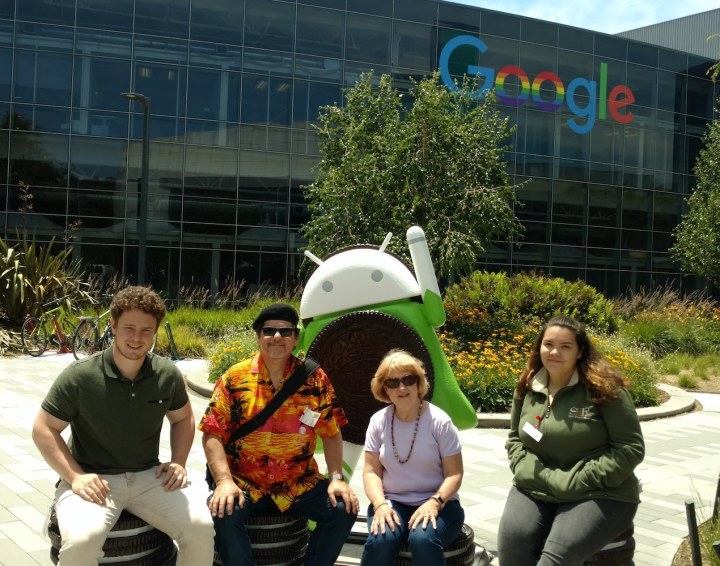
Back in the quad, we posed with Oreo, the current OS. People do this a lot. We took another family’s picture, then they took ours. We didn’t speak the same language, but there was no mistaking what was wanted.

Family with Oreo

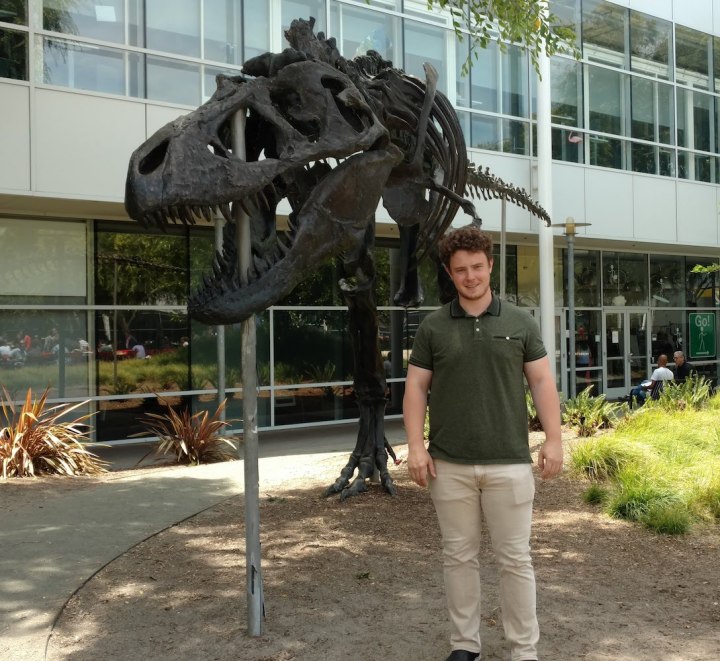
Also in the quad is Stan, a full-sized replica of an actual T. rex skeleton. Sometimes he is beset by flamingos, but not on the day we visited.

Liam with Stan 2018

Finally, my favorite, the Google meeting bike.

GoogleMeetingBike.jpg

There are six seats, so on a nice day–I mean, on any day in Mountain View–six folks can have a meeting while pedaling. The person in the elevated seat at the right steers; you can just make out the steering wheel at the top, center-right. Everyone pedals, and it seems some people in the meeting will be moving backwards, though we did not see this in action. This device makes a lot of sense to me. I have been to many meetings that careen about, steered by a dominant leader, with the participants working hard to keep up, and in various stages of perceiving the intended direction. At least there’s no Power Point screen.

I wonder if it’s possible to take notes while pedaling?