Xmas in NYC

After Thanksgiving, my husband and I came up with the crazy idea of spending Christmas with our younger son, mostly in the NYC area, though the trip started at the Trinity Episcopalian church in Red Bank, NJ where he has been the tenor section leader in the choir for several years. A highlight was his soaring solo rendiction of O Holy Night with organ accompaniment during the candlelight portion of the Christmas Eve service. That was the only place we saw any serious snow as well, thank goodness. Here’s a view from the balcony of our hotel room.

Since we started planning this trip after most hotels were booked, we ended up commuting from Hoboken to the city most days. Here’s the night view from the New Jersey side.

The most moving thing for me was seeing Ground Zero. The sides of both original World Trade Center buildings now look like the photo below, which does not do it justice. The water runs continuously over the sides and into the hole in the middle which seems bottomless. The names of the victims are carved on the flat surface surrounding it.

The gravitas of the water sites is contrasted with the highly popular Oculus mall nearby. It is a monument to overspending and imaginative design.

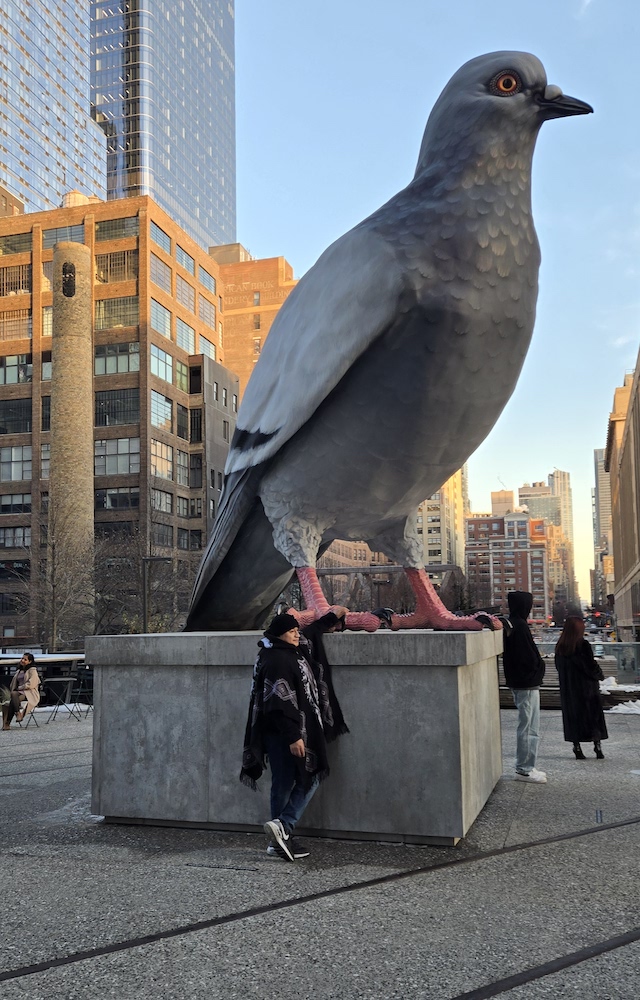
I was excited to finally get a chance to walk the High Line, and I dragged the rest of the family along. We started near the sunning benches, and ended at the large statue named Dinosaur. In between there are numerous, often changing artworks; two of my favorites are shown below.


The High Line ends at Hudson Yards, with an even larger mall, as well as a pretty dramatic viewing platform which I’m sure has a very spectacular view from the top. There was a line and a fee, so we did not go up.

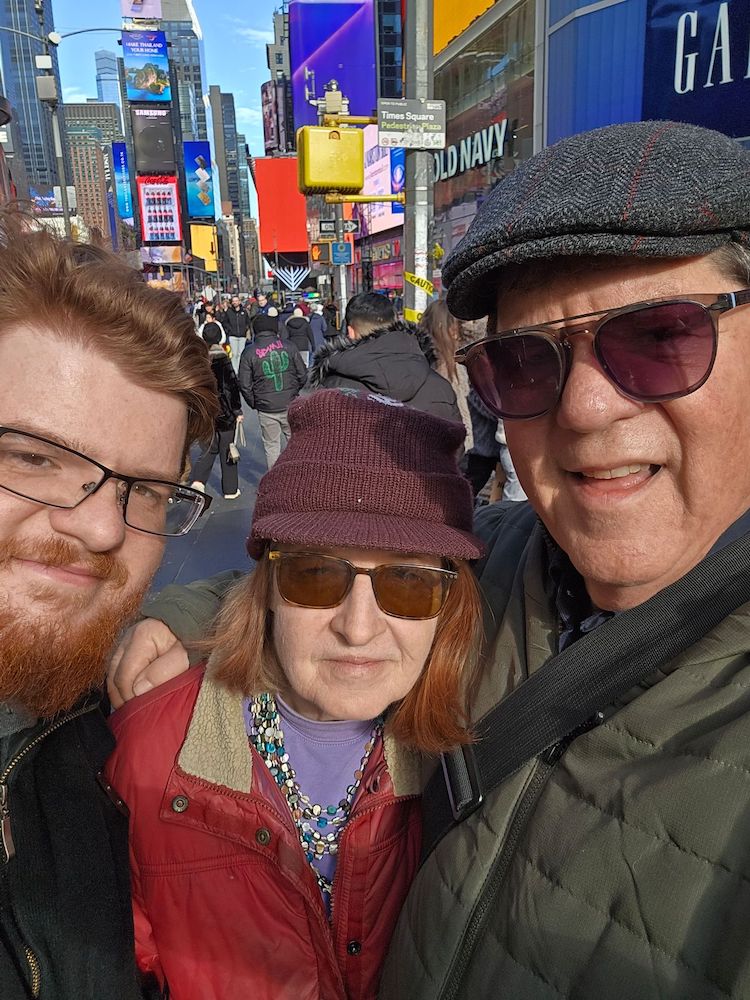
Key characteristics of New York at Christmas include decorations and crowds. We experienced the latter in Times Square and also at Rockefeller center. There is a skating rink under that Christmas tree but we did not attempted to squeeze our way closer since we know what it looks like.

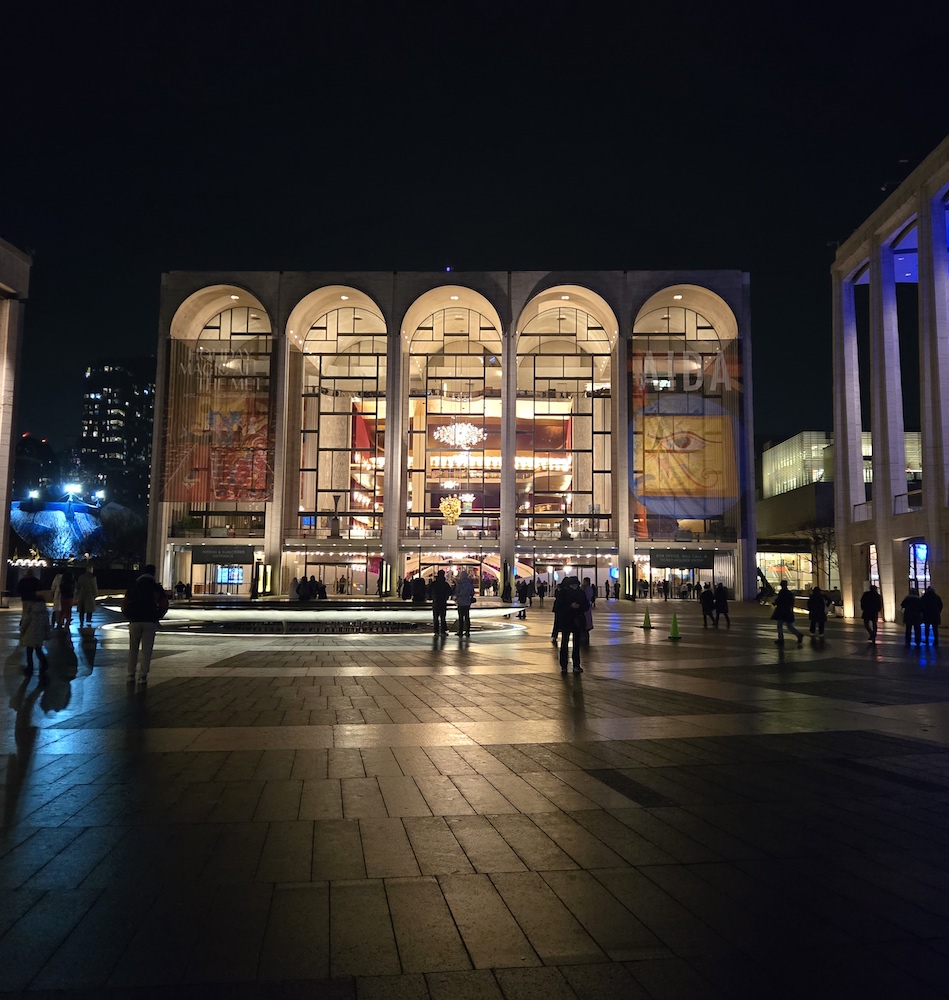
The Broadway show we bought tickets to, Gypsy, was canceled (multiple times!) due to cast illness, but we were able to see the Julie Taymor version of Mozart’s Magic Flute at the Met. I was so excited as we approached the the Met, then came around the corner, and There It Was, all lit up, beckoning for us to enter. It’s one of my happy places. The production was jaw-dropping, indescribable, standard Met.
Bloomingdale’s Christmas windows featured the movie Wicked, but were disappointingly commercial. Macy’s were much more festive and fun, though we didn’t get any pictures. Saks didn’t participate this year, unfortunately.

On our last full day, we stayed in Hoboken and hung out with friends we had met in Brookline, who served a spectacular homemade Indian meal in their gorgeous apartment. Afterword we took a walking tour of the that tiny yet momentous town, including this extraordinary piece of history we didn’t even know about.
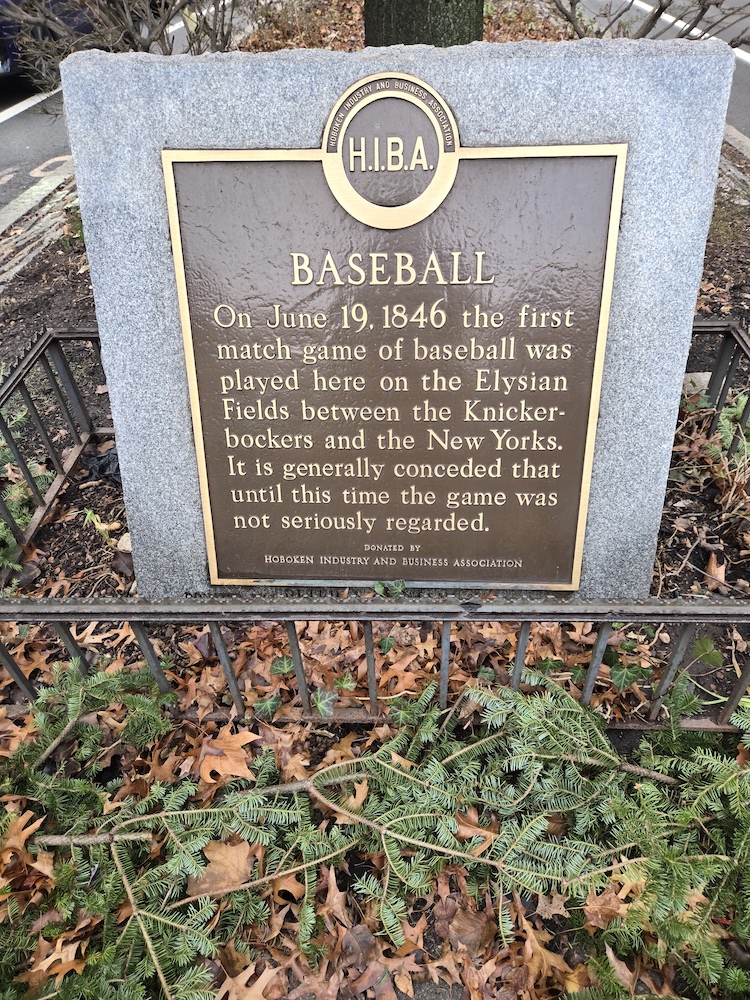
The intersection nearby is where the game was actually played, with the pitcher’s mound in the middle and the four bases on the four corners of the intersection labeled. Since we count ourselves among those who seriously regard the game of baseball, my husband and I were very pleased to see this. Overall, a delightful and rewarding trip.

Fascism v Liberalism

The ideas in this blog are derived from the “Naples” essay written by Walter Benjamin of the Frankfort school with help from proletariat Asja Lacis. As you may know, the Frankfurt School refers to a group of thinkers dissatisfied with all then-current forms of government who coalesced during the interwar period in Europe. What struck me about the essay was the comparison of fascism and liberalism, which I found it very enlightening and still useful.

Fascism divides the world into “the vital and the decadent, the essential and the discardable, the us and the them.” All the dichotomies are false of course, similar to the old joke, There are two types of people: Those who love cats and those who love dogs. Extreme simplification works in a joke, but were it to be applied in reality, it would exclude people who hate both, who love both, who eat both, and who prefer fish.

The other problem with two types thinking is that it usually concludes one of the types is wrong.

Fascism encourages follower to “worship a concocted, false social whole,” like the three decades in America during which Caucasian white- and blue-collar workers were able to support a non-working wife and kids with a single job, usually while owning a late-model car and a TV, and maybe even a dwelling.

These conditions never existed either before or after that time period in the US, but they do survive in the living memory of many Americans today, even though that memory maybe misremembered, remembered from someone else’s life, or gleaned from watching or reading fiction.

Obviously those conditions don’t seem ideal to many today, though I can only speak for women like me, who are much happier wielding a soldering iron and getting paid than wielding a mop and getting ignored.

Liberalism “emphasizes the individual at the expense of the network of relations in which they are embedded.” This definition speaks to me, but seems vaguely worded. One example might be assuming a gay person would politically prioritize gay issues over issues relating to that person being a daughter, aunt, employer, PTO member, football fan, dancer, diabetic, or whale lover. This might be referred to as one type thinking, as in, people have one characteristic that matters, at least in terms of politics, to which all their other webs are subordinate.

That obviously doesn’t work. I can’t even choose between Scottish dancing and line dancing.

Liberalism “encourages followers to banish the idea of any social whole in favor of abstractions like the economy as if they were entities existing independently of human life.” Two things about this. Firstly, it reminds one painfully of all the election exhortations by liberals about the US economy being the envy of the world, when citizens just weren’t experiencing it that way. When you are reduced to living on disability insurance and your kid has to join the service because all the well-paying jobs with benefits have been shipped overseas to create more billionaires, you really don’t care what the numbers say.

Secondly, the economy is most assuredly an abstraction, something created out of the imaginations of people, for which there are no natural laws. There are plenty of historical societies and even some modern ones that maintain their members’ health and happiness throughout all the stages of their lives, without impoverishing–or over-enriching–anyone. The ideal that “making any challenge to [capitalism is] as pointless as challenging the laws of motion” is also fiction, a way of forcing all people to identify with “the power which beats them.”

In modern America, both fascism and liberalism encourage us to embrace capitalism in a simplistic, unthinking sort of way. We don’t have to, though.

Faced with the incursions of industrialization in the 1920s, “Nealpolitans stubbornly resisted modernization, and refused to be overwhelmed and remade by industrial commodities that flooded their city.” They preferred to fix their own cars, even if they had to stop every mile to do so, and often re-purposed modern inventions to be actually useful. Everyone not only had hands-on knowledge but also believed it was important in order to avoid reliance on outsiders or elites.

It still is. How deftly capitalism conceals its dark side! We all can purchase an industrial good without thinking of “the late-night labor, the unattended children, the workplace injuries,” or the laborers who are slaves, prisoners, or children. How empowered could we be with the ability to get our goals accomplished without kowtowing to a system designed to endlessly syphon more wealth to the wealthy?

Is Murder Always Bad?

Mainstream media and government elites are “shocked” by a massive outpouring of haha emojis after the assassination of the CEO of United Healthcare. Shooting people is not a great way to solve things, and it’s probably not going to work out well for the accused assassin, unless he can pull an OJ Simpson with the jury. But chronic pain, permanent impairment, financial ruin, and, yes, even murder avoidable death, are being dealt every day to ordinary Americans by ordinary American health insurance companies.

I have to admit that when I first heard the headline my immediate response was, Well, no surprise there.

The insurance company Anthem had recently announced a plan to limit anesthesia coverage to the predicted duration of an operation, as opposed to its actual duration. This announcement was met with equanimity by the major press and politicians, among whom there are apparently no persons who can imagine what it would be like to be dropped off anesthesia before you’re stitched up. Anthem reversed that decision immediately after the assassination, a tangible positive result.

I feel like I should stop the blog right here, because everyone knows this already, right? Our singular for-profit healthcare system makes people sicker, and America’s health has plummeted in my lifetime while its healthcare costs have burgeoned.

The observable failure of our healthcare system has fed into the cynicism created by decades of being blanketed with false messages about government waste and trickle-down economics combined with stories of why three is the right number for yachts as well as bears. The only people doing well in America are moguls, and non-mogul 21st-century Americans are ready for a piece of the action, including our doctors. Getting more money is a good thing, however you go about it. If we’re rich we’re trying to get richer. If we’re not we’re trying to get there.

I heard today that Detroit was having an “upturn” after a decline lasting over 50 years. I hope they’ll have an upturn lasting 50 years. If this neglect of Detroit is exemplary of other regions of the country, no wonder citizen-victims of all ages are fed up with waiting for their turn to prosper.

The depth of the cynicism is truly fathomless, especially for us those of us who grew up when it was pretty simple to identify an asshole. Like Pete Hegseth, a jerk, an alcoholic, a misogynist, and a perpetrator of sexual assault. Even so, zero Republican male Senators are going to vote against him while the Republican women Senators are “trying” to find a way to vote Yes.

I guess Republicans just want the Cabinet to behave more like the Supreme Court.

The Democrats are cynical as well, responsible for moving most blue-collar jobs overseas, destroying limits on monopolies and income inequality, failing to devise reasonable immigration policy for decades, and making policies that led to us imprisoning more people than any other nation.

We’re number one!

So I really am sympathetic to those who felt neither voting choice was good. Soon I fear I will need to be empathetic with them as well. When the macroeconomically-challenged Elon and Vivek take the $1.5 trillion of Social Security payments out of circulation, my own personal economy is going to collapse along with the nation’s.

Pretty sure I won’t be around for 50 years of decline though.

Exhausted by Eventbrite

I just spent 20 minutes trying to buy tickets on Eventbright and I got so tired I decided to stop and write this instead. The event is some goofy little thing in a largish city park where are you drive through a 15-mile route and view Christmas lights. I guess maybe they’re sort of animated; an exploding volcano is mentioned. I guess there are some sort of special effects; special glasses are mentioned. I guess it’s very popular, because it was hard to find a time during which a ticket for my size of car, a regular passenger car, was available.

Each of the snags was picayune, yet they continued to pile up, perhaps like the light lava from that volcano. The first page came up with available times on today’s date only. So I picked another date and chose a time, only to discover that nothing is available for my car size. So I started at the top again, and again, experimenting with dates and times to try to spiral into one that has available tickets.

Is this an example of the time-saving convenience of ordering online, or just slovenly programing which we have come to accept? A site doing such a poor job should go out of business, but Eventbrite has become ubiquitous.

Finally I found an available slot that was not ideal, but livable. This led to the reveal that the price for these tickets is slightly more than their face value because there’s an extra fee. I don’t expect Eventbright to do this for free, but it sure would be nice if the price was just the price, with all that stuff included. Actors and janitors are paid also, but I don’t have to get involved.

Next I had the option of buying special glasses, although still no hints about what the glasses do for you, so I passed, on the principle that if you want me to buy something, you need to tell me why. I think I’m old school.

After that, I had to agree to a list of statements that are not true, such as, Do you agree that you have received the special directions to the event? –which I need because they are not accessible using a standard navigator and these tickets are non-refundable. But I didn’t have those directions at that time, since I was still buying the ticket.

Even so I proceeded to the next reveal, which was that two pairs of glasses are included with my ticket but I can buy more when I arrive. We were planning on bringing four people and I had started to get the idea that the glasses are necessary, but still no exclamation of why and no idea about how much this might cost.

How much could they be? It’s not the point. It’s the disrespect, requiring people to commit to undefined purchases for undefined reasons, using a website designed by someone who never heard of ergonomics.

I’ve been forced to use Eventbright before to see something I really wanted to see, and it has never been a good experience. But Ticketmaster is much, much worse. Their fees are not to be scoffed at; since the government passed the law forcing them to reveal the fees, I have found them to be around 30% of the ticket price.

Like everyone else, I’ve become accustomed to being able to buy things while sitting on my duff at home, but it’s so irritating I would almost rather go somewhere. When I get a chance to go to a box office, or even call one, it’s so nice to talk to someone who can explain the features of the different seating locations, and there’s rarely an extra fee. Recently I’ve bought several gifts in stores and I’m certain I ended up with different choices than I would have after looking at pictures online, because someone was supplying me with useful information.

I’m sure this seems like a petty rant, because it is. Instead of staring at a screen, parsing the little boxes, guessing at the meaning of the myriad symbols, and working on my carpal tunnel syndrome, I feel like I should just go walk by the ocean.

So I think I will do that. It’s much more impressive than a light volcano anyway.

A Pharmaceutical Even a Paleo Dieter Can Love

The New York Times, which I recently disdained on this site for its health coverage, published an article on November 19 about Ozempic, an excerpt of which follows:

Ozempic users…aren’t just eating less. They’re eating differently. GLP-1 drugs seem not only to shrink appetite but to rewrite people’s desires. They attack…the industrial palate: the set of preferences created by our acclimatization, often starting with baby food, to the tastes and textures of artificial flavors and preservatives. Patients on GLP-1 drugs have reported losing interest in ultraprocessed foods, products that are made with ingredients you wouldn’t find in an ordinary kitchen: colorings, bleaching agents, artificial sweeteners and modified starches. Some users realize that many packaged snacks they once loved now taste repugnant. “Wegovy destroyed my taste buds,” a Redditor wrote on a support group, adding: “And I love it.”

I would suggest to that Redditor that Wegovy revived his taste buds. Nitpicky?

I had been under the impression that drugs like Ozempic, aka GLP-1 agonists, block ghrelin, the hunger hormone, but I was wrong. Instead, they emulate a hormone called GLP-1, which stimulates the pancreas to release insulin and blocks the pancreas from releasing glycogen. Insulin reduces blood glucose levels and glycogen increases them, so GLP-1 agonists overall reduce blood sugar. They also slow digestion and increase the feeling of satiety.

It does not appear that AI was used to create these drugs, but they share with AI products the characteristic of their human creators not knowing how they actually work, and this aversion to ultraprocessed foods seems to be a surprise to their inventors. The NYT article is filled with quotes from patients who were delighted to realize what a strawberry, for example, really tastes like, versus the processed flavoring versions of strawberries they have had up to now. They uniformly seem pleased with the new things they were tasting and uninterested in returning to diets of Campbell Soup and Pepperidge Farms. One spontaneously volunteered, I eat a lot of kale.

That may be going too far.

Big Pharma hangs out with its friend Big Ag, and they agree that this is Not a Good Thing! Yes folks, I know this comes as a shock, but gigantic corporations really don’t want us to eat real food. So many Americans are taking these drugs that there has already been an impact on sales of ultraprocessed food, and the industry is fighting back hard. There are at least two prongs to the strategy: make new foods that taste good to people on GLP-1 agonists and make new foods that taste more like real foods.

As long as they *aren’t* real foods, that is. In order to generate extreme profits, they must be ultraprocessed foods. So how it that going?

The author tasted some of these new offerings and found them inferior to “ripe Rainier cherries” and other natural foods. He writes, The mild flavor profiles and engineered textures…were similar to existing packaged foods [sic], like Betty Crocker cake mixes and Tyson Grilled & Ready chicken strips.

In other words, ultraprocessed foods taste like ultraprocessed foods. Those of us trying to eat outside the industrial food system already know that not only are real foods tastier, they also slow digestion and increase satiety, and we don’t even have to give ourselves a shot every week. However, not everyone can do this on their own, so suddenly I find myself considering being in favor of a pharmaceutical. It’s not just about weight-loss; there are many chronic illness associated with eating ultraprocessed food.

Pharmaceuticals are synthetics engineered from nature for extremely high concentrations of the active substance, which allows them to have manageable dose sizes and to produce quick results, but also produces side effects. So do GLP-1 agonists have any severe side effects? Yes, though rarely: Pancreatitis, medullary thyroid cancer, acute kidney injury, and worsening diabetes-related retinopathy.

So if you can discipline yourself to eat outside the industrial food system for maybe 4-8 weeks, your body will likely make the adjustment on its own. I was astounded by how quickly I not only didn’t miss but also didn’t want all the things I stopped eating, and more important, loved my new food choices. If that’s not you though, maybe consider the drug.

The doctors will tell you you have to stay on it for your entire life. I wonder if someone came to love real food by using a GLP-1 agonist and then discontinued the drug while maintaining the healthy diet, would their new taste preferences persist?

Corporations will not be doing any research to answer that question for us.

RFK might be OK

I’m almost as depressed by the dialogue around this election as I am about the results. I really feel the blue angst-fest is missing the obvious. Case in point was an interview on Politico about RFK becoming secretary of HHS. The guest had a lot of credentials from Georgetown university, including a program he devised that is supported by WHO. In other words, he was another elite of the sort who have been running the country since the 1990s.

While he briefly acknowledged that eating fewer processed foods could be healthy, the guest, as well as the journalist interviewing him, were making the point that having RFK in charge of health would be a really bad idea, ie, piling on with collapse-of-the-country predictions, and by-the-way simply can’t imagine what Trump voters were thinking.

Castigating voters is not getting us anywhere. Millions of people are not stupid or crazy, they’re voting their own interest based on their own narrative. While some of these are clearly concerned with America becoming a “minority majority” nation, a lot of them have noticed that decades of political control by graduates of elite universities has led to declining living conditions here.

The healthcare expert on Politico, for example, did not even mention–and was not asked about–the fact that health in the United States had cratered during this century. We are one of the most unhealthy populations in the world, rife with chronic diseases and mental illnesses, often starting in childhood, for which we are offered expensive, corporation-enriching patented pharmaceuticals that allay some symptoms while introducing others, rather than treatments that might effect a cure.

Someone, as in at least one Democrat of prominence, should *apologize* for selling us all out. Because that is what has happened here. Instead, they are daily asking for more money! The beneficiaries of the inaccurately-named meritocracy have taken their subsidized Ivy League credentials right to the bank. Most are wallowing in the ill-gotten gains of a financial industry optimized to extract value from everywhere and stuff it into the pockets of those seeking a baby yacht for their momma yacht.

Re-focusing on healthcare, others have gotten very wealthy trying to “cure” cancer with bank-account emptying, damaging procedures–because how would we make money if we prevent cancer?–or re-purposing their research to serving big pharma in the race for patentable pharmaceuticals people can pay for for the rest of our lives, instead of saving for retirement .

if RFK says that raw milk is good for us, or that highly processed foods are not good for us, why can’t we test and find out whether this is true?

Don’t answer, I know the answer, I’m just playing with you!

It’s really hard to get major funding to figure out whether a lifestyle solution such as a change in diet would improve health, because that doesn’t lead to any big paydays for the funders. The US healthcare system is the rare for-profit healthcare system, and the sicker we are, the richer the top 10% will be.

If blue journalists and Democratic politicians want to have any credibility going forward, after apologizing, they might try to find out why so many people, smart people, rejected them. Both red and blue are hobnobbing with billionaires, and both sides have prominent members who are willing to use their positions to maximize their own wealth and prestige, one of whom I would posit is the president-elect. But the blue siders keep saying, We care about working families, and then using their power in ways that promote income and job inequality.

Three caveats:

  • Shoutout to Biden, who did pass several major bills with long-range improvements for jobs and infrastructure that will mostly take effect in time for Republicans to take credit, but points off for waiting so long to do anything then not selling it.
  • I’m thinking and reading a lot about this, but ultimately I’m guessing about motivations, because, as most of you know, I still think the blue side has more of a chance of actually improving conditions for We the Folk.
  • I drink a therapeutic 8 ounces of raw milk most days.

Seeing is Believing–Not!

Sometime between the release of Photoshop in 1990 and the release of Forrest Gump in 1994, I realized that I would never trust any photographic image again. This has unexpectedly saved me an enormous amount of time, due to its side effect of my not being interested in looking at any image from cute kittens to YouTube videos, because why waste my time? I won’t know if it’s real or not, so I don’t really care.

My default reaction to anything remotely peculiar or startling is, That’s fake.

For most of my adult life I have been a person who thinks that if you don’t see the actual thing you haven’t seen it. A photograph of the Mona Lisa is not like seeing the Mona Lisa; a video of a fireworks celebration is not like experiencing a fireworks celebration. This has unexpectedly enriched my life, due to its side effect of spurring me to leave my domicile and seek real experiences.

I don’t think re-creations are useless. I learn from and enjoy listening to recorded music, although I am well aware of the limitations of playback, having heard a lot of live performances. I can get an idea of something I’ve never experienced, such as a drone display, by watching one on YouTube, though I would still assert I have never seen one.

As part of the post-election analysis, most of which I’m avoiding, I read that people no longer believe what they see, rather they see what they believe. This has always been true. It took me a long time to accept it, but even engineers bring a lot of bias and emotion to the decisions we make. Even me. It’s part of being human, and arguably critical to the survival of social animals.

Now, however, this is making us crazy, and I’m not assigning craziness to a particular viewpoint. All of us have become amazingly credulous about all sorts of goofiness we can’t easily confirm, and even about many things we can easily confirm yet for some reason continue to deny. Whether you believe the earth is flat or that people who disagree with you are uneducated, you can think, investigate, observe, engage, or poke around to learn more.

The hard part is, you can’t do this wholly, or even primarily, using the Internet, a compendium of every truth and every falsehood that has occurred to man from the beginning of time, a scrapheap of uncurated gobbledygook. At most you could start with an assertion from the Internet, but you have to corroborate or refute it elsewhere.

When I say hard, I mean really hard. No matter which authority you favor, that site or person has biases, and is going to present something that is wrong. We still subscribe to the New York Times, yet I never read the opinion columns and I’m wary about anything it posts regarding nutrition or health. I guess the good news is, once you get to know a site you can perceive to see its weaknesses, but only if you’ve exposed yourself to other sources of information and kept an open mind.

It’s also hard because so many organizations and salespeople with a megaphone are telling us what they want us to believe in order to get us to do something, with no compunction about confining themselves to the truth and no motivation to give us advice that will make us calmer or more resilient.

In other words, Photoshop was perhaps the beginning, and now most of us are living in a headspace that is completely artificial. We need to get back to basics, which for me are a deep connection with Earth and with each other.

Still Waiting for the First Amish President

When our younger son was in third grade he fell off the monkey bars and broke his elbow. The ER doctor was flabbergasted when she heard that we were watching when it happened. She couldn’t imagine why any parent would allow a child to play on the monkey bars, an apparatus that brought the hospital quite a bit of business. At the time I was substitute teaching, and spent plenty of lunch periods watching streams of children of all ages cross the monkey bars without incident.

Our life experiences shape what we believe, and that ER doctor and I will never agree on the monkey bars since we both know what the monkey bars are really like. However, that doesn’t stop us from having a lot of other things in common.

A lot of people on the Freedom to Play on the Monkey Bars party, having lost the last election, now profess complete shock that anyone on the Prohibit Playing on the Monkey Bars party could not see things their way, yet in retrospect the outcome seems sort of inevitable.

Workers like me who were both white and white-collar in the 1990s and 2000s had a great run. Our wages were high, our subsidized 401(k) programs were burgeoning in the stock market, and we fully believed we were the vanguard of the so-called meritocracy, which of course turned out to have nothing whatsoever to do with merit.

During that same time period, politicians of all persuasions were cozying up to billionaires for contributions, removing restrictions on corporate greed and overgrowth, sending manufacturing jobs abroad, cracking down on “crimes” such as the inability to pay bail, admitting immigrants from migrant farmers to engineers to increase the employment pools for corporations from Big Ag to Silicon Valley, and sending the children of small town America to fight and sometimes die in multiple wars in the Middle East. Those who tried to change their trajectories by going to college were saddled with inexplicably nondischargeable student loans, then released into an economy in which greed-frenzied CEOs colluded to minimize both the number and the wages of their employees, unimpeded by unions, which were reeling under attacks from both government and corporations mesmerized by capitalism.

I think we are the only developed country that went full bore down the rabbit hole of worshiping capitalism. Folks who think capitalism is some sort of moral calling remind me of folks who think hunger is an emotion, except it’s not at all funny.

The gang of Prohibits in the White House is not going to make any of this better in my view. However, I can certainly understand why a lot of people who think we need to get off the monkey bars because we’re all broken decided to crash the system rather than let it spend a fourth (roughly) decade impoverishing them.

I can also understand why the Freedoms, with whom I identify, feel beset by mobs seeking to control how we worship and what we read, and to limit our medical choices, especially when it comes to vaccines, demonstrably one of the most effective public health improvements in history, yet now completely prohibited in parts of Idaho and discouraged in Florida.

Banning vaccines certainly feels like going back, waaaaay back, feels crazy, to us. Some would even say “uneducated,” but that’s not fair. For Freedoms who want to seek common ground, I would recommend you meditate on what it would feel like to have your family’s net worth and opportunity for advancement continually dropping for decades. Might you not also get tired of waiting?

The Message and the Narrative

The Narrative is the way humans explain things to ourselves, and like most of what we invent, it can be used to inform or to obfuscate. Narratives are powerful, and an entrenched narrative in a society is very difficult to dispute, much less dislodge. The narratives of America are very much in play right now, with currents of patriotism and paternalism, generosity and exploitation, diversity and exclusion, unity and retribution swirling madly through our public discourse.

Can Americans be both good and bad, kind and hateful, on the right side and on the wrong side? Since we are humans, how can we not? The narrative of, We built a great country but we had to ride roughshod over a lot of people to do it is simply not as compelling as the narrative, We did our very best and though not perfect the positives vastly outweigh the negatives.

Most difficult is the realization that a narrative we’ve been believing for a long time is not completely true. We all encounter inconvenient truths in life, perhaps as a poor job review, a lower than expected grade, an unanticipated breakup, or a recording of ourselves singing. Such revelations, while initially painful and unwelcome, can lead to strengthening changes if we are open enough to consider them.

The Message is a new book by Ta-nehisi Coates, a daring challenge to many of our most closely held narratives, which has incited critical responses ranging from vitriol to acclamation. In it, Coates travels to South Carolina, Senegal, and Palestine hoping to clarify some of his own life experiences and observations. At each location he probes the narratives he has internalized, comparing them to the reality in situ. The result combines history and revelation into an extraordinarily thoughtful and moving personal account, an account that starts with his own soul and expands to embrace the world.

I love this book, a compelling mental journey described step by step in an almost intimate exploration of his thought processes. He revisits his own past as well, exploring his experiences and thoughts as a younger person, as a successful writer, and as a seeker. All of these pieces come together to form a moving and persuasive whole.

I loved it, but I can’t do it justice! How The Message made me feel, made me think, and most important, transformed my relationship to and awareness of the ubiquity of Narratives, stands out compared to other books, yet I am simply not finding the words to convey that. Perhaps the Muse is not with me today.

Beyond Barcelona

We had such a great time on our vacation that my husband and I are thinking of canceling all the planned budgetary items that involve house improvements over the next few years in favor of going on more vacations. But where?

We definitely liked the city thing, that was perfect for us, and there are so many cities that I assumed we would have no trouble choosing destinations for however much time we have left, but this might not be the case. Today I happened to speak to a friend who visited Australia this summer, and she said it was impossible to get dinner or groceries there after about 8 PM, mostly because they don’t have enough people to work menial jobs and they very much do not want non-white people to enter their country. Even worse, the legal code treats Aboriginal people differently, as in they have different rights and are allowed to do different things compared to white people, by which I mean fewer things.

Countries that regulate residents by race are usually not on my must-visit list.

The same friend also felt that Germany was similar, at least in terms of closing early; I believe Germany is currently an enthusiastic recruiter of immigrants. I think Berlin might be a good fit for us, but not if it doesn’t have any nightlife. On the other hand, one of our sons went a few years ago and had no trouble finding nightlife so it may be specific to where one stays or what one seeks.

This leads one to think about what is it about a city that one really likes. Starting with myself as the first one, I would say diversity, energy, street life, fabulous public transportation, and a wide variety of interesting things to do and see. I like to take my time at home in the morning and then stay out late. I like for the city to be clean and well run, and for the neighborhood where I’m staying to be safe until at least midnight.

I guess we will be investigating the possibilities over the next few months or years.

Meanwhile, there’s always Paris and London, those work. Or we could even go back to Barcelona. Or maybe the Barcelona we experienced has already disappeared, like Brigadoon, and one can only savor the memories.