If It’s Not Fiction, It’s Nonfiction

When we planned the trip in New Jersey for our younger son’s senior recital, we allowed some extra days to hang out with him. And we have, at least when he’s not practicing, or sleeping, or studying, or working. Since it’s cold here, we’re spending a lot of that time in the Cafe at Barnes and Noble.

Entering today, I perused the Must-Read Nonfiction table and immediately thought, These books are not about facts. Then Obvious Man leapt into my head, noting that nonfiction doesn’t mean factual, it means not fictional. Hence this Contemplation of Nonfiction, which is not the same as a Contemplation of Truth.

Biographies on the table included Chernow’s Grant and Alexander Hamilton, Isaacson’s Leonardo da Vinci, and Gold Dust Woman, about Stevie Nicks. Only the most boring biography will be about facts, and the most boring biography is not going to make the must-read table. What we tell biographers about ourselves, what others remember of us, what we write in letters and diaries, what we say in conversations: all of these are far from objective truth. The biographer can only assure us that these sources are accurately transcribed.

I hope Hamilton the biography is more accurate than Hamilton the musical. The guy was a disdainful elitist who prized hierarchy and feared democracy, folks!

Memoirs are obviously hopeless fonts of wishful thinking. It’s literally impossible to observe ourselves objectively, since we can only approach that subject from it’s own viewpoint. Carrie Fisher’s The Princess Diarist and Springsteen’s Born to Run were on offer. I’ve read the former; while including some facts, its most riveting insights concern her childhood-shaped self-image, which surely informed both her early success and her untimely death.

Can one really escape childhood?

I strongly objected to the inclusion on the table of Why Buddhism is True, until my fabulously widely-read husband explained it argues that the practice of meditation has real physiological and psychological benefits, apart from the metaphysical aspects of the religion. Ok, that’s possible.

What about The New Jim Crow: Mass Incarceration in the Age of Colorblindness, by Michelle Alexander with a forward by Cornel West? With two political activists named on the cover, my instinct is to suspect this book has a viewpoint, and like many of us, I suspect viewpoints other than mine may be fictional.  Yet a well-argued viewpoint can be persuasive, and persuasive writing is certainly a category of non-fiction. In my dotage, I even allow emotionally-based arguments, since I’ve come to accept, regretfully, that those are most persuasive to Humans.

There were standard examples of general nonfiction, such as Elizabeth Kolbert’s The Sixth Extinction, a carefully researched work that won the Pulitzer Prize in 2015. Climate change deniers might move it to the fiction table. At the other extreme, I was surprised to see the classic, true-story-based thriller Midnight in the Garden of Good and Evil, published in 1994 and still the longest-standing NYT Best Seller, at 216 weeks. If you think you should read nonfiction but prefer novels, this one is for you.

I laughed to see The Life-Changing Magic of Tidying Up, a book I love, but nonfiction? The author certainly believes it, and there are some helpful tips, including one that became a mantra for me: Don’t Buy Anything until you Know where you’ll Store it. On the other hand, she believes that sock balls are painful to socks, and non-read books want to be freed to find someone who will read them. The damage definitely started in her childhood.

Other self-help books on the table included The Seven Principles for Making Marriage Work, Wreck This Journal, and How to Get Shit Done. You might get lucky with one of these, but nonfiction does not constitute a guarantee.

Finally, I must mention Roz Chast’s Going Into Town. You know Roz Chast, yes? A comic-strip author. Aren’t comics usually in the fiction section? This one is a “love letter to New York”, so she was able to jump genres. So have dozens of graphic novels. Expression of nonfiction, as well as of truth, is not confined to words.

Can It Be True?

Two new things I learned this week seem incredible. According to a GQ article posted on March 7, “In the U.S., gun shops outnumber Starbucks, McDonald’s, and all grocery stores combined.” Wow, right? Being human, my reaction is, But I see Starbucks and McDonald’s and grocery stores everywhere, and I almost never see a gun shop. Even when visiting Houston. But I must not be looking. According to ATFE, “The United States has 58,344 Federally Licensed Gun Dealers.” Odds are, you live close to someone with a Federal Firearms License. 95.3% of Californians do. If you want to check out your state, the percentage and a map can be found at https://everytownresearch.org/how-many-gun-dealers-are-there-in-your-state/. Click on Download to see each map.

There are caveats. FFLs don’t outnumber all the stores mentioned above in every state, just nationwide. Whether you live near an FFL is also related to the geography of your state. For instance, Texas has almost 14 times as many FFLs as Massachusetts, but the ones in the Commonwealth are more evenly distributed, so a slightly higher percent of Mass citizens live near one.

Still it seems creepy to me, both that there are so many nearby FFLs and that I am so blind.

Meanwhile, a Vox article dated March 8 analyzed an MIT study published in Science that claims falsehoods spread faster than truths on Twitter.* The bottom line: Individuals spread fake stories farther and faster than either large accounts with millions of followers or bots. The reason: Falsehoods are often more striking, surprising, and emotionally engaging than facts.

This seems obvious. I’m not on Twitter, but I receive exciting-sounding clickbait all the time. If I don’t dismiss it, I do some fact checking, because I’m a dour skeptic.

I’m engaged–gently, with positive, helpful posts–on Nextdoor this very day, because someone posted a link to a questionable site that claims flu shots induce rather than prevent flu. The person knows it’s right, because everyone she knows who got a flu shot contracted flu! Plus a researcher at CDC who believed it hasn’t been seen in a long time, so it’s obviously being suppressed!

Bully for Twitter for allowing the MIT researchers access to the data. Too bad this seems unsolvable. People are going to retweet exciting stuff, period. Most people, including most people in my extended family, aren’t dour skeptics. Often this is a good thing.

================

* Article is here: https://www.vox.com/science-and-health/2018/3/8/17085928/fake-news-study-mit-science

Bad Medicine, Bad Math: Reprise

Doctors are driving me crazy with their terrible theories. The latest one I read about was a UK medical professor who thinks the pandemic of diabetes is due to longer human life span.

That’s bad medicine, and bad math.

The term “life span” is usually a shortened version of “life expectancy at birth”, which has indeed risen from 35 for most of human existence to 70 or thereabouts in first world countries since the 19th century or so. That is mostly due to a huge reduction in infant mortality. Premodern humans were highly likely to die before the age of 15 months, for any number of reasons. If the average age of death is 35, then for every person who dies at age 1, someone else lives to be 69. #Math.

That’s plenty old enough to contract diabetes, if it were age-related.

Most of us who avoid fatal accidents and diseases will die in the age range of 70-80, which is feeling pretty young to me right now. Medical intervention or, better, great genes, can keep us going up to 125ish. Most scientists today believe that is the maximum human age, though that is not settled science.

Really, “settled science” is an oxymoron, though some scientific facts are more settled than others.

Meanwhile, medical science is in the midst of a huge paradigm shift based partly on its own error in identifying all microbes as either pathogenic or neutral, leading to our blanketing ourselves, our foods, our homes, our soil, and our water supplies in antibiotics and antibacterials from birth to death. Combined with our significant shift away from vegetables and fermented foods in our diets, as well as increases in Caesarian deliveries and formula feeding, we no longer develop robust microbiomes, leading to crippled immune systems, leading to a huge rise in noncommunicable diseases, including diabetes.

Much money was and is being made by treating NCDs, so there is huge resistance to accepting that lifestyle changes would work a lot better, at least for prevention. Sometimes I think we won’t make real progress on restoring our microbiomes, and therefore our health, until most current doctors die. Similarly, I fear we won’t make real progress on racism, sexism, and our other isms until all the ism-purveyors die. I’m not wishing people would die. I’m just noticing these entrenched beliefs may only be extinguished in that way.

The only people I sort of wish would die are those billionaires who plan to live until molecules dissociate, especially the ones who carry a button to alert the cryonics team in case of a medical emergency.

Yes, I am standing on my usual soapbox. I was hoping to talk about the microbiome on The Daily Show, but another middle-aged woman won the interview lottery.


News Bites

I am the busiest unemployed person I know. This is all the blog I have time for today.

New news: Our older son has accepted a job with Google in Mountain View. He is hoping to live in SF and ride the Google bus to work, where he will also receive three free meals a day. He may crash with us for a while until he gets it all sorted.

Known news: Our younger son is having his senior recital on St. Patrick’s Day, and we are helping to prepare by editing (me) and formatting (my husband) his program. It includes quite detailed program notes, containing terms new to me, such as opera seria and through-composed. For those, I just checked the spelling.

Travel news: This past weekend, the boys met me in Houston where we visited my mother on her 79th birthday weekend. The boys arrived from Missouri and California, an audition and an interview respectively. Houston was having uncharacteristically fantastic weather: think zephyr.

Utah news: The reopening of vast quantities of Utah monument lands to intrepid pioneers on February 2nd seems not to have led to a rush of claims. When I first read that new land would be available to anyone willing to set up a few corner posts, fill in some paperwork, and pay $212, all per an 1872 law, I figured lots of people would be eager to own a canyon or two, yet not one claim has been submitted. Even the extraction industries are leaving the area’s uranium, coal, and shale oil in place. Apparently these claims were also legal between 1872 and 2016, and there were no takers then, either.

Moon news: A Berlin-based team is planning to send Audi Quattro rovers to the moon in 2019 in a SpaceX Falcon 9 rocket. The rovers will communicate with each other and Earth via a custom 4G network created by Vodaphone Germany and Nokia. I guess we’ll have to stop thinking about the moon as a nearly-barren rock when it becomes a high-tech branding mecca beaming HD video through the cosmos.

Let’s hope the Dark Forest theory of the universe is not correct.

Winging It

I was dropped off at SFO around noon PST on Friday, and entered my hotel room in Houston eleven hours later. It was raining on California’s Central Coast, for probably the second time this year, and rain on roads after long dry spells often leads vehicles along unexpected vectors. Anticipating multiple slowdowns, my husband and I allowed plenty of time for the trip, and we were already halfway there when I got the text saying my departure was delayed one hour.

Though it was raining, don’t picture a deluge. It was raining in a desultory fashion, intermittently skeptical and emphatic, but never pelting. So I assumed the delay only affected my particular flight chain.

Assuming is usually wrong. Multiple flights were delayed or canceled due to weather, including the very weather above us. The line for gate agents was carefully culled to admit only folks rebooking due to cancellations or missed connections, yet it was not short. I managed to snag a seat on the Last Flight To Houston, and moved on to security.

Happily I had TSA Precheck, but for the first time I was randomly selected for a pat-down, that is, placed in a holding area to await a female authorized to fondle my genitals, briefly, through clothing. Does that make sense in this gender-indefinite age?

I had a lot of time in the airport so I checked out some of the amenities.

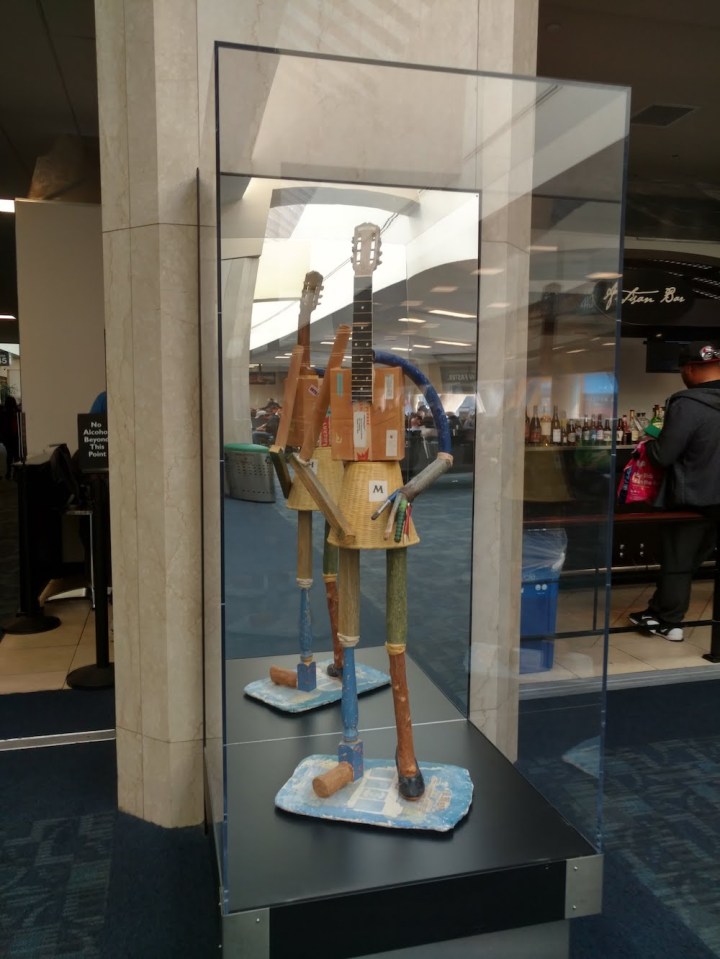
Quirky Art:

female sculpture

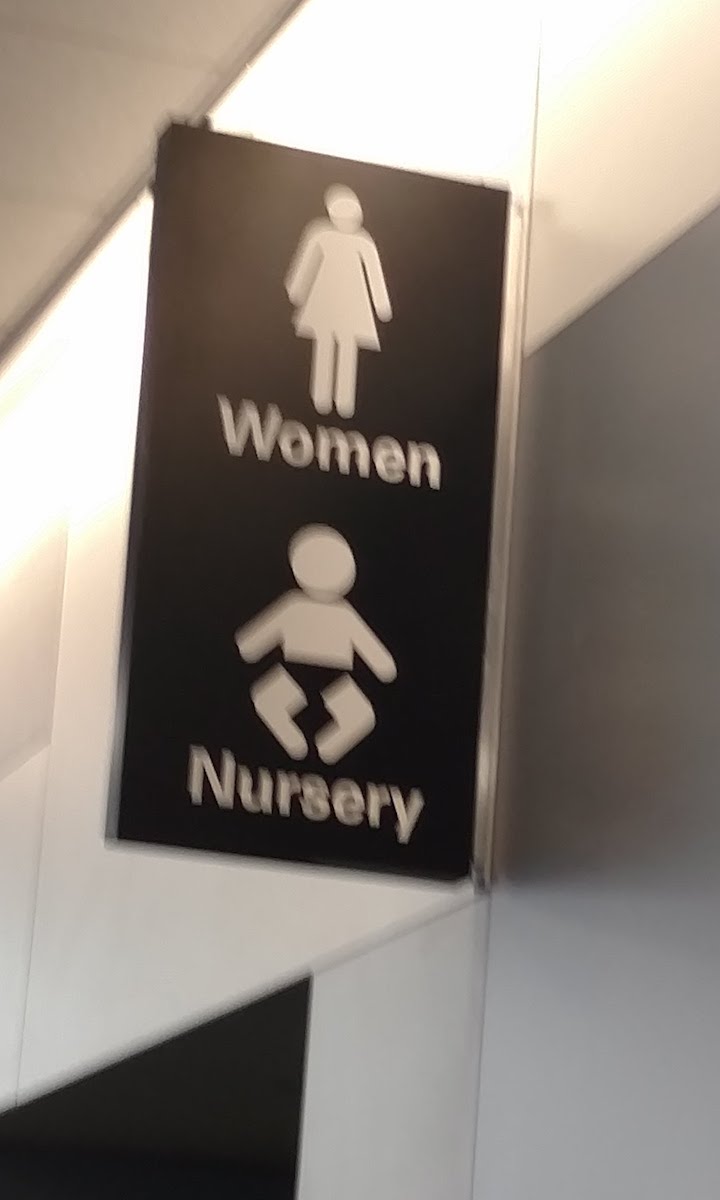
Fuzzy picture of Understandable Sign:

Women Nursery

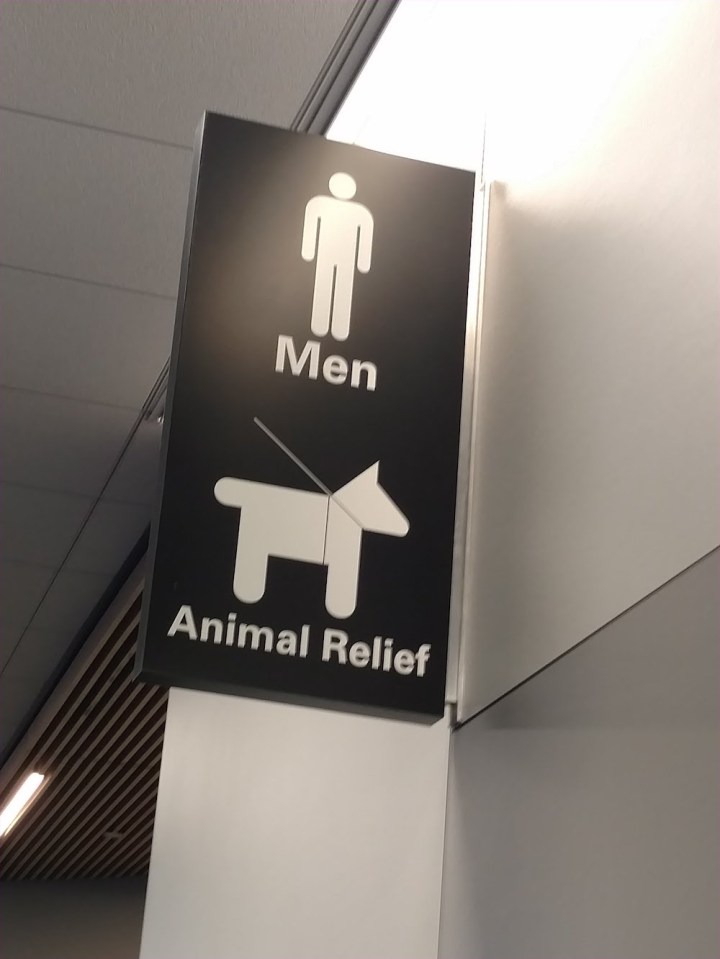
Clear picture of Mystery Sign:

animal relief sign

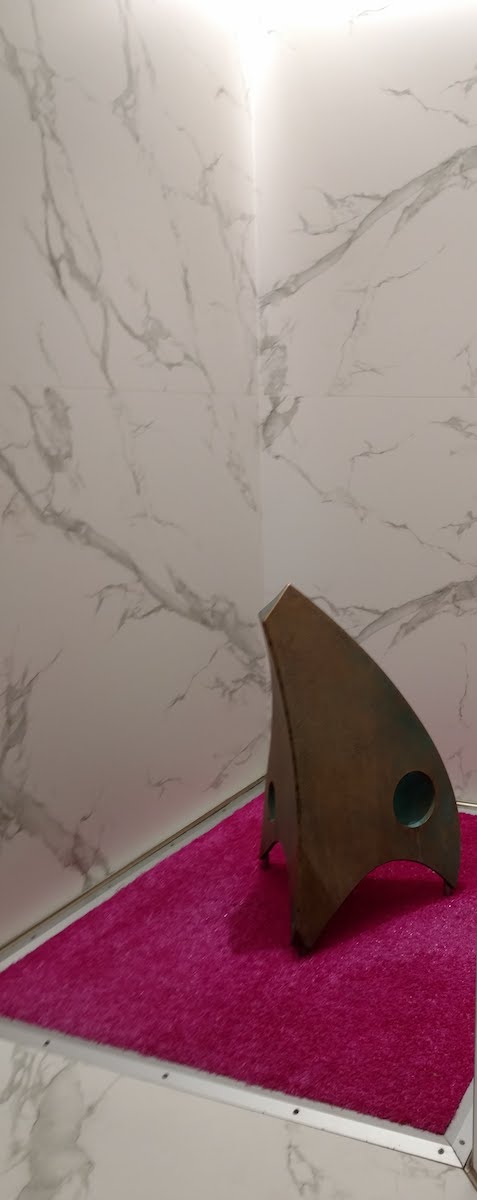
Peek into the Animal Relief area, which was empty. I imagined a line of emotional support animals outside, including pigs both potbellied and guinea:

dog relief

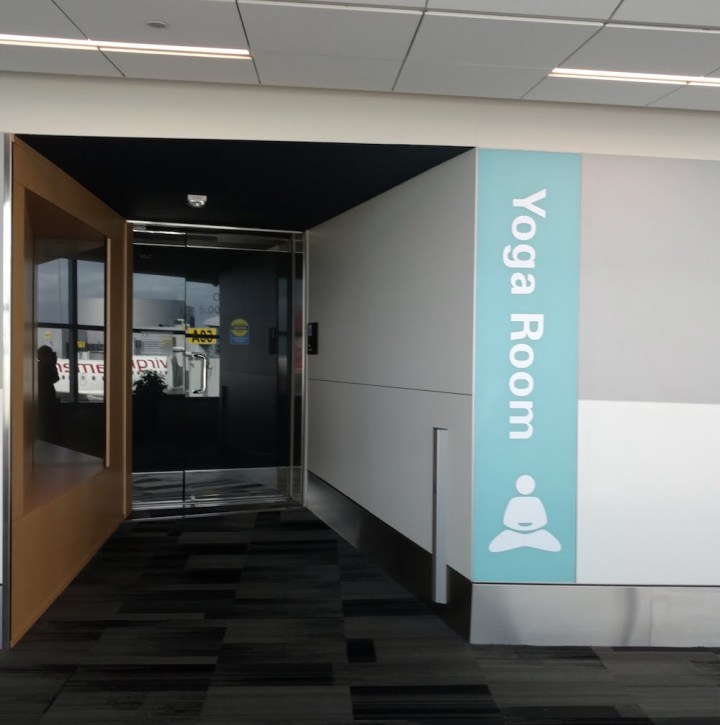
A welcoming, friendly room:

yoga room

I enjoy yoga, so I went in to take a snap. This room was occupied by one man, not in yoga garb, his back facing me, preoccupied with something I could not easily see but was wary to photograph.

I will spare you the tiresome details of the various insults of interrupted travel on major airlines. No weather at all was visible once we were aloft, just spiky, snow-covered mountains, red buttes scattered amid blue lakes, and the endless, brilliantly lit, flat cities of Texas, unfettered by geographic features. Plus a sensational sight no cell phone camera can capture: the Moon Illusion from 30,000 feet.

Pain and Culture

The March issue of Harper’s Magazine including a fascinating small excerpt* from a Pearson nursing textbook, an excerpt alerting nursing students to cultural differences that might affect the way patients report their pain. It gave diverse reasons various racial or ethnic groups might be more or less likely to request or consume pain medications. I thought this information would be extremely useful to nurses.

Due to a groundswell of objections citing racism, Pearson has announced it will be withdrawing the passages from future publications of the text, both online and hardcopy; recalling some of the extant textbooks; scrutinizing its textbook line for similar material; and not including similar material in the future.

Pearson apparently agrees with the objectors, so I must be a racist.

The primary objection is that the groups are too large, so a clinician might react incorrectly to an individual simply because s/he is a member of the group.

Here’s an example: “Filipinos clients may not take pain medication because they view pain as the will of God.” How would such information be used? I thought that, confronted with a Filipino patient possibly non-compliant, a nurse would be sure to make a space for that sort of objection to surface during the conversation. Spirituality is a topic often avoided outside of explicitly religious care providers.

Do the objectors think that someone who read that statement would not bother to prescribe pain meds to a Filipino, assuming the patient wouldn’t use them?

I understand that America has a long and ongoing history of undertreating people of color, but I don’t think that’s because the clinicians in question know more or less about those people’s cultures. I think it’s because the clinicians in question are actual racists, as in, they respect, believe, and value people different from them less than they do people similar to them, even if they do so subconsciously.

But I am an old person raised during a more explicitly racist time, in a state that even today produces racially-biased outcomes for its citizens, and still has some racially-explicit laws on the books. And I readily agree that completely individualized treatment is by far the best. Understanding the patient’s background, current home environment, previous treatments, and attitudes toward health care, then customizing treatment around these factors as well as his or her expressed genome, including markers, and current microbiome, would be outstanding. A clean page for each patient, no assumptions.

Until we are all in the top 1% though, most of us get the probabilistic method of treatment:

You have the symptoms of this disease, which is currently going around.

People your age with those symptoms are usually suffering from this.

We have successfully treated your disease in others using this method. 

Clinicians make assumptions all the time. They have to in order to manage their case loads. If a little background information about a patient’s culture could bring a little more individualization to treatment, I think that could be a good thing.

==================

* The complete item is here: https://harpers.org/archive/2018/03/regarding-the-pain-of-others/ .

Seen, Unseen, and Felt

I’m very much in favor of first-hand experience in life, so much so that I don’t think second-hand experiences count. No matter how many pictures of the Mona Lisa you’ve seen, you haven’t really seen it unless you’ve been to the Louvre. Even there you are looking through bullet-proof glass, and possibly being prodded to move on so someone else can have a turn, and it’s disappointingly small, so maybe that’s not the best example. Go to the Gardner Museum and look at John Singer Sargent’s El Jaleo. You may have seen a reproduction, but that will not matter. I love that painting, yet I gasped and stared when I saw it in person.

Watching the fireworks display or the baseball game on TV is also not the same as being there, though it’s a better proxy if you have in the past attended a fireworks display or a baseball game in person, because you may be able to evoke the associated sounds, smells, and tactile sensations. If you haven’t been in a long time, though, your brain has probably toyed with those memories.

Not that I think we shouldn’t look at art in books or watch celebratory TV events. I just think we can’t afterward say, I was there, or I’ve seen that. It’s not a checkoff for your bucket list, in other words. Unless you have Experience a proxy of reality on your list.

I notice a lot of people experiencing reality through the phone camera, and I’m starting to wonder if that even counts. At Monterey Bay Aquarium, for instance, it often seems like everyone standing between me and the sea nettles or penguins is taking a snapshot or a video, often with nary a glance. Then most stand there poking the phone for a little longer to send or store or whatever you do next to the captured image, before moving on.

I spend a lot of time waiting for people to finish doing this.

If you’ve only seen the Grand Canyon through a lens, have you really seen it?

If someone wanted to be really snarky, that person, who isn’t me, might observe that a lot of what we do isn’t real-real, even if it’s real. Seeing a captive octopus at MBA is better than seeing a picture of an octopus, but it isn’t as real as seeing a wild one while diving, at least not if you are interested in what an unfettered octopus might do.

Your presence might also influence the behavior of the wild octopus, so maybe it is not possible to truly observe the reality of an octopus.

I guess I’m glad I experienced living through many, so many, long, cold winters in New England. I notice that people who have never done that really don’t seem to understand it, and no amount of explaining helps. I remember day after day of feeling like I had been hit in the face by a plank as soon as I exited my house, so I can be sympathetic, and understanding, and genuinely grateful, when I see winter on the Weather Channel.

My husband and I are heading to New Jersey in March, hoping for an early spring.

Ban the Backpack

I heard someone on the radio suggest that school security guards, already “embedded” with the faculty, should be armed so that when a school shooting starts they can respond immediately instead of waiting for the police. I have a vague repulsion to militarization of schools, and am underimpressed by a solution that aims to curtail, rather than prevent, school shootings.

Instead, how about a backpack ban?

If you haven’t been in a school for a while, you may not realize that over the past twenty years students have been carrying increasingly huge backpacks filled with textbooks, notebooks, and supplies. Heavy packs can cause neck, shoulder, and back pain, with the potential for permanent damage.

Double-depth students also create hallway traffic gridlock between classes, unintentionally clear horizontal surfaces in classrooms, and smack bystanders when they turn or swivel abruptly.

Reducing the need for backpacks–for the above reasons, not due to fear of hidden firearms–has been a project at my sons’ public high school since before the younger one graduated, more than four years ago. It is a typical progressive, well-funded, East Coast public HS, with biology-based sex ed, a let-adolescents-sleep start time, and open campus. The plan: Purchase extra “classroom sets” of new textbooks, allowing students to leave their own books at home, drastically reducing the weight and size of their luggables.

To reduce the backpack size even more, we could use technology. Many schools already have carts of laptops for classroom use. The last HS in which I had a permanent assignment took that idea farther: Every student received a laptop during freshman year, and used it to access class notes, homework, and announcements, and to communicate with teachers and administrators, for all four years. This school was not at all progressive, with traditional rote teaching methods and a 7:30 AM start time.

The less paper we generate, the fewer 3″ binders students need to carry.

Combining these, I picture most students strolling into school carrying a slim computer case and maybe a lunchbox. The kid bringing the automatic weapons and spare magazines would really stand out.

That leaves athletic duffel bags and band instruments. Let’s have the jocks stow their duffel bags in the gym locker room, lined up and unzipped for coach staff inspection. That would air them out, too. Hey, I was a hockey mom.

The band kids are demographically less suspect in my mind, but to eliminate all chances, we should think of something. Transparent cases? We’d also have to replace the lockers with cubbies, which is a space- and cost-saver that is easily accomplished.

Even if we ban all guns tomorrow–and we won’t, the US is not Australia–there are tons here already. We can revert to Wild West style justice, or we can aim for a civil society that doesn’t fetishize violence.

Recycling vs Privacy

In my experience, small offices everywhere are emptying the receptacles of their crosscut paper shredders into the plastic bags provided by the shredder vendors and placing those into recycling bins. The trouble is, almost no recycler takes them. I couldn’t find anyone who did other than San Francisco, the Elizabeth Regina of municipal recycling.

The problem is baling. Most recycling is baled and sold, and it’s hard to bale those tiny strands. SF gets around it by requiring shredded paper to be inside a sealed paper sack, basically pre-baled. If you don’t live in SF, you can use shredded paper in compost, as mulch, for hamster bedding, or to supplement kitty litter. Or can you? The ink content question is worth researching if you’re considering one of those options.

I have on occasion had the temerity to mention this to someone else, though I’m learning not to. People do not like to hear that anything can’t be recycled, especially large boluses of paper. I’ve experienced anger, disdain, incredulity, scorn, and outright laughter–obviously, I’m joking–followed by a quick change of subject.

I think, or rather I fear, that it’s very important for us to believe that our stuff is being recycled because at some level we know we are creating too much waste, but if it’s recycled, that’s ok, right? I say fear because I’m not proud of us, educated progressives most, for letting our emotions cloud our understanding. Recycling uses energy. Sorting relies on low-paid laborers doing icky work, especially at the end of the chain. Recycled goods are hard to sell. Do you buy the second-time-around paper towels?

Me neither. And yes, I should be using dish towels instead, and probably cloth napkins.

Reduce is hard–so much laundry!–and so is reuse. I am reusing about five Whole Foods olive containers, and I just don’t need any more, yet still I visit the olive bar. Santa Cruz recycling accepts those containers, but not the produce clamshells from Trader Joe’s, even though they are so cute. I’ve met frugal party hosters who wash and re-use plastic utensils and even plastic-coated paper cups, but can one really sanitize such things?

Hey everyone, go grab some microbial contamination!

Perhaps you’ve heard that China, last stop for most US and European recycling for twenty years, has stopped accepting plastics, unsorted paper, and textiles this year, leaving first-world countries scrambling to find replacement countries while cast-offs pile up. Chinese workers were doing activities such as reducing discarded textiles to threads, manually. This could change the recycling meme. If you have the stomach for it, there was a great article summing up the main issues in the Huffington Post last month:

https://www.huffingtonpost.com/entry/china-recycling-waste-ban_us_5a684285e4b0dc592a0dd7b9

In response, EU and UK are moving to ban more plastics, ie, the Reduce option. The US federal government is not doing that.


Ream Blizzard

In California, I’ve been temping in small medical and legal offices that are extraordinarily paper-based, making me suspect this is more common than I realized. Here are some exemplary practices I have observed:

  • Upon receiving a document via email, immediately print it and re-scan it for saving, eliminating any of the helpful search features of the original.
  • Store all the paper in individual files, shelves and drawers and boxes of them, filling walls and file cabinets and rooms of them.
  • Pull the file for each client or patient encounter, and pair it with hardcopy forms to be used to capture the proceedings.
  • Before shredding obsolete files, remove the staples and scan hundreds of pages into large-chunk-sized chronological archival files, then scratch and discard any CDs (received from others, likely never used).

One office was the proud owner of a high-end machine capable of duplex copy and scan, as well as document (searchable) scan, yet they only made and stored single-sided copies and picture scans. In most, the workflow was documented online, including templates; my favorite was a standard fax for vendors and partners asserting, We Require Hardcopy, with the caveat that up to 2000 sheets is acceptable.

People at these offices are well-educated, intelligent, caring, and environmentally-conscious. They vigorously recycle, easily filling the blue bin each week. You know those small plastic post-its that look like file tabs? One office reuses those. Many reuse all sort of slightly battered office supplies that I would discard at home without a thought.

Oops! My bad. I should be more frugal.

Years or decades ago, when these professionals began their careers, paper-based office management was more common. Their original methods are established and well-understood. It would be disruptive to introduce a new system, and, while quite viable, the businesses aren’t growing fast enough to justify the expense.

It’s not a nightmare, really, I mean they do recycle, and if people spend more time shuffling paper than they would without it, they also get a lot more exercise climbing on stools to reach files and emptying the shredder container than they would by pulling PDFs up on a screen all day.

Is excess paper dangerous? I believe I read that it played a role in the collapse of the twin towers. Certainly the airline fuel burned out within minutes, yet the buildings’ contents were aflame for more than an hour, weakening their structures. How much of that was fueled by paper?

If that seems incredible to you, ask for a tour of a paper-based office some day soon. I’m just glad smoking indoors is illegal.