Barceloneta and Montjuic

I’m stateside now, but hoping to finish blogging some more of our trip before I forget it. We got home Monday evening and I slept 12 hours Monday and then 11 hours Tuesday, which is the day it is now. So I’m almost back to normal from the time zone perspective, and also in the sense that the memories are already slipping. I’m trying to sort through it by the dates on the pictures, but there is a definite possibility that the group of items I cover on this post didn’t actually happen on the same day.

Sometimes I feel like my brain is a bag of sand was a hole in it. There still does to be some stuff in there though, so maybe it’s a very, very small hole, or a poor metaphor.

Our Barcelona trip was entirely spent in four neighborhoods. Eixample, our home base, includes many small businesses, several Modernist buildings, and Sagrada Familia. West of it is Gràcia, which we only visited once, when we went to Park Guell. East of it is the Cuidad Vella, or Old City, which includes La Rambla, Gotic Barri, El Born, and Barceloneta and abuts the Mediterranean. South of both Eixample and Cuidad Vella is the huge neightborhood of Sants-Montjuic, which includes Montjuic, a bluff overlooking the water with both cultural and natural attractions, and the commercial port of Barcelona.

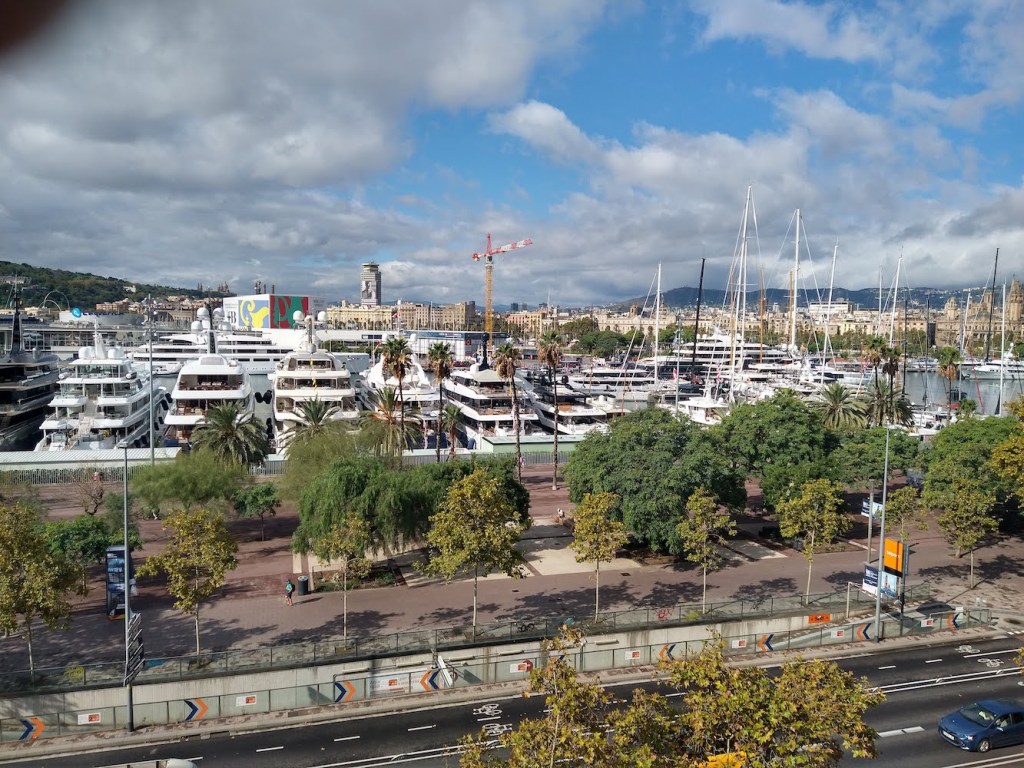
On March 3rd we started with our chef-led tapas-making class, which took place in the chef’s apartment in Barceloneta. It did not seem appropriate to take pictures inside someone else’s house, but we did get one from the balcony, which shows some of the many extra yachts in town to see the America’s cup races.
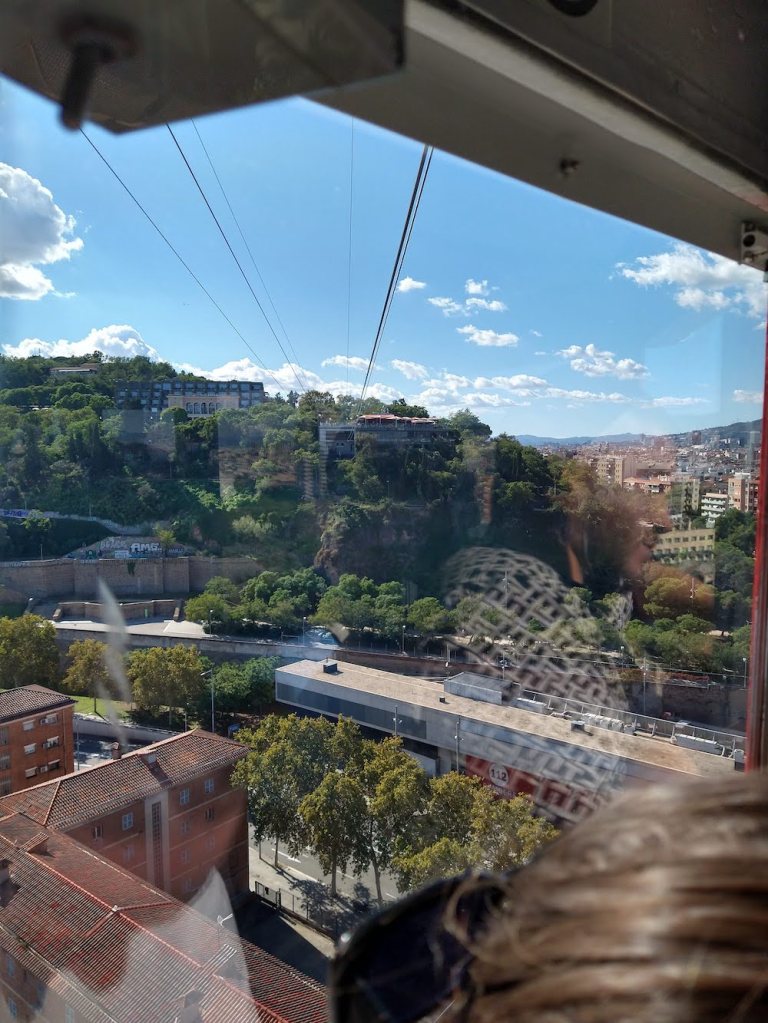
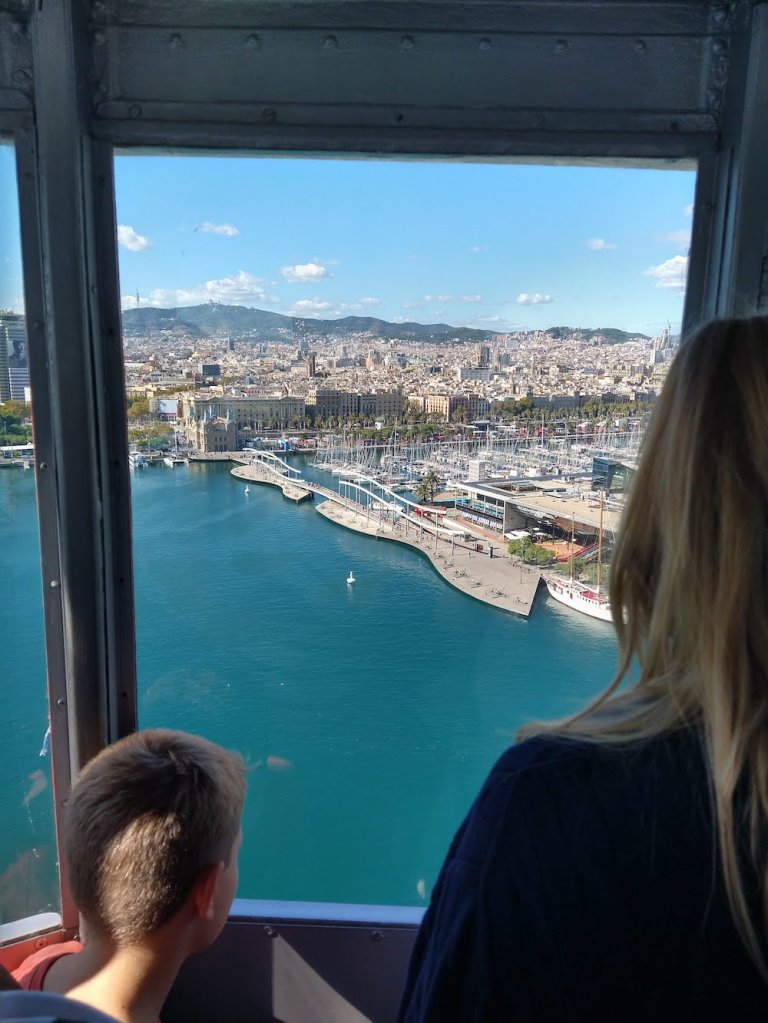
After the class we decided to take the tram from Barceloneta to Montjuic, a very good cardiac workout for a acrophobe such as myself. The tram ride is about six minutes long, extending between a tower on the beach and a land station about halfway up the bluff. I was clutching a pole in the middle, but my husband got pictures looking north toward the modern city, south at the commercial port, down from the midway point, and coming in for a landing.
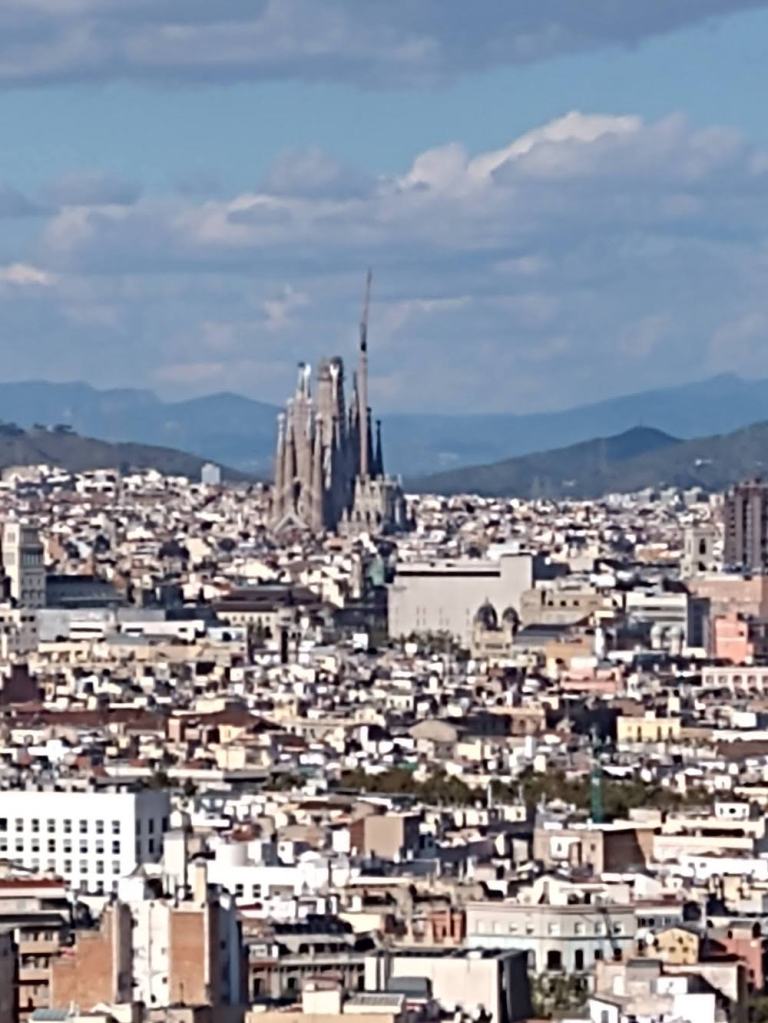
Olympic venues from the 1992 games are scattered about the city, and we stopped at a concession near the Natatorium, which has a beautiful view. Sagrada Familia is shown by an arrow in the long shot and then again in a closeup. As you may remember, its highest tower when finished will be a few feet shorter than Montjuic, but the cranes seem to be a little taller than that.

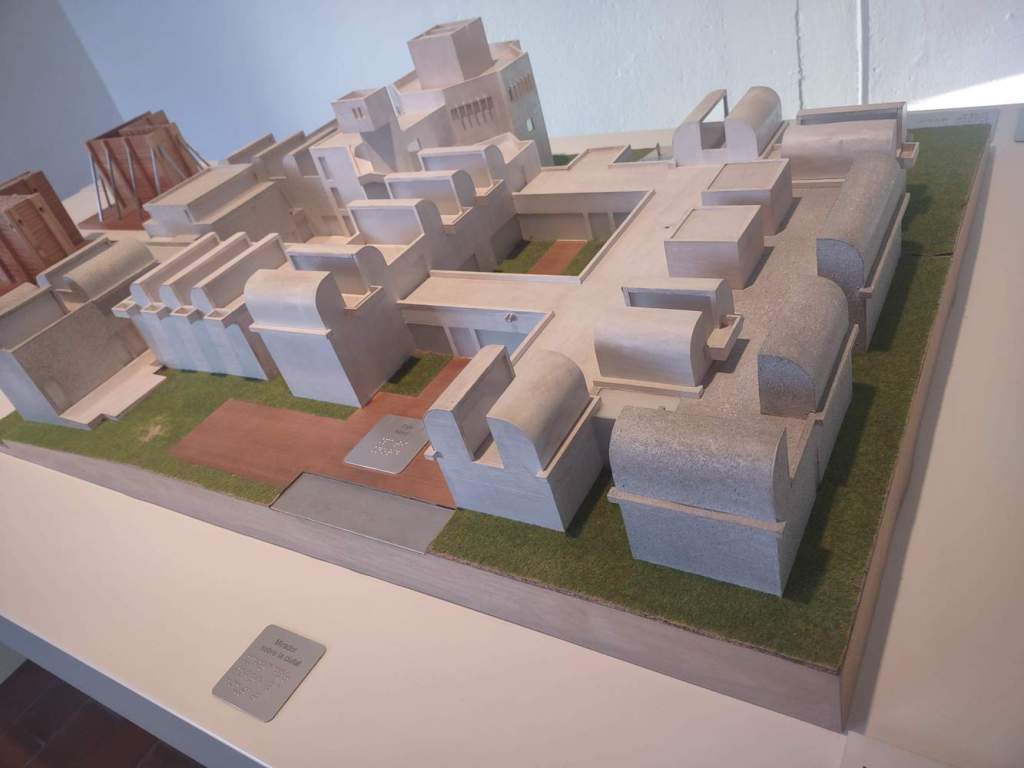
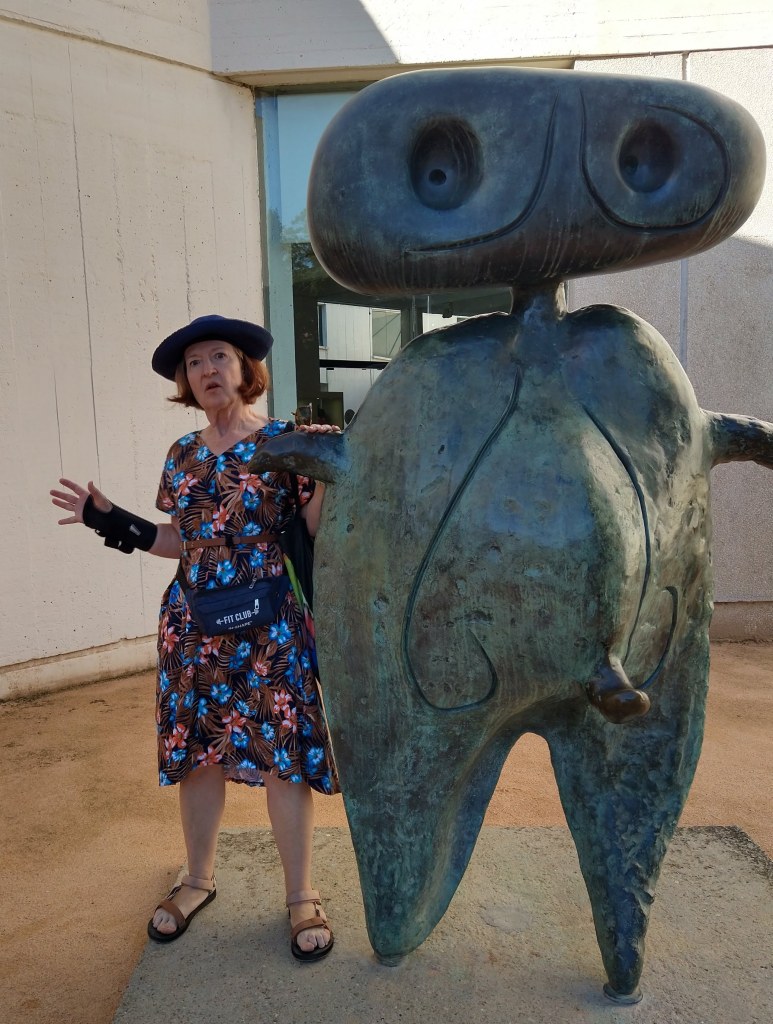
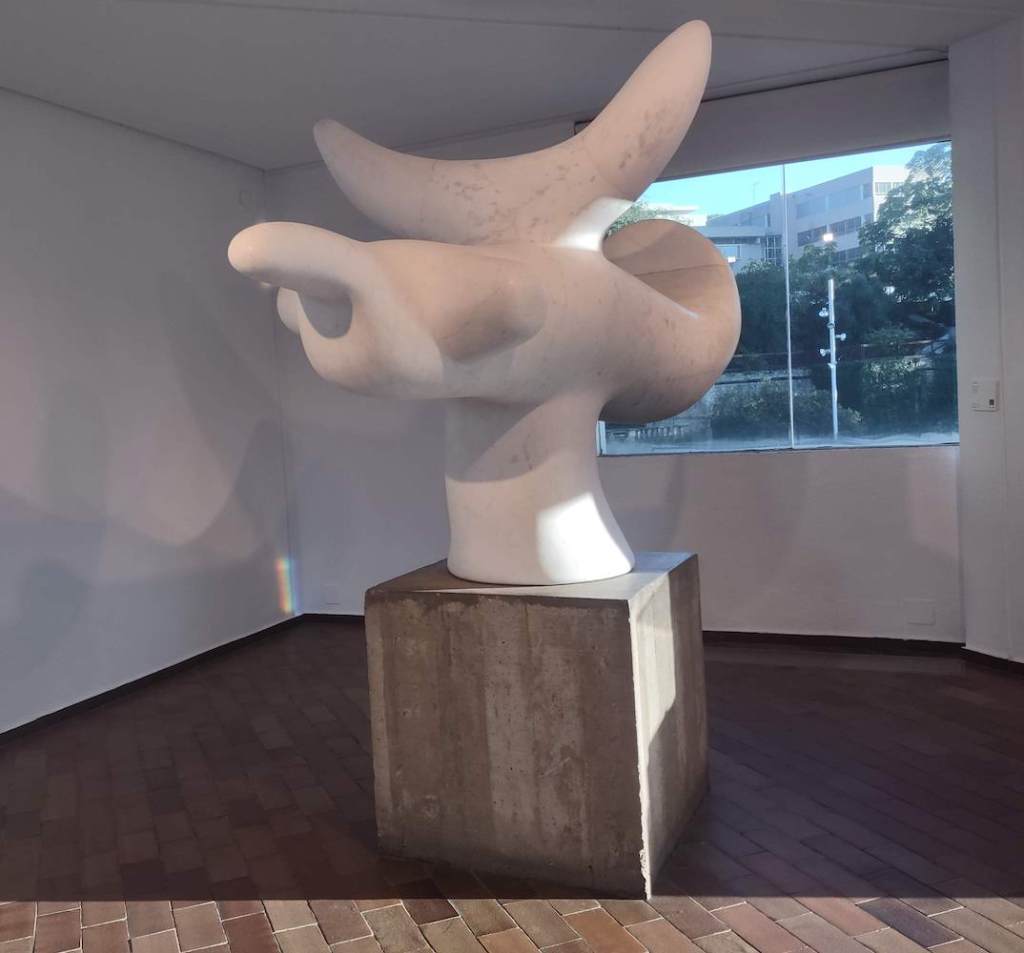
We ended the afternoon at the Fundació Joan Miró, a fun museum at which I took zero pictures of the paintings though they were lovely. I did pose with a friend at the entrance, and took one picture of the Solar Bird, which appeared in many guises and sizes, often alongside the Lunar Bird. The last shot shows the accessible model of the facility, which was designed to be touched. There was another model for the sighted.
In contrast to pretty much all of our friends, my husband and I are visual art challenged, but we both really enjoyed the Miro. Amusingly, Miro also has a large mosaic installation on the street in La Rambla near the Liceu opera venue which we must have walked over at least three times yet never noticed. We looked at pictures later. It is huge, and brightly colored. Feel free to draw any conclusions that seem correct.

Gaudi’s Most Popular Site…

… Is certainly Sagrada Familia, which is also his most famous, as well as the largest structure by volume and height. Larger in site area, however, and much more popular as measured by visitor density, is Park Guell. These are the only two Gaudi sites one must pre-book in order to be assured of a visit.

Surely many more people visit S. Familia, but it’s such a large building that you can find a space for yourself even while surrounded by others. Park Guell is another story. The park itself covers 45 acres, but the Gaudi portions comprise only a fraction of that.

We started with a bus ride, on a city bus that was crowded when we got on and jammed by the time we reached our stop, at which two-thirds of the passengers dismounted. I greatly amused a companion by exclaiming, Surely all these people aren’t going to Park Guell!

They were.

Pathways and promenades, vistas and plazas, pavilions and viaducts, all were crawling with humanity. There were long lines for entry into buildings, stairs were packed railing-to-railing, and even to take a picture you had to wait for others to finish. It reminded me of the Mona Lisa, a small painting protected by thick glass, live guards, and velvet ropes, with a long line of hopefuls waiting for a brief glimpse.

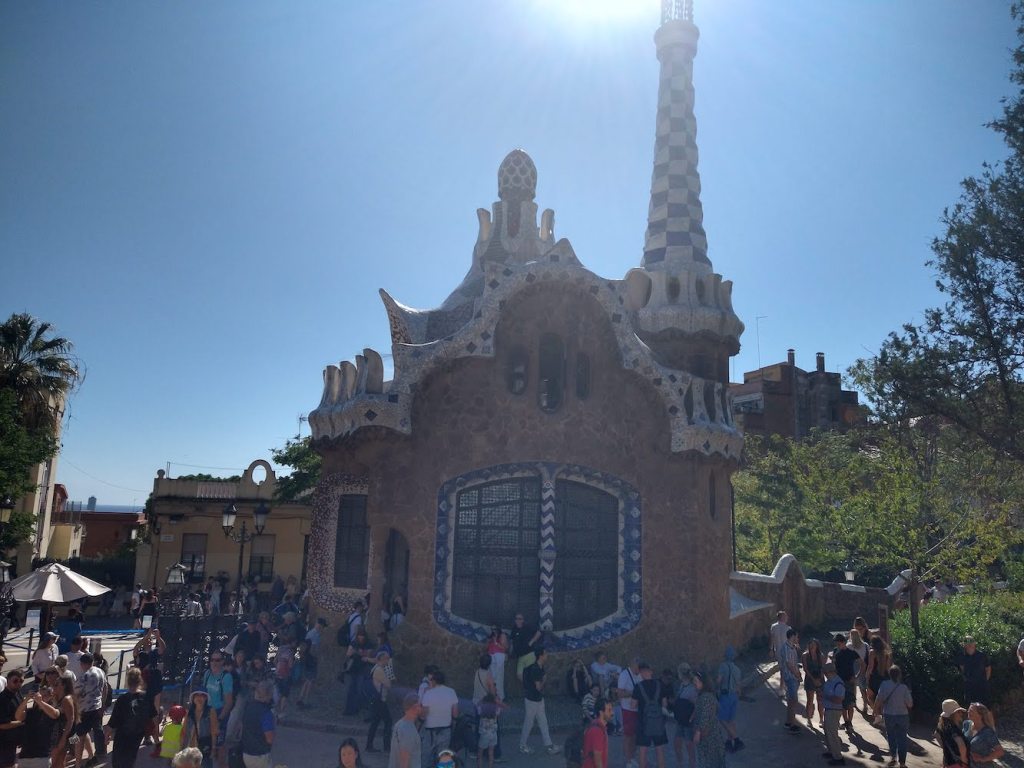
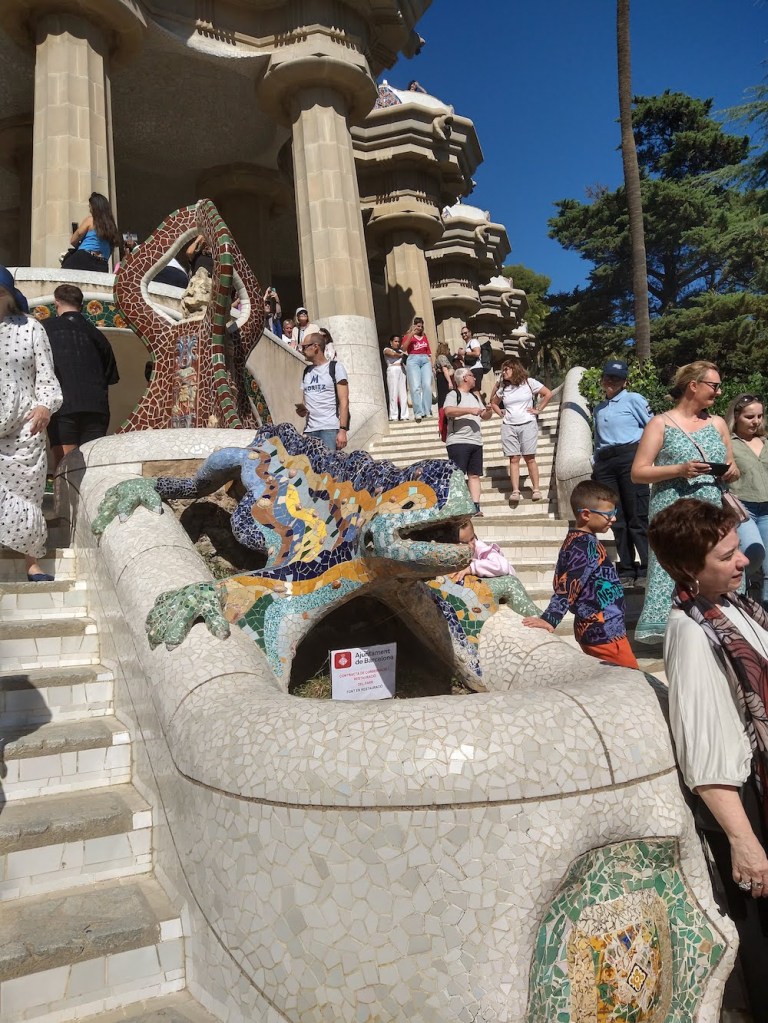
Some–I mean all–of our photos contain people as well as things. This is the exit, originally designed as the main entrance to what was intended to be a gated community, but it was too far from Barcelona to attract tenants, so Gaudi sold it to the city as a park. It’s flanked by two lovely little houses but we didn’t get a picture of the entire expanse. It’s known as the Stairway to Heaven. I think this predates Led Zeppelin.

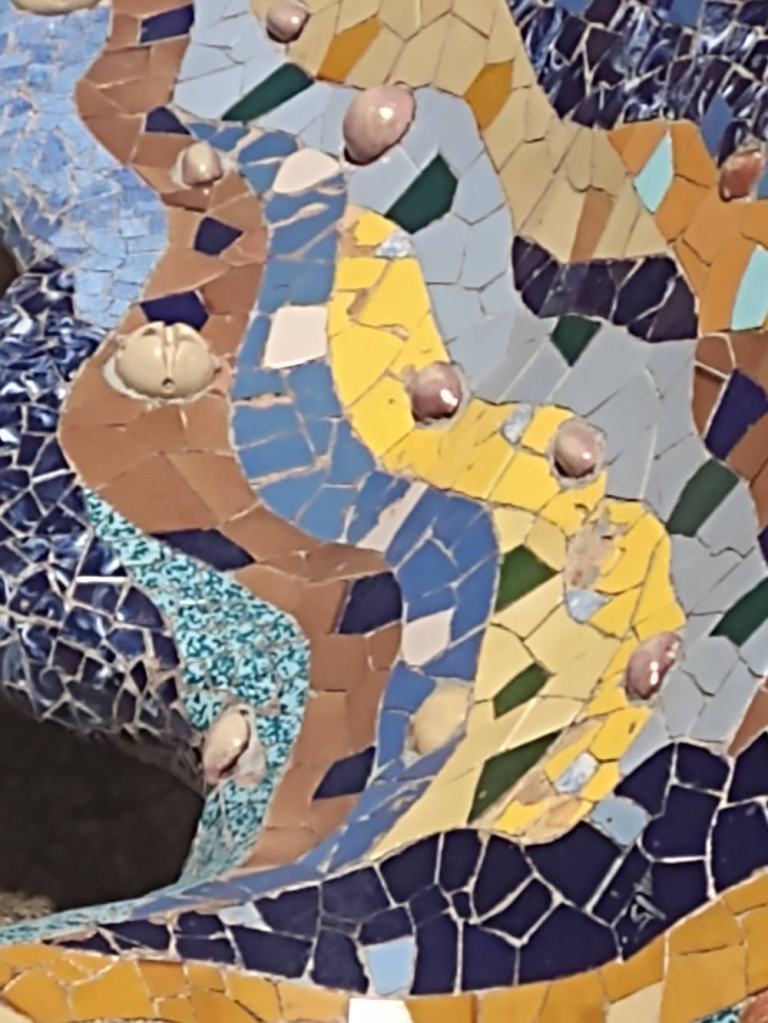
The Guardian of the Stairway, followed by a close-up of his hide.

Here’s one of many adorable edifices that most people of the time didn’t want to move this far to live in. There are several, mostly repurposed as museums with additional entry fees, but all the structures are of this ilk. This could be a restroom for all I remember.

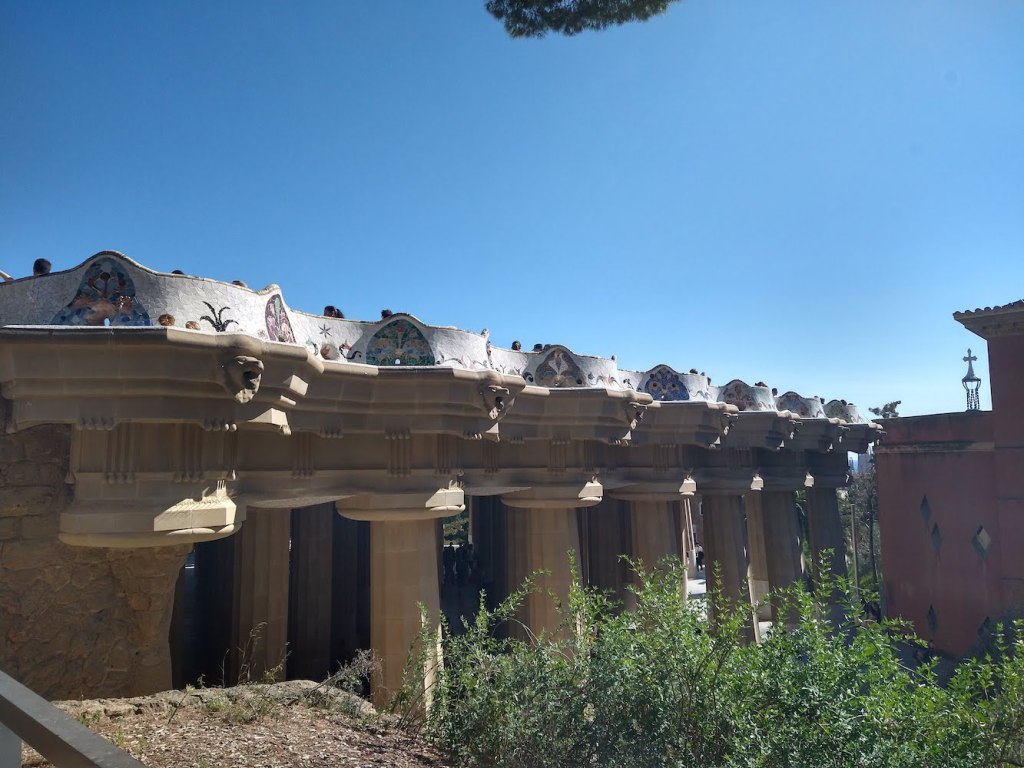
Here’s a closer look at the top of the colonnade that crowns the Stairway entrance. It is a plaza outlined by a very long Dragon Bench. You can some heads poking up, representing a few of the hundreds of people on the plaza.

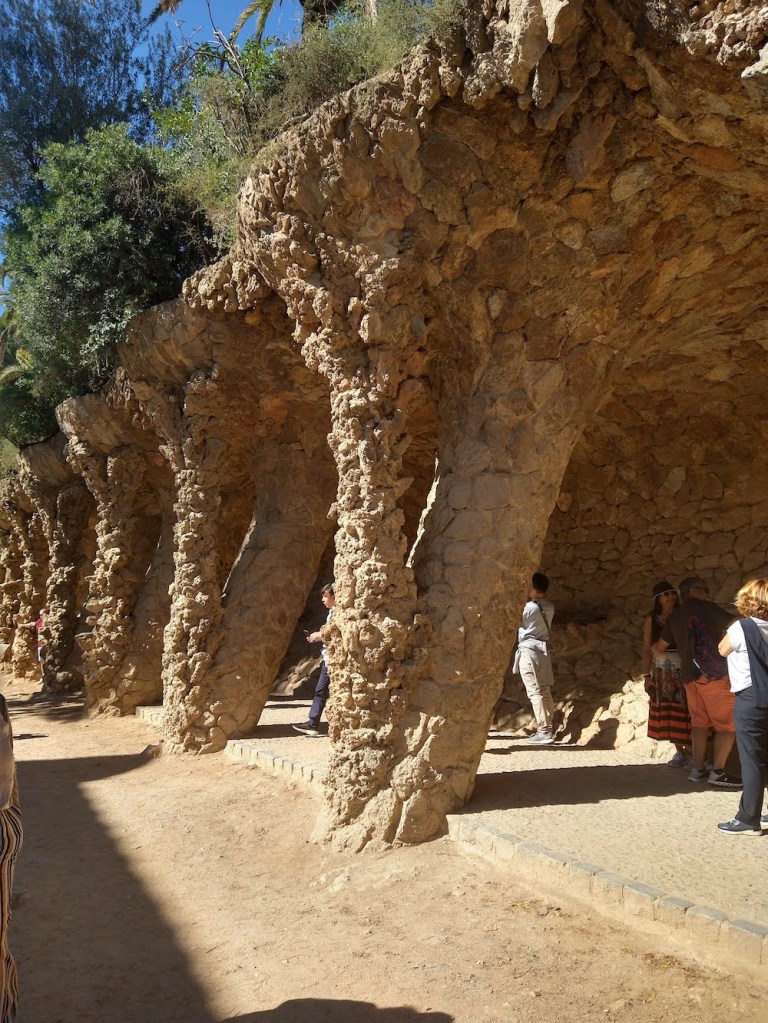
My husband took that picture from our favorite spot, a relatively unvisited promenade perhaps 200 meters long, near a small forest. It was quiet enough to hear cries of the ubiquitous monk parakeets, and included the statue of the water-bearing woman below.

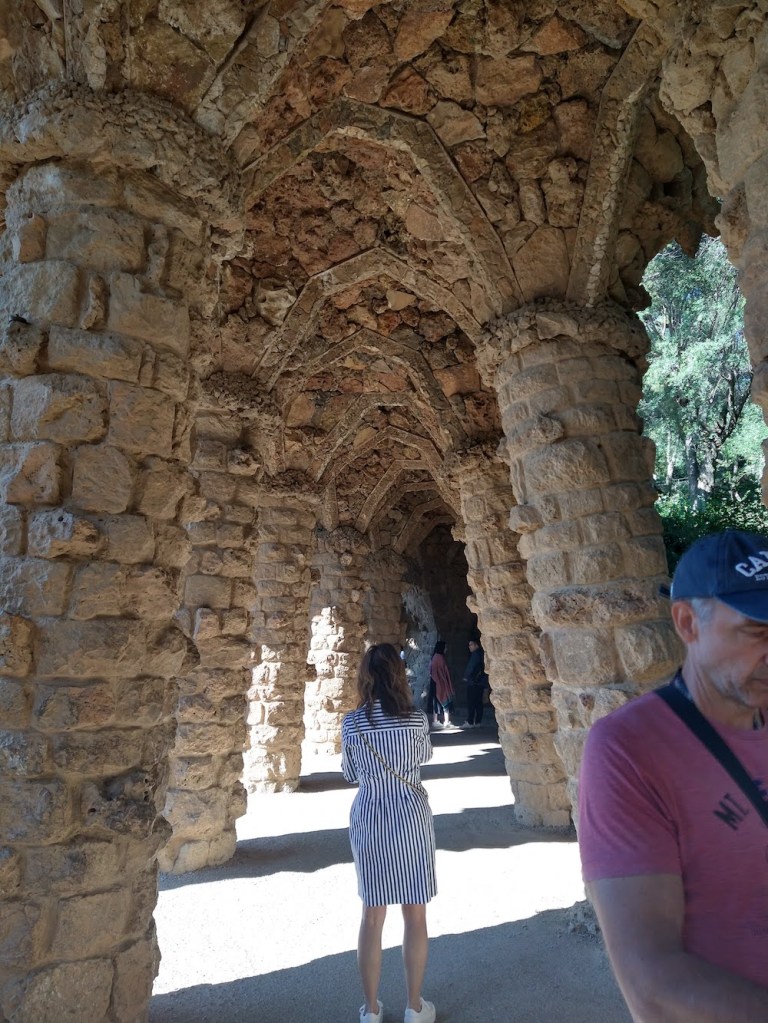
The original entrance is the tourist exit, as I mentioned. The tourist entrance is near the top of the park, where one can find a colonnade that is sort of a precursor of the forest nave of S. Familia in the way the columns form a canopy at the top. Note some are tilted, as real trees would be.

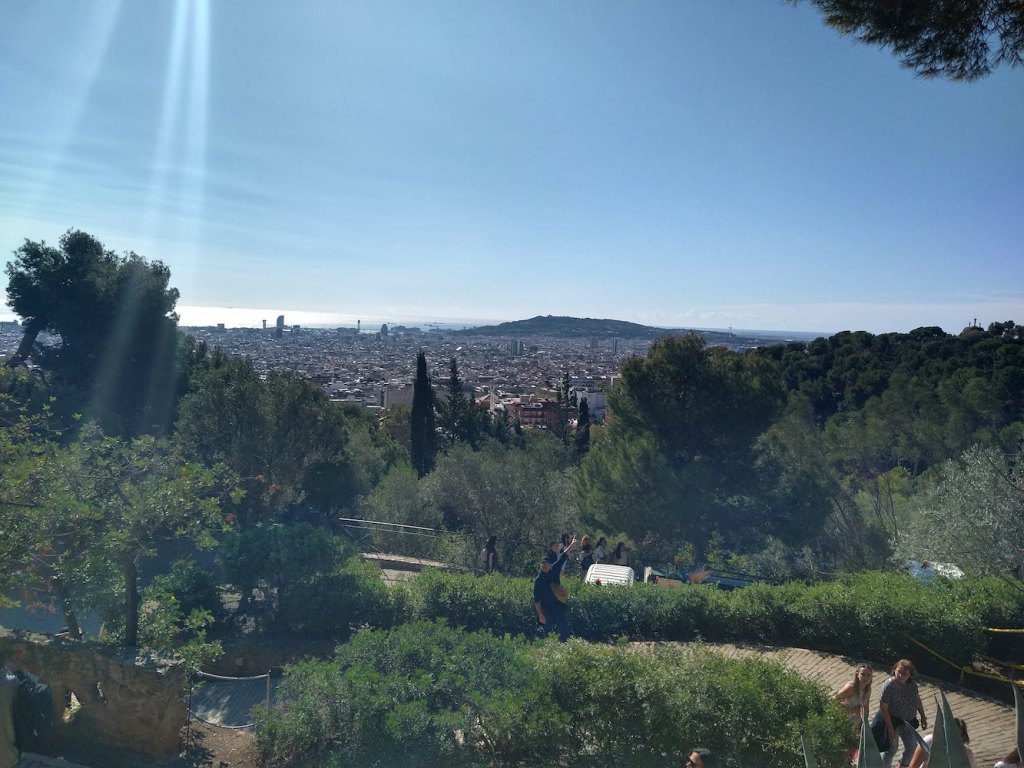
From the top, or close to the top is a view of far-away Barcelona and the Mediterranean Sea, with which I will end this post.

Casa Batlló

Our first eleven days in Barcelona were slow with respect to visitors. After that, we scheduled three consecutive couples staying six, five, and four days. We’re in the midst of that now, and I have not any time to blog. Too busy having fun! After today, I may not get another chance until I’m home in California.

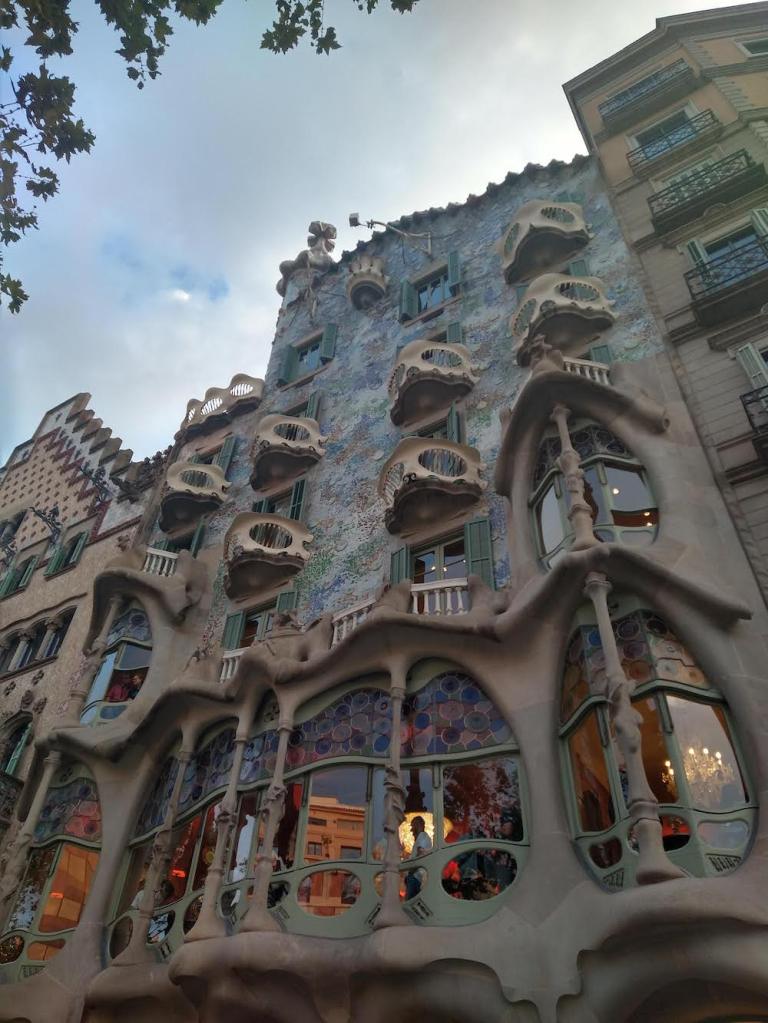
I do have a little time this afternoon though, so I’m going to write about the Gaudi edifice mentioned in the title. This one I found truly impressive, the most fanciful and creative of all the ones I plan to see on this trip. It’s a single-family home with a theme of marine life and an interior composed of wood, tile, and stucco arranged in a series of nature-mimicking curves. In addition to being beautiful, it is well-engineered and ergonomic.

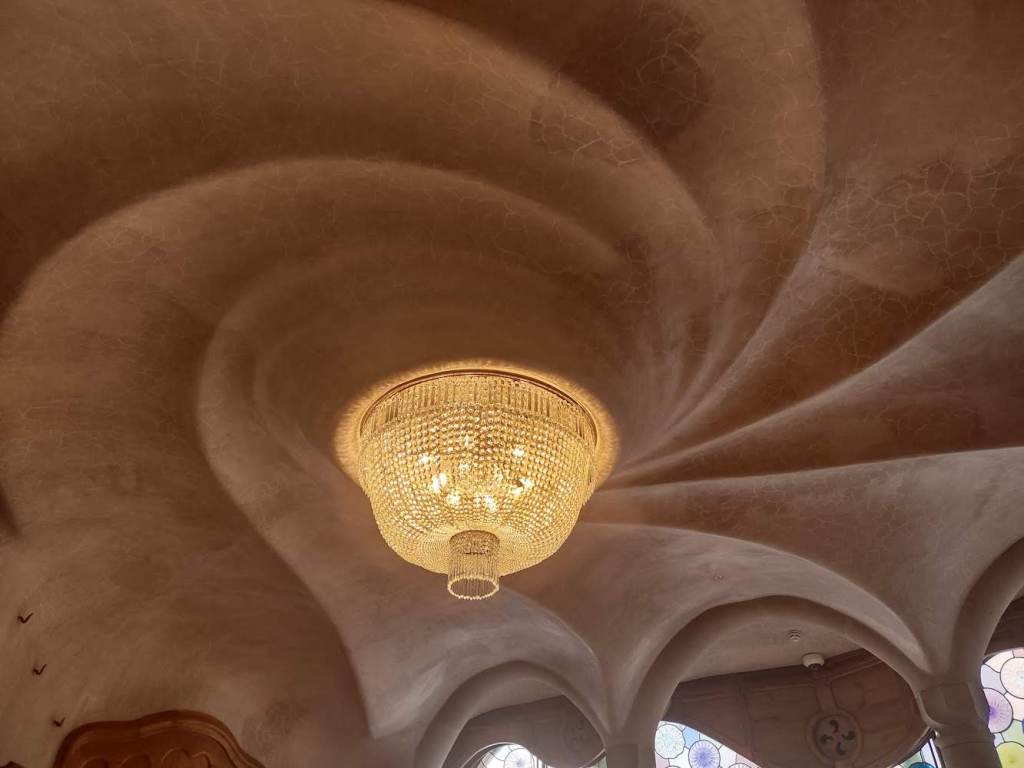
All the words in the world can’t do it justice, and I was so stunned I didn’t take a lot of pictures, so I’m hoping these few will help you imagine the rest. Let’s start in the dining room, looking at the ceiling.

Next is the door entering the dining room from from the study. Notice the texture of the walls. The tri-fold wooden door makes a perfect seal with the complex shape above the opening.

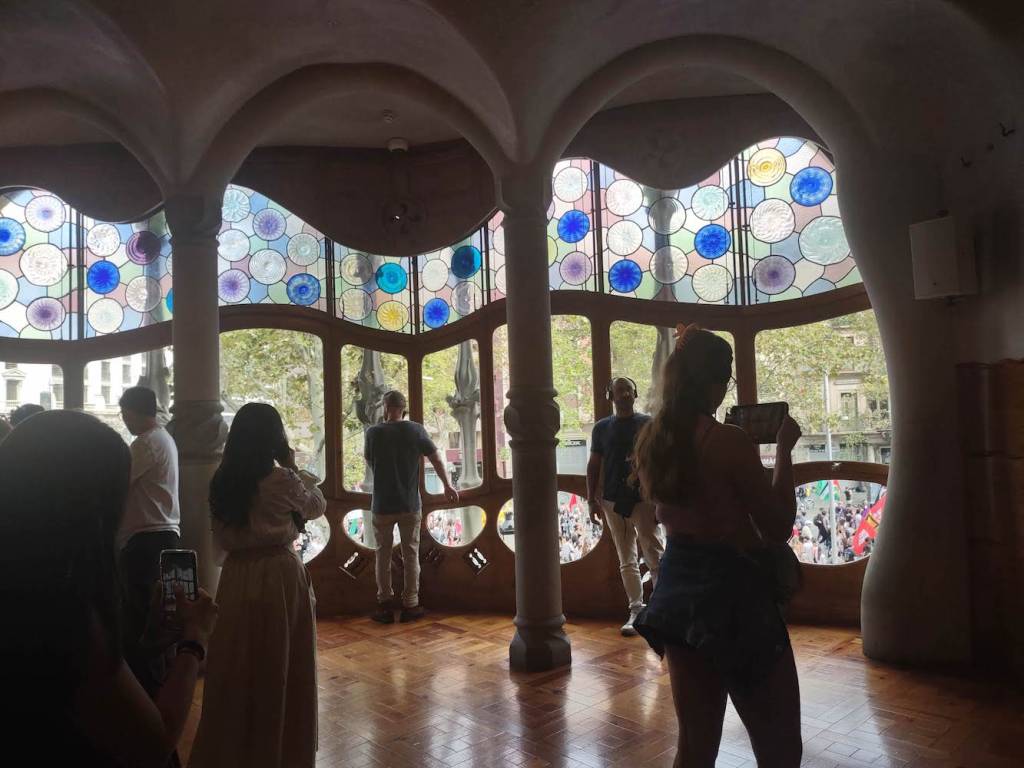
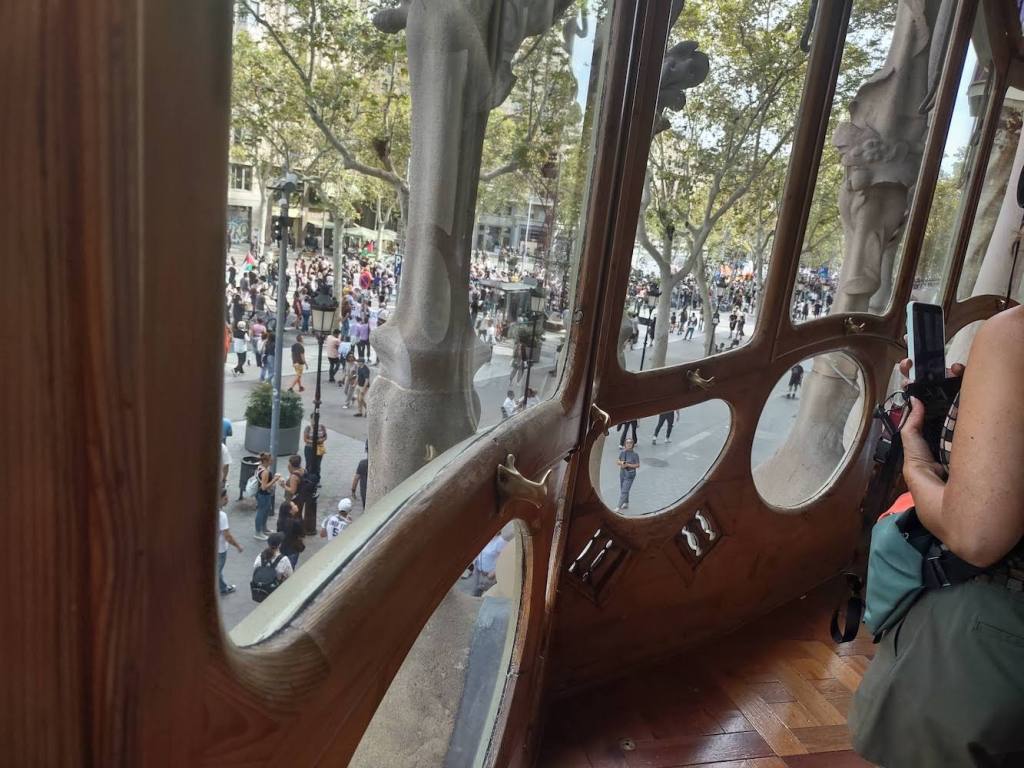
This is the front window of the dining room looking out onto the main street. Keep that marine environment theme in your mind. Also notice the crowds; this is a popular site, though hardly Gaudi’s most popular. There are latches between the lowest windows and those above them, shown in the second shot below.

This window can become a balcony! First open all the latches roughly at waist level across the entire opening, then find a hinged, vertical panel at your left which conceals a lever. That moves the upper windows in some manner–we did not see this done–leaving the lower portion with the latches now serving as the railing to an open balcony.

Your many notice the street Passeig de Gracia, is particularly crowded. This was October 6, and there was another large free Palestine demonstration, the second we’ve seen.

Finally I will reveal the facade. The configurable balcony would open the upper part of the middle of the second story, which is the lowest level shown in this shot. Also notice the serrated wall at the top which forms a dragon’s back. You’ll see the other side of that later.

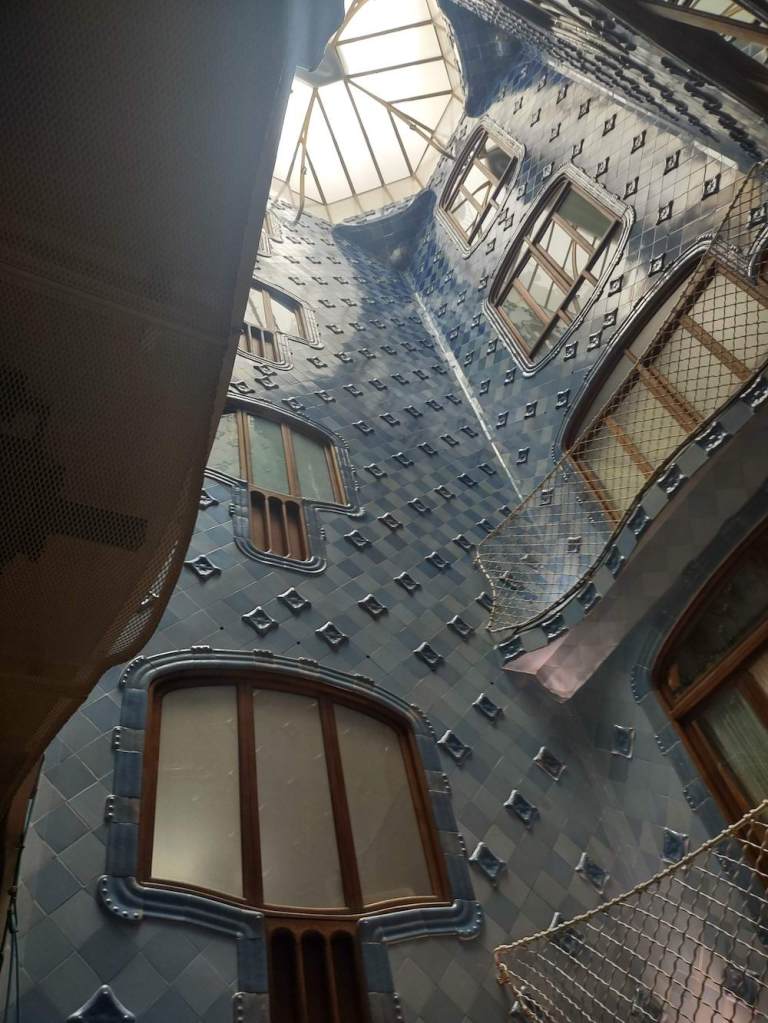
Now for a few random glimpses. There are two ground to roof openings to circulate light and air, which fill the entire structure wonderfully. Those shafts look like this from the inside.

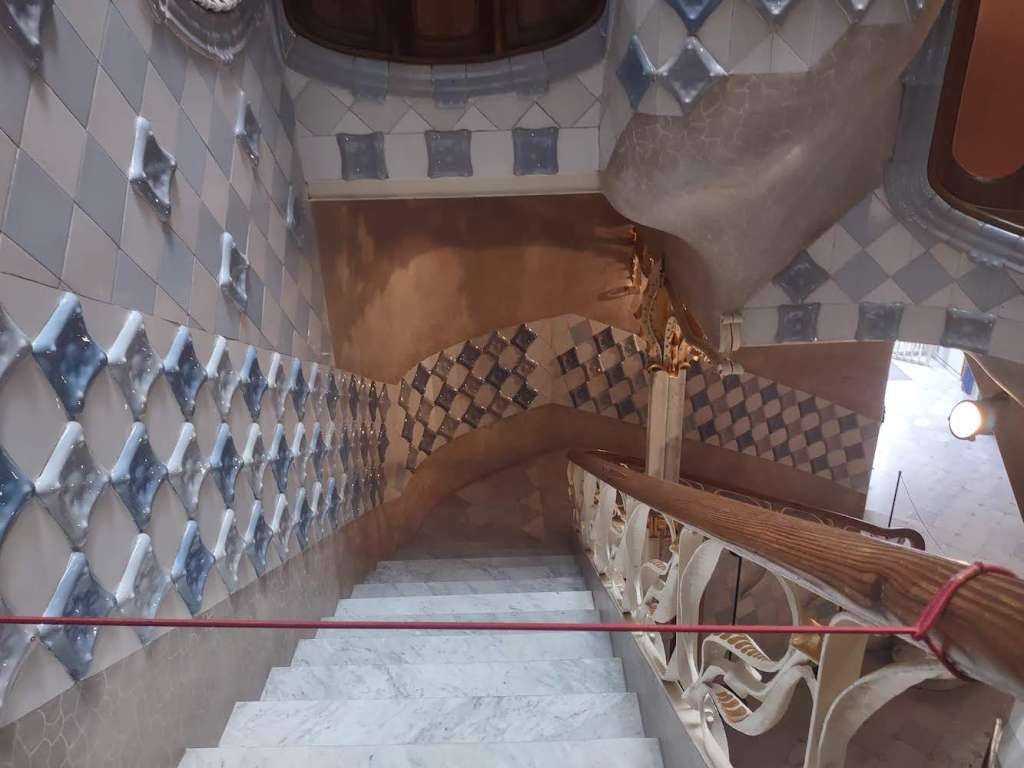
There are some gorgeous stairwells of many different designs. Here’s one.

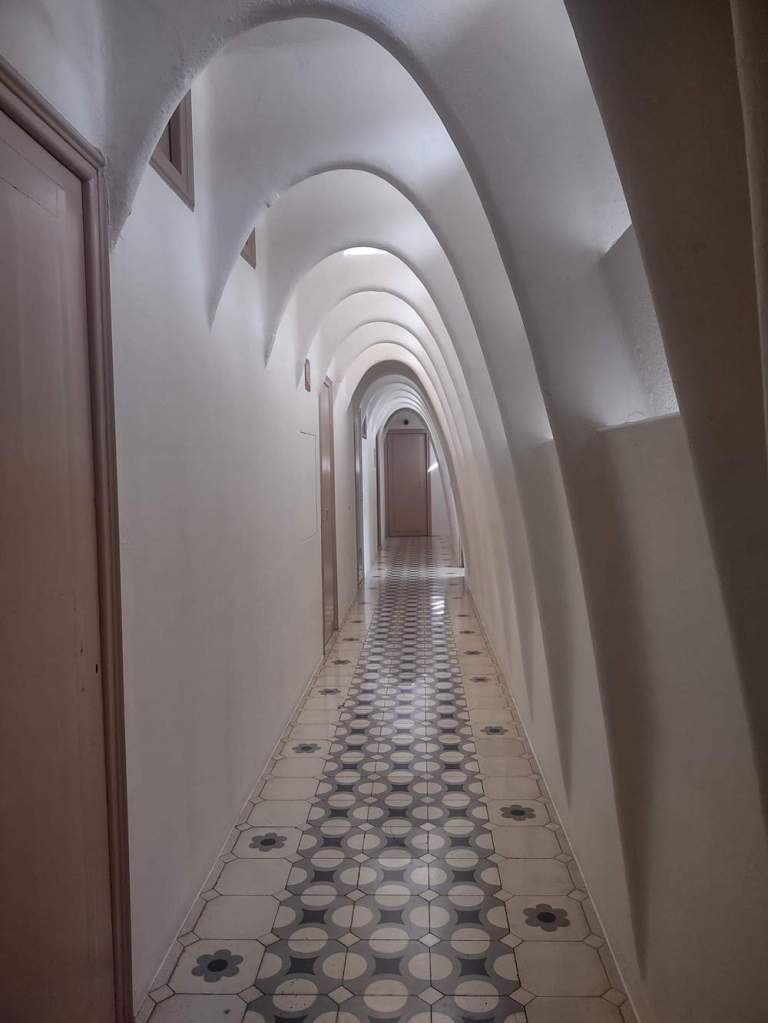
Even the simplest features seem fluid and biological.

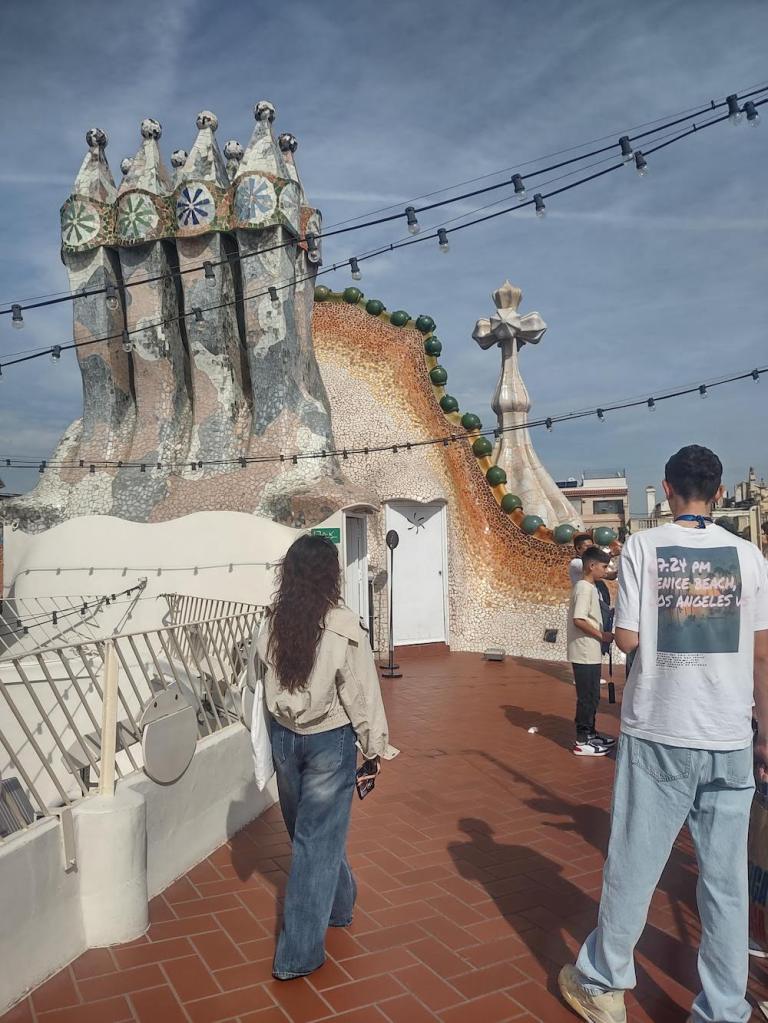
Now let’s skip to the roof. Instead of making 27 holes for the 27 chimneys, Gaudi grouped them, making the roof seem spacious and exposing views of Barcelona at many angles. In this shot you can see the central skylight at the left, one group of eight chimneys, and a portion of the features at the front of the building, including the one known as the dragon’s back, which conceals a clever water distribution system. The roof includes a concession where one can enjoy a drink al fresco. After all those stairs, we were happy to indulge.

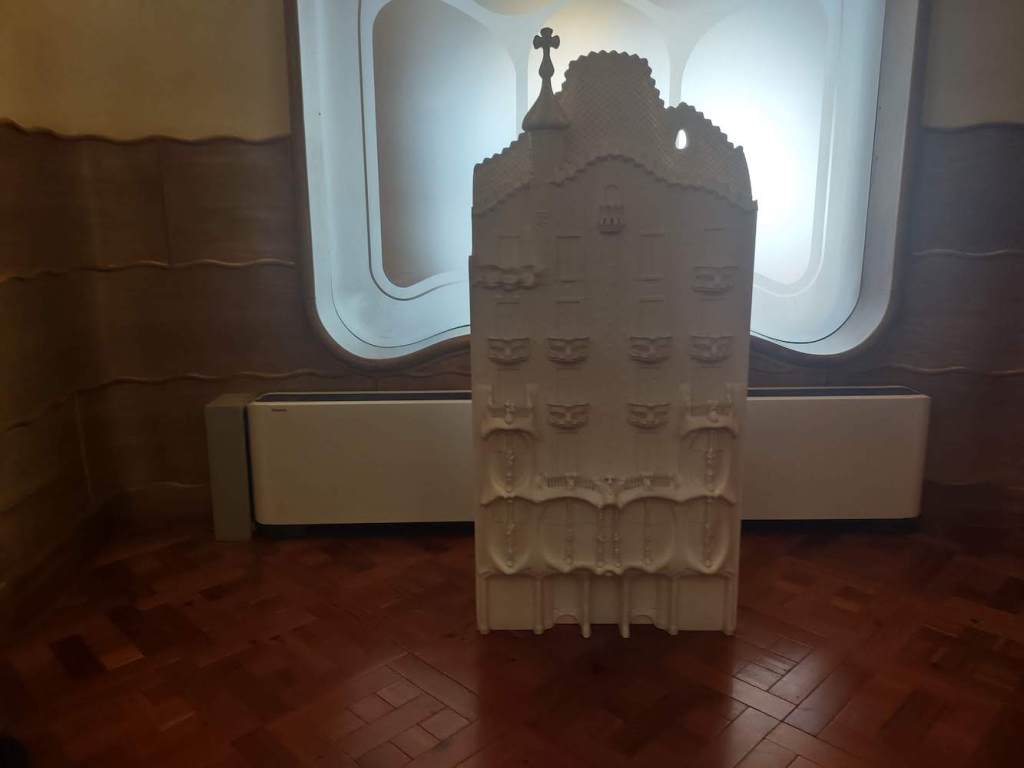
Gaudi made a model of the exterior. According to an interpretive sign I don’t completely believe, he directed the construction using only this, no other drawings or plans. And yes, the sign was in English.

I have no more words to summarize this creation than I did to introduce it, so I will bid farewell.

Nature versus Culture

Last month, two volunteer colleagues of mine were waxing eloquent about the rafting trip down the Grand Canyon, describing it as “life-changing.” They were religious about it, as in, If this isn’t something you really want to do, something is wrong with you.

What’s wrong with me is I have aged out of “roughing it.” I do find a mountain hike or lake swim relaxing and refreshing, yet now there must be a cot at least at the end of each day, and somewhere, plumbing.

I now make the case for the culture vacation. Orient Express, anyone? How about Paris for a week with a museum pass? What a thrill it would be to visit all the opera houses of Europe!

We got started on that last set at Barcelona’s Liceu last Saturday, where we viewed Shostakovich’s Lady Macbeth of Mtsensk. This intense production did not hesitate to graphically present murder, rape, and passion. Did I miss a ratings warning at the start? The music was gorgeous, and the performers–a cast of approximately 80–did not hold back.

The Liceu itself was built in 1847, with all the flourish of that time, then suffered a serious fire in 1995. In yet another display of a prosperous, high-functioning metropolis making the most of an opportunity, Barcelona rebuilt the interior in its original glory while updating the acoustic and technical components to the latest standards, resulting in a classical venue with a modern sound which reopened in 1999. That feat is chronicled in a mini-documentary video before each performance.

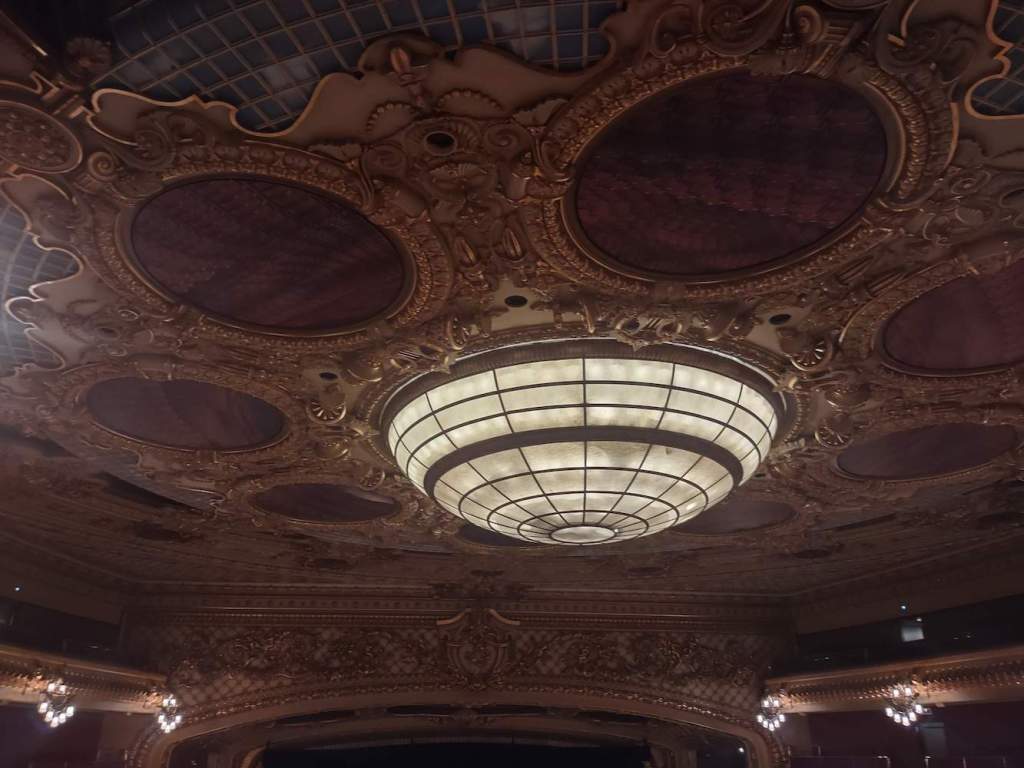
We came early so we could explore the building, and shot this video while the orchestra was warming up. From the outside, it’s hardly intimidating, but the facade is deceiving. Below are shots of that, the ceiling, and the view from our seat, the enormous stage behind the screen showing a list of donors. We were on the penultimate level.

Liceu is located near the end of the storied La Rambla, a wide concourse extending from the central plaza of the city to the waterfront, primarily devoted to pedestrians, though a single lane of vehicular traffic creeps along each side. Here is a video from the front of the opera house.

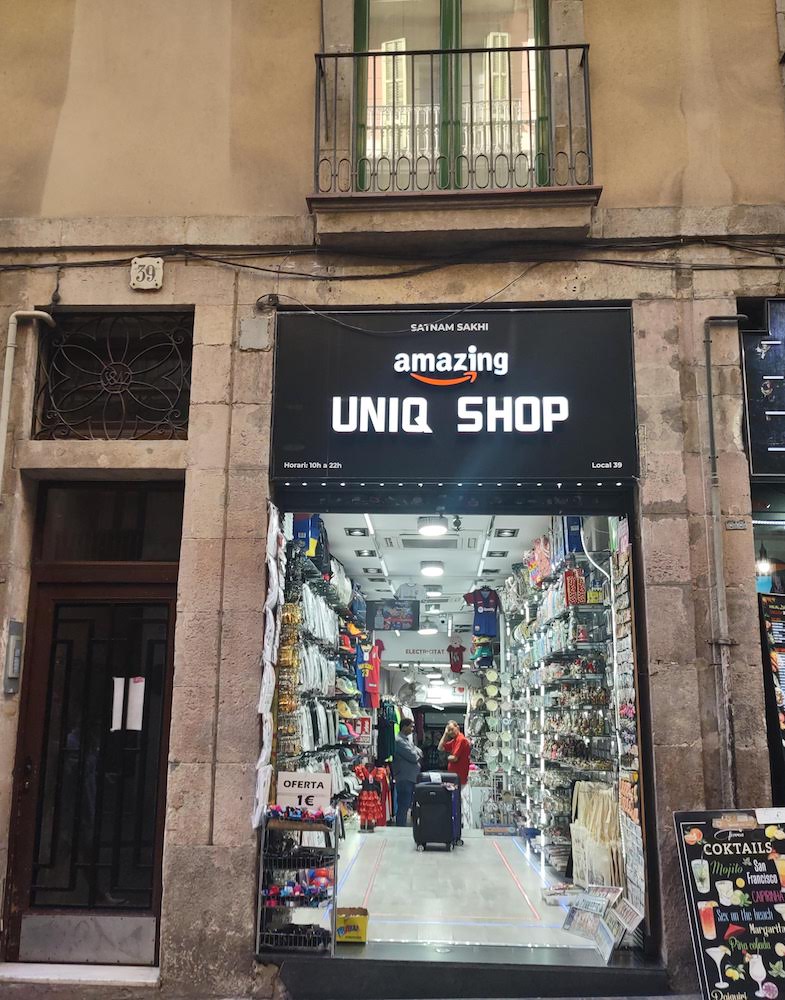
Nearby we spied this unique shop. Logo copyright violation? Or maybe the long reach of US law falls short of here.

Sagrada Familia

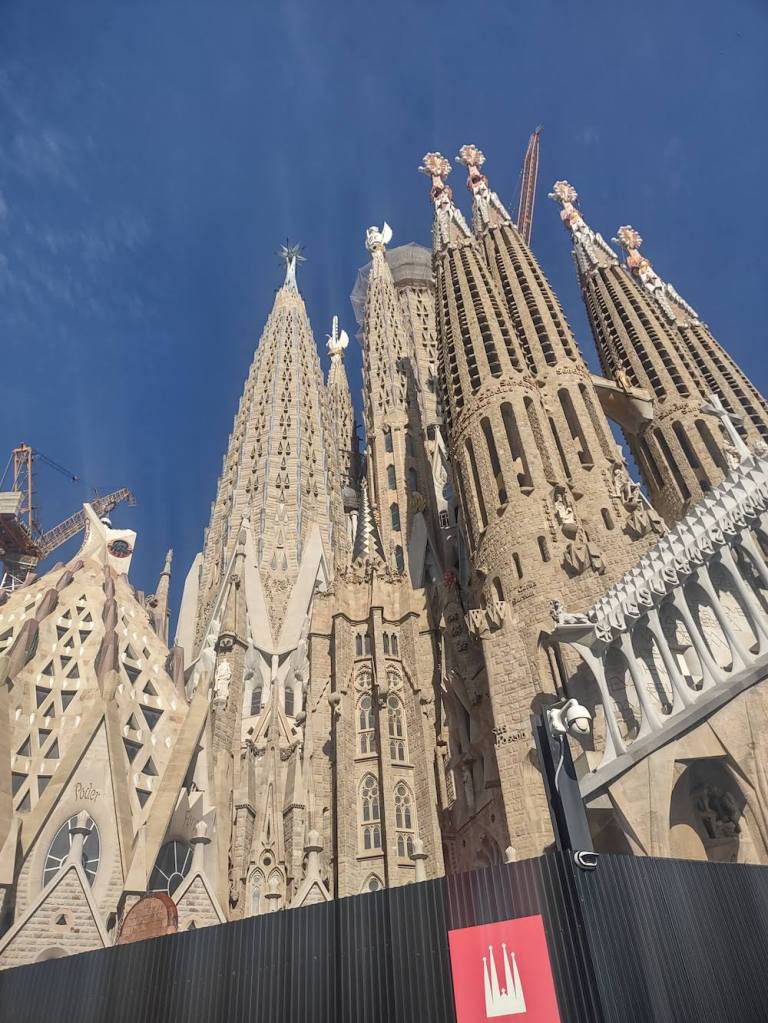
The name of this consecrated, minor Roman Catholic basilica is translated as “the holy family” in English, so I’m going to refer to it herein as HF, since SF means San Francisco to me. HF is a little overwhelming, and I’m not really even going to try to do it justice.

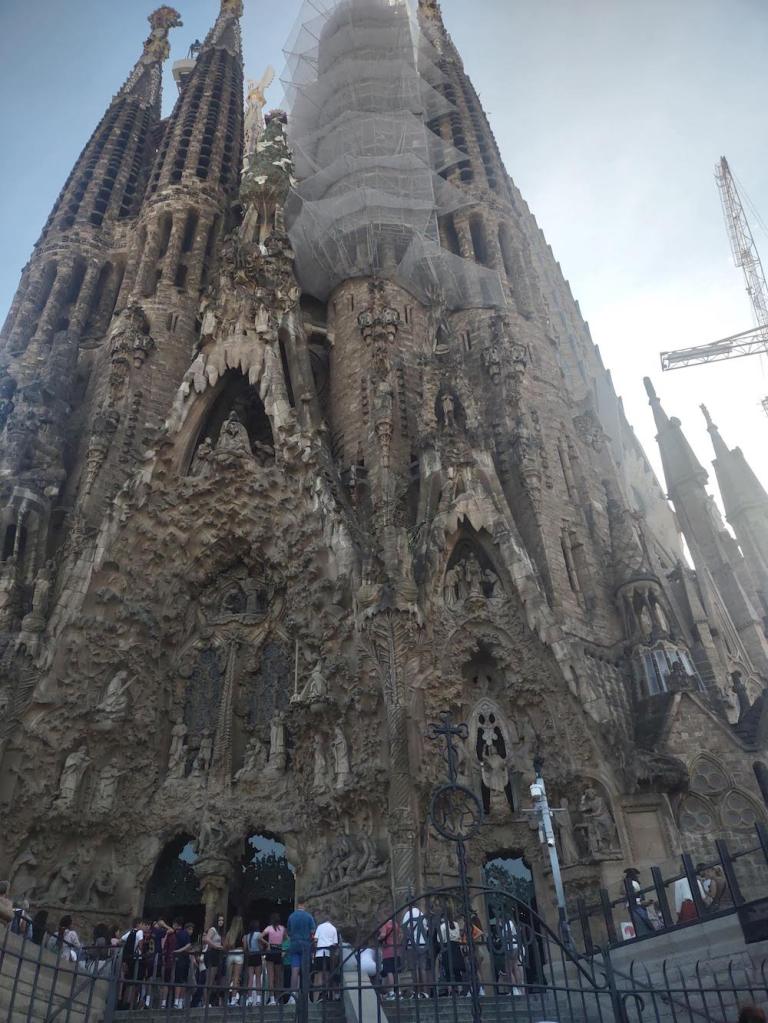
The pictures will tell most of the story as far as architecture is concerned. HF is not complete, even though construction started in the 1800s, and its main architect, Gaudi, died in 1926. The basic plan is a very unconventional-looking cathedral surrounded by 18 towers, honoring the twelve apostles, the four authors of the Gospels, Mary, and Jesus. All have been constructed but only six are currently erected. There are also three facades, nativity, passion, and glory, though only the first two are complete.

The exterior is covered with reliefs, particularly around the nativity entrance, where they depict events associated with the birth of Christ. The passion entrance is more austere, displaying events associated with His death. I am guessing the glory entrance decor will relate to Christ’s ascension.

The level of detail cannot be exaggerated, and can hardly be comprehended in person. I would not be surprised if every mention of Christ in the Bible and other texts is represented somewhere in this edifice. There are also other references, perhaps designed to appeal to the global community, such as lists of sacred sites all over the world and messages in many different languages.

Although extraordinarily religious, Gaudi was also inspired by nature, and believed that man’s work should not exceed God’s. For that reason the apex of HF will be slightly lower than the height of nearby Montjuic.

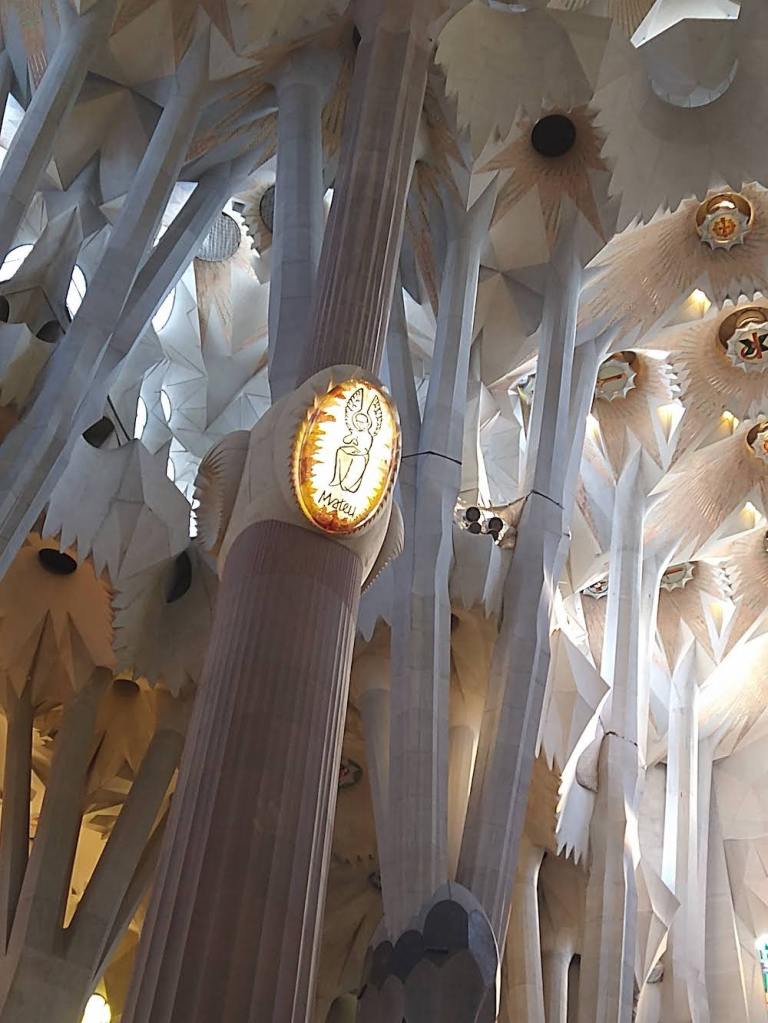
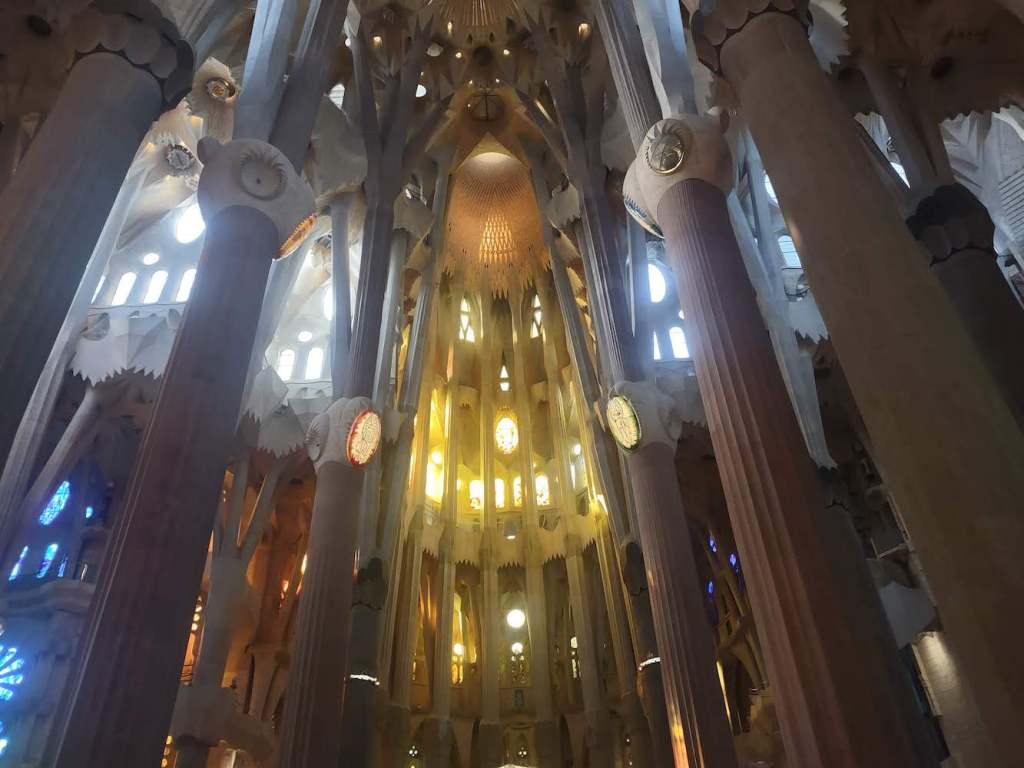
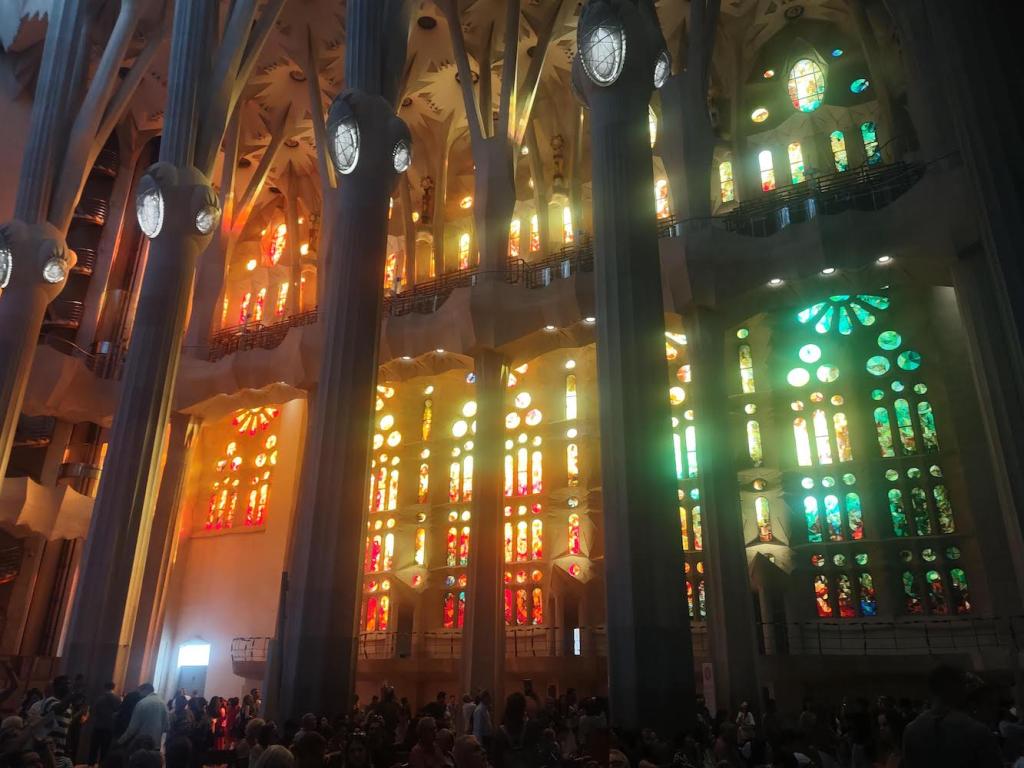
The cathedral includes a nave transected by an apse, cloisters and choirs, an altar and a crypt (where Gaudi lies), yet is not obviously comparable to any other cathedral in most respects. The major supporting columns, composed of various woods based on the weight each must bear, reach straight up toward the ceiling then branch into a tree-like canopy on reaching it, leading the audioguide to refer to the nave as “the forest.” Below is a closeup of the branching, followed by a longer view toward the altar.

You may feel the tour is just getting started, and if you were there that would be true, but this is about as much as I can handle. We purposely chose our tour for an afternoon time so we could see the western windows aglow, so I’m including a picture of those, and the eastern ones as well, because they look great, too. You will easily be able to identify them by the associated coloring.

I’ve tried to be respectful here in terms of capitalization of religious terms, but also not to go overboard with that. While I was in the moment, the audioguide murmuring in my ear, I was mesmerized, hardly aware of those nearby or any physical reality outside of HF, but eventually the trance was broken. While I have great appreciation for beautiful religious monuments and inspiring classical masses, HF is a whole new level. Should we expend this sort of effort and labor and human genius for more than a century toward metaphysical ends?

Sometimes I feel we could it be living like the Jetsons if we were a little more interested in improving humanity’s physical well-being and enjoyment. Better yet, we could try to achieve peace on earth, good will toward men, not performatively as at a church service, but daily, at every level of society, for every category of employment, and as our most sacred, admired, and rewarded measure of merit.

Did I Dream This?

Travel, one hears, is broadening, and certainly we’re getting a new perspective on a few things. Yesterday, for instance, there were protests in Madrid, Bilbao, and Barcelona called by unions and NGOs to show solidarity with Palestine. The march here passed directly under our balcony and felt historic in its majesty and intensity. I filmed for close to an hour; here’s one portion, which starts with a brief rally before resuming the slow walk. The street is one-way and is three lanes wide plus a bike lane.

I have friends of all religions and certainly don’t want to downplay the complexity of the situation in the middle east, but I am also a math person, and I can’t help noticing that we’ve gone from an eye for an eye to at least 40 eyes for an eye, with no end in sight. The power of this protest was in its size, a slowly flowing river of humanity. It was frankly quite moving. My husband and I were both riveted, standing at the windows until the end.

Like everything in Spain, this protest was very well organized. Slow-moving police vehicles bracketed the marchers fore and aft, implying that this was a permitted event, and everyone was orderly in the context of what they were doing, which was of course designed to be disruptive at some level.

Nothing could be less effective than a protest that doesn’t inconvenience anyone.

I took part in two DC marches, the Million Mom March for stricter gun control in 2000 and one of the reproductive rights marches, which were all called March for Women’s Lives, in the 80s. Participation in each of those events numbered in the low hundreds of thousands. I’m no crowd estimator, and it’s hard to compare a crowd of moving people to a static crowd. I have a video, but there are a lot of trees.

Nonetheless, I’ll have a go: I believe 30 rows of 20 people each passed my window every minute, which in 40 minutes would be 24,000 people. This is not implausible. I feel all of my assumptions are on the conservative side.

Why do I have to compute this? Because I can’t find the information anywhere! There’s not the slightest reporting of this in any US news source to which I have access, including the vaunted New York Times, to which we continue to subscribe despite its penchant to disappoint. The Guardian doesn’t seem to have a search (my bad?) plus keeps popping up to bug me for money, which since I fed it not two days ago makes me very annoyed. The announcement of the protest showed up at something called aa.com, but not the reporting of the aftermath.

I don’t think we should continue to call this the information age. Though if I were seeking information on the Kardashians I’m sure I would be overwhelmed.

City Schadenfreude

We moved to a rural county of California eight years ago and quickly realized–oops?– we are city people. There are advantages to each, and we get a taste of the city once or twice a month when we travel to San Francisco or San Jose, but one of the main purposes of this vacation was to return to city immersion, which was “just like riding a bike.”

The streets here are lively from whenever we wake up until around midnight, bustling with every sort of person and vehicle. Within short walking distance of our apartment one finds restaurants and drinking establishments, trades of all sorts, Supermercats and flower markets, butcheries and bakeries, banks and ballet, and a joint called Acrobatica which offers a chance to dangle from the top of a skyscraper in a harness. How delightful to leave our house at 9 pm for a late dinner, a quick trip to the farmácia, or an impulse visit to the gelato shop.

So many Metro passes! We prefer the 10-rides-for-€13 reloadable cards. It is so delightful to scan your card, be in El Born in ten minutes, visit a museum, walk to a plaça (pronounced plasha in Catalan), eat al fresco, then return by a different subway/train/bus using the same card. I was surprised to feel a thrill of real pleasure the first time we got on the subway, so familiar, so easy, so practical, so environmentally correct. Flashback to my 35 years in Boston. Some Americans say a car is freedom, but in a well-run city, car-free is worry-free.
During our nearly month-long stay in the city we will experience a professional opera at one of Europe’s storied opera houses, the Liceu; dance with the local chapter of the Royal Scottish Country Dance Society; take a private tapas cooking class with a chef in his beachside home; visit multiple World Heritage Sites; and view the America’s Cup race. Only in the city are such a variety of world-class opportunities available in such a compressed area–we aren’t even planning to travel outside of Zone 1.

So, am I piling on a little bit? Well your turn for schadenfreude! A couple days ago I developed covid for the first time in my life. It was probably longer ago than that because I’ve never had covid so it took me two days of symptoms before it even occurred to me to take a test. For the last two days I’ve been more or less in the apartment, or venturing out on foot only, while wearing a mask, my favorite activity. I’ve been fairly miserable with congestion, rhinorrhea, and pharyngitis, and even taking a few OTC meds. Fortunately our remaining guests are pretty chill about this, all of them being Covid veterans, as are most people, now including me. Infectious diseases also happen in a city.
Another new experience for me: binge watching. Of the eight episodes of Breathless, we–that includes my patient, supportive, taking-care-of-me husband–saw four in one day, all in a row, then three the next day, something a healthy me would never have the patience to sit through. I’m not recommending the show or bingeing in general, but it did make some time pass. It is set in Valencia at least–when in Spain?

La Merce

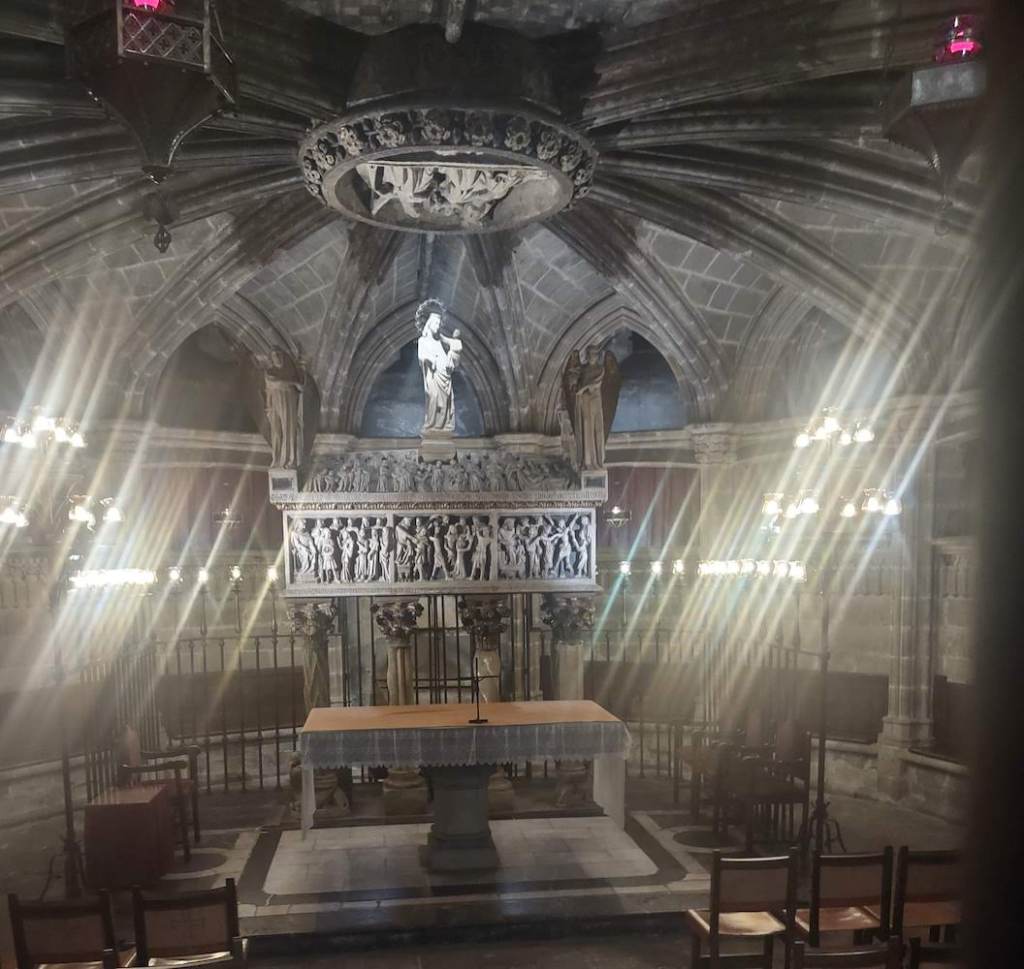
We are fortunate to be visiting turning the primary festival of the city of Barcelona, which honors our Lady of Mercy, also known as the Virgin Mary. The tradition started in 1687 when the Lady saved the city from a plague of locusts. She shares the role of patron saint of the city with Saint Eulalia, whose crypt I saw in the Cathedral of Barcelona. The rays of light in the picture did not appear to the naked eye, leading to some banter about holy presence. It happened several times that day. Later it turned out I just needed to clean my camera lens.

This year the festival ran from September 20 through the 24th, so we were here for the entire time and saw a lot of it. It contains some features that are unique to me such as castellers and correfocs, as well as some I have seen elsewhere, including gigantes and fireworks.

In order to enjoy such a festival one must either be wealthy enough to command a private viewing platform, or a person who embraces crowds; we are both the latter. While not anxious to be crushed or fumbled, we find most festive crowds quite well behaved, and being in the midst of one a source of shared joy.

After an excessively celebratory tapas meal at a lively restaurant Saturday night, we encountered the correfoc, or fire run, on Passeig de Gracia while walking home. The components include elaborate, car-sized renditions of devils and monsters as well as people costumed similarly, both spraying lit fireworks into the air to a rhythm provided by ranks of drummers and dancers. Continuous fireworks-spewing structures are also erected over the street at intervals. It’s loud and action-packed and slightly dangerous–those who venture near usually wear (slightly) protective clothing, whereas others watch from farther back. The noise and heat and light and general atmosphere of dissolution are easily experienced at a safe distance, but are very difficult to photograph, though some Youtubers have managed. There’s a Reuters video that appears to be shot at that very location on that very night, but I’m not allowed to link to it.

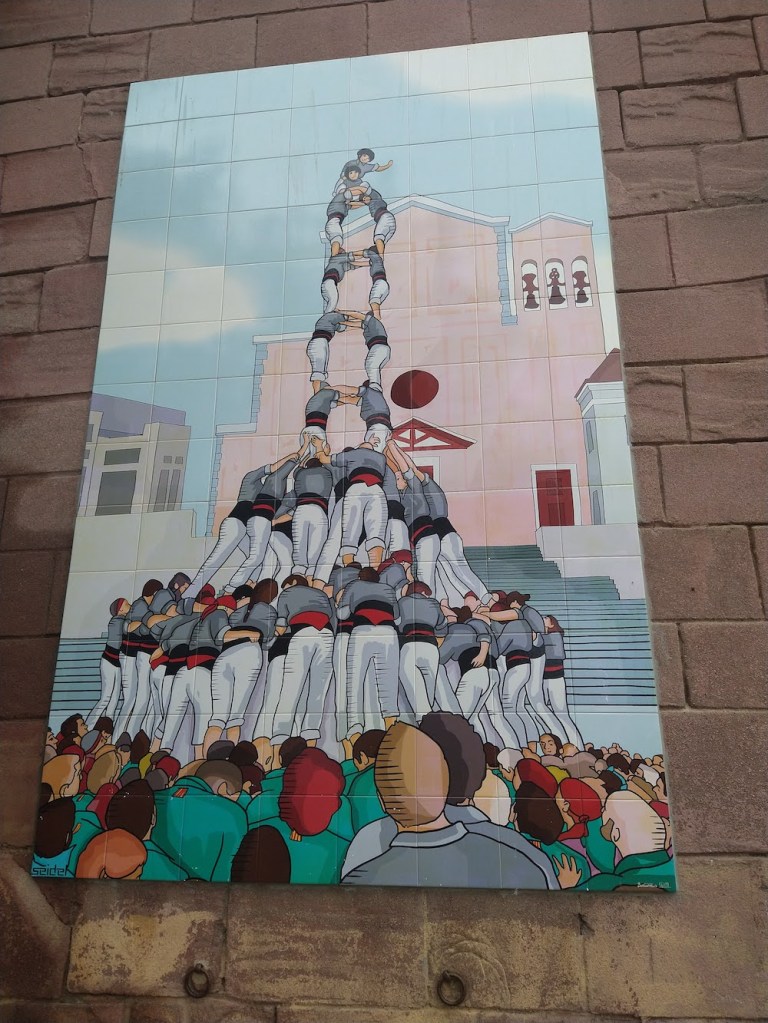
Castellers are teams of people, not completely dissimilar to Morris teams, who create human turrets by standing on each other shoulders. These rise quickly and are not considered complete until a child, by appearance I’d say someone around 10, climbs to the very top and gives a thumbs up, after which the tower is disassembled. We did manage to get a video of this, but mostly what you see is the crowd, as we didn’t get there at the very beginning. Looking toward the opening at the far side of the square you’ll see one group in green and white on the right forming a shorter tower, and another in red and white at the left. The crowd cheers when the kids reach the top, with the video maker’s (my husband’s) voice prominent. I also have a drawing, below.

Gigantes are very large puppets manipulated by people inside, which we used to see every Easter in Boston, and we also saw them when we were in San Antonio for the solar eclipse earlier this year. The ones in Barcelona may be the largest. We missed both the main display–we tried for it but couldn’t find it!–and the parade, so I have no evidence.

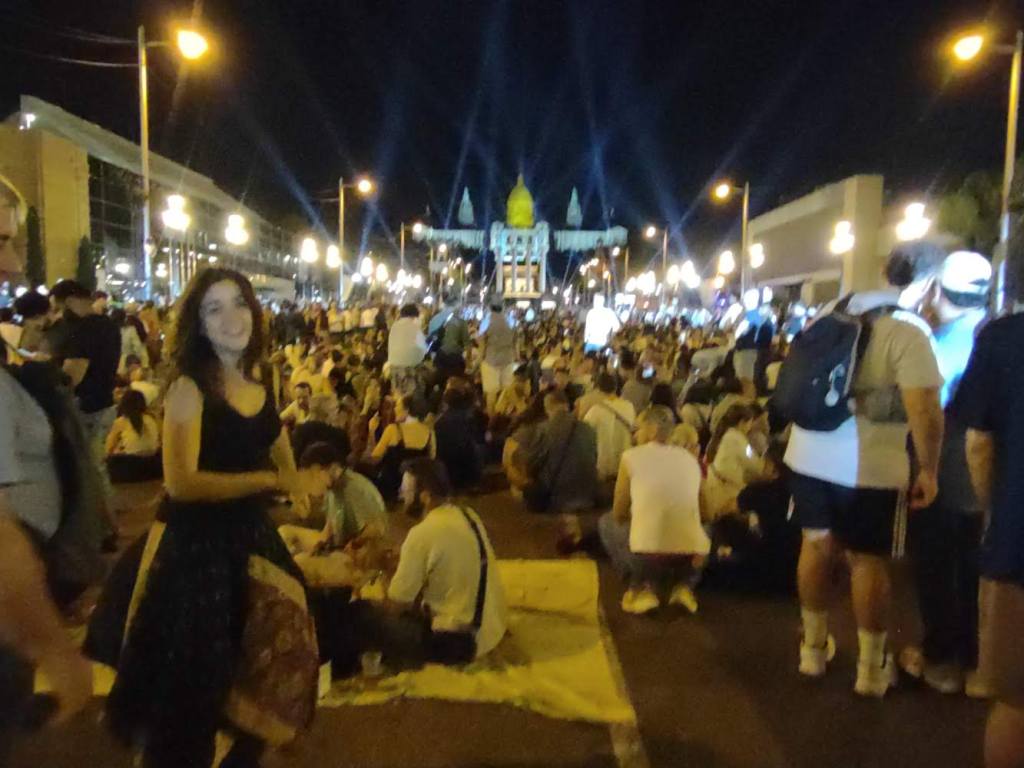
Fireworks are fireworks, for the most part. They were a big part of my growing-up family so I’m sure I’ve rambled on about them here before. The differences in Barcelona were the site on Montjuic, including a nice castlely sort of building in the background; a dearth of concessionaires, excepting a couple of guys with beers and bottled water in a backpack roaming around; and a pop music soundtrack devoid of martial or jingoistic themes, at least as far as we could tell.

My husband found that last difference made the whole experience more enjoyable, or perhaps I should say, less fraught. For him. I love martial music, though I enjoyed the dancebeat vibe as well.

What’s Going Up There?

The guide books advise tourists to “look up” when in Barcelona, and it’s good advice. There are many items visible on the rooftops from the sidewalks. Often these are plants, including trees, perhaps in pots. They are also various kinds of statues and what I can only describe as festive shapes. The edges of the roofs are often founded by ornamental railings, implying that they are spaces for relaxing or gathering, and occasionally you glimpse a person.

Architectural features on the upper levels of buildings are even more common and much more diverse, ranging from decorative stone reliefs and wrought-iron balustrades to fantastical creatures in vibrant colors and full-blown statuary launching into space. Spires and towers of all heights abound, most with decorative details.

Barcelona is ringed by mountains and highlands on the inland side, and includes Montjuic near the sea. Looking out from many vantage points within the city, these heights seem dotted with structures spired, domed, and both, as well as modern buildings and technology monuments such as windmills and antennas. This list implies a skyline cluttered with man’s works, but it’s instead quite a long skyline punctuated by a few scattered structures.

Not that Barcelona is a monument to nature. This is a 1.5 million person city and it’s quite dense, at least in zone one where we are staying. So far we’ve heard very few birds and identified only one: the monk parakeet. Here’s a deep dive for the birders among you: https://www.birdguides.com/articles/conservation/the-parakeets-of-barcelona/

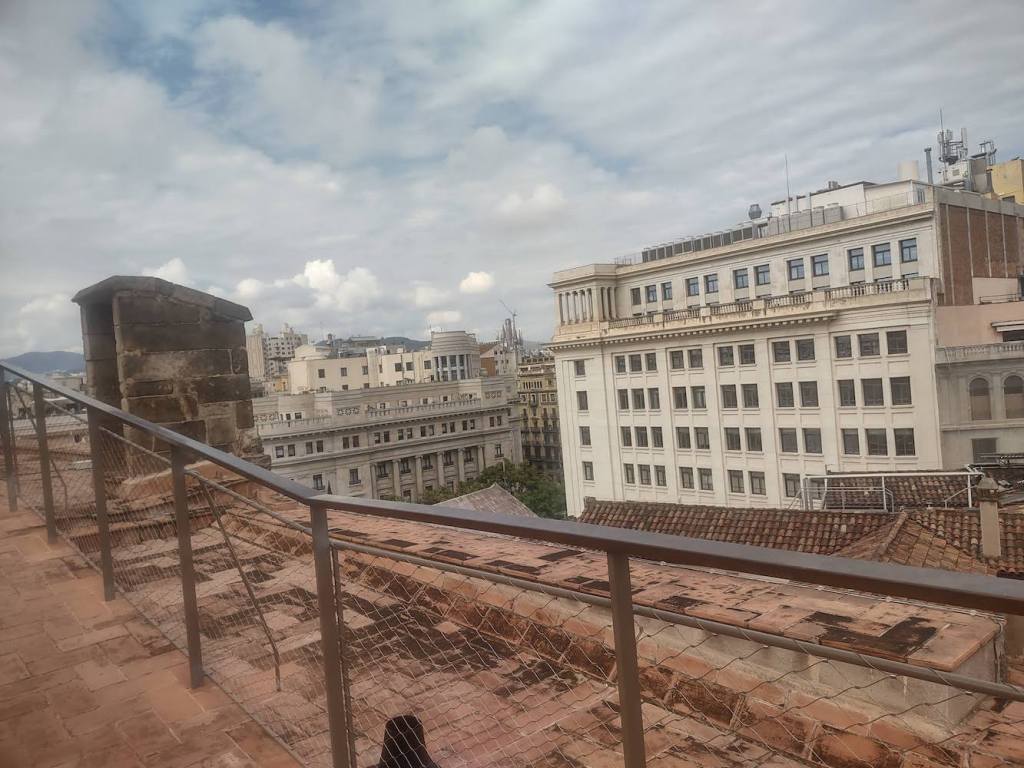
Back to the rooftops, I spent a nice afternoon with one of our guests visiting the stunning Cathedral of Barcelona, built between 1298 and 1450. Our ticket included a trip to the roof, in an elevator rated to carry 800 kilograms/10 people. The patient gatekeeper counted 10 of us at a time from the line without weighing us. An average of 176 pounds per person seems low to me, but I am from America. On the return journey, there was no guide, so we obediently queued up and fed ourselves into the elevator, again 10 people at a time. It was a little cramped, but quite a short ride.

From there I got my first glimpse of Sagrada Familia. Do you see it? Hint: Look for the crane amid spires.

Meet Montaner

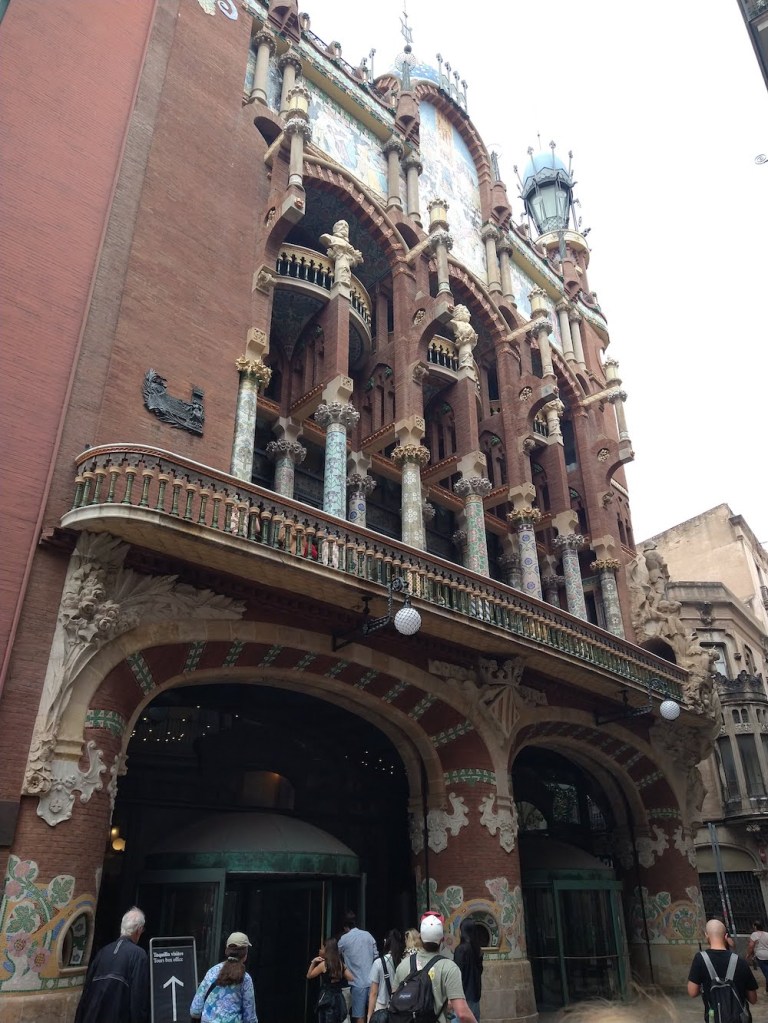
Our first guests left today. Turns out that when we have guests we are pretty busy; it was particularly intense because these two were only here for something like 48 hours. I really don’t have much time to blog given the circumstances! But I want to get something out there, so here are some pictures and comments from my husband’s and my trip to Palau de la Musica Catalana, a Montaner edifice.

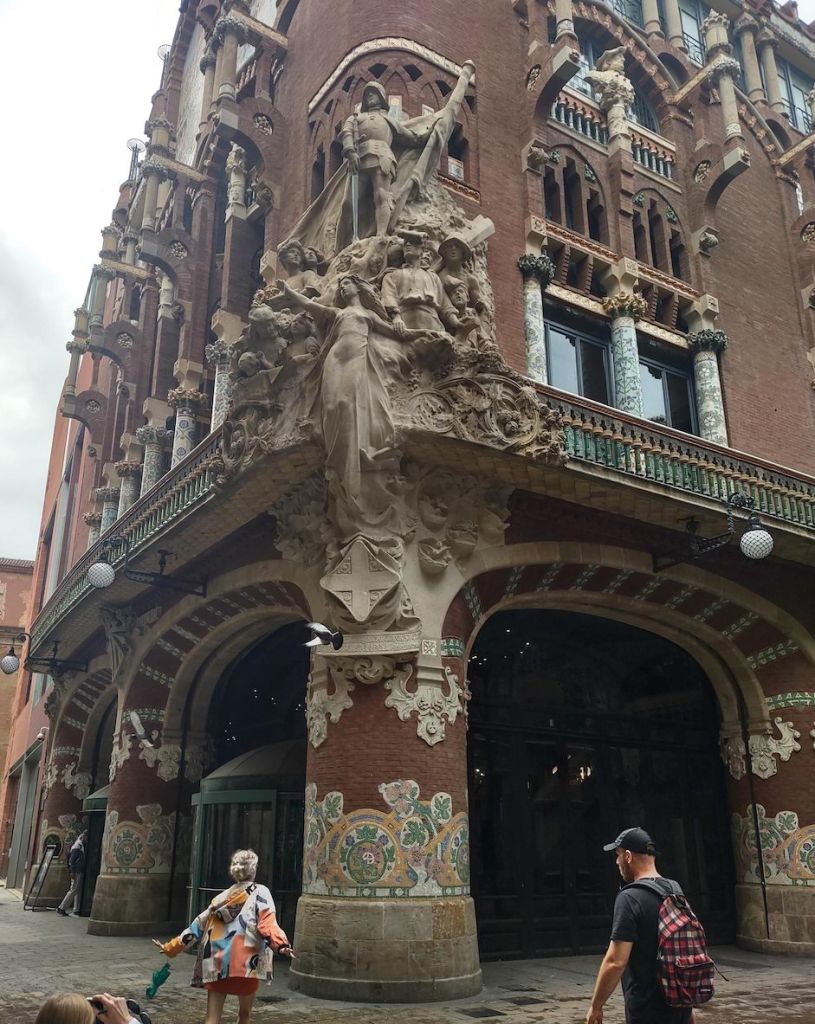
The facade is said to be impossible to capture in a photo. If you’ve seen it in person, perhaps you can decide how we did.

If you think of the building as a ship, St. George commands the prow.

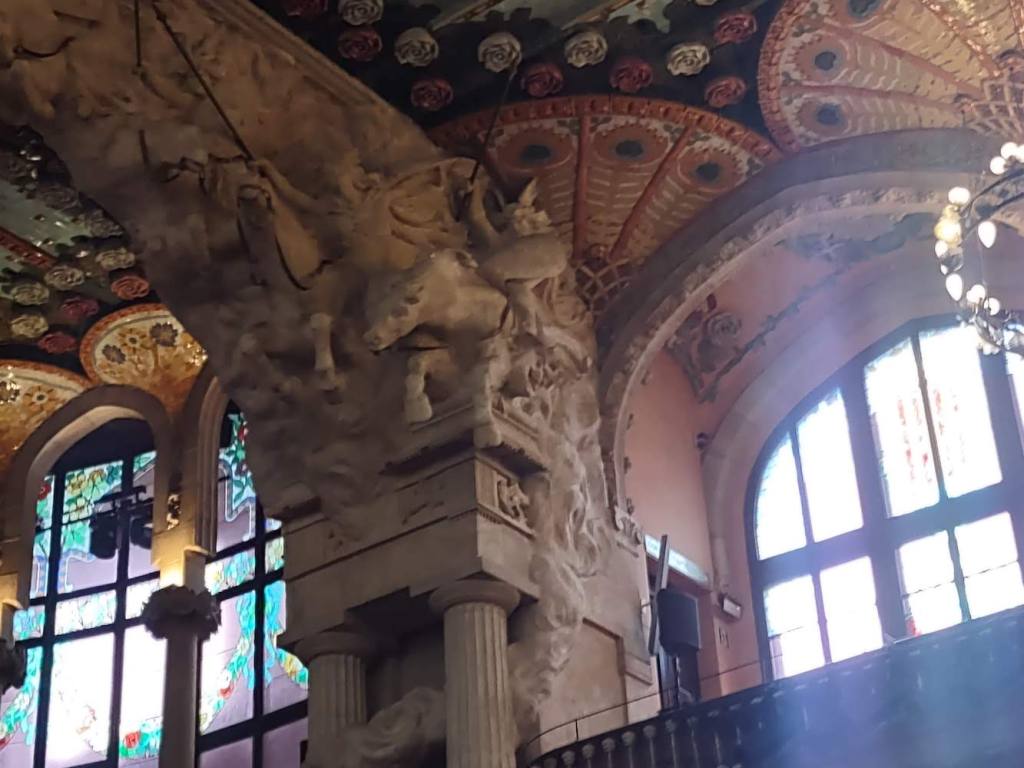
There is a lot of archi-art in the performance hall. On stage left, we have Beethoven…

… and above him, the Valkyries.

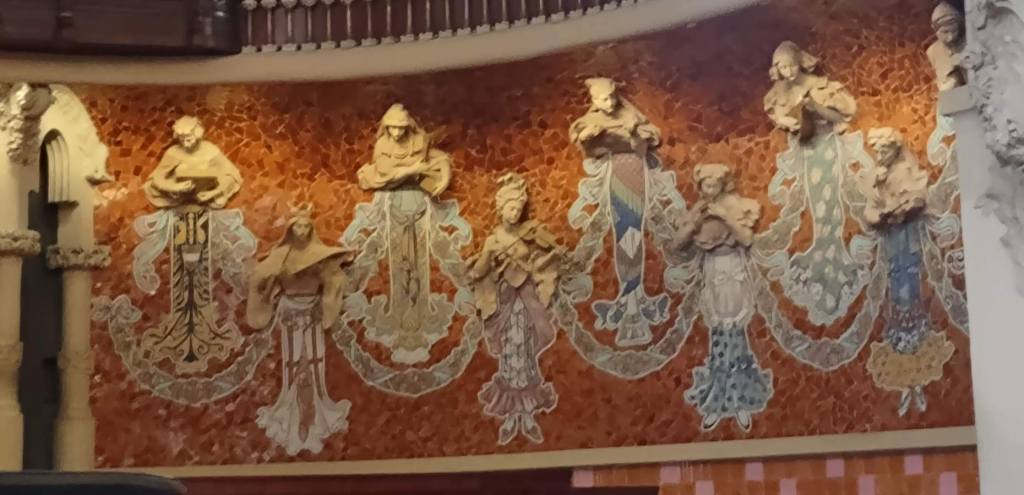
Behind the stage are eighteen muses, each holding a different instrument. Here are a few.

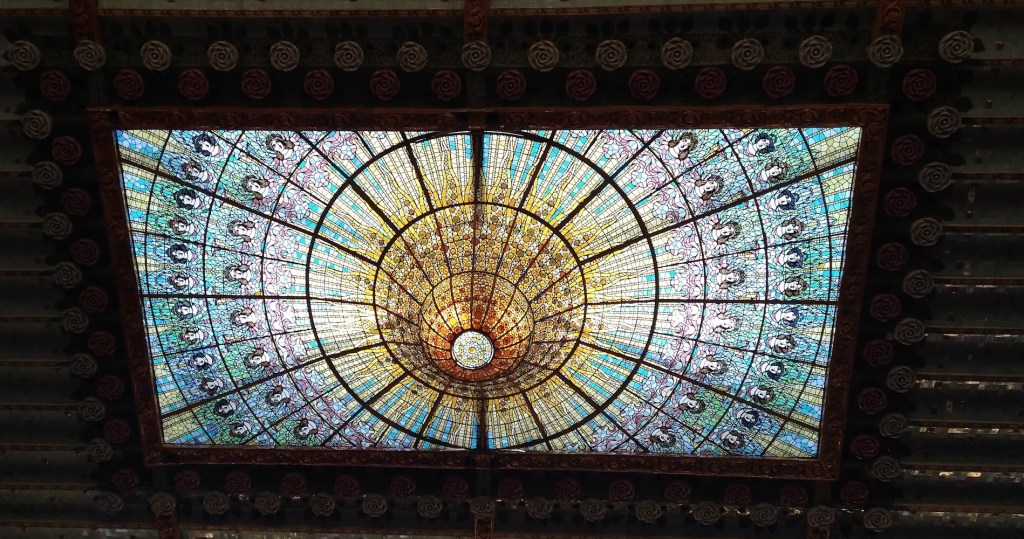
The ceiling is the sun, surrounded by a chorus, acknowledging the central role of the human voice in music performance.

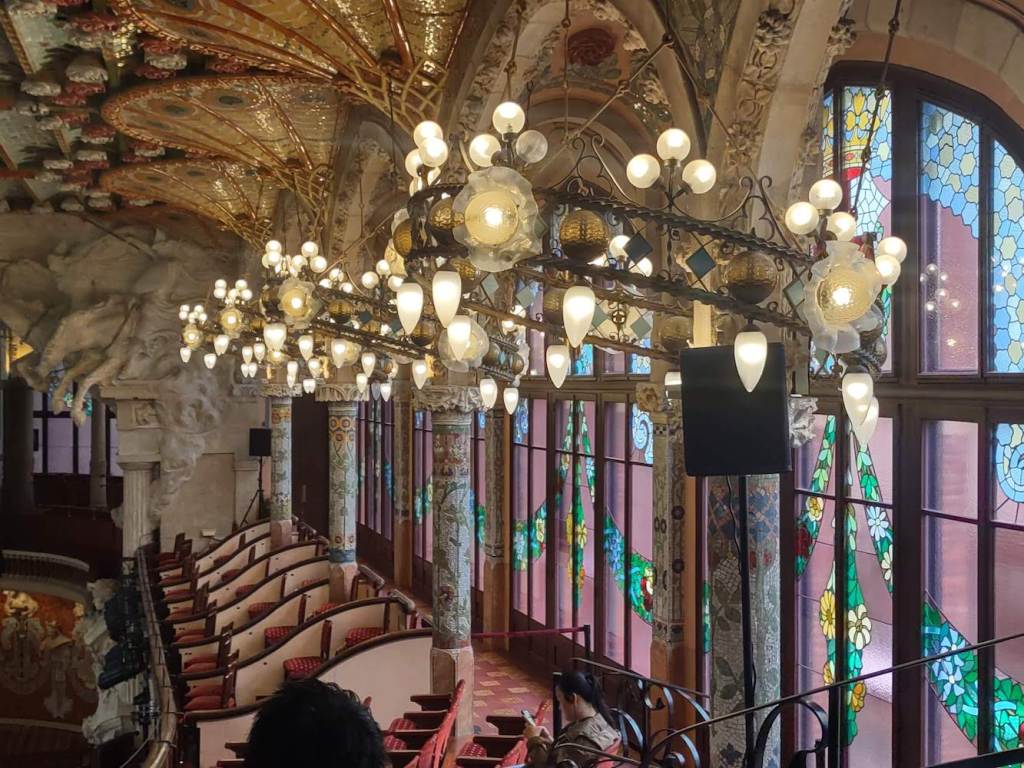
I love these canted light-rings.

This was a lot of it. Not all certainly. You can work out on your own the similarities and differences between the work of Gaudi and Montaner perhaps. If not, I will try to send more helpful info soon.

These pictures were taken on Sep. 21, so I am a few days behind. In addition to our first successful guest round completion, we made a date to meet some new local friends after (their) work this Thursday. I’m still searching for the ex-pat community in Barcelona, with hopes of finding a debate watch party in English before Nov. 1. We are going to the last day of the welcome-fall festival tomorrow. I hope everyone had a great autumnal equinox yesterday!