American Symphony: Review

I’m trying to get back into blogging…no, that’s not right. I’m occasionally thinking I should get back into blogging and then not doing it. Partly that’s because all the things that are on my mind at the moment are either quotidian–life is fine, family is fine, weather is fine–or terribly depressing, topics I don’t really want to dwell on and readers probably prefer to avoid as well. Also, I have well and truly conquered my previously-bemoaned inability to waste time, so completely that wasting time is most of what I do. Unlike during my pre-retirement life, I find doing nothing of importance for most of a day delightful; No Regrets.

My first day of time-wasting followed my last day of band class, May 21, so the thrill may wane as more wasteful days pour on, and of course I still have some volunteer obligations and many regular items on my social calendar. Today I am trying some light blogging, namely a review of the documentary American Symphony, which I loved.

This is one of those follow-someone-with-a-camera-then-edit documentaries, or rather follow two people married to each other, namely Jon Batiste and Suleika Jaouad. He’s a well-known, Grammy-winning musician, and she’s a slightly less famous but very accomplished author, musician, and artist. The film captures a critical point in their lives: He is composing his first symphony and preparing for its premier in Carnegie Hall, while her work is interrupted by the shocking return of leukemia at the age of 32, after ten years of remission.

The first thing he does when he finds out her disease is back it to ask her to marry him. Their intimate wedding is only one high point in a film with lots of extreme moments that never drags. These people are creative and thoughtful, a loving couple with a lot of genuine human connections as well as personal struggles, all of which they share honestly in front of the camera.

A couple of vignettes: During the actual symphony premier, the electricity fails unexpectedly, a problem for a work with multimedia components. Jon improvises an amazing piano interlude sounding like a storm on the ocean, after which power is restored; the audience suspects nothing.

The morning after the 2022 Grammy Awards in Las Vegas, at which Jon won five of the eleven awards for which he was nominated, including best album, we find him in the airport, where the documentary camera caught all sorts of folks politely congratulating him, two female tweens sneaking in a selfie while he gets his shoes shined, and the older Slavic shoe-shiner asking, Are you famous?, to which Jon replied, No, I’m just hanging out with this friend, but he happens to be a cameraman. That may sound patronizing but it was the opposite; it was Jon breaking down any walls that might separate him from a genuine encounter, however brief.

Later he spoke seriously about fame, how it gets in the way of your relationships and your work unless you carve it out and set it aside. So many famous people in our world could benefit from this approach, starting with all the Silicon Valley billionaire bros seeking to add Autocrat to their resumes.

The film includes many affecting scenes, such as one in which the young couple play a form of Simon Says while together wheeling Suleika’s infusion cart through hospital corridors. Their version is wordless and graceful, really a dance, filled with touches and joy. This is not a downer disease movie, not least because these are the last two people who will ever give in to a disease. We also see Suleika in her element, playing orchestral bass, writing, and exhibiting her paintings.

I was inspired to watch this documentary after reading an article about Suleika in The Atlantic. That same magazine also profiled Daniel Radcliffe, leading to another documentary watching event, which I will review tomorrow, if I manage two days of accomplishment in a row.


Eclipse: Mission Accomplished

We went to San Antonio to see the total solar eclipse, and we saw it!

We arrived Wednesday for a Monday eclipse, which I was calling that stupid eclipse by Thursday evening. SA was in a frenzy. Our little hotel showed non-stop news in the lobby, 90% about the eclipse. Every programmable highway sign reminded us to Arrive Early, Stay Put, Leave Late or cautioned Solar Eclipse Monday, Delays Possible, while radio traffic predicted hurricane-evacuation-level backups (this did not happen). Weather professionals provided oracular minute-by-minute cloud-cover predictions and analyses for various potential viewing locations, as well as Texan-targeted advice such as Don’t drive while wearing eclipse glasses.

Too snarky? I am a Texan after all.

On the appointed day, clouds were swirling about, but we kept our eyes on the star and saw every phase, including the misty corona and even the glowing “beads” that travel around the ring as totality is ending, though not the “diamond ring.”

Though we did not have a long view of the approaching shadow, we did experience the darkening, the drop in temperature, and the switch from the clamor of bugs to birds as the light disappeared and then returned. It was a little eerie, but not for me at least in any way transformational, as some describe it. My photos of the sun did not come out. One of our party took this viewing shot, which I chose to share since no one in it is taggable.

We were with two other couples, one of them friends of ours from San Jose and the other friends of theirs from Washington state, in the latter’s time-share near Hunt, all lovely people. Although we were not allowed to park there, the resort was a quiet place to watch the sky, with lots of room for everyone. I had tried to get lodging in Kerrville eight months ago when I booked, but hotel prices were already quadrupled by then, so we chose regular-priced lodging in SA–fortunately, since when we arrived in Kerrville, a small and ostentatiously religious town, early on eclipse morning to pay $50 to leave our car in one of numerous lots re-configured to accommodate paid parking, my husband’s immediate response was, What would we have done here all week?

We would not have been able to visit San Fernando Cathedral, for example, which shortly after this picture was taken had a son et lumiere, though we only saw part of that. We did take some peeks of a lovely wedding there during the afternoon, and viewed a mini coffin containing an inexplicable number of heroes of the Alamo.

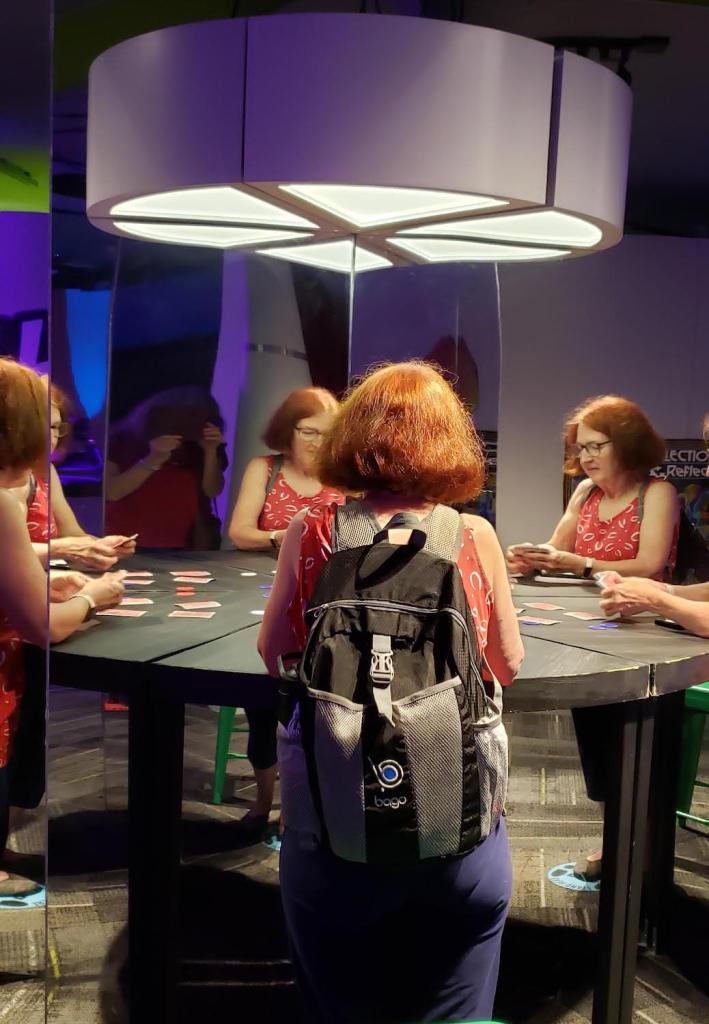
We also went to SeaWorld, checked out the River Walk, found a good downtown restaurant with live jazz, visited the Japanese gardens, and hung out with our friend Melanie, who convinced me to visit Ripley’s Believe It or Not for the first time in my life. She and I chose the optical illusions tour, and it was surprisingly fun! Below is Jo with her most easily read poker opponents.

Some folks have expressed surprise that a marine biology volunteer would go to SeaWorld, but it has a decent reputation among many m. biologists I have come to know. SeaWorld does a lot of animal rescue and releases, provides good homes for animals that cannot return to the wild, and has forsworn its orca entertainment program, which will be ending as soon as their extant orcas, which can’t be rewilded, expire. Naturally I wanted to see those while I could, plus I was interested in the beluga whales, which UCSC’s own Long Marine Lab is currently studying, albeit at the Georgia Aquarium instead of SeaWorld.

Most important, my husband got to go on one of those terrifying rides he loves, the Great White 360-degree roller coaster. It sped by too fast for me to catch, but here’s a stock photo to give you the idea.

Go Fund Yourself

Title sound a little aggressive? This blog is about my journey to making peace with the site Go Fund Me.

I don’t remember when I first heard about it, but it must have when I was snooty and well-heeled because I thought, Why not just fund yourself? Or I think that’s what I thought. This may be another case of memory lapse–a topic I will never blog about, unless I already have and forgot–because GFM was founded in 2010, well into my nuclear family’s period of trading European vacations for more time with an adult at home monitoring teens, though before we were exposed to high-deductible health care plans for engineers.

I remember a colleague in our town’s HS whose daughter was an aspiring singer. He often remarked–plaintively–that if “everyone” in our HS community would give “just” $3 she would be able to fund her next program. True, I agreed, yet everyone else in the community could say the same thing for themselves, why should she be the lucky one?

As a father, he found the answer to this obvious, but the rest of you may see my point.

Eventually I came to see that corporate greed and concomitant income inequality was sinking American workers at a rapid pace, and even though we knowledge workers still felt we controlled our own destinies, I was not unsympathetic to the gaping holes in our safety net that might force others to attempt to fund medical procedures or disaster recovery through friends and strangers.

Now this has hit me personally, as I recently discovered someone close to me who is struggling with financial issues I cannot personally address, and for which I have no tenable solutions to suggest. So I found myself offering to create a GFM for this person, Keira, and she accepted.

I enjoyed the writing part, and my sister, who is more familiar with both GFM in particular and social media in general, gave me lots of guidance and advice. Keira loved what I wrote, and I felt hopeful as I launched the site.

Then the email messages started rolling in–not from potential or actual donors, but from GFM itself. You have to Share the site, they pointed out. You have to Send it to people. The more people who see it, the better.

I was bummed. Solicitation has never been my style. I didn’t even like school fundraisers, at least not when I was on the call-other-parents-and-ask-them side. Today, gunning for money just reminds me of grubbiness of living in a country in which almost everyone seems to be shopping for sales, buying cheap goods of questionable provenance, and trading off basic needs such as food vs medicine, or housing vs education.

Also, I really don’t have much of a social media presence, and I don’t want one. That I am not willing to give up, but I do feel the need to do something more to advance Keira’s cause, so I am sharing the post with you. If you have any sort of forum in which you are willing to display it, so it will have more exposure, that would be the most helpful thing you could do.

In other words, I’m still not soliciting money, or I’m trying not to. The link: https://gofund.me/d5e71f51

Appalachian Trial, Bears, and Freedom

My reading group has chosen two walking books this go-round, one of which is A Walk in the Woods by Bill Bryson. This decades old book is quite famous, perhaps because it is very amusing, and I’d thought it was about walking the Appalachian Trail, but nay. Bill and his buddy Carl do not come within bragging distance of walking the trail. Rather, it is about how and why one might not do so, as they not did.

At the time of their attempt, Bill and Carl were already too old to carry their packs overhead as they forded a stream, one of many fundamental requirements they lacked for success. At 66 1/2–my half-birthday was yesterday!–I also have long lost the ability to hold 40 lbs at arms’ length over my head for multiple minutes. If you have not, kudos.

I’m not super keen on rough camping, prolonged exposure to dangerous weather, sharing rodent-infested cabins with people bereft of plumbing for weeks, or hiking in the woods for six months at a time, so I had never aspired to this conquest, yet I found the book quite compelling. I learned rather more than I needed to know about the AT, a lot about hypothermia, which is harder to avoid than one might suspect, and a good deal about bears. I think about bears differently now.

As a marine mammal rescue worker as well as an aquarium interpreter, I think a lot about how humans interact with animals, and I tend toward the view that while we think we know more than they do, quite the opposite is the case, and Bryson’s observations (all second-hand, admittedly) reinforce this feeling. Bears, as it turns out, do whatever they wish.

When a bear of any sort sees one of us, a number of things could happen. We might make ourselves “big” and loud, or run, or climb a tree. The bear might turn away, perhaps annoyed, perhaps bored, perhaps remembering that we sometimes carry guns that while they rarely kill, can be a bit ouchy. On the other hand, it might maul us, or maul and eat us. Really, it’s just a choice, whatever they feel like, and not at all predictable or related to what we do. Bears are powerful, free animals which do as they please.

Other bears are ok with this.

How different from people! We are forced to conform in myriad ways, every day of our lives, and if we stray may suffer loneliness, social cancellation, or even incarceration, all at the hands of our own species. Whether we have access to food, medical care, or housing depends in large part on how conformist we are–as well as how lucky, where we were born, and what race we are of course, though I’m not dealing with those today.

I wish people could be free to make our own choices without the constant threat of reprisal. I don’t think about that on a personal basis myself, but I’m constantly reminded of it, mostly in the news, wherein one hears of persons denied freedoms ranging from freedom to move about, for committing property “crimes,” to freedom to continue to be alive, for residing in a location targeted for demolition by the “great” powers of the world and their clients.

Things that bears never, ever worry about.

I’ve also been reading Bernie Sanders book It’s Ok to Be Angry About Capitalism, though I have to take it in small doses. That’s not because I disagree with him. I think that people should be mostly concerned with each other, that no one should be hungry or homeless or unable to get treatment when they’re sick, and that we could easily accomplish this in our post-industrial world if it were a priority, which clearly it is not. No, the hard thing about reading this book is how great a case he makes for Doing the Right Thing and how unlikely it is, I’d say impossible, that we will ever, ever do it, at least not in the US.

Why does everyone want to come here? It’s not as portrayed on TV, unless you’re watching The Wire. Better to set your sights on living as bears do.

Inside China’s Tech Boom

The blog title is also the title of a Nova episode I just finished watching and didn’t wait to blog about. I recommend that everyone with any technical interest or acumen whatsoever–basically everyone–should view this episode, which I obviously found fascinating.

There is a story arc, so ideally you will commit to watching the entire thing. It starts with, China is amazing! then moves to US put China out of business! followed by China may be back.

Alarmed by China’s dominance of the global 5G market, the US shut down China’s access to semiconductors, tanking a lot of its technical outreach. Then China became a country with a mission, seeking a way to regain dominance. The end of the story is not known, but the cultural comparisons are telling. Do Americans want to live like Chinese people? For the most part, emphatically not. But we could learn some things about systemic thinking and the advantages of having a population that instinctively knows how to create and execute a complicated plan, and welcomes the contribution of government resources.

Along the journey, you learn about China’s history of sourcing quality items, such as silks and other textiles, porcelain, and paper, including paper money. Later you learn about Deng’s quest to return China to its ancient legacy, with the conversion of rural Shenzhen to an urban manufacturing hub; less than a decade after that, Shenzhen is filled with Maker spaces, which are in turn thronged by citizens working on their personal projects outside of their 10/6 workweek.

A nation of people who know how to build things. Formidable! (Italicized because it’s French.)

I also loved the narrator, a Chinese-American heavy metal band founder–that part happened in China–who lives affirmatively in the US now. His clear view of the strengths and weaknesses of both nations allows him to deliver a very balanced and credible account.

For those of you who have not visited the Googleplex, or for that matter any of the other FAANG campuses, after you see the picture of Huawei, you might want to compare (Spoiler alert: At Huawei there are marble statues), although the differences in training are much more interesting than the differences in architecture. Everyone at Huawei, for example, must be trained in how to install 5G in urban, rural, and remote mountainous regions, even the administrative staff, because that is a primary mission of that company.

I seem to get excited by systematic, widespread societal changes extending over decades or centuries that have concrete impact on everyone’s daily lives and explain at least a part of our world. That’s what this Nova episode is really about.

End of Streaming = Opportunity

In the US, our media overlords have been threatening us with the end of streaming as we know it: No more account sharing. No more commercial-free content without extra $$. No More premium content, because who wants it? Even Millennials mostly watch reruns of Seinfeld or Friends.

Moreover, these changes are being implemented now. Tonight we decided to watch a Paramount movie, but sharing has ended; we declined to sign up. That has happened to us more than once this month. Even Prime, to whom we have paid a three-figure membership fee annually for years, is adding ads unless we pony up a little more each month.

It’s the next logical extension of the Age of Greed, and I think it’s great.

I vaguely remember when I first got cable, maybe in the early 1980s? Among the tens of channels on offer, I was astounded to find many with imbedded ads. Wasn’t the entire point to pay in advance and therefore avoid the ads associated with broadcast TV? Silly me, being so logical. Only the premium channels–pay for cable and then pay more–were ad-free.

I hate ads, I’m pretty lukewarm on sitcoms, I can no longer bear to look at SD format shows, I have a low tolerance for violence, and I am Very Picky about writing, story arc, and production quality, so for many years, even decades, I managed not to watch much TV, at least not compared to most people, as was made obvious by all the references I didn’t recognize, the episodes I hadn’t seen, the memes (as we now call them) that left me shrugging. I remember being stunned by the movie Mash compared to the weekly show, of which I was a fan until I realized it was both cheaply made and derivative.

But all this changed sometime this century, when premium channels started producing stellar content. I have not been able to resist Ted Lasso, or The Crown, or The Queen’s Gambit, or The Marvelous Mrs. Maisel, or Downton Abbey seasons 1-3, or The Expanse. Many other great shows have been recommended to me, but I can only commit so much time to TV, so I try to limit myself to 4-5 series, plus Last Week Tonight.

I won’t have to do that any more. Asking me to pay even more for streaming, particularly the chance to stream lower-quality fare, forces me to confront my inner couch potato, and I’m thinking it’s time to say fare-thee-well. I know I can do it. I used to be an I’m the Slime fan! I think I still own my Pernicious T-shirt!

The timing perfectly coincides with the new semester of wind band, in which I have much more challenging roles needing more practice, and my retirement starting March 2, an infusion of extra time I can use for more hiking, more dancing, and more jigsaw puzzles, rather than more TV.

In other good news, on Marketplace tonight I learned about two technologies designed to help artists protect their content from machine learning scraping algorithms, one by disguising the style of an image to make it hard to reproduce and the other by introducing false results that obfuscate the topic being pursued. These are rare cases of technology advances designed to protect people who do their own laundry from predation by the mega-yacht set, who always need another yacht, or whose mega-yacht needs a baby yacht.

Once I was moved from despair to elation watching a wild rabbit easily elude my leash-slipping dog. Although my role as prey in the streaming world is clear, tonight I’m feeling a new strength, the possibility of resistance.

My Year with Google

Today Google sent me a Timeline for 2023. My impulse was to delete it unopened, but I am sidelined with a rotator cuff injury, so I read it, and then I had many questions.

How does Google track me? My guess is via my Android phone, though my Fitbit tracker may also play a role. I usually have both items with me. I don’t have Location enabled on my Macbook, though I do use the Google chrome browser.

My meager travels show me as a committed bicoaster, with a swath through northern California and into Nevada, and a smudge in NJ/PA. For the first time in years, there were no trips to Texas, though we plan to return there in April of this year. The NoCal/Nevada and East Coast forays represent a single trip each. Among Santa Cruzans, I stand out because of weekly road trips to San Francisco, East Bay, or Silicon Valley, which many locals shun, but by the standards of the coastal urban crowd we abandoned eight years ago, I am a committed homebody.

I walked 142 miles in 57 hours, which seems quite low for a year. Fitbit has two tracking concepts related to walking: a Walk, defined as at least 20 minutes of continuous walking or walking-like movement (international dancing registers this way) and Steps, theoretically the number of steps I take each day, although this counter can be affected by piano playing or shelf-stocking. I usually get 10,000 Steps per day, but if there is not an official Walk (or Run, Aerobics workout, Bike trip, Yoga class, or Weights session) Fitbit will credit me with zero Exercise on that day. So I’m not sure whether the cumulative Google walk number is based on Fitbit Walks or just on walking.

I walk well over an hour per week, in fact, most days I walk more than an hour per day, though not always in 20-minute continuous increments.

I drove–or was driven?–9747 miles in 431 hours, an average of 22 mph. The mileage seems right for my car, Hachi, but of course I also ride in my husband’s Mustang, and both ride and drive in various vehicles associated with The Marine Mammal Center. The speed seems about right for around-town travel but I feel like I spend most of my driving time on the highway. On longish trips, including my frequent TMMC runs to Half Moon Bay and any half-hour or longer trip around the Bay area, I put my phone into airplane mode; do those miles “count?” The 4-day Nevada trip alone was conservatively 900 miles round-trip, or a tenth of the total, which seems like two large a proportion for four days.

I traveled a total of 15,034 miles, so the other 5145 miles must have been on the plane trip to Newark. That total is 60% of the distance around the world, which is hilarious, since I mostly did not go anywhere. Now I want to see Timelines for some of my more itinerant friends and relatives. I’ve got to be in the bottom 1% for annual travel distance this year.

I spent 476 hours shopping in 28 places. That is even more hilarious, because I HATE shopping, and I am very confident I did not spend 9 hours/week shopping last year. You may already think you know the answer, which is that I work in a retail store 16 hours/week, but that would give me 800 hours this year for work alone. So this number is a real mystery. How can it know that I am shopping other than by figuring out when I am inside a store? Plus sometimes I shop online, could it be tracking that?

Working, BTW, is one of my activities for which Fitbit registers lots of Steps but no Exercise.

I spent 60 hours eating out at 34 places. Now admittedly I do try to minimize eating out, which in almost all cases involves significant exposure to toxic or inflammatory substances with little nutritive value. But when I do eat out, it’s always at a slow-food restaurant, and it’s usually an event of at least an hour, and I can name some restaurants I visited more than once this year. On our two trips we ate out every meal, so that’s about 20 restaurant meals right there. Averaging five hours/month seems a little low, too, though not crazy low.

I used the terms seems and feel a lot. Maybe I should just accept these values as reality and ignore my own perceptions? I sometimes make fun of people who are confused by data; am I one? One way to find out would be to try to track these things myself and compare results. I am definitely not planning to spend any time doing that.

After scrutinizing this Timeline, I am less concerned about the accuracy with which our corporate overlords can track us, but more concerned about using this information to make any policy decisions or societal conclusions whatsoever.

Culmination of a Year’s Work

No, I’m not talking about Oxford University Press’ selection of rizz as the word of the year, stunning though that is. Rizz triumphed over Swiftie, situationship, and prompt. I hadn’t been keeping up with this category, but I observe is has been trending lame on and off for a while. Apparently Oxford is working hard to shed its old image, represented in my mind by the Bodleian Library and All Souls College, to compete on Instagram and TikTok.

The title refers to a project of my own: a selection of twelve gentle, jazz-adjacent Christmas arrangements performed on my digital approximation of a piano. I chose the pieces and learned them from January through around July, recorded them over the summer, then spent most of the fall putting them together with an audio editor.

I purposefully allowed a year, and was surprised when I actually needed most of that time. How rare for me to estimate something correctly! Of course I was doing other things, but I worked on this many days and every week. The result is far from perfect, but also I hope far from terrible; at least my husband seemed to genuinely enjoy them, though he is very good at being a husband.

I said goodby to several people these past few years, including my mother, brother, and uncle, so I’m executing most of the pieces in a slow and contemplative way. There are some upbeat numbers, but nothing remotely approaching the Chipmunks or Mariah Carey, which you may be hearing a lot lately, particularly if you work in a retail establishment, as I do. The collection includes the arrangement of Still, Still, Still played at my mother’s memorial service, and ends with a plaintive Auld Lang Syne.

This last week has been devoted to figuring out how to distribute this, and I haven’t actually got that covered yet. One easy choice is Soundcloud, so I’m putting a link to that below. I don’t think one has to be a subscriber to listen–just click on the song, not the App box. The playback fidelity will depend on your own system of course.

If any of you is willing to try it and give me feedback about the access, I would be grateful. It’s Christmas music after all, and in a few scant days everyone will be moving on, so I am planning on doing some more distribution soon. If opening this is impossible, involves a charge of any kind, or is tantamount to mastering a new app, I want to find Another Way.

Happy Holidays!

Link: https://on.soundcloud.com/WPcXr

Remember Cherán

It may seem odd to ask you to remember Cherán, a village in the Mexican state of Michoacán, if you realize that it is both extant and thriving, and may it remain so. Yet it may not. Meanwhile its many notable qualities symbolize much which is valuable to remember.

According to an article in this month’s Harper’s, Michoacán is the premier avocado-producing region in the world, providing nearly a third of the global supply and eighty percent of the avocados sold in the US. As the global market for this healthy fruit, specifically a single-seeded berry, has mushroomed to the $18 billion, Michoacán has suffered deforestation, reduced rainfall and groundwater, violence, dismemberment, and death, as the famed–or maybe infamous, or even nonexistent, but something is going on there–cartels of Mexico are drawn to money as flies are drawn to decay.

Mexico does have a very cool constitutional right that guarantees autonomy for indigenous communities, and when Cherán, a mostly Purépecha community of about 20,000, started to experience these negative outcomes, it successfully petitioned for its independence, which entitles it to millions of dollars annually. Since 2014 it has a charter which includes a government by an elected elected, local council; a military force committed to both safely and environment protection, in lieu of a police force; and bans on both political parties and avocados.

Dozens of localities in the state have followed Cherán’s model, though all are under constant pressure from outside forces, and some have re-succumbed to the lures of trading near-term riches for long-term sterility, either due to local greed or under outside duress. For this reason, Cherán must remain ever-vigilant. All visitors are cleared through checkpoints, and daily forays perform missions ranging from routine inspections to armed engagement with poachers. The entire town works together to achieve its goal of restoring the natural environment, and there is considerable pride in being an independent, self-governed entity amid a conventional state. I believe pretty much everyone owns firearms, often including automatic weapons.

Cherán’s people have a lot to teach the rest of us about ethnic separatism within a state, self-governance, living with firearms, standing up to powerful armed groups, reforestation, water filtration and groundwater maintenance, and choosing sustainable community life over being a cog in the global industrialization. The rosy dawn sings, It is really possible! The ominous shadow whispers, For how long?

Meanwhile, woeful though it makes me, I believe the time has come for me to stop eating avocados.

Quest for Cauliflower Crust

I’ve been mostly gluten-free since 2018–Abs! Lightness! Energy!–but I still like pizza, and my favorite veggie pizza crust is cauliflower. I first had it at a dive I can no longer name in New Brunswick, NJ, a bar bar with bar food and karaoke, the last place I expected to find a crust alternative to love forever.

C. crust occasionally pops up on menus, but the only way to control quality is to cook at home, and my Adorable husband decided to take on the project. A delicious, large crust perfectly balanced between thin and thick can be made with little more than an organic cauliflower and cage-free eggs. Doing so, though, is a kitchen-cleanness-destroying, time-devouring, multi-container-and-appliance-using process that leaves residue in the air and the cook’s hair.

Did I mention that my husband is a Really Great Husband? He has done this multiple times for me!

Given the drama required, when I noticed that Whole Foods offered a frozen cauliflower pizza crust I nabbed a box, and last night we (actually my husband, that Prince) made pizza using it. It was tasty enough, though the pizzas were tiny and the crust very thin. Sadly, the ingredients list revealed that it was actually rice-based: the first ingredient was cauliflower, but the next two (tricky!) were rice and rice oil. Then there were some other inflammatory oil and chemicals. Also there was sodium, lots and lots of sodium. No organic ingredients either.

I am able to read while shopping, but sometimes I don’t.

This product is an example of a major theme of our decaying civilization, that it is just about impossible to eat healthy food that has been packaged. No surprise really, since most people don’t want to pay much for food, nor do we differentiate between taste and nutrition. In fact, the food industry showers us with hyper-palatable foods that are addictive as well as nutrient-sparse. That’s mean though, and it’s making us sick.

Online I found other choices that seem better, including an almond-flour-based version of pizza crust and an organic cauliflower one with no other veggies or grains in the ingredients list. I want to maintain my husband’s sanity as well as his great hair, so I will probably keep experimenting with pre-packaged crust, just not too often.

Now I’ve gotta run. My regenerative beef heart and organic turtle bean chili is ready!