It’s Raining, and Children Are for Sale Despite Having Parents

Yes, this is one of my downer posts. I was outraged by this issue yesterday, but rare frank rain has me in a morose funk as I write.

There is a shortage of adoptable children in the US. Foreign countries now try to place children needing parents at home, which has overall reduced the availability of foreign children by more than 80%, while more US women are choosing to raise unplanned babies as the stigma of single parenthood continues to decline. That is to say, there is a dearth of supply in a resource coveted by well-heeled childless people in the US, and capitalism has combined with politics to provide a solution: Foster parent intervention.

Some people who have the misfortune of being unable to care for their children, even temporarily, lose their children to the foster system. Depending on their state of residence, these parents often have a supervised plan under which they can regain custody after demonstrating they have removed obstacles to child-rearing, which can range from inability to support and/or house the child to drug addiction or abuse. The foster child system in recent years has been designed to return the children to their birth parents as soon as possible. This is no longer true.

A lawyer in Colorado created the concept of foster parent intervention. This phrase encompasses a complicated process of petitioning the state on the child’s behalf, documenting the child’s behaviors, and paying experts to observe the child during birth parent visits, experts who subsequently write reports opining that the child is negatively affected by those visits. This lawyer works closely with one of these behavioral experts, and as a team the two of them were able to convince the state to award the child to the foster parents 90% of the time. Many of the children were infants, the age most coveted in this “market,” and hence the most lucrative cases to pursue.

I wrote “were able” because a pair of clever birth parents who lost their child, after years of both meticulous compliance with their plan and legal battling, publicized the huge expenditure of both money and time on the part of their county to remove their child from them. Now only were they able to reverse the case, but the Colorado legislature also passed some laws prohibiting many of the practices of the interveners.

There is an article about this in the current issue of The New Yorker.

However, this practice had already spread widely and is still extant in many states, some with laws more egregious than those expunged in Colorado. Indiana allows non-relatives to petition for a foster child even if they aren’t fostering it, with a very short legal window open for the child’s relatives to respond. In this way, a grandmother lost her grandchild because she did not know a claim had been filed and did not respond in time.

Mounting a foster intervention is expensive for those seeking a child and lucrative for the professionals helping them. The original lawyer came up with the concept because he found a client base willing to pay quite a lot to realize their dream of having a baby. My assessment of this practice is that multiple US states have legalized the purchase of children by wealthy persons from loving families using arcane procedures and doctored evidence.

The cynicism of our age is depthless.
Geology, Astronomy, and Ecology

But first, music: I’ve joined the percussion section of a wind band which is keeping me quite busy since I am learning to play six instruments I don’t own, so I can only practice in the percussion room. Once again I am resolved to revive my blog, though my resolution level resembles irregular lunar cycles, with an emphasis on waning.

We took a mini-vacation with our two sons to South Lake Tahoe and Nevada, primarily to see the annular solar eclipse, which we managed to do, only because we tend to be a lucky group. We left SLT before 5am for a three-plus hour drive to Winnemucca, NV, located in the middle of the 125-mile strip comprising the full-ring viewing area. The drive was virtually settlement free, classic basin and range: flat or slightly hilly plains punctuated by mountain ranges created by erosion from an ancient high mesa rather than by uplift; that’s what I remember from reading John McPhee, and maybe it’s true. Big Sky country.

As soon as there was any light, we noticed an alarming amount of cloud cover, and there was even some misty rain. The eclipse duration was about an hour, with four minutes of full ring viewing. When we encountered sunny patches–and by patch I mean a large area, perhaps miles wide–we donned our eclipse glasses and stopped to view the sun’s crescent. While we were watching, the clouds would shift, then we would drive elsewhere. These were wide swaths of dense clouds, but the landscape was also wide, allowing us to locate another sunny patch farther on.

We weren’t the only carful doing this; it was the eclipse version of Storm Chasers.

The clouds seemed to worsen as the peak viewing window approached, and we took off on another move with minutes to spare, heading over gravel roads into another field. We stopped, leapt out, and looked up, and were able to see a round disk completely encircled by a silver ring for about 30 seconds.

More Ring of Steel than Ring of Fire. But I’ll take it! I crossed “annular solar eclipse” off my (mental) list!

Optics were unusual. The eclipse glasses worked fine through wispy clouds, but as the cloud cover thickened, the glasses blocked the view even when we could still see a bit of it with our eyes. And yes, not only did I sneak a few unprotected peaks, during the brief full ring time we could only see it directly. I have no idea why this is. When the glasses did work, the sun looked amazing, especially when it was shaped into smiling or frowning crescents. We checked the glasses beforehand by viewing the full sun, which also looked very cool, more three-dimensional somehow, and visibly mottled and spotted.

Back in Lake Tahoe, the kokanee salmon run was underway. These salmon, which spawn in streams that feed the lake, never reaching the ocean, are one of four types of fish introduced after invasive humans (ie, non-natives) fished the original Lahontan Cutthroat Trout to extinction in the 1800s. LCT have recently been re-introduced using fry from native tribes who have preserved the species for almost two centuries, but it is unclear whether enough of the small fish will survive to adulthood.

This was very interesting, but not a bit like a PBS documentary, which must take pictures of leaping fish and string them together. These would leap occasionally, but mostly they were patiently swimming against the current, advancing incrementally. They were dramatic looking, as their final metamorphosis results in dark red bodies below the head and a mouth that looks like a large claw.

We also took a cruise, during which we learned that Lake Tahoe is one of the purest bodies of water in the world: 99.994%. Commercially distilled water is 99.998%. The water mostly comes from snowmelt which is filtered by marshes and meadows. LT is surrounded by hundreds of miles of national forest and is very wild outside of the two main ski resort areas.

We tried but failed to see black bears, though they were all around. Four bears lived across the street from our hotel, and everyone from the front desk staff to other guests sharing breakfast showed us pictures of bears in the parking lot or making a try on the dumpster, but we managed to miss those. We got up early one day to seek bears at the salmon run, but the bears got up earlier.

We already have plane tickets to San Antonio for the full eclipse in April. I have every intention of blogging again before then.

Death of the Internet

Catchy title? Death is probably too strong, but the Internet has become fairly useless at this point.

While volunteering at the Seymour Center, I heard another docent tell someone that swell shark eggs are made of collagen. She added, We used to say keratin, but recently I learned it was collagen. I had been telling people it was keratin for years, even while noticing many differences between the shark eggs and another keratin-based show-and-tell item, blue whale baleen. While I waited to engage my colleague on this topic, I googled, Are swell shark eggs made of collagen?

The top hit replied in the affirmative. Then I googled, Are swell shark eggs made of keratin? Again the top response, a different site from the previous, answered Yes. Both were science-adjacent sites, and I sent some time deciding the first one was probably accurate. The web is just as confused as the docents were, and had I googled, What are swell shark eggs made of? I would have had perhaps a 50% chance of getting the wrong answer.

During the time, currently ongoing, the media are reporting on the horrible wildfires that hit Maui, I often heard that these were the worst fires in Hawaii in “84 years” or “more than eight decades.” NYT reported that initially as well, then appended a correction which said the value was closer to twelve years, with no additional detail. Since then, I have heard the first two phrases repeated on all sorts of outlets numerous times, the lower value not at all. I tried to research the sources on the web with no luck. Since web content lasts forever, I expect this possibly incorrect figure to appear in every level of scholarship on this topic from published books to grade school reports for at least the next century.

I previously mentioned a friend at work who is a flat earther. Occasionally–rarely–I follow up on something he mentions to me, and I am always amazed by how quickly I am catapulted into the Shady-though-not-quite-Dark Web. If I ask about a conspiracy by name, I often get a hit from a conspiracy site, as opposed to a mainstream report on the phenomenon, despite using my own laptop, presumably well-trained by my preference for refereed sources. Maybe I should be pleased that it allows me to go rogue at will, but I’m not.

I remember when I first saw photoshopped photographs. From that day to this one, I have not believed anything based solely on photographic evidence. Show me a cute cat pic, I will say, Someone probably made that up. Now I can say the same about the Internet.

Going with my gut, which is all I have left, I would assert the climate is telling us climate change is a bad thing, our obesity and disease rates are telling us ultra-processed food is a bad thing, and our lack of basic civility in handling disagreements is telling us social media influencers are bad things, but I certainly can’t prove any of that.

More End Times Signs

I encountered more evidence of humanity, or at least Texas state legislators, jumping the shark this week: a state law making it illegal for construction workers to have mandated water breaks, negating municipal laws requiring such breaks. Why? Because such laws are anti-business. This is in the summer, in a hot state, targeting a trade in which 12-hour days are common, not that anyone doing manual labor in 120 degree heat for only eight hours shouldn’t drink water. Iron workers on NPR, doubtless coached by freaks eager to end business as we currently suffer from it–no, not that, anything but that!–claim they have to watch each other for evidence of dehydration, such as not sweating.

I have no commentary on this; I am….scriptless? Miggy, a character in James McBride’s new novel The Heaven and Earth Grocery Store, may offer some insight into the source of my silent despair: Their illness is honesty, for they live in a world of lies, ruled by those who surrendered all the good things that God gived them for money, living on stolen land.

On a lighter note, though still in the approaching-armageddon category, are notes from a New Yorker article about returning items, both to stores and online. Basically this article says that the practice is common and that most of this stuff was thrown away until recently. The clothes and other cheap returns are still thrown away, but an industry has grown up around refurbishing and reselling the commonly returned higher-end items.

Vacuum cleaners are returned when their bags are full–I mean, it was working and it stopped, right? Pressure cleaners, the second most popular suburban power tool after the chain saw, are returned because you have to connect them to a water source before you turn them on to avoid burning out the motor–I mean, it never worked, right? Personal printers are returned because a lot of us struggle with connecting things to wifi; resold with printer cables, return count plummets–I mean, if Mammon meant for it to have a cable, it would have come with one, right?

Full disclosure: My husband and I, holders of four technical degrees between us, are currently managing without a printer due to wifi connectivity issues. We own a cable but are not ready to stoop.

Industry goes to “stoop” quickly of course, so many of these items are constructed in hard-to-repair ways, such as using glue in place of screws. Consumers are hardly standing erect though; in addition to the dumb-friend returns mentioned above, intentional use-once-and-return is common. An amazing number of artificial Christmas trees become defective in January. I’ll have a slice of landfill with a side of fossil fuel, please.

Fifty MBAs at a Georgia Tech seminar on the growing returnables market were asked if they would purchase a high-end computer for the same price as their current one that was 50% lighter, 50% more durable, with 50% more memory and a 50% faster processor, but non-returnable. Zero were interested.

I think I see a stock play here. I just hope it has time to pay off before the Doomsday Clock strikes.

Secondary Morning Chorus

In the summer I usually get up between 9 and 10, well after Mr. Sun, so I miss the primary morning chorus, but there is another between 8:30 and 9:00 or so, and I happened to not only hear but also record it using the Merlin app last week. On Friday, July 28th, I got this surprisingly long list:

  • Northern Mockingbird
  • American Robin
  • Lesser Goldfinch
  • Black Phoebe
  • Red-Winged Blackbird *
  • European Collared Dove
  • Osprey *
  • Western Tanager *
  • Belted Kingfisher
  • Short-billed Dowitcher *
  • Hutton’s Vireo
  • Red-Shouldered Hawk
  • Western Bluebird
  • Oak Titmouse
  • Great-tailed Grackle *

Heavens! Usually I get about five hits at that hour. Looking at the first bird on the list, it’s possible all these are the same bird, to wit our local N. Mockingbird, an industrious fellow who often practices all night and performs all morning during summer. However, I could hear more than one bird, so perhaps not. Per Merlin, the dowitcher and the grackle are not found on central coast, and the three other asterisked ones are highly unlikely now, though we had a osprey neighbor until last year when luxury homes demolished its tree and field. In any case, let’s reduce the list to 11.

Who can remember the ancient times, late last century, when we had to get out of bed to research such questions? I laid the phone on the windowsill while I read, then clicked on each result to hear the recording and get info about each bird’s migration patterns. There are also pictures too, which is good, because it’s quite hard for me to identify most of these birds in the wild because they hide or move, excepting the mockingbird, who has a favored rooftop perch giving him a wide broadcast range, and the doves, who roost in the tree outside our bedroom window.

I was apparently on some sort of regular sleep schedule last week because I woke up in time to do the same thing on Saturday. This time I got 13 hits, nine of them highly probable, including Chestut-backed Chickadee, House Finch, Bushtit, California Scrub Jay, and Common Yellowthroat. I love having so many birds around, although were I able to return to even ancienter times when the Ohlone lived here, circa 1600s, I would be overwhelmed by bird plenitude.

Lying around listening to birds is one of the many joys of semi-retirement, and an inspiration for me to move on to actual retirement as planned. My favorite uncle, only ten years older than me, has been battling cancer and recently was moved into hospice, much sooner than any of us had hoped or was prepared for. Planning for the future is useful, yet so is enjoying every day we can.

From that perspective, my Sunday of indolence–this blog is about the only thing I got done–doesn’t seem so indulgent.

Great Movies of 1942

If you’re like me, you’re thinking of Casablanca, an amazing movie which also took Best Picture award in this crowd. But there were lots of contenders, many, unsurprisingly, with war- or Nazi-related themes. Ones you may have heard of include Mrs. Miniver, The Magnificent Ambersons, All Through the Night, Woman of the Year, The Talk of the Town, plus some lighter fare such as Yankee Doodle Dandy, Holiday Inn, and For Me and My Gal.

We’ve been watching more “old” movies due to the writers’ strike, and last night we stumbled onto another gem from 1942, Keeper of the Flame. It’s a Hepburn/Tracy thriller about a war hero who dies tragically, with wide-ranging impacts felt globally. There’s twist that is intended, perhaps, as a critique of the Third Reich, but feels au courant for those of us living through 21st century propaganda campaigns. I found it completely engrossing, intelligent, and meaningful.

I’m not purposefully surrounding myself with material that speaks to my times, the times of burgeoning authoritarianism, narcissism, runaway greed, and misanthropy, but a lot of authors of both fiction and non-fiction are presenting work that comments on these issues, for obvious reasons. I’m about one-third of the way through Alex Ross’ new book Wagnerism, and although Ross is best known as a music critic, this book casts a wide net around Wagner and his influence in the spheres of politics and culture as well as music and the arts, with a hint of lessons-to-be-learned in every chapter.

I continue to ponder the outsized effects of some persons on history. It might seem logical that someone like me would enjoy pulling threads together, but I am definitely a splitter in the sense that I only award expertise where it seems due. No matter how much I might love Wagner’s music–it’s a bad example really, because I’m not a huge fan, but this is a thought experiment–it would never occur to me to take what he says about politics or genetics seriously, at least not unless he could legitimately claim some acumen in those areas. In fact, I am quite able to actively disagree with an artist while appreciating their work, or a politician while appreciating their efforts to improve people’s lives, or a scientist while admiring their discoveries. I naturally compartmentalize.

I have to acknowledge my use of the singular “their” in the previous paragraph. I have converted on this point, partly because of the singular “you” and partly due to laziness.

I feel like most people do not do this, and it makes me feel a little sad, like being the person on the edge of the group who is watching everyone else scream and dance but not getting why they feel that way. It is easier to follow an idol perhaps, but I would be a narcissistic misanthrope were I to conclude that most other people are not thinking as hard as I am. Maybe it’s just my skepticism, which puts me at odds with other things that most people embrace, such as religion.

Religion actually may offer a hint. As far as I can see, there are So Many Religions that it must serve some evolutionary purpose, and of course for such social animals as us it isn’t hard to think of one of two. Maybe that it is the secret behind following certain compelling figures as well, which makes us part of a fangroup, which can easily lead to a freindsgroup, especially in the age of social media. Being part of a group also boosts oxytocin, a powerful hormone indeed.

Having circled around to this, I feel readers are emitting a resounding, DUH! I’m not part of many popular groups of today, but happily there are still a lot of movies I can watch.

Cauliflower Trees

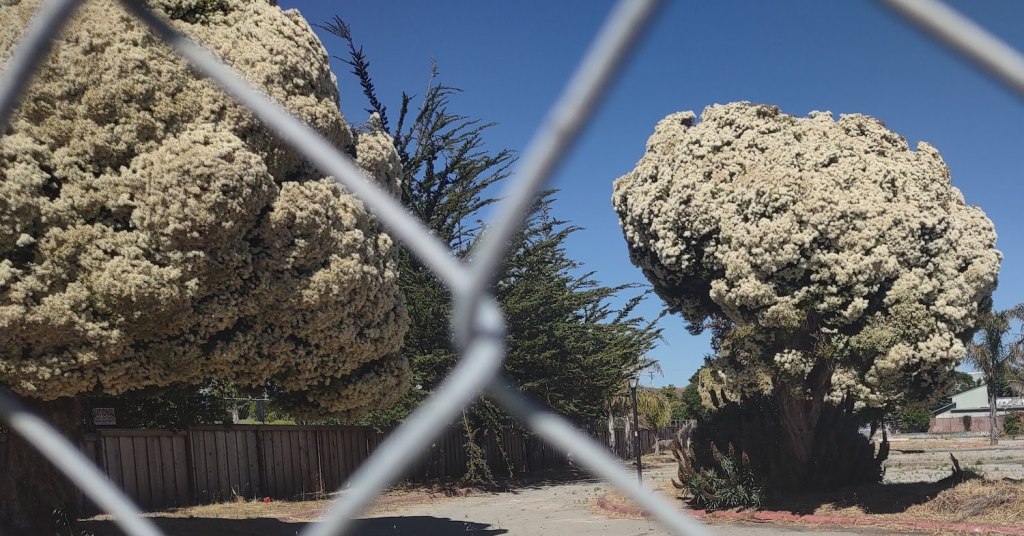
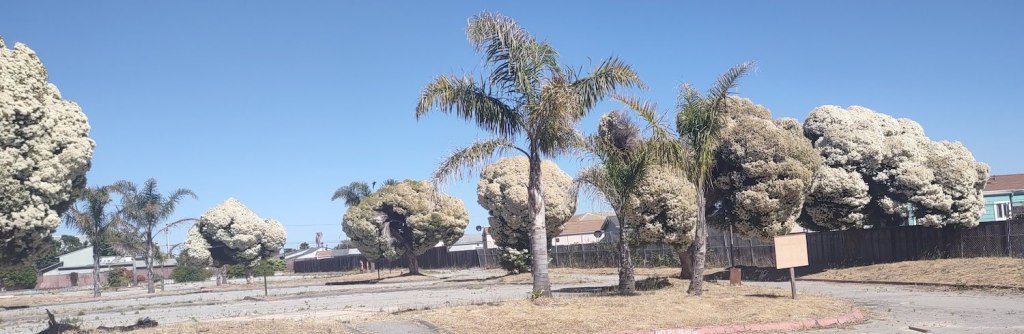
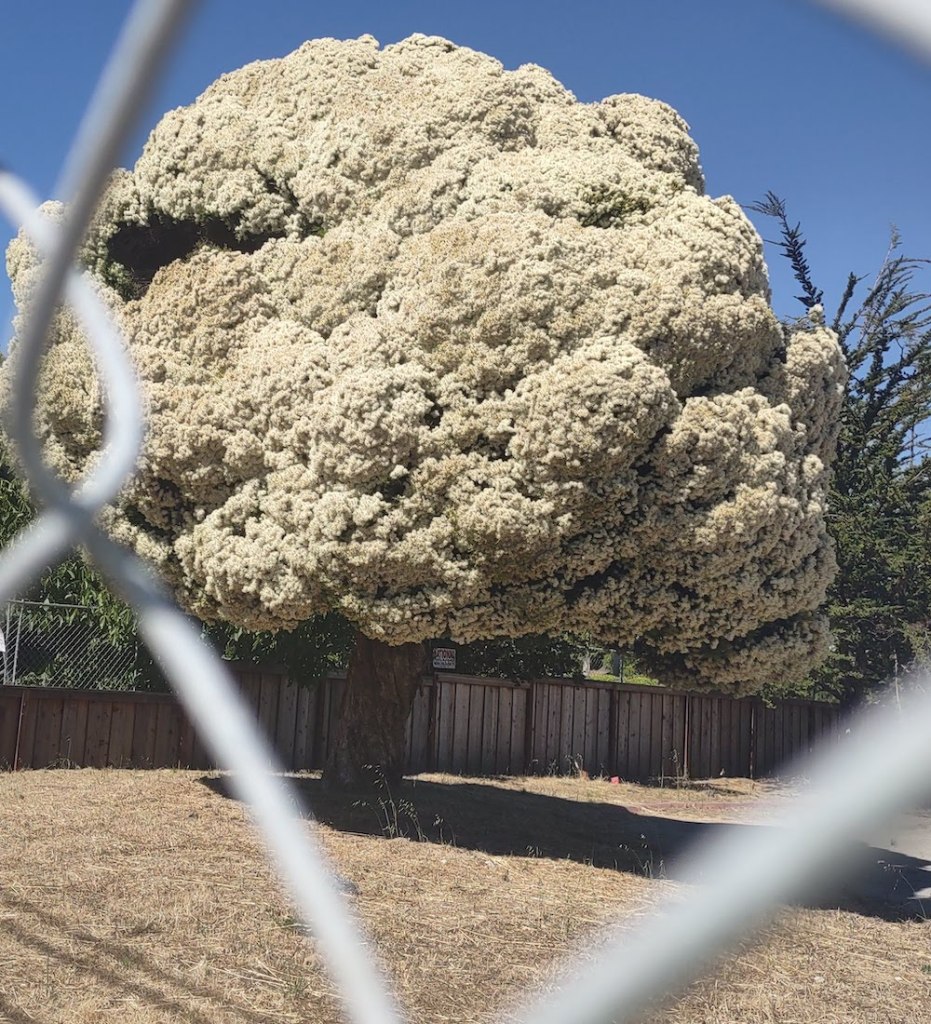
In my seventh California spring, I finally remembered to take pictures of the cauliflower trees. These are behind a fence, perhaps a rabbit-proof one? I love these trees because they are a sort of combination of California and Texas, a giant-sized version of a healthy food. As the Internet has taught us, a picture is proof of reality. Can you deny that these are real?

As I approach retirement I find myself more willing to waste time, almost as though this is the goal of retirement, and perhaps it should be. I find it utterly thrilling to spend most of a day on something completely purposeless, often a jigsaw puzzle or a math game, and feel deliciously relaxed afterward. Chores, however, seem increasingly onerous; I really don’t want to organize any closets or drawers, although I fervently wish they were organized. Where is Mary Poppins when you need her? I do have some success in gamifying dishwasher loading, which has some similarity to Tetris. Have you ever devised a dinner menu based on which vessel(s) you need to complete a dishwasher load? I have.

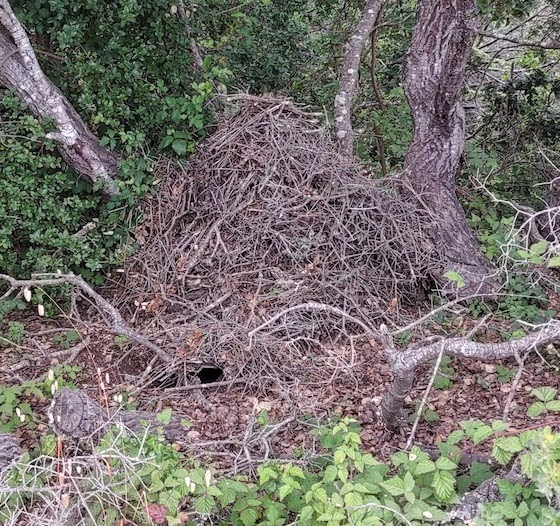
Although I’m sedentary when working on a game, I also enjoy wasting time in physical activities, which when combined with a shower can easily mop up several hours. What’s more fun than a Zumba class at the gym? I walk with friends several times a week, and hike with a Meetup group at least twice a month. Last week, in the hills above Wilder ranch, the trail had been moved, allowing us a rare glimpse of a wood rat nest. Neither wood rats nor their nests are actually rare, at least not according to my fellow hikers, but their nests are usually hidden farther from people paths. This one is about three feet tall and has a visible entrance, and probably also a back door.

I just finished lightly skimming/skipping Greg King’s depressing book The Ghost Forest, about the mostly losing fight to save virgin growth redwoods in California between the 1850s and now. For most of that time, the California Department of Forestry and the Save the Redwoods League, both ironically named, collaborated with corrupt politicians, notably including Dianne Feinstein, to cut the vast majority of ancient stands of redwoods in the state, and the efforts continue today, albeit at a slower pace; after all, there aren’t many gigantic trees left. Meanwhile, the FBI, assisted by northern Cal sheriff departments and, oddly, the Oakland police, harassed and on once occasion bombed preservationist protestors while refusing to enforce either pro-environment laws or free speech rights. A single virgin growth redwood can provide more than a million board feet of straight, knot-free, fire-resistant, rot-free lumber, used for everything from home building to water mains.

So now you don’t have to read that. I’m also going to reverse recommend (spoiler alert!) Eleanor Catton’s novel Birnham Wood, which, while well-written and fast-paced, devolves quickly from a light-hearted hippie-style nature restoration story to a full on horror tale with a rapidly mounting body count that doesn’t even resolve at the end. The villain is a tech billionaire bro gone wild, which is neither as funny nor as improbable as it may sound.

Someday I will get its more egregious images out of my head. Mindless twiddling combined with declining memory should help.

Fewer Than 1000 Words

This is a picture of a small rosebush in our back garden. I have been admiring it for the last few days because it is blooming so avidly, with many more blooms at the same time than it has produced during the previous six years. The more I look at it though, the more it occurs to me that it says a lot about me. If you want to play, spend a little time looking at it for clues before you read on.

First off, the weather. As you can see, it’s sunny and dry on the Central Coast. We had a rainy winter and spring, but we are back in paradise now. Our smart speaker predicted no rain for the next ten days this morning, and since we haven’t had any for the last ten, I turned on our Rain Bird. What, me water?

As my heritage-rose-obsessed friend assures me, there is nothing special about this rosebush. It’s not even native to our area. For the most part, we have accepted what was present in our small garden and been thrilled that neglect can’t kill plants in this climate. Besides, how can I go all hater on such a happy little plant?

Neglect would be the next obvious thing, or probably the first one for gardeners. Yes, there’s mulch, but it hasn’t prevented grass-like weeds from encroaching, and no one has taken time to deadhead. It has a few splotchy leaves–disease? pests? has anyone even wondered?–and clearly has not been trimmed or shaped in any fashion.

This is 99% due to my lack of skills in or proclivity for gardening in any form. My husband has some skills–he managed to keep us in tomatoes for a couple of summers–but gardening is vanishingly low on his interest list. As in, after those two summers, it vanished completely.

Not that I can’t make a case. Everything I read about climate change says, Get native plants. Wait, I haven’t done that. The next bit is usually, let the plants have a natural cycle, which I take to mean, Leave them alone. That I can manage. Bugs and birds and butterflies forage and nest and insert larvae into fallen stems and leaf litter, and we leave them to it for the most part. This particular plant may be a little neater than some others in our yard, but I have no intention of showing you those.

I do wonder at my own lethargy sometimes. It’s not a lack of energy. I have plenty of energy to hike, and give tours of the lab, and haul marine mammals off the beach, and folk dance multiple times a week, and stand for eight hours at my job. Looking at our garden makes me guilty, but then I go read a book and forget about it.

I have ideas for the garden and I would love for them to be magically enacted. I realize that in my cohort this would actually translate into, Engage a gardening service. My climate-savvy gardener friends seem to have trouble finding anyone who knows how to garden in ways that optimize nature; they spend a lot of time supervising to catch mistakes, and explaining why they don’t want to decompact their soil, for example.

I’m definitely not qualified to direct this activity.

I do have two native plant sites bookmarked though, and after retirement, who knows? Maybe I will need more activities to fill my time. Or maybe I will meet my dream gardener and hire her/him. Or maybe I will get a pet unicorn.

Insomnia Accoutrements, #FirstWorld Solutions

If Whole Foods customers are typical, lots of Americans aren’t sleeping well today, and customers seek advice on this all the time. I’m not a clinician, but clinicians aren’t really killing it on improving sleep any more than they are on reducing diabetes, obesity, anxiety, or asthma, so with a disclaimer, I’m comfortable taking a shot, especially since I’m an experienced insomniac.

The overwhelming number of influencer podcasts trumpeting the importance of sleep to all aspects of health has led me to prioritize sleep for myself with reasonable results, if setting arbitrary sleep goals (7 hours 15 minutes nightly) then using questionable technology (wrist tracker) to determine whether I’ve reached them counts as reasonable. The number of items I rely on regularly probably does not.

First I turn off my phone and banish all room lights. The equipment basics include a good mattress, a flat pillow, two sheets and a comforter. Then there are the accoutrements. Below is a partial list.

  • Side pillow
  • Electric heating pad
  • Wraparound sleep mask
  • Ceiling fan
  • White noise generator
  • Shea butter
  • Water bottle
  • Artificial tears
  • WF Sleep Support
  • Back scratcher
  • Flashlight
  • Post-it notes
  • Acetaminophen

The first five are used most nights. Shea butter is for my dry lips, which occasionally wake me, as can thirst and dry eyes. I use the melatonin-and-adaptogen supplement no more than 4X per month, and the back scratcher rarely, though when a back itch is driving me crazy it’s that or wake my spouse, a big No-No. The flashlight and post-it notes are for writing down swirling thoughts, ensuring I will address or at least remember them the next day. As a rule I avoid all analgesics, in fact all pharmaceuticals, but when my aging muscles can get achy after strenuous days, I take the hit to my liver.

That’a a lot of stuff!–and then there’s the process. If I can manage to stop eating, exercising, or staring at screens two hours before bedtime, I can usually fall asleep within an hour, but I can never do that, although maybe I should add my blue blocker glasses to the equipment list, since I use those to mitigate screen time when I remember. Glasses or not, most nights I will be lying awake, or dosing on and off, for a long time, during which I first try breath work, meditation, and clearing my brain. Next stage is mentally walking down infinite stairs or various dull numerical or alphabetical games that may bore me to sleep. I don’t get up to do something else or even read in bed. I lie there. For hours.

I realize how very lucky I am to be able to spend 9-11 hours in bed, which is what I seem to need to reliably reach my goal with at least one hour each of deep and REM sleep. I don’t wake up to an alarm, or if I do, it will be a sleep-deprived day. My clock display is turned off. My alarm is sometimes on to prevent oversleeping emergencies, but I wake up before it goes off.

Yes, it is actually possible to still be asleep after being in bed more than ten hours. REM sleep in particular comes late in my cycle. My husband convinced me the last two hours are most important, so if the morning chorus wakes me, I turn over my pillow and remind myself that the best is yet to come. A friend suggested I try going to bed later and staying there for a shorter time, and I tried, but no luck.

All of this is only possible in the semi-retired state. As a working adult and parent of school-age children, I had more stuff to do, so I had to be awake longer, and a lot of that stuff started early, so I had to use an alarm. I was sleep-deprived for thirty years at least.

Is all this sleep the reason I can now maintain my weight and experience high energy levels while awake? Who knows. Most of what we believe is illusionary.

Keystone Species: H. Sapiens

I recently re-reread The Grapes of Wrath for my reading group, and it was evocative, and thought-provoking, and even topical, and I remember why it is one of my three favorite books. I often disdain reading older non-fiction books though, simply because I assume they will be out-of-date. There are exceptions, most notably Weston Price’s Nutrition and Physical Degeneration and Lynn Margolis’ Acquiring Genomes, which chronicle knowledge our society has lost and rejected theories now accepted respectively. Nonetheless, when my husband offered me Nature’s Operating Instructions, having checked it out and decided not to read it. I noticed that it was a climate-oriented work from 2004 and nearly passed it up.

I’m still reading it, and already have dozens of new insights and at least one new Big Idea. A Big Idea is something that changes the way I see everything, or a good portion of everything, so a new Big Idea is pretty exciting for me.

Meanwhile I’ve had a new small idea about blogging which I’m going to try today. That idea is that I’m not going to fact check everything like I’m writing for the New Yorker. The first topic is a bulb called Bodicea, except I’m not sure of the exact spelling, but it’s close to that. I’m writing it like a genus name (capitalized) but it may be a species name or even a common name. It doesn’t really matter to the story and it takes a while to track this stuff down. I’m guessing most of you didn’t know I was doing that anyway so you won’t miss it.

Anyway, this Bodicea was a foodstuff for folks already living in…California I think…when European explorers arrived, and on into the 19th century. After the natives were sufficiently suppressed though, it disappeared. A scientist somewhere else, let’s call her Jenn, saw some Bodicea growing and tried to dig it up but found it quite difficult. She was surprised that a hard-to-harvest plant would be so beloved and manage to find an anthropologist, we’ll call him Kevin, who studied the tribe and knew a living person who had the story from his n-greats grandparent: the Bodicea were harvested at a particular time of year using a special stick to pry the bulbs out, then they were shaken before being placed into a basket.

Jenn recreated the stick and waited until the next particular time of year then approached her Bodicea patch. She was easily able to pry large bulbs from underground, and noticed that each was covered with smaller bulbs. When she shook the large bulb, the smaller ones flew off. She didn’t need her science cred to suspect that this method would not only provide food at this particular time but also spread the B. patch, but being a scientist she tried it for a few years, and so it was.

Which is to say, B. health and spread were dependent on humans just as orchids depend on pollenating wasps or forests depend on soil containing mycelium. These plants may survive without the partner organisms, but they won’t thrive. So now we have human beings as a key part of the web of life in at least one case.

There are others. The region of “undiscovered” California we now know as “the Bay area” was rife with forests of trees interspersed with meadows that supported huge herds of grazing ungulates, hundred-count pods of cetaceans, salmon runs so thick one could “almost walk” on them, as well as bear, wolves, and mountain lions. In every case, specific actions of humans can be linked to this surfeit of life, for example, controlled burning to manage forest undergrowth.

One tribe in particular, and no I’m not going to look up its name, was allowed to collect oysters from nearby bays until 1920. when the National Park Service took over and decided this was in conflict with Nature, which should be free of human interference. Though there were numerous oyster beds in pre-European California, there were eleven thriving ones until 1920, and now there are none. Or maybe one, I don’t remember. They died pretty quickly after tribal harvesting was banned, as tribal citizens said they would. The NPS investigated, and found that selectively removing the larger animals at a specific point in their life cycle allowed the smaller ones to spread out and grow, making the entire colony resilient.

The Big Idea, in case you haven’t see it yet, is that native peoples weren’t benefitting from robust nature in sort of a native Garden of Eden languor, but instead were actively managing nature to mutual benefit as a keystone species. Once you start looking for this, you find it everywhere, including a recent Science article on multiple managed tracts in the Amazon that still have superior soil, and the idea that natives managed huge herds of both buffalo and passenger pigeons, not least by maintaining the productivity of their habitats.

One corollary of this is that by separating us from nature, viewing it as something that happens far from us, we threaten not only other species but also ourselves. That is, we threaten nature not by our existence but by our absconding from our caretaker roles, to the extent that we hardly recognize natural cycles, much less support them, which could mean we will lose them.

In a life of perhaps excessive sci-fi consumption, I have encountered more than once the concept of a planet populated by humans whose surface is completely covered by cities, which could only be conceived by someone in this post-nature state of ignorance. What could the people on such a planet be breathing?