Excellent Octopus and Friends

At the Seymour Center, our aquarium curator provides a wanted-species list to a few of the research scientists associated with UCSC who have licenses to pick up animals from Monterey Bay. None of our choices is rare, so we usually get what we ask before the Exhibit In Transition sign has been up too long. There is usually a red octopus on display, a new one every year or so since their total lifespan is only two years.

The red octopus is perhaps the lead attraction in our facility, at least in terms of inspiring hope. Everyone wants to see an octopus, yet an octopus does not wish to be seen, so much searching and yearning is involved. If our octopus is provided with a hidey hole, therein it will lie. Otherwise it might lurk in the dark corners at the very top of the exhibit, behind the signboard. Occasionally it will spread its arms and glide across the front of the tank, imbuing any visitors or volunteers in range with a my-lucky-day feeling. Quite rarely it will remove its bottle stopper and extract food while a human is present, and that person should immediately purchase a lottery ticket.

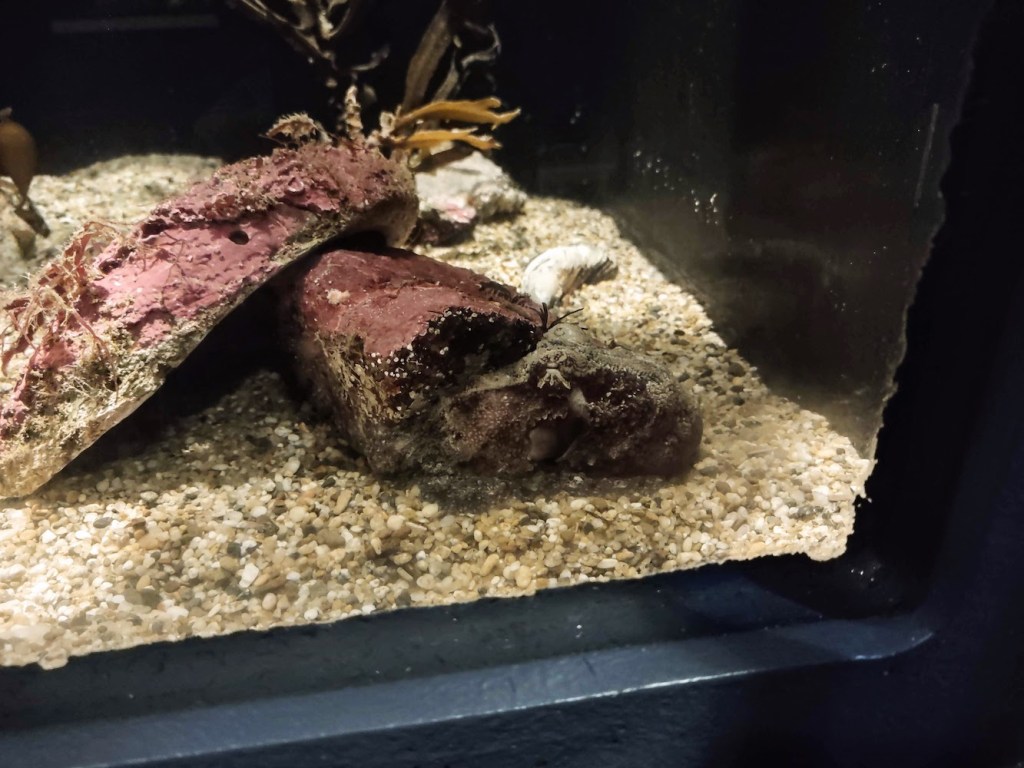
Sea-creature-following readers know that the red octopus is not red, or at least not reliably red. Like all octopuses it can change both color and texture at will to match its background, and our current octopus is a master of this art. It frequently forms a rock and poses right at the front of the tank, fooling all but the most assiduous viewers. In the picture, the small rock at the right is the octopus, just in front of a larger rock, which is partially under an even larger shell. The “octopus rock” is perhaps 5″ wide and 3″ tall.
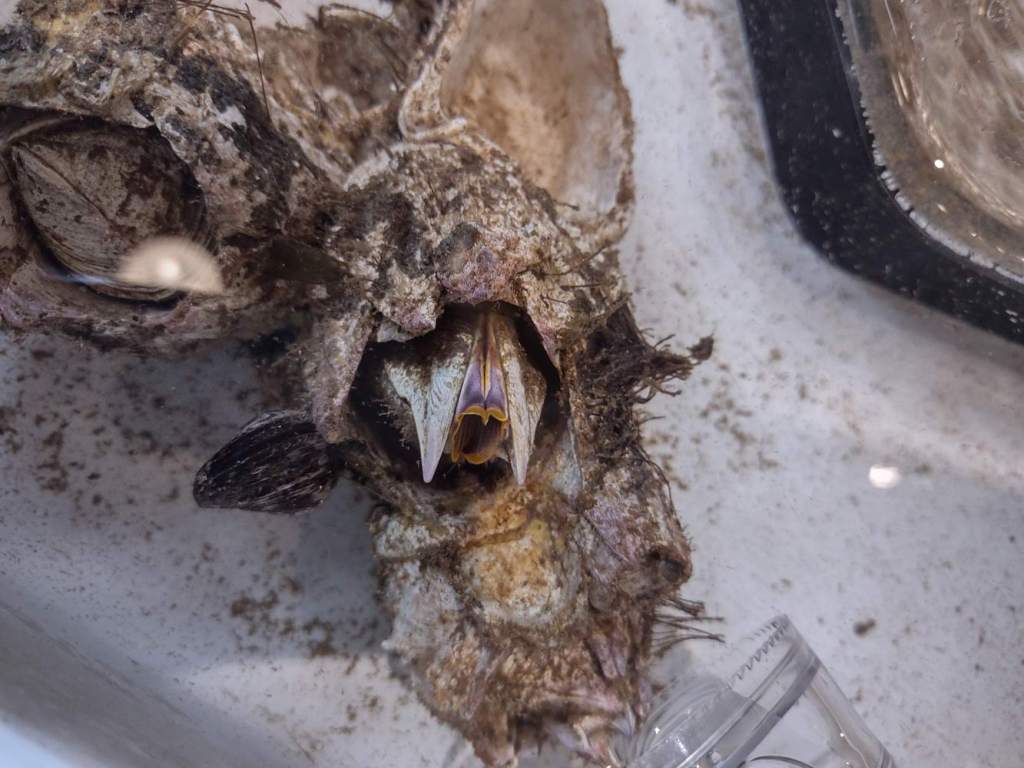
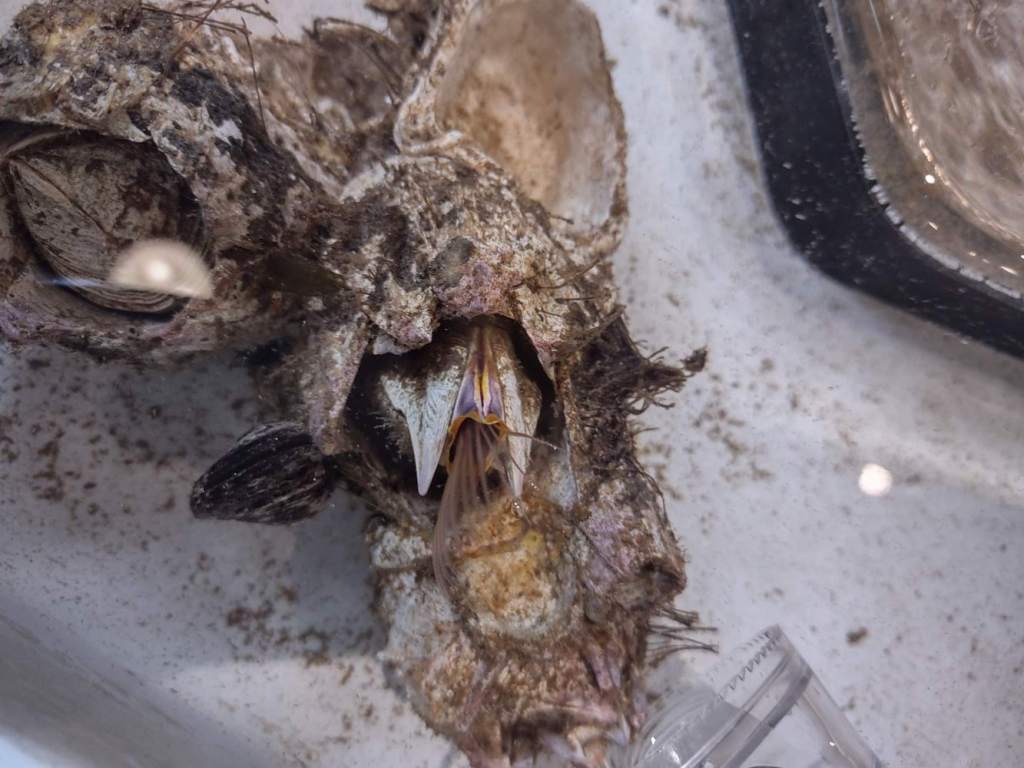
We now have acorn barnacles for the first time, living in a shallow display with no chance of escape, but since their entire bodies other than their feet are inside their shells for their adult lives, they may not realize this. They seem to feed at will, stretching feathery feet into the water to capture brine shrimp, who also have no chance of escape. Pictures below show first resting, then feeding; look for faint fonds extending out the opening between the two spikes. These animals are about 2″ in diameter.
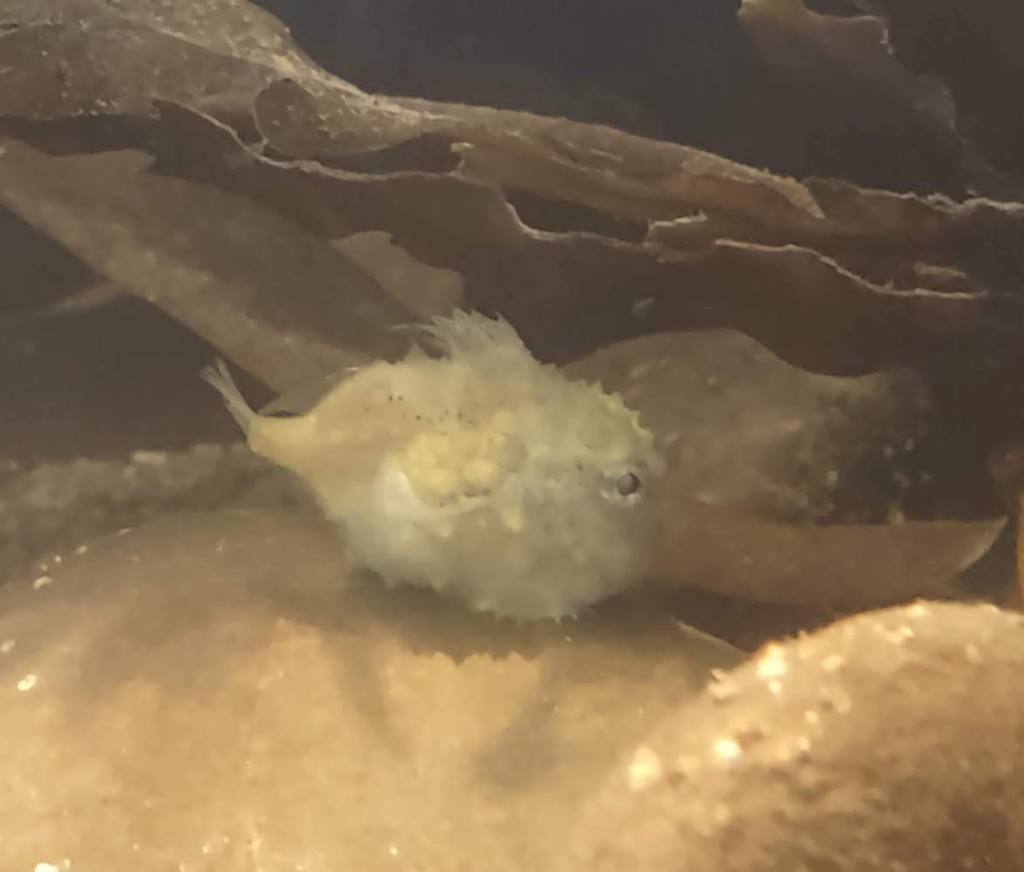
Seymour also keeps trying to display lumpsuckers, but it’s sort of a depressing cycle. Inevitably we start with a tank full of adorable, plump, 1″-long fish-corks wriggling vigorously to swim at a slow pace, hanging out together, even mating and laying eggs. Over a few short weeks though, the numbers drop, and soon they are all gone. We never seem to get any babies either. We volunteers ask why, and the answer is, Lumpsuckers are hard to take care of. I realize all aquarium animals are captive ambassadors for their species, not wild and free creatures living their best lives, but the rate we go though lumpsuckers is a bit alarming. However, our most recent batch has one determined survivor who has been living in regal solitude for weeks: Behold, The Last Lumpsucker.
It’s pupping season for marine mammals, and my TMMC volunteer work has been exciting lately, with multiple rescues and feeds per day, many taking place in the rain and/or darkness, since California is in a decades-high rainy season and the feeding window for these creatures is 8 am to 10 pm. We don’t take publishable pictures, though rescues are often filmed by bystanders. Maybe all this time spent volunteering with animals is why I don’t miss having a pet.

Carpe Noctum

These are the final words of Johan Eklof’s book The Darkness Manifesto, at least half of which is about light, naturally. Although it calls attention to the looming threat of light pollution to our planet’s biota, the work includes new fun facts about vision, plus the good news that this problem is easily solved, with examples of piecemeal progress.

As with many of our self-imposed crises, this one mostly affects non-human animals. Birds, bees, bats, and insects are among the creatures so dependent on natural light cycles that they literally stop mating, or fail to successfully feed, when signals from the sun, moon, and stars are blocked by artificial lights. Yes, stars. Amazing numbers of animals, most of them very, very small, rely on information from starlight to live, including the location of Polaris. Some even react to the zodiacal light.

Many plants also require a certain number of consecutive hours of dark/light to flower or set seed. The interactions among pollinators, ie all the animal types listed above, and plants, including timing coordination, are threatened on a fairly large scale, as described in the most worrisome sections of the book. Insect populations in particular have decreased by at least one-third in the last fifty years, and possibly closer to three-quarters. Kids my age, do you remember all the insect splats on the car windshield during family vacations? If you still take long distance drives, as we certainly do in the Golden State, you’ll know that’s no longer a problem, unless you just happen to encounter a Biblical event in progress.

Humans aren’t immune from the effects of decoupling our wake/sleep cycles from nature either, with sleep deprivation (duh), obesity, and some cancers already linked. An amazing hospital in Sweden with interior lighting that mimics outside light in color and intensity all day long, then at night provides minimal illumination only where needed, claims to have seen health improvements among both patients and staff. Having spent late hours in glaring ER lobbies, I believe it.

In order to take advantage of light/dark cycles, creatures have to be able to perceive and process some portion of the electromagnetic spectrum, and since the sun, moon, and stars predate all life, nature has evolved lots and lots of those systems. I thought I knew the human version pretty well, and was amazed to learn that we all have excellent greyscale vision after dark. To achieve this ultimate night vision, you have to be away from artificial light for 30-60 minutes, and the clock resets every time you peek at your phone. Some millennials living in megacities like Singapore and Hong Kong may have reached adulthood without once experiencing this.

I knew that our eyes contain rods for grey vision and cones for color vision. I did not know that while we have three cones, and birds have four, the color vision champion of the world is the mantis shrimp, with 16 cones! Humans have no way to even imagine what “colors” the mantis shrimp can see. We can do a little better guessing what animals that have ultraviolet or infrared vision might be seeing, since we have created instruments that can “look” with those spectra. Migrating birds though, may use quantum entanglement in their eyes to see–no quotes!–the Earth’s magnetic field. I imagine looking down from the window of an overnight flight at a glittering geodesic sphere enveloping the Earth.

Reducing light pollution with timers, motion detectors, downward-facing shades, and red-spectrum or reduced intensity sources are some of the current-technology fixes that could rapidly turn this problem around, and light designers, who see themselves as artists working with light and shadow, have embraced this book. Darkness is being recognized and protected around the world from national parks to city suburbs. Deep-darkness vacation destinations, from the obvious astronomical-phenomena-based ones to nighttime safaris, are now a thing.

Need another reason to read it? The chapters are short and the book is slender.


Fetters of the Past

I forgot to bring a book to work the other day. I only have three breaks during a full work day, two 10-minute and one 30-minute, but I have two goals for those breaks, firstly to sit down, secondly to read. I occasionally chat or shop during my breaks, but reading is most rejuvenating, removing me from the workspace entirely.

We live ten minutes away and if I had forgotten my phone or my work shoes, I would have called my husband and thrown myself on his generosity, which while copious is not something I want to abuse, and besides, my own department stocks the magazine rack, so I decided to grab a magazine and return it afterward. I laid it Very Carefully on a clean surface. Happily I had brought one of my neater meal choices.

Our store’s magazine rack selections are less provocative than those of an airport newsstand, and I did not have a lot of time to browse. I selected a National Geographic on the human body, sort of a salute to my childhood. NG was a revered, authoritative source in the household of my growing-up family, and I read NG avidly through elementary and maybe even middle school. I remember my father paid me to index (using cards!) our collection when I was 11 or so, too young to babysit yet anxious for spending money. I remember NG as sciency.

This issue disconcerted me. No wonder I mastered it as grade-schooler; based on its vocabulary, level of detail, and sentence construction, that’s the target age. Much of the writing was so vague as to be information-free, and a few factual assertions were actually obsolete.

I am the sole remaining member of my natal family, so I can’t fact-check my memory with anyone. Did the magazine change? Or is this just another example of how the past continues to flout us as we age?

I spend a certain amount of time in the store talking to people who are stuck in the past when it comes to health and nutrition–and, I should hasten to add, lots more time with people who have researched the latest thing and want to discuss why we don’t carry it. The stuck ones often have attitudes along the lines of, If it was good enough for [insert generation here] it is good enough for [insert following generation here]: my parents/me, me/my kids, that sort of thing. I agree with this somewhat–I might “kill” to have access to the un-industrialized food of my grandparents, for instance, but that menu is not on offer now, so the good enough part doesn’t scan.

Some of my memories can be verified. Crowd scenes from the 70s, for instance, confirm my memory that overweight people were rare then. My mother was overweight, and I was the only person I knew with an overweight parent. There was a fat boy in my grade, and we had a snarky nickname for him, which he put up with, partly because he was the only one.

About ten years after getting my undergraduate degree in biomedical engineering, I remember reading about chaos theory and realizing that everything I had learned about homeostasis was being rethought. Experiences like that, as well as the fundamental changes in our daily lives during my lifetime, had led me to believe that I was untethered from my past. Yet there I was, bereft and adrift by the discovery that NG was not what I remembered, and more fundamentally, that in some core I am sheltering a lot of beliefs that were never real.

The only way out is straight through! I will embrace the present, live a balanced life, and seek to understand the past as described by the scholars of today, with no reliance on the experienced past residing in my leaky brain.

Moving Backward

There are plenty of important things I could blog about, but I’m in a slough of despond so I’m going to share. Fun? Not! Maybe it will spark some regeneration for my spirit though.

Last week I got a cold, which for me was a severe cold. I often say, I never get sick, but it really isn’t true. I do sometimes have a logy period, or a slightly leaky nose, or a persistent small cough. What I never do is alter any of my activities due to same. Last week though, I woke up with a fever of over 101 degrees F on a work day, and I felt really lousy. Even my boss, hard-hit because we were already short-handed, pointed out that I should rest for at least 24 hours. I also had a painfully scratchy throat, so I went to urgent care (is that rest? I sat around waiting for three hours) and got cleared on both strep and Covid counts. By that time the fever portion was over.

The next couple of days I was still feeling substandard, so I took it easy, in my own fashion. On Sunday we went to see Falstaff in San Jose, and my husband drove, dropping me off to minimize the need for me to walk. We went out to dinner afterward, where I drank only water. On Monday, I worked at the store from 11-5, choosing when possible less strenuous duties, and rested the remainder of the evening afterward. On Tuesday I rested all day. Toward the end of that day I found myself thinking, I’m back! Bill was at class, so I made myself dinner, then got up from the table to walk into the living room.

I’m not sure what happened then. I fell, obviously, I remember falling. I don’t remember why I fell, or why I couldn’t break my fall with my arms, but I face-planted onto the side of my head, leading my glasses frames to carve a second eyebrow under my regular one, and deeply bruising the entire orbit of my right eye socket. I didn’t know this immediately, of course. What I knew is that I was on my hands and knees howling as buckets of blood poured from my face and spread across the dining room floor.

For a while I just lived the moment. Then it occurred to me to wonder if I had broken anything, like my nose (also bleeding) or my eye socket. I couldn’t see anything, and I wasn’t worried enough to drip blood onto the bathroom floor (newish) or any carpeted area. I looked outside to see if anyone was in the parking lot then tried to call a neighbor, but no luck. I left a message for my son to try to reach my husband. I poked my face and decided based on the pain level (low) that nothing was broken.

Being female, my next thoughts were of cleaning. The hot tub towels were piled nearby since it was raining outside, so I used one to mop the floor and my face, not in that order. I noticed blood on the tablecloth, removed it, found more on the table, wiped it up. By this time my own bleeding was manageable with a smaller towel, so I carefully removed my shoes and examined my socks, then ventured into the laundry/bath area to get one. By the time my husband got home an hour or so after the event, all visible-to-humans blood was gone and the linens were in the dryer.

I had–and have–a huge shiner around my eye, and my husband felt the laceration warranted stitches, so off to the ER with us. That took four hours, and I got four stitches, one for each hour. We got to bed at 2:30 am.

Less than six months after achieving Medicare, I am an elderly person who injured herself in a fall. For 2-3 weeks I will be either sharing the monstrosity that is now my face with others or, more likely, wearing a vision-impairing eye patch, which invokes curiosity but not nausea. A choice of social nicety over efficient function? Mostly I am thinking that once seen, this deformity won’t be erased from memory, and I don’t want my customers and co-workers to retain that image of me. But I will not be able to completely shake the image myself.

I wish I could feel more pleased with my relative resilience than despairing over my fragility, but Proximity Matters. If I don’t have any more time-absorbing, feature-destroying, work-missing incidents for, say six months, I will start to feel safer, but at the moment I feel justifiably paranoid. This could be the start of the precipitous slope to disability, aka the time when I start becoming my mother.

Weaponized Earthquake

I’ve never solved the mystery of why some people are easier to befriend than others. My first college roommate was a perfect match on the shared-interests questionnaire, yet five minutes after we met we knew it wasn’t going to work. We spent the next eight weeks avoiding each other until we had met enough other freshmen to arrange a swap.

I’ve also hit if off with folks immediately, really liked people who’ve rebuffed me, and cautiously avoided others who are made an effort to hang out with me. My closest friends are whose who see the world as I do, though I have grown apart from some other the years. I also have a few very close friends who don’t share my worldview at all. My best guess is that it mostly comes down to chemistry.

Work friends are different. I’m friendly with a lot of folks at work, then after I leave or they leave, I never see them again, with a few exceptions. There are some who are more fun to talk to than others, and since work friendships tend to start with work-related contact, work friends are more likely to have different worldviews from my own. My current job is no exception. In particular there are two people I would call young men, probably late 30s or early 40s, with whom I interact frequently even though they are conspiracy theorists.

I’m willing to listen for the most part, though I vocally disagree–not arguing point by point, just pointing out that I don’t believe the Earth is flat or the government wants to enslave us, and that Internet sites are not going to persuade me. I do not want to mislead anyone into thinking I agree, but I also don’t want to reject someone because we aren’t in sync on every topic.

After the huge pair of earthquakes in Turkey Feb. 6 however, these differences feel more consequential. Conspiracy theorists feel every significant event must be a conspiracy, including a very plausible news headline such as Large Earthquake in Turkey. These work friends were quick to explain that this was an attack on Turkey by the US, which has weapons capable of creating seismic events much bigger than Mother Nature can manage. This makes sense, they assured me, because of all the other weather-related weapons we have: The US can create torrential rain at will, and Israel has at least one submarine that creates tidal waves.

I made the mistake of bringing up the northwest Pacific coast earthquake that sent a 10-foot tsunami across the entire Pacific to Japan in 1700. Briefly I’d forgotten that everything humans might know based on sudden drops in land masses, massive death of forests, survivor reports, or tree ring, fossil, and sediment strata observations, is cat food compared to the wealth of (heavily recycled?) Internet evidence of weaponized weather.

Can we please send some of the dial-it-up rain to California before fire season starts? I’m sad that our Wakanda-level tech is never used for good, or I would be if I believed in vibranium.

Meanwhile, with a current death estimate of 41,000 in Turkey and Syria, I feel the need to disengage from the deniers. At some point it is offensive to say to the survivors, Whatever you think happened, we know better. Worse, it sets us an expectation of victimhood for the next weather event: Don’t blame Mother Nature or your God; other humans are doing this to you intentionally. This substitutes cynicism for empathy in those unaffected, and revenge-seeking for remedy-seeking in those afflicted. What the world needs now is empathy and remedies!

Spare is Amazing?

I was surprised when my digital library copy of Spare, the memoir by the Duke of Sussex, whom Americans, perhaps incorrectly, call Prince Harry, arrived within two weeks of my hold request. As a Crown fan I was curious enough to try it, despite risking opprobrium from the Scottish country dance community, or at least the Brits therein.

It turned out to be a supercharged version of my life as a Whole Body team member: Listening to someone you don’t know describe his most intimate experiences, revealing rich amateur couch-diagnosis fodder–and I don’t even have to come up with a recommendation! This is not an expose´, rather a cry for help. I devoured it.

When Diana was killed, Harry was 12. He never saw the body, so he thought she was just hiding for five or even seven years. His brother had the same idea separately–they grew apart rather than bonding after this event–but gave it up sooner, concluding that she would have found a way to contact them sooner. Left with only non-hugging adults in his family giving him buck-up style comfort, he fell into predictable depression, marked by scholastic underachievement and substance abuse.

Some spark kept him searching for succor and he found three primary sources: the military, Botswana, and charity work. He had several military tours in which he served with distinction, but each was cut short by his notoriety, which made him a target that endangered his unit, and/or Palace demands. In Botswana he made some lifelong friends, one nearly a mother-replacement, and found peace and spiritual connection in the wildness of the land. His charity work embraced both, focusing on disabled veterans and various overlooked needs of African people and animals.

The bane of his life was, and is, the things that killed his mother: Paparazzi. He calls them paps. Their level of intrusiveness is staggering, because the payoff for getting a photo of a royal, or even a friend of a royal, is staggering. The royals themselves can avoid this by staying inside their secure palaces, but all friends and especially love interests are pestered continuously, sometimes even after ending the relationship. One of Meaghan’s dogs went insane from people surrounded her house day and night, ringing the bell and knocking on windows. A previous girlfriend killed herself, years after eschewing the relationship. All of Harry’s serious girlfriends before his wife left him due to paps, and Meaghan briefly contemplated suicide due to the stress.

As a royal, straying outside the bubble means enduring constant harassment, often at very close quarters. Think about riding your bike to the grocery store, or walking along the beach, or eating at a public restaurant. Those are the sort of things royals can never do without either security or disguise, and paps are specialists at breaching the latter. Late for an early date with Meaghan due to traffic, Harry is frustrated when she asks him to just walk the last few blocks. If he did that he might “start a riot,” plus his bodyguards would have to get out and try to protect him in an uncontrolled environment, a big ask.

I am going to stop buying those big lottery tickets, and to enjoy what I hope will be lifelong public anonymity.

More shocking than the constant clamor of the paps was the political infighting among the royal staffs. There are at least four major groups, supporting QEII, Charles and Camilla, “Willy” and Kate, and Harry, later together with Meaghan. Representing the Spare to the Heir, Harry’s staff is smallest and least powerful. Each of these groups views the others as rivals for positive public opinion and media coverage, and some staff members as well as at least one principal (Camilla) were infamous for leaking negative information about rivals to the paps. We have seen some of this in The Crown, for example when Charles is angry with Diana for making Camilla look less compassionate by comparison when Diana hugs a child AIDS-sufferer in NYC, and also when C&C hire an agent to build their brand so she can become his wife and later his queen, an obviously successful campaign that led to a permanent position.

One example from the book. Meaghan is required to wear a tiara at her wedding, and she is planning to wear Diana’s, when QEII unexpectedly summons them and offers M. a choice of five tiaras of hers. All agree that one of those is perfect for M. QEII reminds the couple to have the tiara sent over soon since there is quite a bit of prep getting it to work with the veil and the hairdo, and refers them to her assistant Angela. Harry proceeds to contact Angela multiple times, always respectfully, asking for the tiara to be sent over, but gets no response. As the wedding approaches they are about to revert to the first plan when A. abruptly arrives with the tiara and paperwork to sign. After the wedding, A. leaks a story to the press about how M. demanded one of the queen’s tiaras, then harassed her about sending it over immediately.

The tiny grain of truth in this otherwise preposterous rendition renders it impossible to officially refute, according to The Palace. This sort of thing happens repeatedly, and get very ugly when the stories turn to racism. Honestly, I never watched Suits, and the pictures of Meaghan I have seen did not scream African-American to me, but her mom is, and it appears that quite a few Brits, not just the Bring-Back-Boris fans, are horrifyingly concerned about the darkening of the royal lineage. Unclear how the royal family themselves feel, although none of them made any serious effort to quell the ugliness.

Having written this, I read Meaghan’s Wikipedia page for contrast, and that it provided. Many of the same events of her life since 2017 were described therein without drama, and I imagine the Duke’s page would be similar. Is this book a fever dream? While I was reading it, I felt Harry was standing before me, revealing details I would not share with my best friend if in his position. It’s hard to resist someone so compelling and vulnerable who is pouring out his heart, but I can sense that this immediacy will fade. Truth is elusive.

MIA: Obvious Man

Remember Obvious Man? What an anachronism! Nothing is obvious any more, at least not to our political, academic, and media elites.

Latest evidence of this is recent trending news of China’s new “catastrophe,” a falling birth rate. Obvious Man would have said, Human population reduction is always good, and everyone would have known why that was obvious. Now it would need to be explained, to wit, a huge amount of human activity, associated with a huge amount of humans, has changed everything about Earth from its climate to its tilt; a lot of the humans are struggling or starving; ecosystems are being decimated to produce more disease-producing non-food.

Instead we have Capitalism Man, who explains that the only imaginable way for humans to organize themselves is to have younger humans donate part of their wages to support older ones, so China has to create some babies who they can quickly grow into wage-workers. To which O. Man might retort, Accepting your premise, though it seems dubious, China could achieve this goal sooner by inviting the underemployed folks willing to travel for work, like the ones who just finished building all the World Cup venues in Qatar, to China where they would instantly contribute to the economy.

If their families were also invited, the solution would be long-term.

About last year’s oil price rise, O. Man might have remarked, What a great motivation to stop using fossil fuels! Even C. Man could have commented on market forces now favoring renewable energy sources, if he hadn’t been too busy making deals with murderous sheiks to resume flow-as-usual. News reports mostly went with sound bites: Pain at the Pump!

O. Man would have had a field day with Covid. Obviously:

  • Unless cancer screens are useless, canceling them will result in more cases of cancer. [It did.]
  • Working at home is not an option for 90% of American workers, so if folks need to stay home, they will need to be paid to do so. [Zero support for this option, since those controlling the funds were mostly in the 10%.]
  • Either cancer or heart disease kills more people per month than Covid, so to reduce unnecessary deaths, we should make the lifestyles choices associated with avoiding those diseases available to everyone. [We have been living with a much higher unnecessary death rate than Covid created for a while with no outrage.]

Jill Lapore’s extraordinary critique of the January 6th Report in this week’s New Yorker includes a characterization of what we once termed the Chattering Classes that gives us a clue as to why no obvious questions are ever asked, or alternate societal organizations explored: “…elite[s] … increasingly living their lives in a Met Gala to Davos to White House Correspondents Dinner world….”

That is, so cocooned in our greed-driven faux meritocracy that they can’t or won’t criticize it.

Not So Fuzzy Animals

I’m almost done reading Mary Roach’s Fuzz: When Animals Break the Law and I’m keen to blog about it, having failed to resume sleep during my tenth hour in bed. Roach is an entertaining writer, though I haven’t read many of her books because she loves to write about gross stuff, eg cadavers, while I have a squeamish nature and like to read during meals.

Fun facts I’ve learned include:

  • Residents of outlying areas of Aspen allow voracious pre-hibernation bears to enter their homes and raid their refrigerators. The bears in turn are careful not to disturb other items in the houses.
  • Animals under attack often vomit not out of fear, but in order to tempt their prey with an alternate food choice. This strategy also deters human attackers, though not for that reason.
  • Deer don’t “freeze” in headlights; they simply don’t see the attached car. An invention that illuminates car grilles with UV light significantly increases cases of deer exiting the roadway in time, and is currently patent-pending in the US.

In addition to animal scofflaws, this book addresses animal/human interactions of various sorts worldwide, with humans on the iniquitous side of the equation as often as not. I will now share the startling story of sunflower seed farming. This story may make you briefly allow your heavy head to droop toward the ground.

Huge sunflower farming operations in the Dakotas lie directly in the path of migrating birds during harvest time, and their owners have been battling mightily to stop those birds from landing for a meal en route. You read that right: Farmers are trying to stop wild birds from eating birdseed.

Quick fill-in-the-blank quiz: This is a(n) ________ battle.

Losing was a good choice, although there are others. The birds take 1-2% of the crop, which is less than is lost by the combine during reaping. The flocks also consume tons of insects which would otherwise damage the plants, so one could posit that remuneration is more appropriate, but depredation is what is on offer. The sunflower-farming operations have poisoned, bombed, shot, and frightened the birds, with 200,000 or so killed most years, through at least 2018.

Quick True/False quiz: The proportion of seeds eaten by the flocks has been reduced during this campaign.

Of course the answer is False; quizzes never have an obvious T/F question, though you would be an odd duck if you weren’t asking, Why not? Mostly because the balance of nature can’t be completely destroyed by humans. When populations are reduced, there is more food for the remaining creatures, so they are healthier for reproduction, producing larger litters and/or having more offspring survive to adulthood.

Extinction would work, if it is even possible to kill all of any given type of bird, and No, I’m not going to quiz you for counterexamples. In this case, multiple species of mostly songbirds are involved so extinction attempts might hit the news media and generate some outrage among the public, for a few days at least.

What is really keeping me awake as far as sunflowers go is, should I be eating them in my salads? I already try to avoid industrialized nut and seed oils, including sunflower oil, but it’s getting harder; at work I’ve noticed their use expand beyond processed foods into body care products. I’m pretty sure the USDA Organic rating does not cover this case, since it specifically addresses biocides. I also wonder whether sunflowers should continue to be considered vegetarian fare since songbirds are killed in their production. All of which leads to the question I avoid: What else don’t I know?

We have a lot to be outraged about. It’s tiring. However, I hope that won’t deter you from reading this book. There are lots of amusing and encouraging stories, including a chapter about how albatrosses ejected the US military from Midway Island. Whatever the topic, Mary Roach makes you LOL on every page.

Umwelt

I recently read Naming Nature by Carol Yoon, which is ostensibly about taxonomy but turns out to be about umwelt. After reading the book I thought I understood this concept, but having just scanned a portion of its Wikipedia page, I’m dubious. Herein I will follow my original impressions, but please don’t regard this as reference material.

Living creatures create hierarchical maps that categorize and describe other living creatures, both flora and fauna. We can only imagine the umwelten of creatures that live underwater, say, or hunt by echolocation, but the umwelt of humans appears to be consistent throughout history, with diverse populations of humans using essentially identical models of life. While cultural variation of course exists, overall every human group has devised groups such as mammals, fish, birds, bugs, trees, shrubs, flowers, and so forth. That it is not obvious that this should be so is best illustrated by the rare exceptions, such as the tribes who classify a cassowary as a mammal, or various orchids as human body parts.

That umwelt is innate is also suggested through rare medical cases, the sort of thing you may remember if you read The Man Who Mistook His Wife for a Hat. People suffering from damage to certain brain areas can easily name any manufactured item, such as a pencil or a car, but are at a loss for the name or even purpose of any living item, such as an apple, or a cat, or an oak tree. One hospitalized patient was found attempting to eat his bedsheets, because although starving, he was unable to identify food.

This points us to the value of the umwelt: it allows us to sort the world into categories so we know how to interact with, well, every living thing we encounter. Some things are edible, some might eat us, or poison us. Some are useful for building boats, some cure diseases, or provide shade, or are appealing and rare enough to be traded for something someone else has that we want.

For most of human existence we only had to know about a few thousand other forms of life because most of us didn’t travel too much. As transportation modes developed, more folks traveled, and as communication became global, those were able to report their findings of nature’s enormous variety to everyone else. Being umwelt-driven, we categorized the new stuff initially into relationships that were subjectively determined, mostly by observable characteristics, and that aligned pretty closely with our umwelt. A lot of this work can be credited to Linnaeus. Darwin pushed for an evolution-based sorting, but we didn’t figure out how to do that until we could read DNA, which allowed us to create a hierarchy based on molecular evidence.

Yoon posits that this classification transition, from that’s-a-butterfly to sequence-a-sample-in-the-lab, has effectively severed humanity’s connection to nature, taking away our ability to make sense of our world. For example, if a fish is something that looks like a fish, then a lungfish, a salmon, and a whale would all be one, and for most of our existence, they were. Now scientists tell us that whales are mammals, and lungfish are evolutionarily closer to cows than salmon, so actually “fish” is not a category. We can all see that there are fish, yet science is so sure that there aren’t any, so we sort of give up on the natural world. Post-genetics, it doesn’t make sense to us in any useful way.

It’s true: current scholarship does not recognize “fish” as a meaningful word in science.

These may seem like radical ideas, but this is the second book I read on this topic–the other is Why Fish Don’t Exist by Lulu Miller–and the arguments resonated for me. It explains why people resist evolution, and why perhaps we should. Since the umwelt is innate we can’t not have one, and, in a horror-movie-level twist, Yoon proposes that those of us in the most “advanced” civilizations have substituted brand identification. She claims that while four-year-olds raised in natural environments can identify 300 plants, the same age-group raised in artificial environments can identify 300 logos. Yipes.

My late friend Jackie, a somewhat business-oriented engineer, who often said Yipes, liked to assert that Marketing Works, but she could never definitively explain why. Maybe this does.

Finally, Yoon also attributes lassitude over climate change to umwelt disruption. Picturing all these different species, thousands of them, most of them meaningless to us in any practical sense, that are now threatened is, well, abstract at best. Even if we want to care, how can we? Why should we?

DV III: The Extremes

Our last full day in Death Valley was one of extremes. Of course we visited the lowest point in the Western hemisphere, Badwater, a salt flat which is 282 feet below sea level. The Eastern hemisphere owns this record, though, with the Dead Sea at -1385 feet, and several other sites in the negative hundreds. Looming behind the parking lot at Badwater is a cliff with a sign marking the sea level; as you would imagine, looking up that sign can be spotted about 28 stories above your head.

Towering over Badwater on the far side of the valley is Telescope Peak, the highest point in DV at 11,331 feet above sea level. We did not go there, as it would have been about a three-hour drive, but we could see it, and anyone on it could probably see us, since its name honors its 100 mile views in all directions. On the far side it overlooks Panamint Valley, which is part of DV Nat’l Park and very much resembles DV.

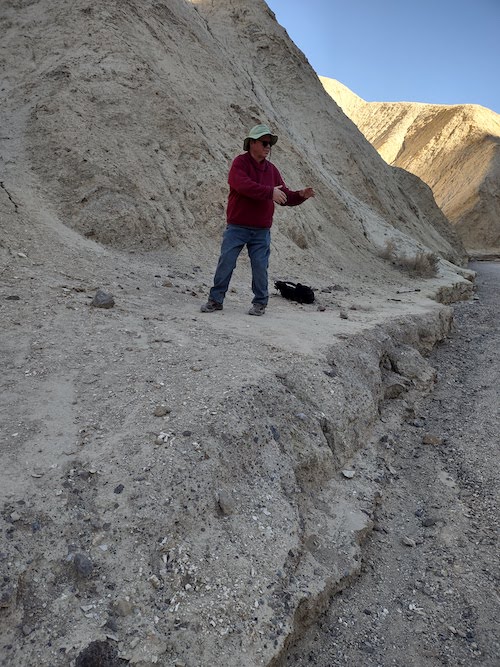
We also experienced some extremes of color. These are relative extremes, because colors are subtle in DV. We hiked Golden Canyon, whose various golds contrasted with a reddish iron cliff at the end of the trail. You may be able to discern some color in the photo. There’s also a shot of my husband doing Tai Chi on the trailside. The hiking stick lying beyond his pack will be left behind. I was fated to leave part of my computer charger in the room the next day. Our brains may have been affected by the extreme dryness of which numerous signs warned.

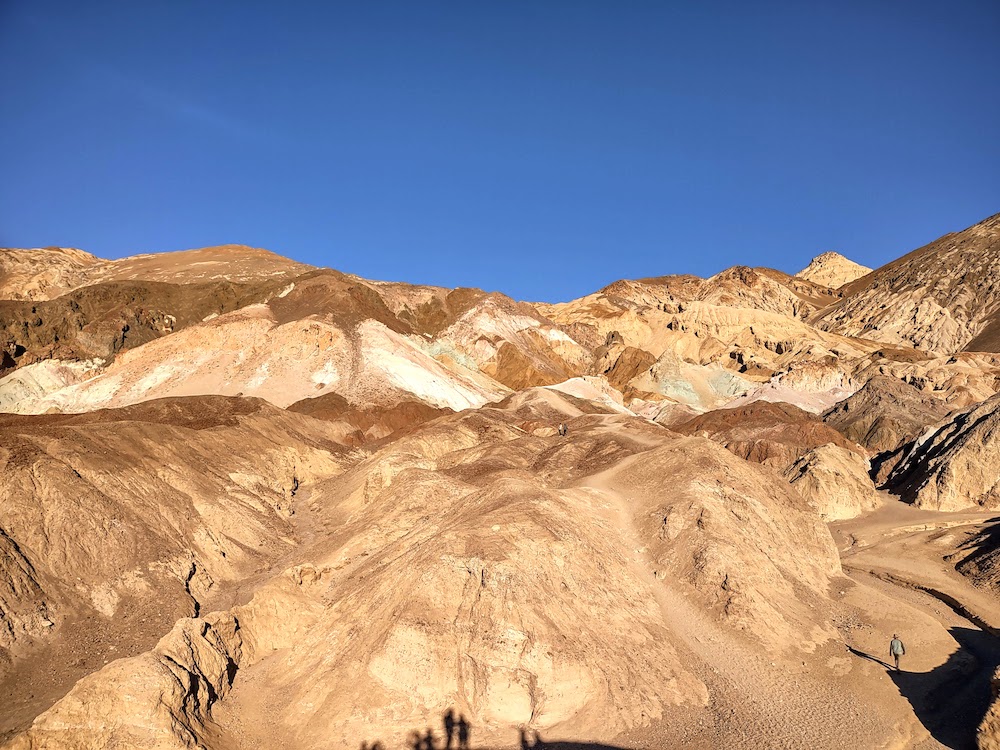
We agreed that the Artist’s Palate, a nine-mile drive through variously colored volcanic formations, was our favorite site. There were viewpoints, one of which is shown below, though the phone camera really doesn’t do it justice. The most dramatic scenery was in the last 4 miles or so, when the road twists among variously shaped monoliths, the view changing with every curve. No pictures: we just gawked and gasped.

Our final extreme was the extreme difference between the homey village of Stovepipe Wells and the fabulous oases of Furnace Creek. Dusty from a day of hiking, we pulled in hoping for dinner, which was available if you like your post-trail entrees between $40 and $80. I just can’t spend that sort of money on food when I’m so underdressed and sweaty. There were palm trees and designer stores and museums and you-pay wifi; even the ranger station was a triumph of understated elegance and contemporary architecture. We scuttled back to friendly, downscale SW for another cheeseburger at the Badwater bar, though we poshed it up a bit by choosing The Frenchy. I think it had brie on it.

This ends our tour. Next time I promise something extremely different.