DV II: The Heavens

We awoke to a world transformed by the distance we’d traveled in pitch dark the night before. Being a valley, Death Valley is surrounded by mountains, which draw the eye, even at a distance, but there’s plenty of sorta-flat beige expanse among them, mostly rocky or scrubby, some sandy, some actual salt flats or sand dunes. Biology rarely impinges, but geology shouts or whispers its presence every moment, from the 4000 foot gain in elevation over a 30-mile road that seems flat to every sensor except the Eustachian tubes, to the procession of round, conical, frozen-flow, spiky, vertical, and stepped formations sprouting near and far in every direction.

After breakfast in our rustic hotel, we hiked in a slot canyon featuring breccia and dolomite, the latter so marble-like that hiking boots don’t provide purchase, but if you manage to scramble up it’s a smooth slide on the way down. DV is the largest national park in the lower 48, so during a four-day-including-travel visit we weren’t going to be seeing all of it, including the almost-700-feet-tall Eureka dunes, but we were quite close to the 100-foot-tall Mesquite dunes, so we went over around sunset to check them out as the guidebook suggested. Unsurprisingly we had some company.

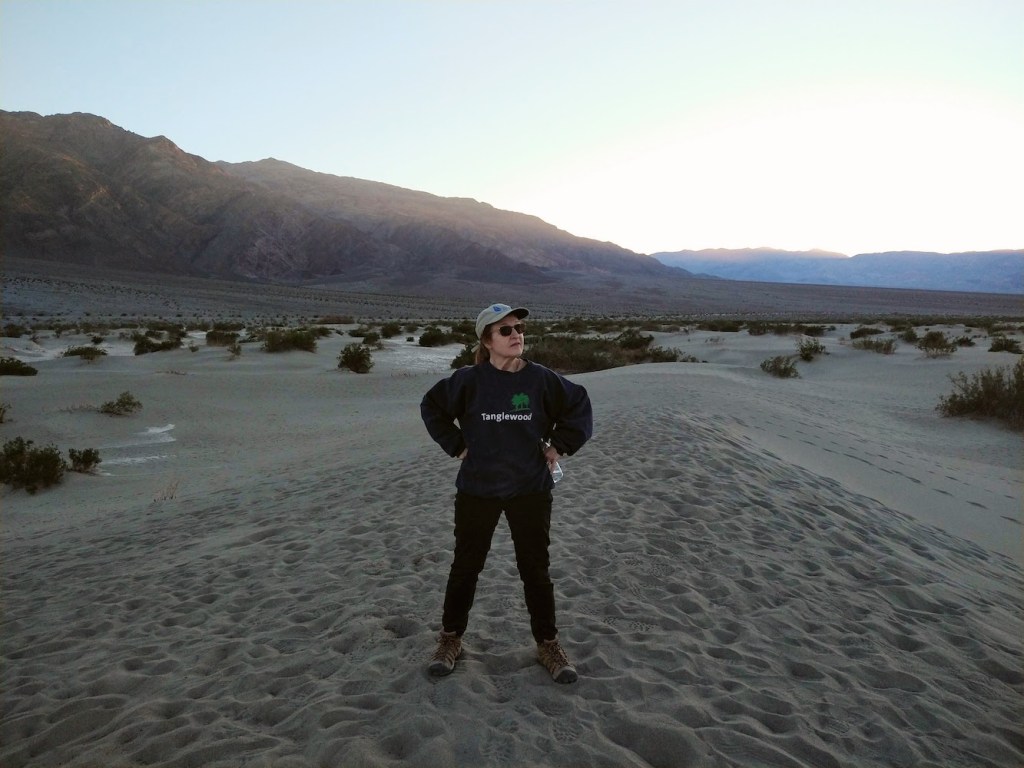
Happily a crowd at DV is like a slow day at Yosemite, and with 100 or so dunes, everyone got one. From the top of the dunes you could see the road and parking lot, but near their bases every direction looked identical. After walking up and down two, we stopped on top of a third and chose a target dune a few dunes over, then plotted a route to it that involved less clambering. Here are pics of our shadows on one end of a dune we’re sharing with a stranger, then of me claiming a dune of our own, unfortunately without a flag to plant.

The best find on the dunes was Eric, a 28-year-old law student with a serious astronomy hobby, who was setting up for a 10-hour automated sequence of pictures of the Pleiades on what he assured us would be a stellar, as it were, night for stargazing. We left to grab some dinner and our chairs, returning after astronomical darkness, which started at 6:10 pm on this winter Solstice eve, after which we enjoyed the wisdom and observations of Eric for a couple of hours, along with plenty of others who came over to check out his setup. He was friendly, knowledgeable, and generous, and did I mention that the sky was gorgeous? Buckets of stars, with the winter Milky Way, though not as flamboyant as the summer version, very much in evidence.

Also in evidence was the nightglow from Las Vegas 150 miles away, or maybe closer as the turkey buzzard flies. DV is a Certified Dark-Sky park, so we did not expect that. The glow was dim but noticeable enough that many asked, What is that?

Eric was set up on a flat rocky portion not too far from the parking lot, to avoid both shifting sand and long treks with heavy equipment, so his photos were much more affected by the startling number of people who pulled into the parking log and shone their headlights out over the dunes. Were they taking in the view from the car? It was disturbing to those of us with dark-adapted vision, though probably not malevolent, as I imagine it did not occur to many that there was star-gazing underway. Happily, Eric’s computer will purge any shots ruined by external light from the final conglomerate image.

Overall, it was a lovely fulfillment of our main vacation goal. We felt quite lucky, especially when we learned that the weather prediction for the next night, our last, was scattered clouds.

DV I: The Journey

My husband and I took a 4-day mini-vacation to Death Valley during the time of the new moon, mostly to see stars, and also so we could check another California National Park off our visit list, DV being our third of nine total. We’ve lived here six years already, so at our age we clearly need to step up the pace.

We said goodbye to the ocean less than 30 minutes from our house and headed generally southeast to pick up 101 in Salinas Valley. Cali is a vertically oriented state striped with mountain ranges and valleys, so traveling across it is largely a matter of long drives through flat country followed by maneuvering around ranges, and not being a native, I don’t know many place names. This first part took us through artichoke, strawberry, and Brussels sprout farms, sadly mostly conventional as evidenced by the dust plumes rising behind heavy equipment disturbing depleted soil, with coastal mountains to the right and inland ones to the left.

We passed King City, the extent of my regular traveling range as a volunteer for TMMC, and stopped to eat in the pleasant town center of Paso Robles, also the name of an American Viticultural Center due to being surrounded by 250 vineyards of which we did not visit even one. We did have time to walk through the central plaza which included a somewhat elaborate horseshoes…course? field? lawn?

At this point the terrain was hilly, but a scant hour or so later we started crossing what I believe may have been the southern part of Central Valley, or if not, just south of that. We could have been in the Texas panhandle: very, very flat for a very long time with some dried-out looking farms and rectilinear orchards, a lot of scrub, tumbleweeds, and oil fields large and small. We saw more nodding donkeys than cows. Signs warned of excessive dust in the air; we kept the windows up.

This tiresome section ended in Bakersfield, a sprawling, butt-ugly oil city where we suitably filled our tank for $3.69/gallon, the best price we have seen in years! This was the timewise halfway point of our 7.5 hour, 440-mile journey. We were rejuvenated as we left Bakersfield behind and the scenery immediately improved, with swooping foothills and long vistas, dissipating our loginess. We re-acquainted ourselves with the function of the steering wheel as the endless straight highway to the horizon transfigured into swoops and curves, and we passed semis by the handfuls as the grade steepened.

This was the nicest part of the journey, curving very slowly east and then starting north around the end of mountains, enjoying view after view including a gorgeous sunset amid row upon row of ridgetop windmills. From here to the end, which is to say, most of the second half, we are driving through wilderness with an occasional small town or lonely train track. We noticed this when we went to Yosemite too, hours of wilderness surrounding the approach. It seems a great portion of eastern California is untamed, and happily so unless you are nervous without cell service.

The final two hours were driven in darkness, by which I mean No Lights At All. We were on small, mostly un-numbered roads following the navigator attentively through frequent turns. Various clues indicated the roads were sometimes on flat ground and sometimes near precipices, but we couldn’t see more than the few hundred feet straight ahead illuminated by the high-beams. For a while we drove through a salt mining area, including its associated factory town, and occasionally we saw a gleaming power plant in the distance. Mostly it was darkness on a two-lane road, the only lights being those of the occasion oncoming car, with no sign of human habitation.

When we got to our hotel in the park, we dumped our stuff and headed right out to look at the sky. The gorgeous sunset should have warned us: Cloud cover! We were completely socked in, not a twinkle in sight. Would we achieve our main vacation goal?

Near Miss?

My husband and I drove to SF after I got off work yesterday to deliver Christmas presents to our older son, since we’re traveling next week and he’s traveling the following two weeks. We spent a couple of hours together, including dinner at a local pub while we cheered the Patriots to a win. Our son’s home TV setup is nicer, but he hosted a Christmas party for his friends group the night before and still had a fair bit of cleaning to do, not least because one of the guests brought those little things that explode into tiny pieces of paper when you throw them onto the floor. Apparently the Roomba is not great with that sort of thing, so sweeping was on the agenda.

We left around 9:30, and I was designated driver. The apartment is about three blocks from the freeway entrance, and we were waiting at the stoplight, with the on-ramp for 101N beckoning on the other side of an empty cross street, when we heard a terrifyingly loud pop-pop-pop-pop-pop-pop-pop-pop, closely spaced but slightly irregular, 20-30 pops in all. The sounds seemed to be crossing the street behind us, and were, again, amazingly loud.

It was not those little things that explode when you throw them on the floor.

I was at the front of the line in my lane, and I could have just driven, but I didn’t. I remember even flinching, and neither of us ducked or moved in any way. It was over quickly, perhaps 20 seconds. The cars on either side of us also did not advance, and the cars behind were obviously blocked. Afterward, I intelligently commented that it couldn’t have been gunfire because no one moved, but what the heck was it? My husband opined that it was definitely gunfire. The light changed and we drove home.

My phone was on low battery and I had it in airplane mode for the drive, so it wasn’t until we reached SC around 11:00 that I got the message from our son wondering whether we had heard the shots. He had access to a local incidents app and the shooting, for so it was, occurred between two men, both of whom survived but were hospitalized.

So many thoughts.

As we approached the intersection, we must have driven right between the two shooters on opposite sides of the street. What if they had started shooting five seconds earlier? My husband felt they were likely waiting for the cars to clear in order to get a good shot. I guess I should be happy they were out to shoot each other instead of cars that day.

Even though I’ve been to the gun range more than once, the loudness of the reports shocked me. I hadn’t thought of that aspect of our school and mall and club shootings, what must be the complete terror of being in an enclosed space with the deafening noise, on top of the fear of the danger of injury or death.

Why didn’t any I react to the shots by driving away? Cars are little protection from gunfire, and we were all within easy range. Shouldn’t my impulse have been escape rather than freeze? Or at least hide, not that it would have helped? I do have a history of freezing in emergencies, but it didn’t feel like one at the time. Maybe my own reaction was related to my denial, but what about my husband’s, or the other drivers’?

We’re very familiar with the neighborhood. We were next to a Costco and a block or two from Bed Bath and Beyond and Trader Joe’s, all of which we have visited, in some instances on foot. Earlier we had walked to a pub about six blocks away. It almost felt like a shooting in our neighborhood–which of course it was for our son.

Speaking of whom, he’s thinking about moving out of SoMa. Maybe he should…though life is not secure, and nothing on this earth is sure.

Judgmental Animals

I bought a copy of This Book is Literally Just Pictures of Animals Silently Judging You as a Christmas present for someone I don’t know very well. How did I miss This Book, which was published in 2021? Almost every page is laugh-out-loud funny. The animals exhibit disapproval in so many ways. Some are fed up. Some are horrified. Some are dismissive, facetious, bored, skeptical, or sizing you up as a dinner option. At least one–a sheep!–has you pinned on the ground and is deciding whether it’s worth it to stomp on your face.

It’s true, I “read” the book before wrapping it.

Several small animals are dressed cutely and seem to be signaling, It’s your species that victimizes me in this pathetic way. Other small animals are terrifying, especially the hairless cat–who owns those? That must be like having Chuckie for a pet. There’s a flat-faced cat that looks so fake I’m not convinced it’s a real thing even after looking at several Google images; none of those had a face as distortedly scrunched as that of the one in the book. Seeing it walk around would be super creepy, as if a plush animal–a really ugly, unnatural plush animal–came to life and jumped onto the breakfast table before you had caffeine.

It occurs to me that someone with issues about judgment could find this book off-putting, and maybe even be driven into a depressive event by the parade of disapproval on offer therein. So why did I send this to someone I don’t know well–why am I sending that person a present anyway? Well, he’s a somewhat new partner of someone I do know quite well, and I can hardly send a present to one and not the other when they’re living together, right? Both are edgy young people so I hope they take it as intended, but for additional cover I wrote, I think this is funny on the tag.

I know, that’s so middle class. Since the Queen and Princess Margaret, by which I mean, actresses portraying the Queen and Princess Margaret, shared I-love-yous then swore to never do so again on the latest season of The Crown, I’ve been thinking about trying not to be so middle class. But honestly, I AM middle class. I grew up lower middle class, and when my husband and I were both working professional jobs we were upper middle class, and now that we’re trying to retire in an expensive state that penalizes newcomers as a financial policy we are regular middle class. I can’t make a case for being any other class.

I don’t really know how the other classes act anyway. I just have to accept conventionality as my fate. At least I’m not surrounded by judgmental animals. In person I imagine they would be rather disturbing.

Too Busy to be Curious

My life is filled with reassessments, mostly moments in which I learn something, or rethink a past experience, and thereafter am forever changed. A memorable example is my younger son’s suicide unit in middle school, which included the story of a person who resolved to jump off the Golden Gate bridge if no one smiled at him on the walk there; he did so. Since my son shared that with me, I’ve smiled at every stranger I pass on any street, no matter how off-putting, threatening, or irascible. Am I a completely different person than I was before I heard the story? No. Do I so something differently than I did before, almost every day of my life? Yes.

Recently I’ve been reflecting on why I was so slow to notice some truths about our world, truths I now embrace years, even decades, after first being exposed to them. One example is breastfeeding. From childhood through to my own pregnancy I thought little about it. While pregnant for the first time in 1992, I started reading about it, and concluded that it was probably better for the baby if I could do it for a while, though I had no intention of giving up my career. I ended up breast-feeding both children for six months, though I started supplementing at two weeks.

During that time, I was exposed to other people, both in person and through reading, who advocated extended breast-feeding periods of two to four years, and I dismissed them out-of-hand. After all, this was not at option for me financially, and they were all different from me, quirky, or hippie-ish, granola types. I’m struck by both my penchant for stereotyping and my complete lack of curiosity as to why so many people took this position. Now I know that extended breast feeding is common in groups of humans who live more naturally, and that it provides for them extended immunity, superior nutrition, a healthy gut microbiome, and even more attractive faces.

I could have improved the health of everyone in my family had I paid attention to leading-edge nutrition science earlier, though I would have had to seek it out. I can use the excuse of not having the time and not being in the circles in which the emerging story first circulated, which was primarily among the wealthy. While these excuses explain why I missed it, they do not absolve me. Now I know many persons who sought the information and found it years ago, so I could have, too.

As a younger person, I demonstrated more curiosity about things that don’t matter. I’ve met people who have pet insects, create sculptures from found objects, build their own cellos, geocache, or send their toy animals on vacation, requesting pictures from the toys’ hosts. In each case I had enough curiosity to learn details about the activity, although I was not inspired to partake.

The big question is, what am I ignoring right now that could make my life matter more? Most days I don’t seem to have the time to figure that out.

Good Morning, Krill

I read an editorial in Science this morning about Antarctic krill that inspires me to blog instead of whatever I would normally do right now. This is my second alert on krill in as many days; I saw (powdered) krill in CVS yesterday, which made me sad.

You know krill, right? These tiny crustaceans are the primary food source for blue whales, as well as occasional food for other baleen whales and many other types of marine life. At the Seymour Center, docents have always discussed krill at our blue whale stop, but since it re-opened, we’ve re-focused the presentation on the krill crisis. What happens to krill, we ask visitors, when the population of the primary predator of krill, blue whales, who eat 5-20 tons per day during their six-month-or-so annual feeding season, is reduced by 80%, as happened during the 20th century after we figured out how to kill those behemoths?

Everyone says, There will be more krill.

It’s a great chance to elucidate a rare practical use of science. There were actually a lot fewer krill, and scientists recently (by science timing standards) figured out why. Whales don’t just eat krill, they recycle krill nutrients, including tons of iron, which feed phytoplankton, which are the the lowest rung on Earth’s food chain: no phytoplankton, no food, planetwide. Krill also eat phytoplankton, so krill populations were drastically reduced because their own food source declined.

For the kids or the bored or the science-schmience folks we also say, Gigantic whales eat tiny krill, then poop out their nutrients. Even tinier phytoplankton use those to turn sunlight into food in their own bodies, which krill eat. Gigantic whales then eat those krill and the cycle continues.

Reclycling in its ultimate zero-waste form: Mother Nature does it best!

Why aren’t krill recovering now that blue whales are not being slaughtered? The happiest reason in my view is the recovery of these whales, though that is proceeding slowly. The primary reasons are-surprise!–due to the activities of the enormous population of one ape: aquaculture and supplements.

Seafood is so healthy and humans evolved to eat it, and I would really like to eat it, but I rarely do, because it’s just not sustainable. My employer, which is Whole Foods in case you’ve forgotten, doesn’t sell krill-based supplements or foods, and good for it, but it does sell the oxymoronic “sustainably-farmed seafood.” I wish it really was sustainable, but it isn’t, and not just because of krill. Even wild seafood is not sustainably collected, in part because at our rate of extraction, all “fisheries” will eventually collapse,

I also take supplements, but not krill. There’s no nutrient in krill you can’t get somewhere else, obviously, since most locations on the planet aren’t intersection points between humans and krill, especially the species of drill that lives in the Southern Ocean. Human never populated Antarctica, though we are now managing to melt a lot of it.

I know the last thing we need two weeks before the primaries is bad news about krill, but there is a big upside: if you care, all you have to do is not purchase krill-based supplements or farmed seafood! It’s so easy that many of you are probably already there.

Back to the Nineties

The 1990s may have been the best decade of my life, the one during which I got married, had my two sons, bought a house in Brookline, got a master’s degree, traveled extensively, and started work at Chipcom, my favorite job ever. The Internet was nascent, smart phones unknown, the deficit falling, and the economy booming.

The joys of my 90s may have been directly related to my being white and college-educated. Policy and social seeds planted then have blossomed into extreme partisanship, mistrust of science, criminalization of Blackness, rampant houselessness, lack of jobs offering a livable wage, and egregious economic inequality. Not the best decade after all.

Nonetheless I was reminded of the joys of my nineties during a visit to my new Medicare doctor’s office, a clothes-on visit, a chance to register myself, get my stats and concerns into the computer, and ferret out any immediate needs.

The PA was pert and personable and persistent. She had a lot of questions and she wrote everything down. Six decades of operation and procedure history plus probing into my most minor health indicators and lifestyle details resulted in a list of medical test to-dos for me. I thought I was pretty healthy, I said. Oh, you’re the healthiest person I’ve seen all day, she chortled.

So why the long list of recommendations? It reminded me of the days before managed care, when I had primo employer-based health insurance and my doctor was Very Concerned that we follow up on even the Slightest Chance of Anything At All, all at No Charge to me. Was I in a time warp?

My husband is a little older than I am, and he got the answer right away: Welcome to the world of Medicare, in which all treatments are covered, the circle of [American economic] life.

Animal Wrongs

The US legal system, having worked its magic personifying corporations and depriving minorities of various rights, is now laser focused on animal illfare.*

Two stories are in the news today. One involves pigs. Pigs are on my mind because Markegard, our regenerative farm source, is now limiting pork to members only, having become unable to meet demand. My husband and I are members, but even member quantities are limited, and supplies of specific cuts sell out quickly. That combined with living in the lovely but remote hamlet of Santa Cruz, whence deliveries only arrive every two weeks, has led to our household being forced to turn to rotating-sow pork more often.

I’m not referring to any sort of porcine dance step. California’s gestation crate rules, which require sows to be in crates of 24 as opposed to 14 square feet, allowing them to turn around, were approved by voters four years ago. Now those are being challenged by pork producers in Iowa, who fear that their rectilinear-sow pork won’t be as valuable if such a large market–13% of pork is sold in the Golden State–is eliminated.

Markegard Farm sows live in large pens together with other sows most of the time, and occasionally have conjugal visits with the boars; all of them get chances to forage in the forest. If I can’t get those, I at least want to get the ones who are able to curl into a ball to sleep. Animals may die for my nutrition, but I think they should have some small pleasures first.

Meanwhile, the northern right whale is critically endangered, and climate change is forcing it to forage in new areas of the oceans, specifically areas near Maine in which vertical-line lobster traps threaten the whales, so Monterey Bay Aquarium’s Seafood Watch, a guide to sustainable seafood, downgraded Maine lobster to Do Not Buy. Mainers are not happy, and they aren’t just complaining about it. Maine’s full complement of representatives is pushing a federal law to defund government funding of MBA, a non-profit organization of world renown.

Seafood Watch is not affecting 13% or even 1.3% of seafood purchases, even here in California. We talk about it in the Seymour Center, a destination for folks interested in conserving the world’s oceans, and maybe a quarter of those have even heard of it. I bet the publicity from this Maine case is the most exposure it has had in years.

Forget about doing the right thing, whatever that is. I just would like for all people to let other people do what they want. Some people may want to eat Maine lobsters because they kill right whales, and I won’t stop them. I remember years ago when voters in Denton, Texas were prevented by their state government from banning fracking in playgrounds. Why can’t voters in an entity like a town or a state choose a lifestyle they prefer?

And why is free commerce more sacred than so many other freedom?

imagine at least one person reading this thinks the right thing for me to do is to be a vegetarian. I’m not arguing that in this blog, but I tried the vegan lifestyle for six months, and my body is telling me to go with evolution on this one.

================

* According to the web, source of much enlightenment, this is a word.

Dream Fulfillment

A perfectly charming, middle-class-seeming friend is currently taking a month-long dream vacation, traveling to four or five world archeology destinations. I’m not clear on all the details, but I think the trip includes Stonehenge, the pyramids at Giza, Petra, and some site in Oman. Embarcation is from London, so since she is starting in California, there’s also a prequel trip.

In any case, it sounds amazing, and she is a good friend, so I ventured to ask whether she would share the cost with me. She would: It was roughly equivalent to the MSRP of a Land Rover MR4.

Yowza.

I’ve read about the megayacht people, but this person is not that. If you really want something though, maybe it’s time to bet the farm, and in a way I admire the verve. Although my husband and I have done well, I started out in a lower-middle-class family in Houston and haven’t completely shaken those sensibilities. I am a little skeptical that any vacation could actually be worth that much, and I am too frugal to make the tradeoffs that would be required, like selling an organ or something.

I do remember how vacation costs can mount, especially for a family of four traveling to another continent. As soon as the kids were old enough, my husband and I would house them in a separate room–or in the case of camping, a separate tent–when we traveled for any length of time. So we were clearly not unwilling to spend some money to improve the restfulness of the trip. We also usually answered Yes! to the Should we… questions: Should we rent a jeep and go off-roading? Tour the cave? Go deep-sea fishing? Parasail? See the play? Take a side trip?

After all, you never know when you’ll be back.

However, these trips never reached the expense level of a new luxury car, a year of tuition at a private college, or a guitar signed by Paul McCartney, even with four people traveling.

Earlier this year I met someone who pays a $400 annual credit card fee to get extra airline miles. This person also likes to travel. At the time, I thought, I would never do that. Now it seems sort of quaint.

Refrigerator Optional

In a recent New Yorker article I learned about the cold chain, the mechanism for creating and maintaining cold food from creation to customer. In the US, we often freeze or refrigerate food items in the field or the abattoir, then move them through a series of stationary storage areas and refrigerated transport containers to grocery store chillers and, ultimately, consumers’ refrigerators. The article described events in Rwanda, which is valiantly trying to create its own cold chain despite daunting challenges ranging from energy needs to confounding customs.

This week’s issue of the magazine includes two letters regarding that article, both appreciative of the effort yet dubious of the chance of success. One was from an expert in industrial architecture who opined that establishing a cold chain was not sufficient to achieve the ultimate goal, using local farmers as suppliers for modern groceries; he enumerated the ways such attempts had failed in other regions previously. It generally reinforced my own concerns about the industrial food system, the enemy of much that is healthy and enabling, namely fresh food and local food production.

The second letter took the discussion to another level. This was from a serious disrupter who said, Don’t prop up the cold chain, destroy it. An NYC resident, he had tried three times to live without a refrigerator, and succeeded for three months, then seven months, and currently eleven months and counting.

What magic is this! How can one live without a refrigerator in a 21st century city?

Often I approach a blog topic by doing research, which ensures my assertions match those of my preferred internet sites, but today I am winging it. My first thought is, buy what you eat the same day or the night before. I first experienced this in Paris, where workers swing by enormous street markets on the way home to grab something for dinner, and by something I mean real food they will then cook, not prepared takeout. No wonder the French are so healthy! No wonder they eat dinner so late!

Each of our local farmers markets is open only one day each week, and then only for 2 to 3 hours, but let’s pretend that by circulating among them I was able to get produce, cheese, and meat most days. I think I could store produce and cheese for a few days, but surely not meat?

Don’t even suggest I give up meat. It’s my source for shiny hair and manic energy.

Then there is milk, yogurt, and a few other items. At this point it occurs to me that I could have more likely done this in Massachusetts where most houses have significant underground storage–basements–that are naturally cool year-round. Great for wine, and maybe even brine pickles, sauerkraut, or yogurt in sealable glass containers, for short times, but milk?

I could give up milk but I don’t want to. I have 12 ounces of raw milk daily. It’s therapeutic.

Perhaps compromise is possible. I can envision replacing my refrigerator with a much smaller one, perhaps a third of the capacity, and using the rest of that space as sort of an insulated cabinet that would serve as a root cellar. It’s not completely a one-way road, as one could always revert to the regular-size frig if it doesn’t work out.

It would require changing a lot of habits, including possibly our relationship with food. It would mean even more time on food shopping and preparation than I spend now. It would have a dangerous possible side effect of moving us to more processed food (so easy to grab and store) over time. My husband might not be into it. And what about ice cream?

Now that I’ve blogged, I will research the world of breaking the last link of the cold chain. I promise to post an update if I make any progress.