On Thanksgiving, my husband and I went to see Fantastic Beasts and Where to Find Them, which was a pleasant-enough diversion, though we aren’t sure we endorse Anthony Lane’s adoring review in the New Yorker. I would rather write more about the fantastic beasts of California, and my continuing attempts to get more involved with them.
Some of you may remember that we had a “pet” rabbit on Griggs Road this year, a rabbit living under the tree in our front yard that became inured to our presence, hardly flinching when we walked by while it was nibbling our grass. I think the new owners dubbed it “Hoppy.” We now have a “pet” hummingbird on Bramble Lane. I think it is an Anna’s hummingbird, and probably a female since it is relatively drab. She seems unperturbed by one of us standing under the tree, observing her at a distance of 4 feet or so. She sits in a low tree and sings, or rather chirrups–almost a tuneful buzz–for long minutes. At other times she preens herself, frequently flicking her extraordinary tongue. I had thought hummingbirds only used the high-speed flapping to hover, but that is how she always flies, with a whirr like a balsa-wood plane’s rubber band unwinding, except it never stops. Sometime she flies straight up 20 or 30 feet into the air and just hovers in place, which looks to be glorious fun.
Most of the animals here are marine animals and sea birds. I have previously written about the tidepool animals nearby and the sea lions at the wharf, as well as some of the animals I spotted during my otter project surveys. During the last couple of weeks I have visited the Monterey Bay Aquarium and also the Seymour Marine Discovery Center, and as you would expect, found animals both places. Unexpectedly, many of them were wild animals.
The Monterey Bay Aquarium is a nice aquarium, similar to the New England Aquarium. I’m not sure it’s larger, but it seems so because it is spread out and has both indoor and outdoor displays, taking advantage of its home climate. Outdoors there are multi-level decks with binoculars and telescopes available for viewing Monterey Bay itself. The day we went there were sea lions, sea otters, seals, brown pelicans, white pelicans, egrets, cormorants, and even humpback whales, who had entered the bay to feed. We could see all of these animals much more clearly than from any previous sightings, and even had docents to answer questions.
The Seymour Marine Discovery Center is adjunct to UCSC, located on the remote, oceanside portion of campus, where the bay meets the ocean. Its charter is to explain the role of scientific research in the understanding and conservation of oceans. It is small, with some live animals to view and touch as well as lots of hands-on science displays. It also has an extensive outdoor portion; during the outside tour we saw an otter and a pod of dolphins. There are two whale skeletons, one of a blue whale, which looks like an insect from the front view: 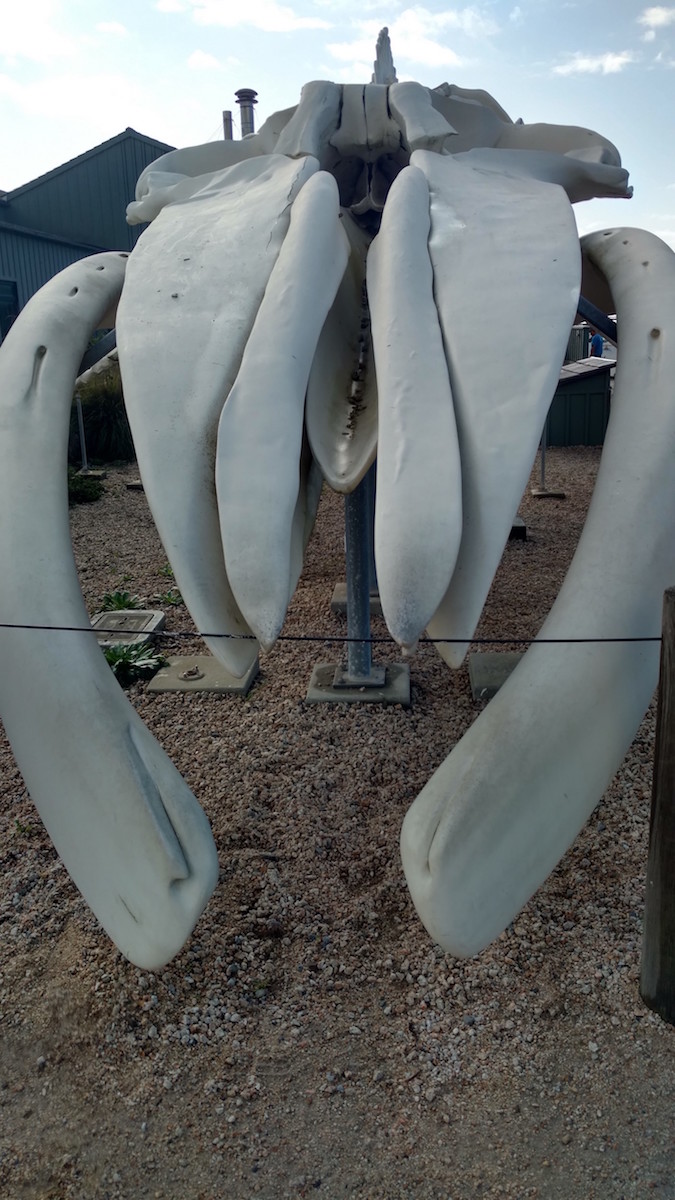
I was there to interview, successfully as it turns out, for a docent position. There are eleven weeks of training, every Wednesday and Saturday starting the second week of January, then a year’s commitment to a half-day shift every other week. I am pretty excited about this work, which involves a serious educational component and is also more social than any of my previous volunteer work, since docents work in volunteer teams and interact with the public.
We went to see the Monarchs again this weekend, but viewing wasn’t very good because the weather was 55 degrees (cold for butterflies) and raining on and off. On the way home, though, we were rewarded by a rainbow practically arching over our house. We could see the rainbow’s end in the ocean, and my husband is pretty sure he got a glimpse of a pot of gold just under the surface. 
 Culminating Triad
Congratulations on the docent position! It sounds perfect.
LikeLike