Unlike a true lagoon, Neary Lagoon shares no water with the ocean at any time of year. I frequent both the Younger and Corcoran Lagoons, each of which is separated from the ocean by a sand berm that breaches occasionally during the “winter”. I wonder how long I will live in California before I stop using quotation marks around that season? Neary Lagoon used to have brackish water, but the interconnecting wetlands were drained and built upon in the early twentieth century, so now it is a freshwater marsh.
Our group was led by a guide from the local natural history museum, and most were interested in birds. Minutes after one woman opined, I hope we see a wood duck, we did. This was one of our last rainy mornings locally–no more rain until November, I hear–and I had not even extracted my phone, so this is a stock photo from Wikimedia Commons.
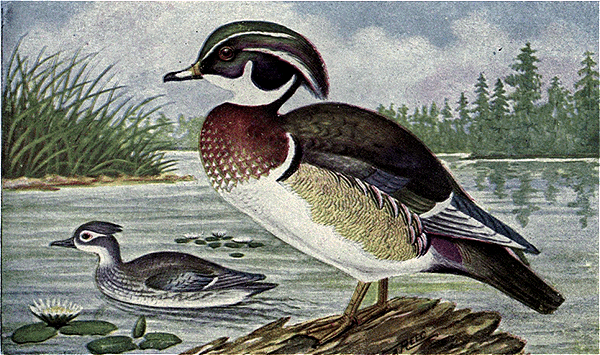
The live male looked almost carved, with precisely-shaped features and distinctly-outlined coloration. We also saw several mallards, both male and female, though our guide told us most of the females were nesting. In fact, we later spotted possibly the first brood of the year.
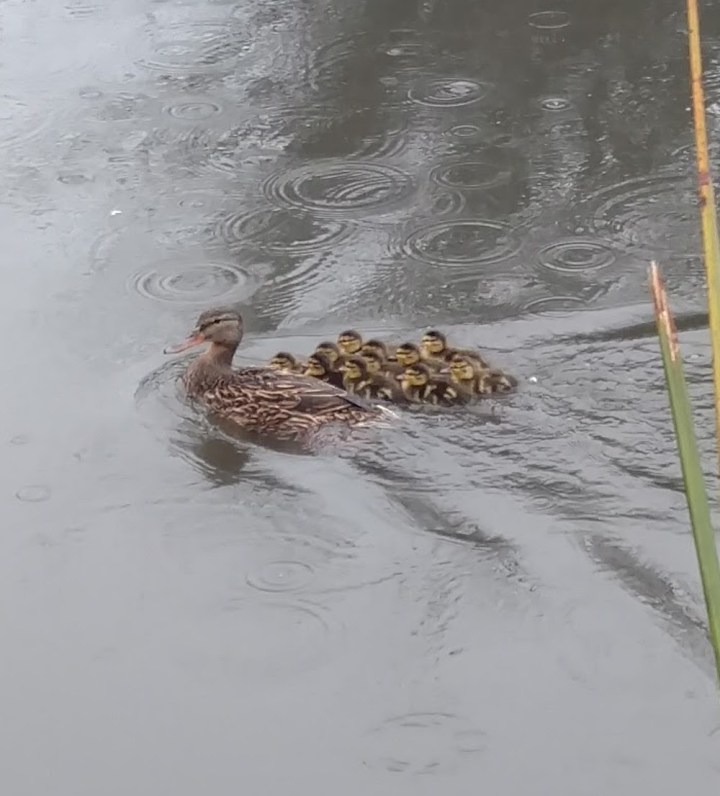
The babies swam in close formation except when the mother turned; then they collided like aggressive bumper car drivers as each frantically tried to follow as closely as possible. I learned that many male ducks, including both mallards and wood ducks, have distinctive, bright plumage only during breeding season. After that they molt and regrow with eclipse plumage, similar in coloring to that of the female ducks. In mallards, the only way to tell males from females then is by the beaks, which are yellow and orange respectively. Both sexes have orange feet.
We also saw American coots, who bob their heads when they paddle. They are rails, not ducks, and their feet have less webbing than duck feet, so coots can easily forage on land to supplement their pond diet. We observed both methods of eating.

Neary Lagoon has some adaptations to cope with large volumes of rain. Most of our tour was on an apparent boardwalk, which seemed quite close to the surface of the water. That’s because it floats on pontoons when the water rises high enough. This mature group was sadly not interested in trying to tip the platform by all standing on one side, though the guide said she safely does that with school tours. Another adaptation is a weir and grate system that allows water to drain into the ocean. It was open, and as we observed it, a great blue heron landed there.
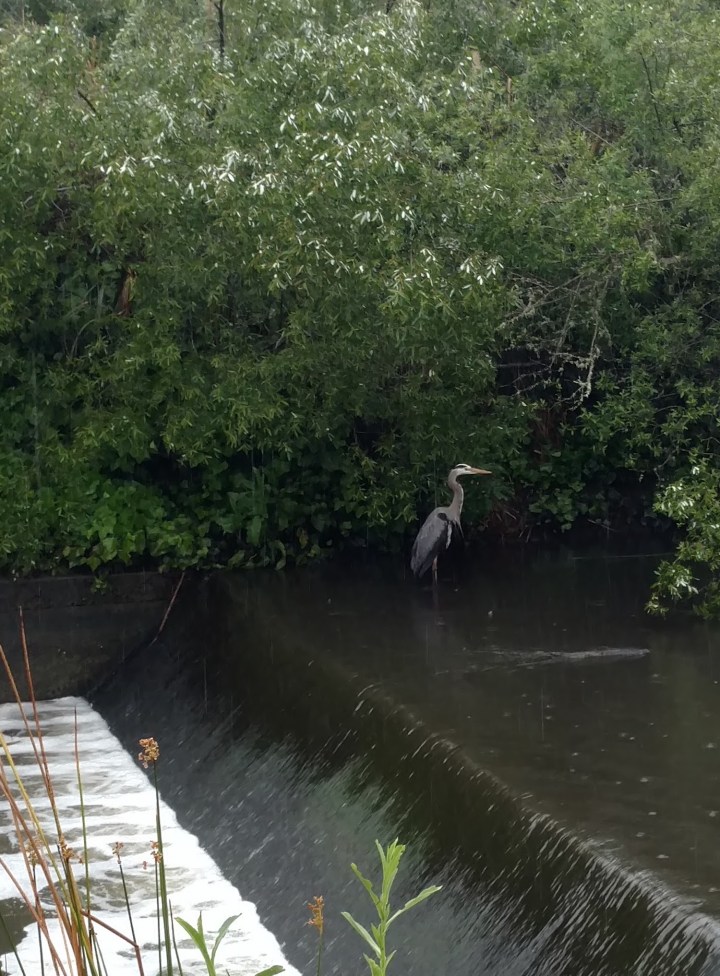
During most of this mile-long walk we could see houses, buildings, and even the local water purification plant, whose odor inspired us to pick up our pace. But in a few spots the boardwalk was the only evidence of human habitation.
The tour members were all fellow docents, many of whom knew each other, and there were some who chatted throughout and others who put space between themselves and the chatters. It’s hard to judge whether quiet contemplation of nature or human fellowship is more rejuvenating. Happily, both are available to most of us at least some of the time.
 Culminating Triad
Your post was a breath of fresh air. Thank you!
LikeLike
Precious Jo Ellen, It seemed as though I accompanied you on this glorious jaunt. I could fairly smell the sea air and water purification plant. I could imagine the small, quiet sounds of the baby ducks as they sped by. I am now planning a weekend trip to the Nature Center near IBM in Clear Lake where ducks and geese are the primary inhabitants along with a stray gator here and there. I love nature and yet I hate nature when the number of baby ducks following mom today is steadily reduced as turtles and gators do what come naturally. Thank you for this exciting and enthralling vision and scene.
LikeLike
There are plenty of American coots. You just need to hang out in the same bars I do.
LikeLike