We awoke to a world transformed by the distance we’d traveled in pitch dark the night before. Being a valley, Death Valley is surrounded by mountains, which draw the eye, even at a distance, but there’s plenty of sorta-flat beige expanse among them, mostly rocky or scrubby, some sandy, some actual salt flats or sand dunes. Biology rarely impinges, but geology shouts or whispers its presence every moment, from the 4000 foot gain in elevation over a 30-mile road that seems flat to every sensor except the Eustachian tubes, to the procession of round, conical, frozen-flow, spiky, vertical, and stepped formations sprouting near and far in every direction.
After breakfast in our rustic hotel, we hiked in a slot canyon featuring breccia and dolomite, the latter so marble-like that hiking boots don’t provide purchase, but if you manage to scramble up it’s a smooth slide on the way down. DV is the largest national park in the lower 48, so during a four-day-including-travel visit we weren’t going to be seeing all of it, including the almost-700-feet-tall Eureka dunes, but we were quite close to the 100-foot-tall Mesquite dunes, so we went over around sunset to check them out as the guidebook suggested. Unsurprisingly we had some company.
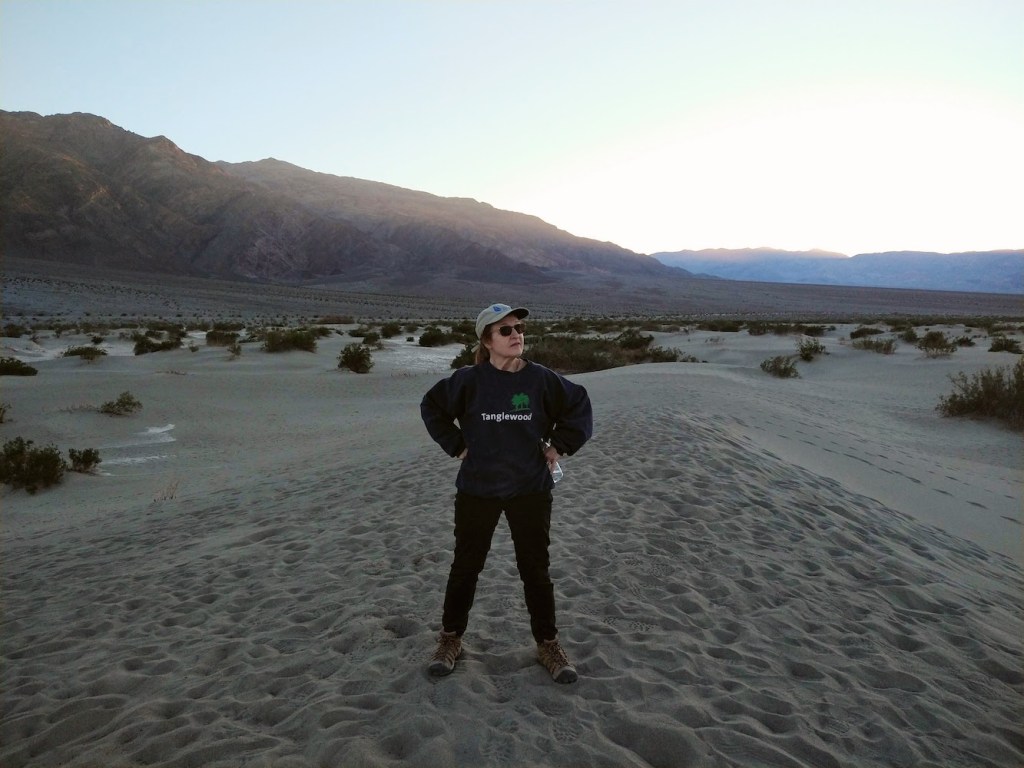
Happily a crowd at DV is like a slow day at Yosemite, and with 100 or so dunes, everyone got one. From the top of the dunes you could see the road and parking lot, but near their bases every direction looked identical. After walking up and down two, we stopped on top of a third and chose a target dune a few dunes over, then plotted a route to it that involved less clambering. Here are pics of our shadows on one end of a dune we’re sharing with a stranger, then of me claiming a dune of our own, unfortunately without a flag to plant.

The best find on the dunes was Eric, a 28-year-old law student with a serious astronomy hobby, who was setting up for a 10-hour automated sequence of pictures of the Pleiades on what he assured us would be a stellar, as it were, night for stargazing. We left to grab some dinner and our chairs, returning after astronomical darkness, which started at 6:10 pm on this winter Solstice eve, after which we enjoyed the wisdom and observations of Eric for a couple of hours, along with plenty of others who came over to check out his setup. He was friendly, knowledgeable, and generous, and did I mention that the sky was gorgeous? Buckets of stars, with the winter Milky Way, though not as flamboyant as the summer version, very much in evidence.
Also in evidence was the nightglow from Las Vegas 150 miles away, or maybe closer as the turkey buzzard flies. DV is a Certified Dark-Sky park, so we did not expect that. The glow was dim but noticeable enough that many asked, What is that?
Eric was set up on a flat rocky portion not too far from the parking lot, to avoid both shifting sand and long treks with heavy equipment, so his photos were much more affected by the startling number of people who pulled into the parking log and shone their headlights out over the dunes. Were they taking in the view from the car? It was disturbing to those of us with dark-adapted vision, though probably not malevolent, as I imagine it did not occur to many that there was star-gazing underway. Happily, Eric’s computer will purge any shots ruined by external light from the final conglomerate image.
Overall, it was a lovely fulfillment of our main vacation goal. We felt quite lucky, especially when we learned that the weather prediction for the next night, our last, was scattered clouds.
 Culminating Triad
Sounds awesome! I have a modest astronomical setup, but we don’t get to use it very often, due to the hazy and light-polluted sky in our area. I had never heard of the Dark Sky certification but it turns out there’s a Dark Sky certified state park less than three hours from us and now I’m intrigued. Thanks for the great info and happy viewing!
LikeLike