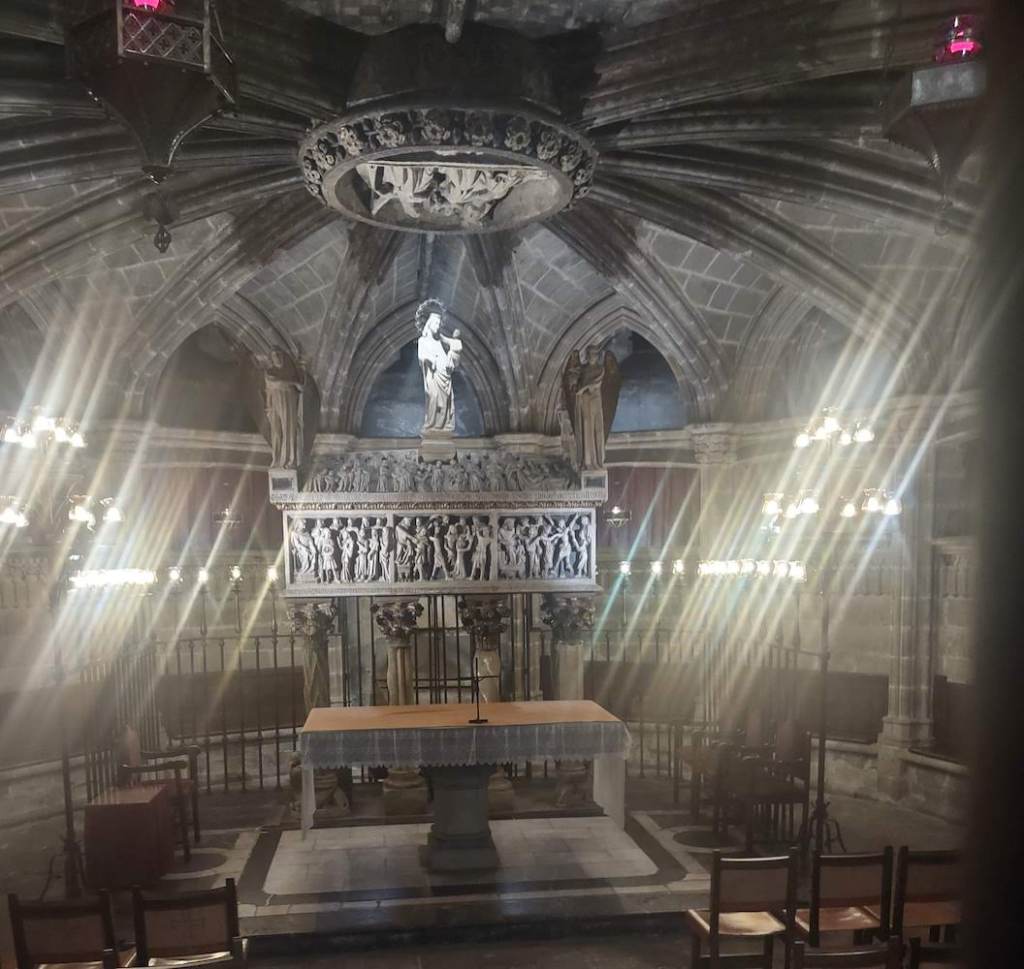
We are fortunate to be visiting turning the primary festival of the city of Barcelona, which honors our Lady of Mercy, also known as the Virgin Mary. The tradition started in 1687 when the Lady saved the city from a plague of locusts. She shares the role of patron saint of the city with Saint Eulalia, whose crypt I saw in the Cathedral of Barcelona. The rays of light in the picture did not appear to the naked eye, leading to some banter about holy presence. It happened several times that day. Later it turned out I just needed to clean my camera lens.
This year the festival ran from September 20 through the 24th, so we were here for the entire time and saw a lot of it. It contains some features that are unique to me such as castellers and correfocs, as well as some I have seen elsewhere, including gigantes and fireworks.
In order to enjoy such a festival one must either be wealthy enough to command a private viewing platform, or a person who embraces crowds; we are both the latter. While not anxious to be crushed or fumbled, we find most festive crowds quite well behaved, and being in the midst of one a source of shared joy.
After an excessively celebratory tapas meal at a lively restaurant Saturday night, we encountered the correfoc, or fire run, on Passeig de Gracia while walking home. The components include elaborate, car-sized renditions of devils and monsters as well as people costumed similarly, both spraying lit fireworks into the air to a rhythm provided by ranks of drummers and dancers. Continuous fireworks-spewing structures are also erected over the street at intervals. It’s loud and action-packed and slightly dangerous–those who venture near usually wear (slightly) protective clothing, whereas others watch from farther back. The noise and heat and light and general atmosphere of dissolution are easily experienced at a safe distance, but are very difficult to photograph, though some Youtubers have managed. There’s a Reuters video that appears to be shot at that very location on that very night, but I’m not allowed to link to it.
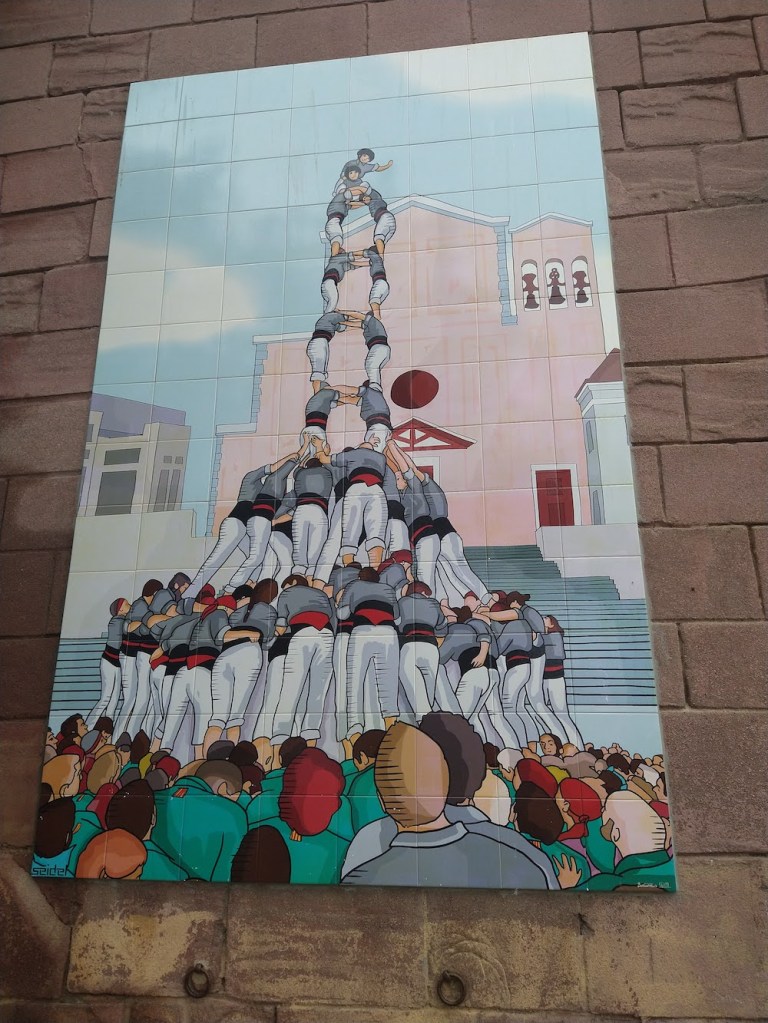
Castellers are teams of people, not completely dissimilar to Morris teams, who create human turrets by standing on each other shoulders. These rise quickly and are not considered complete until a child, by appearance I’d say someone around 10, climbs to the very top and gives a thumbs up, after which the tower is disassembled. We did manage to get a video of this, but mostly what you see is the crowd, as we didn’t get there at the very beginning. Looking toward the opening at the far side of the square you’ll see one group in green and white on the right forming a shorter tower, and another in red and white at the left. The crowd cheers when the kids reach the top, with the video maker’s (my husband’s) voice prominent. I also have a drawing, below.
Gigantes are very large puppets manipulated by people inside, which we used to see every Easter in Boston, and we also saw them when we were in San Antonio for the solar eclipse earlier this year. The ones in Barcelona may be the largest. We missed both the main display–we tried for it but couldn’t find it!–and the parade, so I have no evidence.
Fireworks are fireworks, for the most part. They were a big part of my growing-up family so I’m sure I’ve rambled on about them here before. The differences in Barcelona were the site on Montjuic, including a nice castlely sort of building in the background; a dearth of concessionaires, excepting a couple of guys with beers and bottled water in a backpack roaming around; and a pop music soundtrack devoid of martial or jingoistic themes, at least as far as we could tell.
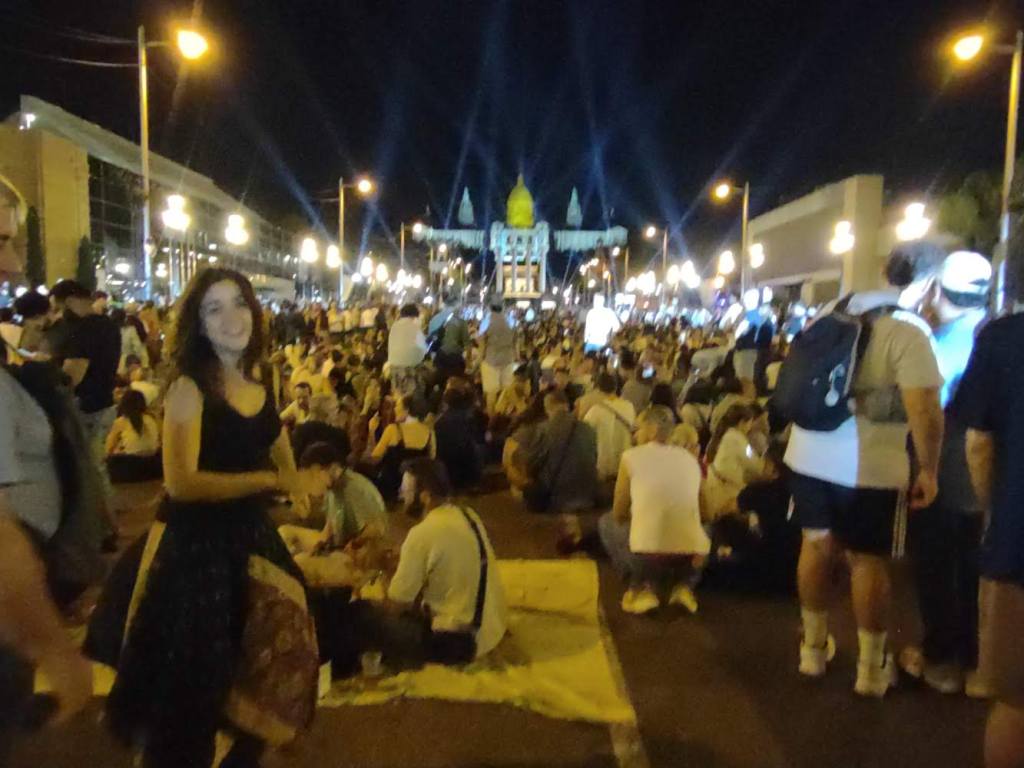
My husband found that last difference made the whole experience more enjoyable, or perhaps I should say, less fraught. For him. I love martial music, though I enjoyed the dancebeat vibe as well.
 Culminating Triad
Jo I am so pleased to be living vicariously on your trip. I’m having a wonderful time. Thank you very much. Ken
LikeLike