The name of this consecrated, minor Roman Catholic basilica is translated as “the holy family” in English, so I’m going to refer to it herein as HF, since SF means San Francisco to me. HF is a little overwhelming, and I’m not really even going to try to do it justice.
The pictures will tell most of the story as far as architecture is concerned. HF is not complete, even though construction started in the 1800s, and its main architect, Gaudi, died in 1926. The basic plan is a very unconventional-looking cathedral surrounded by 18 towers, honoring the twelve apostles, the four authors of the Gospels, Mary, and Jesus. All have been constructed but only six are currently erected. There are also three facades, nativity, passion, and glory, though only the first two are complete.
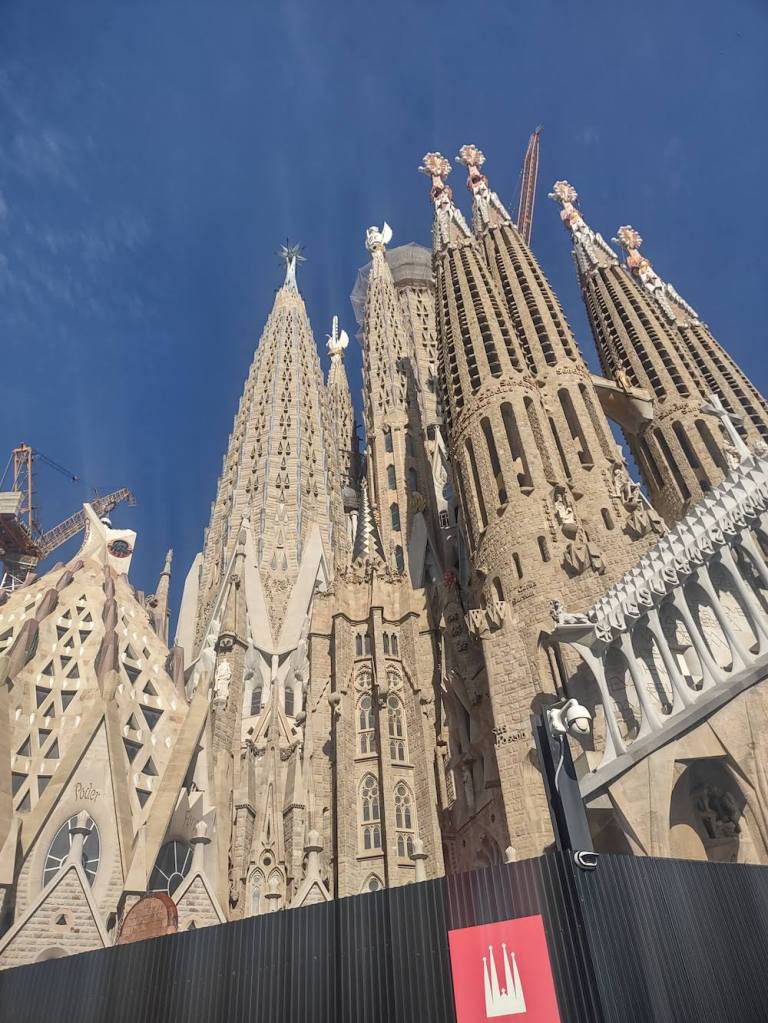
The exterior is covered with reliefs, particularly around the nativity entrance, where they depict events associated with the birth of Christ. The passion entrance is more austere, displaying events associated with His death. I am guessing the glory entrance decor will relate to Christ’s ascension.
The level of detail cannot be exaggerated, and can hardly be comprehended in person. I would not be surprised if every mention of Christ in the Bible and other texts is represented somewhere in this edifice. There are also other references, perhaps designed to appeal to the global community, such as lists of sacred sites all over the world and messages in many different languages.
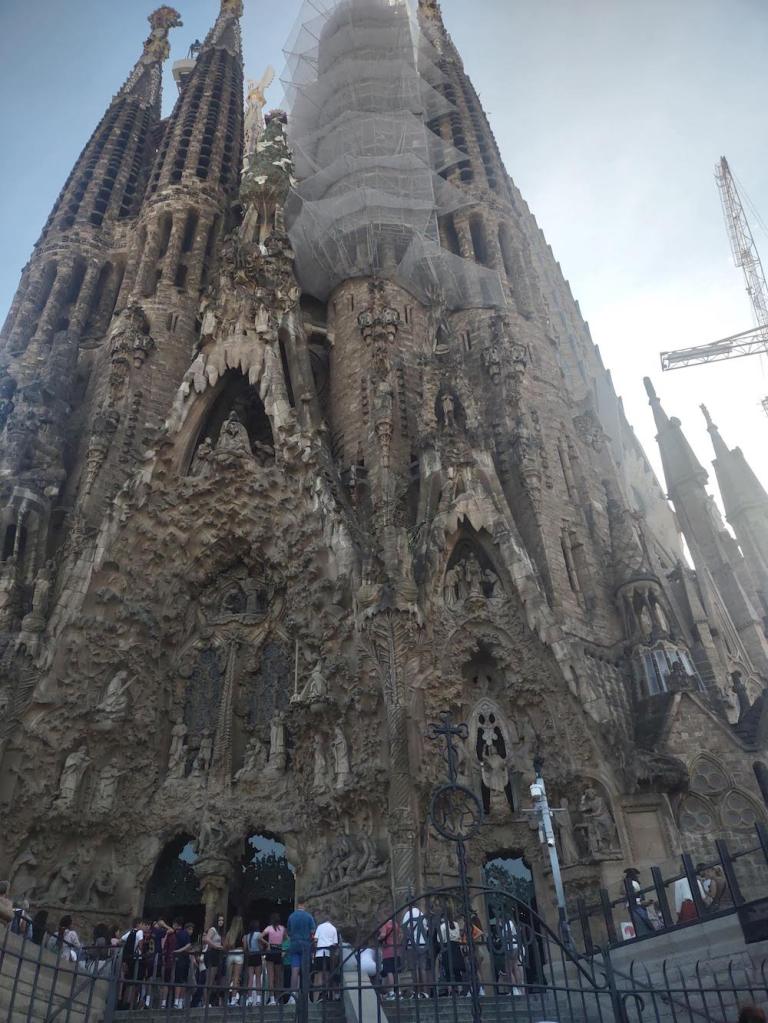
Although extraordinarily religious, Gaudi was also inspired by nature, and believed that man’s work should not exceed God’s. For that reason the apex of HF will be slightly lower than the height of nearby Montjuic.
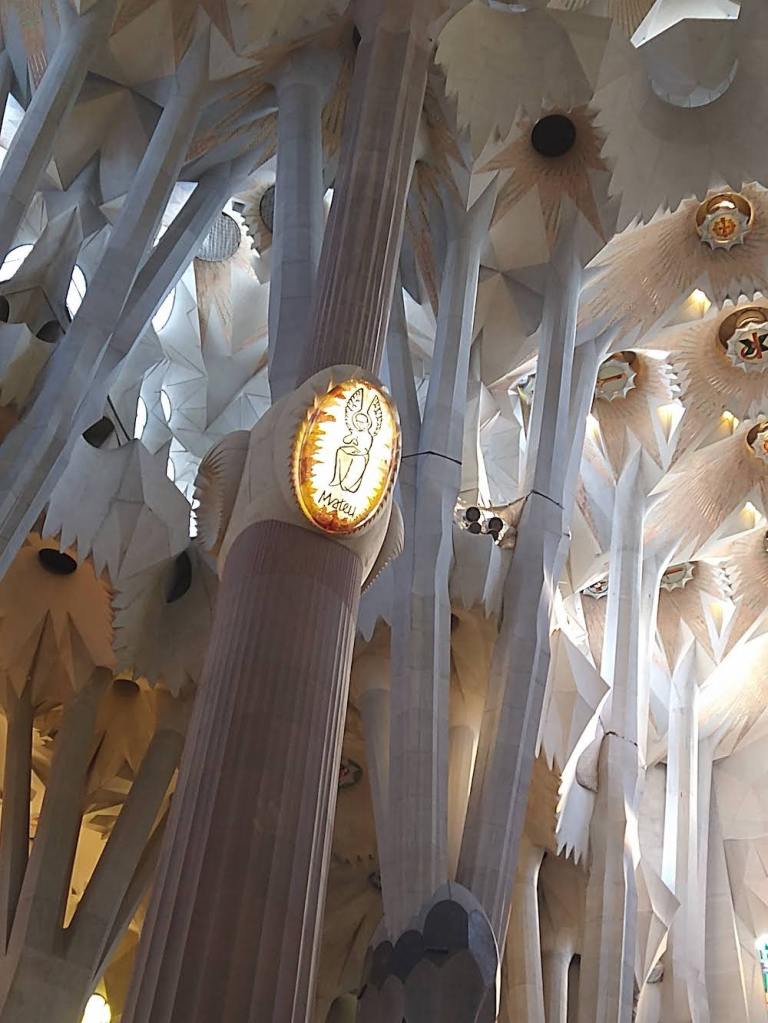
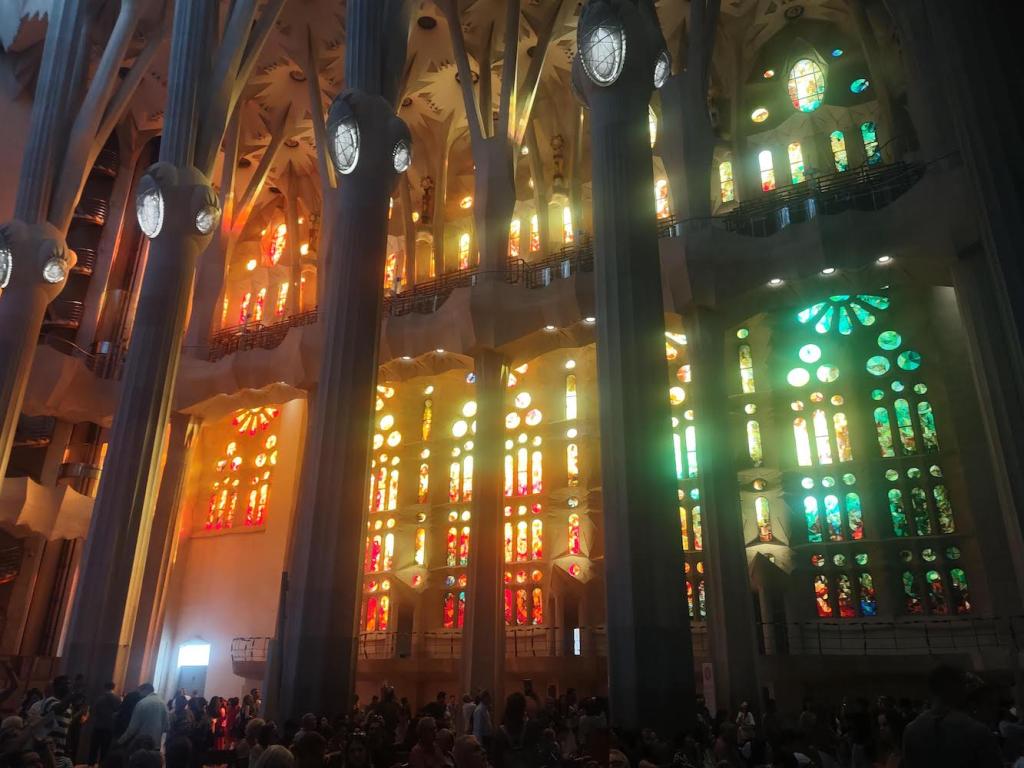
The cathedral includes a nave transected by an apse, cloisters and choirs, an altar and a crypt (where Gaudi lies), yet is not obviously comparable to any other cathedral in most respects. The major supporting columns, composed of various woods based on the weight each must bear, reach straight up toward the ceiling then branch into a tree-like canopy on reaching it, leading the audioguide to refer to the nave as “the forest.” Below is a closeup of the branching, followed by a longer view toward the altar.
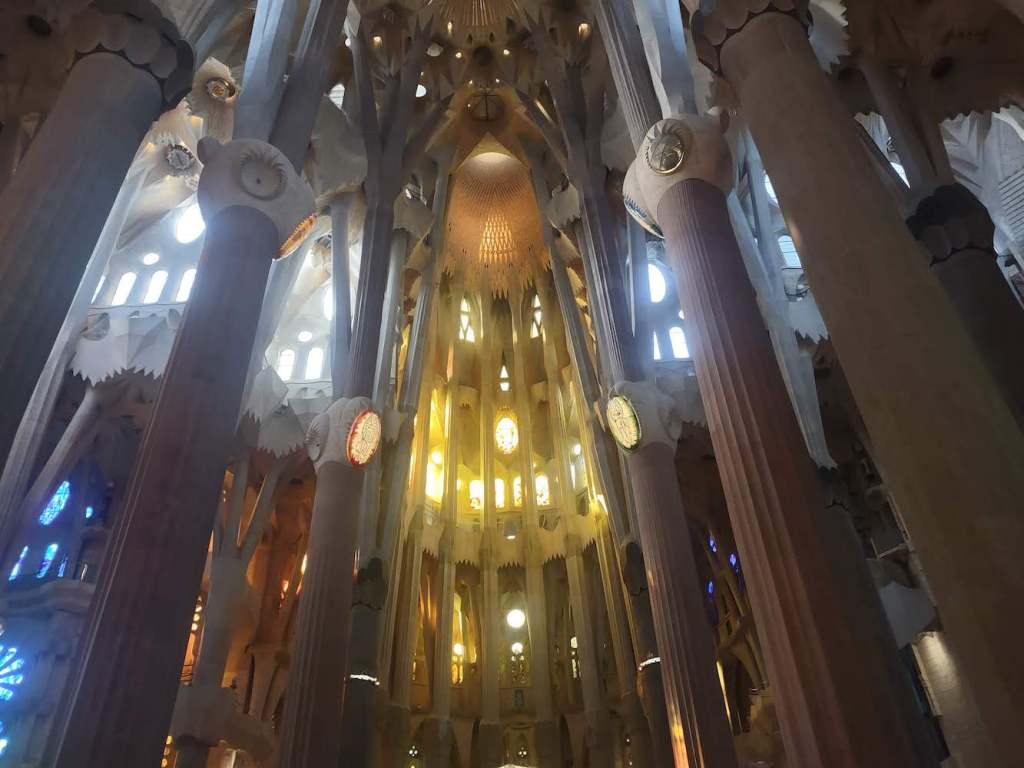
You may feel the tour is just getting started, and if you were there that would be true, but this is about as much as I can handle. We purposely chose our tour for an afternoon time so we could see the western windows aglow, so I’m including a picture of those, and the eastern ones as well, because they look great, too. You will easily be able to identify them by the associated coloring.

I’ve tried to be respectful here in terms of capitalization of religious terms, but also not to go overboard with that. While I was in the moment, the audioguide murmuring in my ear, I was mesmerized, hardly aware of those nearby or any physical reality outside of HF, but eventually the trance was broken. While I have great appreciation for beautiful religious monuments and inspiring classical masses, HF is a whole new level. Should we expend this sort of effort and labor and human genius for more than a century toward metaphysical ends?
Sometimes I feel we could it be living like the Jetsons if we were a little more interested in improving humanity’s physical well-being and enjoyment. Better yet, we could try to achieve peace on earth, good will toward men, not performatively as at a church service, but daily, at every level of society, for every category of employment, and as our most sacred, admired, and rewarded measure of merit.


Regarding your last paragraph, I couldn’t agree more. Ironically, the Calvary Chapel I attended during my Christian phase was in an industrial condo–as far removed from a cathedral of this stature as possible.
LikeLike