High-Tech Acupuncture

In a memorable instant eight months ago, I jumped up and landed too hard on my left foot. Since then my ankle reacts with something between shooting pain and slight twinge when I put weight on it.  I wore a brace. I took SAIDs for a while, and rested for a while, but staying off my feet is a fast track to plumpness–or in my case, I should say even more plumpness–plus everything I do involves feet. I even type at a standing desk usually, though not at this moment.

You are thinking, What about doctors? I saw a PA who recommended a podiatrist who was useless. He didn’t even touch my foot. He shone a light on it, and watched me walk. He wanted me to wear orthopedics and hard shoes. He thought running was always bad and that feet don’t age well since humans are “supposed to” die at 35.

Many people think this. It is a logical fallacy I have discussed before.

As an adherent of McDougall’s  Born to Run, I feel running is therapeutic, but when it actually hurts, I hesitate. I realize medical science might find something by imaging the foot, but my PCP will insist I go through a podiatrist, and they are mostly adherents of the Nature-failed-when-it-came-to-feet school. Even in Boston, dealing with a bunion, I had this problem. I seethe when these guys even talk, because they speak untruth, in the spirit of our zeitgeist, which feels alien to an older person such as myself.

So I decided to try an alternative, either acupuncture or chiropractic. I feel acupuncture has less of a down side, as in, the worst that will happen is nothing. I don’t feel that way about chiropractic. These feelings are based on nothing more or less substantive than web searches.

My husband and older son tried acupuncture about a decade ago, and it has changed. My practitioner uses the needles to apply electric current, replacing the manual manipulation of the needles required by acupuncture of yore. He also practices cupping, which uses a vacuum to stimulate circulation. The vacuum was once created by burning something in a cup which is then placed on the skin. Machine seems better. The third method he uses is a sort of deep foot massage.

The benefits of acupuncture may stem primarily from the logistics. The doctor, highly recommended, is personable and attentive, and exudes mastery. He diagnoses with touch and intuition, important since he hardly speaks English. The room is darkened most of the time, with soothing pentatonic background music. I sometimes doze. When I leave I feel relaxed and refreshed, as if I had visited a salon.

After three treatments, I’m not sure whether acupuncture is helping my foot. It’s certainly improving my mood.

Dance on the Breeze

Allergy season in California is a mystery to me. Blooming is nonstop, yet in April, only April, I suffer. Not as much as I did in Massachusetts in May, but perceptibly. I can’t name the culprit.

Suffer though I may, I’m working next to open windows, as I am a firm believer in exposing myself to windborne nature, especially microbes, whenever possible. I keep the opposite of a sealed home environment. One of the joys of California is that I can do so for at least part of the day almost every day of the year.

Today the wind has been gusty, so I have employed numerous items as paperweights, closed my notebooks and folders, turned books to face pages-away from the wind source, cleared extra papers from the printer trays, and put a line-dry item on a hanger outside. At some point this level of wind-related activity spawned a thought: I should go fly a kite.

I own kites. I like kites. Yet I can’t pinpoint the last time I flew one. The most memorable was in Cancun in 1996. We brought a kite with us from New England and my then four-year-old son and I flew it, while my  husband minded the six-month-old. With all the string out, the kite rose over the six-story hotel. It was the sort of hotel at which a helpful young man appeared to roll up the string for me when it was close to dinnertime.

Today, I grabbed a Prism Parafoil kite and a roll of string from my closet and set out for the nearest ball field. It flew after about six tries, that is, six times of untangling the string and waiting for a gust to lift the kite into the air versus just skittering it along the grass. Then I just flew the kite, letting the string out and hauling it in, pulling it taut and releasing it, walking or running over the field to avoid obstacles as the wind shifted. It was oddly relaxing. Eventually the kite snagged in a tree; I was able to tug it out and fly some more.

When I first arrived, a dad was exhorting three young children to race around the bases. I like to imagine mom was home having a rest. Those were later replaced by a dad and son each wearing a glove, who engaged in a more purposeful game of catch. I stayed in the outfield.

I will miss such impromptu afternoon adventures when I start full-time work, though I will be happy to enable similar chances for my husband, who has worked long enough.

On the way home the radio reported that Americans with full-time, below-living-wage jobs who qualify for government supports such as Medicaid will be asked to do more. I frequently use the phrase First World problem, but I wonder, are we still the First World? I wish I could offer a stressed-out working person an idle afternoon hour in the outfield, though she or he would probably prefer a raise.


How High Are We?

I’m reading Skyfaring by Mark Vanhoenacker, and thinking about altitude.

In my home office on the second floor, my phone app indicates we are 49 feet above sea level, with a possible error of 15 feet. If you are familiar with GPS, you know that my three-dimensional position is actually computed based on my phone’s distance from three or four satellites, each of which is moving. So I’m not shocked when I take my phone on a little walk about the house, return to the same spot, and find myself at 13 feet with a possible error of 45 feet.

Meanwhile, veloroutes.org says the elevation of my house is 55 feet, but freemaptools.com/elevation-finder says it is 46.4 feet, based on the house address. I wonder what methods those sites use.

Happily for me, this is just a matter of curiosity. Not so for a commercial airplane.

The most crucial time for the flight crew members to know their plane’s altitude is when landing, so then they use radar, bouncing a signal off the ground directly below the plane. The radar on the fuselage is programmed to display the distance from the ground to the bottom of the tires hanging from the deployed landing gear. Once the plane actually lands, its weight will compress the tires, so the radar display will indicate that part of the plane is underground.

When the plane is just leaving or approaching an airport, radar might bounce off another plane or a building and give a false reading, so the plane uses an altimeter, which calculates altitude based on air pressure. Air pressure is much more capricious than water pressure, because air is much more compressible. Although our atmosphere is fifteen miles thick, half of its air is crammed into the lower 3.5 miles. Air pressure also changes over the 24-hour light cycle, and due to characteristics of both prevailing and migrating weather systems.

The altimeter has to be calibrated to local conditions on the ground before takeoff, and adjusted during the flight as conditions change. When coming in for a landing, pilots may be given a local altimeter adjustment from the controller. Sometimes they get information from each other while in the air.

During the high-altitude cruising portion of a commercial flight, planes need to be separated by a minimum vertical distance, yet since their altimeters were calibrated at wildly different departure locations, readings might disagree. So pilots switch the altimeters to standard mode when they cruise. The algorithm results may vary from reality by hundreds of feet, but the relative readings among all planes will match. Planes cruise at tens of thousands of feet, so a few hundred won’t put any plane in danger of hitting anything on the ground.

What if a pilot forgets to switch over?

Mountains show up on pilots’ maps as Not Airspace. Navigating mountains combines altitude and location, and though planes use GPS now, it’s not the ultimate solution you might imagine. Beyond the scope of this blog.

When you see your altitude on the seatback screen, it may not be exactly right. In fact, even the pilot rarely knows exactly how high the plane is at any given moment. Earth is both bumpy and not-quite-spherical, making altitude is a moving target.

Should a simple question have a simple answer? Perhaps there are no simple questions. Certainly life seems devoid of absolutes.

Hiking at Pinnacles: Many Firsts

We visited a National Park for the first time since moving to California yesterday, our first chance to use the Geezer Pass, even though we’ve lived here eighteen months, and nine of the fifty-eight national parks in the US are here.

We’ve been touring other parts of this gorgeous state, some National, but not Park.

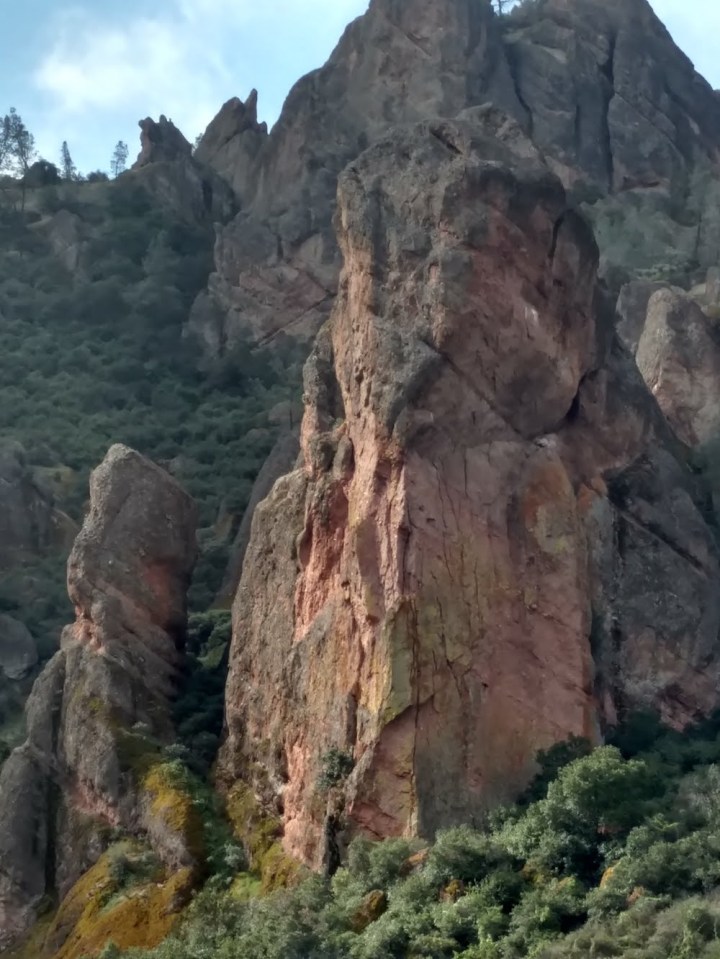
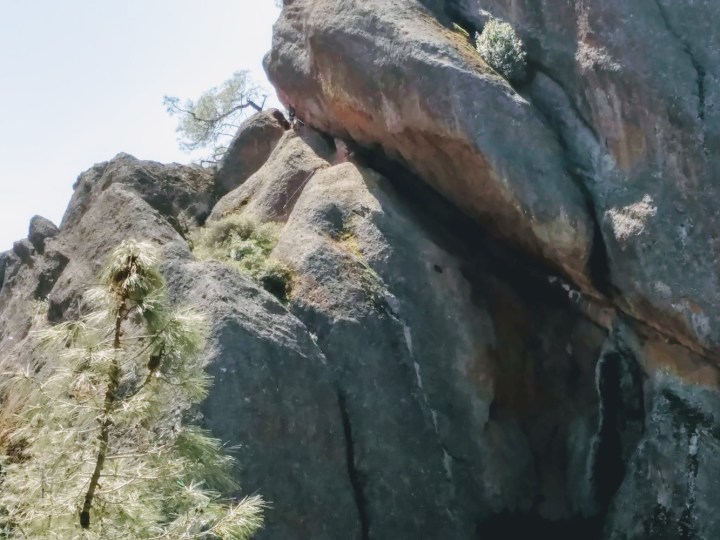
Pinnacles, named for volcanic rock formations millions of years old, is our most youthful national park, set aside in 2013. We saw the pinnacles up close and personal on the High Cliffs trail, which means I have no pictures of those. The path on that trail was steep and rocky, with squeeze-under, squeeze-through, steep-climb, and clambering-required areas, though some had railings. Most had drop-offs. There was one high, narrow bridge, always a favorite for the elevation-challenged.

I felt the need to stow my phone.

Pinnacles is one of two settings for the recovering California condor. One posed on a rock, exhibiting stunning detail of skin and feathers through the ranger’s spotting scope. Mostly they would soar, rising on thermals, or glide, falling with still wings, so we viewed their striking markings from above and below. I learned these bird terms post-trip.

G. californianus is also found in Big Sur. A scenery-appreciating vulture?

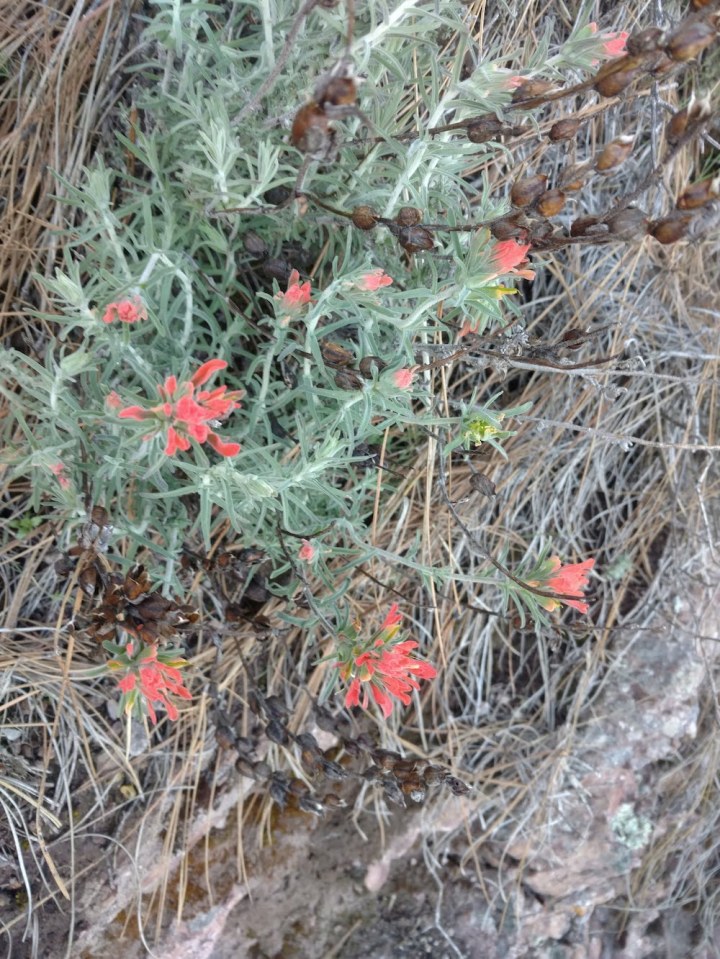
In the spring, Pinnacles is known for wildflowers, with the gloriousness of the display varying with temperature and the amount of winter rain. The most common wildflowers were purple, so I kept putting off taking a picture until I forgot. Here are two I did capture. The yellow ones, Sticky Monkey, have sticky leaves.

RedWildflowers

StickyMonkey

We also saw lichens, each a symbiont between a fungus and an alga. I once found it incredible that organisms from two domains, Eukarya  and Bacteria, could combine so closely, but since I began studying the human microbiome, I’ve realized cross-domain partnerships are Nature’s norm.

Lichen

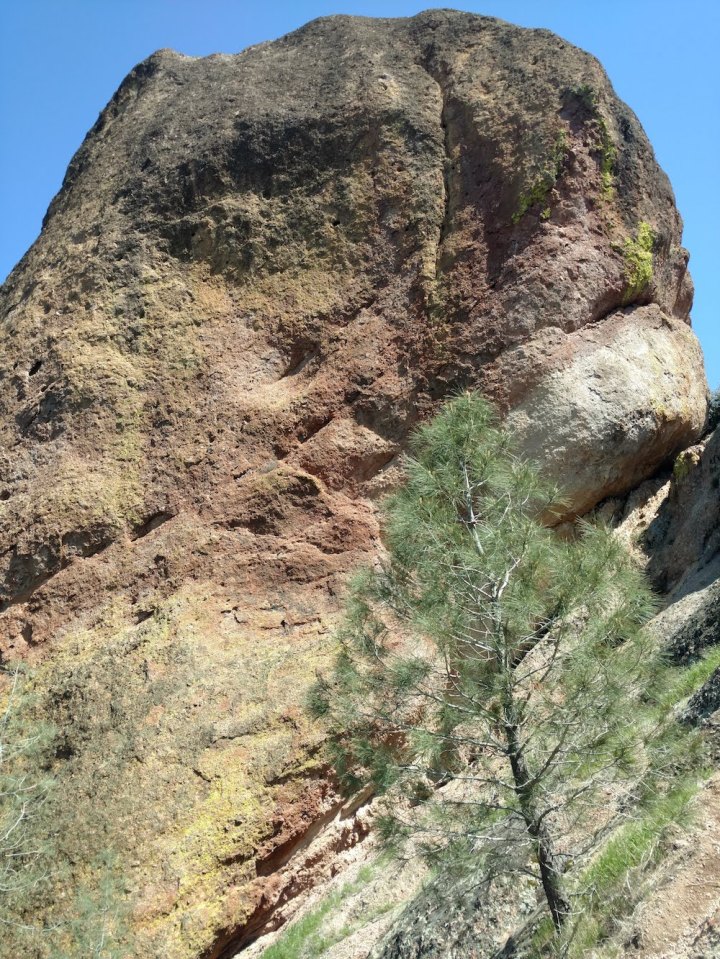
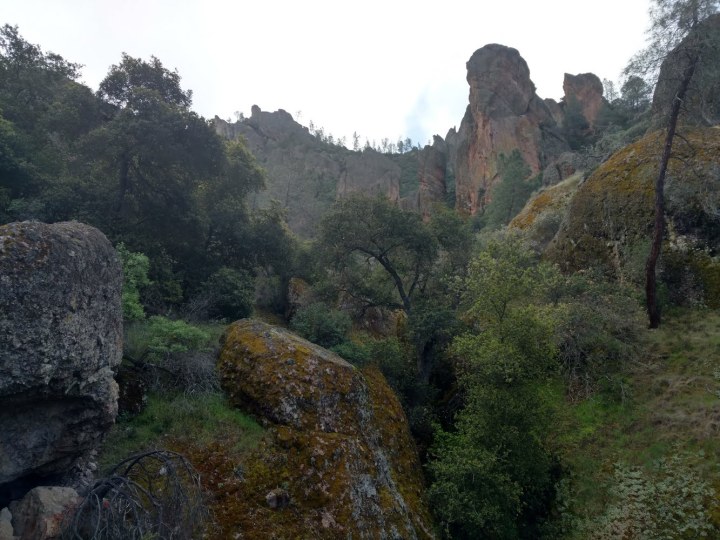
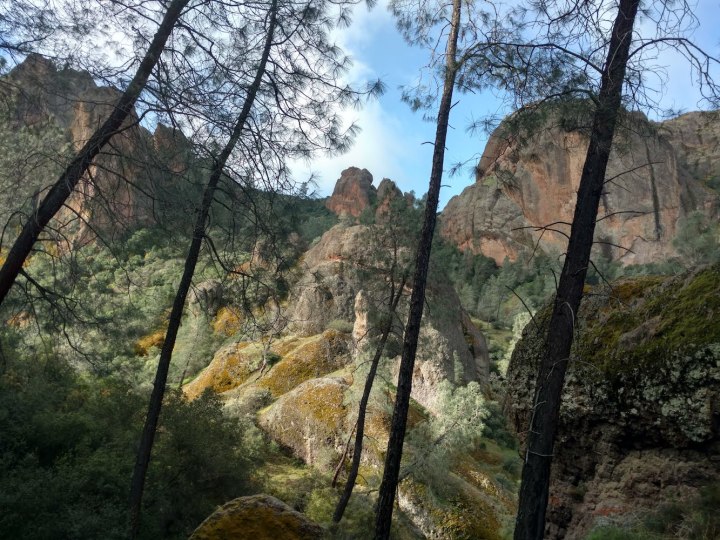
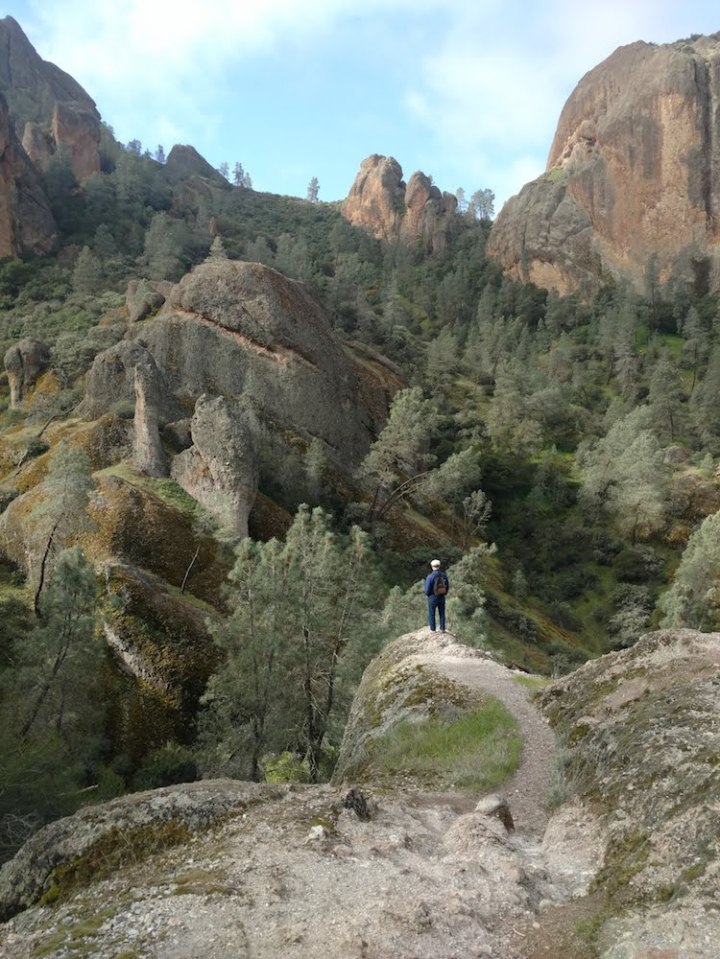
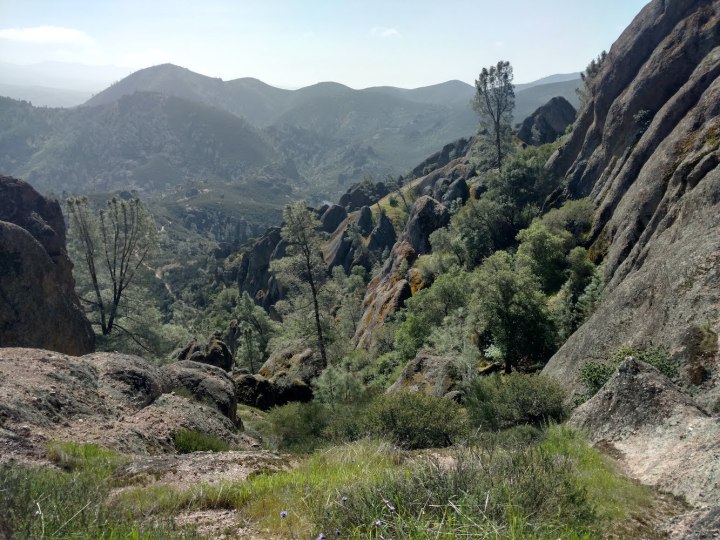
We spent 3 miles of the 4.3-mile trip traversing Juniper Canyon on the way to and from the pinnacles, and I did take some pictures! The canyon includes many Enormous Boulders, Strewn About. One shot includes a person, yet doesn’t really convey the scale.

BigBoulder1.jpg

JuniperCanyon1

JuniperCanyon2.jpg

JuniperCanyonScale

JuniperCanyon3

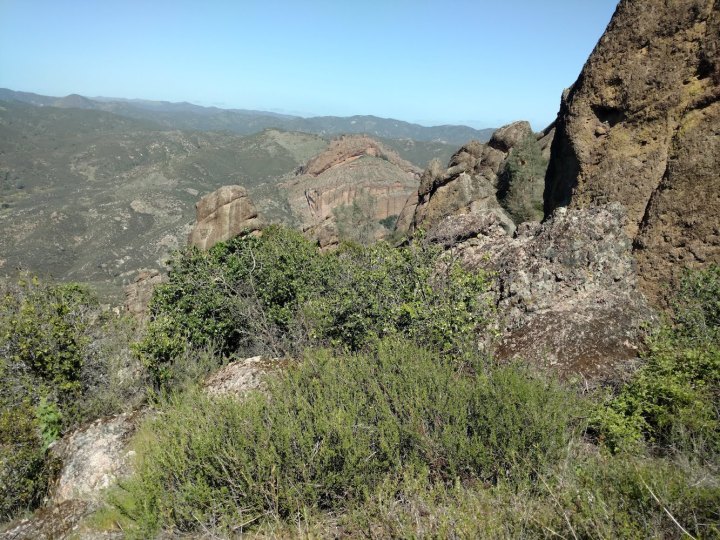
As you rise through the canyon toward Scout Peak, you feel you can see for hundreds of miles with virtually no sign of civilization. No cell phone towers. Few roads. Not even planes.

People-Free1

People-Free2

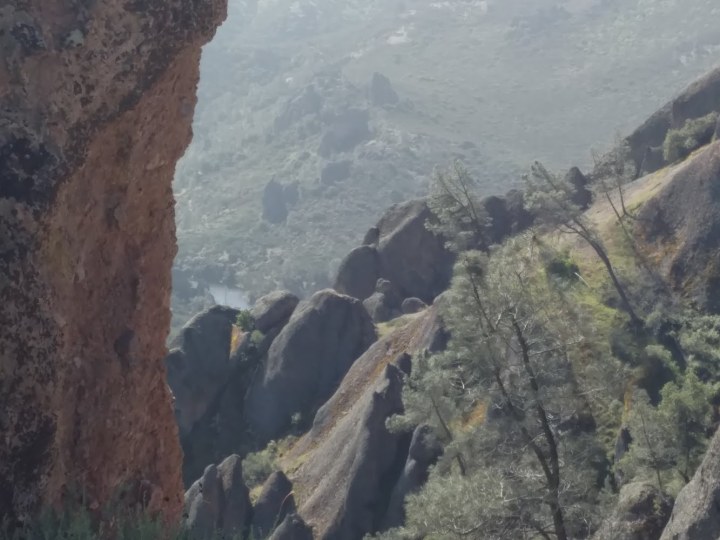
The small gray area just above a rock in the left middle of this picture is 215-million gallon Bear Gulch reservoir, as seen from Scout Peak, 4X magnification.

ReservoirFromScoutsPeak.jpg

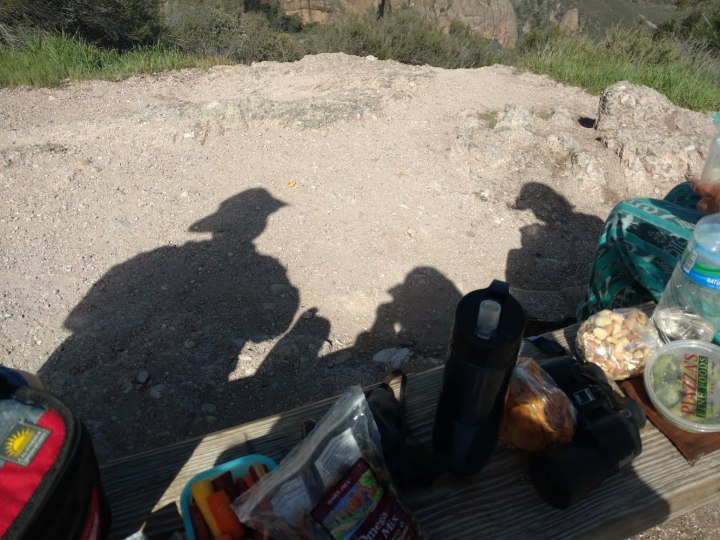
At Scout Peak, about halfway, we had a picnic. The scary part was in our future then.

PicnicScoutsPeak.jpg

On the way back, we saw a boulder that looked folded, perhaps from water erosion.

FoldedBoulder

The round trip took about four hours. Extended physical exertion in a wild, remote area is amazingly rejuvenating. I’m absolutely the first person to say that. We earned our time in the hot tub last night, not to mention over 21,000 Fitbit points.

Watching the River Fly

We’re expecting a storm, and its source will be an atmospheric river, or AR, which is exactly what it sounds like: a river flowing through the atmosphere. There are several, and they transport most of the water vapor outside of the tropics. River is the correct word, though maybe, Large River would be more appropriate. They average 300 miles wide and their flow by volume is similar to that at the mouth of the Mississippi.

AR is the correct term, but I am going to use sky river, which makes other rivers I have known land rivers.

A third to a half of West Coast rain comes from sky rivers, though usually not in April, which is one of our dryer months. That is, the ditty April showers bring May flowers did not originate here. We have flowers all year long, too.

Like the Mississippi, sky rivers meander, though in general they flow from the topics to the poles, just as land rivers flow from high ground to lower ground overall. Humans haven’t figured out a way to force sky rivers into fixed channels, so they wander freely.

The sky river arriving tomorrow is streaming directly from Hawaii to California, and is known as the Pineapple Express.

When a sky river wanders over land, it may release some of its water as rain or snow, or it may not. How much precipitation we will get, as well as its location and form, are still topics of speculation 24 hours before the event. Residents are advised to monitor forecasts during the next three days, as mudslide-creating  rain levels are one possibility.

Scientists have a lot to learn about global atmospheric phenomena, including sky rivers. We are still learning why some land rivers meander as well, and finding out that there are consequences to constraining them, including reduced biodiversity. Are there sky river creatures?  I hope so.

Do airplanes have to ford sky rivers?


Bucket of Rocks Could Work

Like many middle-aged white women, I am a big fan of Trevor Noah. He’s so cute, talented, and polite, and he speaks of his mother with respect tinged with fear. He reminds me of my own sons.

Sometimes we disagree though, and it happened this week, when he scoffed at a plan by a school in Pennsylvania to arm its classrooms with buckets of rocks for students to use in case of a school shooting. I thought it was a brilliant idea.

When I took self-defense for women, one of the main takeaways was Create a Surprise. Nothing complex: you create a surprise by yelling and fighting back. Armed creeps expect obedience, and its opposite discombobulates them. In the happiest case, the miscreant is startled enough to give you a chance to escape. Another heavily-emphasized strategy was Run.

A gunman entering a schoolroom expects the students to cower and avoid eye contact. If instead they all started yelling and throwing rocks, that could be a game-changer.

Taking my cues from Obvious Man, I do not think that arming anyone with anything is the correct approach to school shootings. (If I don’t have to explain this to you, skip to the next paragraph now.) Obviously, that “solution” assumes there will be school shootings and we are trying to reduce the body count, whereas an actual solution would call for America to catch up to the rest of its peers and forestall such events.

The fact is, school shootings are accomplished with guns, and mostly with guns that no one not licensed as a mass killer needs, namely guns that spray bullets. If you are spraying bullets at target practice, you have no idea if you are any good or not, but probably you are not. If you are spraying bullets while hunting wild game hunting, you are the opposite of an apex predator, and also unclear on the concept. If you are planning to spray bullets for self-protection at home or in public, you are clearly unconcerned about collateral damage, ie, not the sort of person who should have a gun.

But people do have bullet-spraying guns in the US, they do and they will. So I recommend we fill our public and private venues with lots and lots of rocks. Rocks under every school desk, at every theatre seat, beneath every pew, on every restaurant table, at every workstation and customer counter. Rocks in every bedroom, in homes and hotels and dorms.

Instead of See something, say something, if you See a shooter, throw a rock. You may want to yell, too.


Sarcopenia: New Worry for Old People

A friend recently told us that the most surprising thing to her about retirement has been that she needs to exercise more. Why is that,  I wondered?

The answer is sarcopenia, the loss of muscle tissue due to aging. Muscle mass rises until about age 30, after which it declines 3-5% per decade. Starting around age 60, not only is the absolute mass declining, but also the amount of work needed to maintain muscle mass is proportionally greater. That’s because older people may have fewer motor neurons, fewer muscle fibers, atrophied muscle fibers, reduced hormones, less efficient protein-to-energy conversion, and/or lower protein intake.
The good news is, you can reverse this process and even build muscle at any age.
The bad news is, you have to do weight-bearing exercises, both progressively and frequently.
Someone with extremely low muscle mass may be able to make progress simply by lifting his or her own body weight: stand, sit, repeat! When you’re ready for weights, use the heaviest ones you can handle with low reps, and increase the reps over time. When you master that, return to lower reps using a higher weight. Rinse and repeat. For different exercises, these may be hand weights, resistance bands, larger free weights, medicine balls, kettlebells, weight-lifting machines, filled two- or three-liter bottles, fire logs, or anvils.
Note: I am not qualified to give this advice. Consult your trainer before proceeding!
Is it worth it? In addition to the obvious, more energy and better balance, benefits may include
  • fasting wound-healing,
  • greater infection resistance,
  • delay or prevention of chronic diseases,
  • reduced likelihood of falling,
  • better fatty acid metabolism,
  • reduced depression, and
  • increased bone and joint health.
The good results accrue relatively quickly, so long as you are consistently working out, progressing, and consuming enough protein to build that mass. Beans, nuts, and soy work as well as meat.
I had done two to three low-weight, high-rep workouts per week that have not changed for years. Over the past few months, based on advice from my husband, I have switched to higher weights and am keeping notes so I can progress, but I still only lift twice a week. After doing this research, I am seriously considering emphasizing weights over aerobic exercise.
At 85 years old, RBG* continues to inspire! If you’ve only seen her exercising that one time with Stephen Colbert, I recommend you get the book.
========================================================================
 * Ruth Bader Ginsburg, whose trainer, Bryant Johnson, wrote The RBG Workout.

Unclear on the Concept

On TV, a liberal pundit dismissed the idea of social media affecting election results. I talk to those people, she said, and they have entrenched ideas. They simply cannot be convinced. 

LOL! Social media certainly does not affect election results by changing opinions through measured arguments.

Take me, for example. If I were active on FB, one might conclude that I am generally anti-corporate. Though I can hardly avoid corporations, I think they are voraciously greedy, perfectly willing to grind anyone into the dust for the mildest profit, including their own mothers.

Personification, yes. And if you are thinking, That’s just capitalism!, that’s not a discussion for today, though I will opine that you have little understanding of the historical relationship between capitalism and business, or an understanding of capitalism as a economic concept.

How to win two-viable-candidate, ie most, US elections? By getting folks to vote for your candidate, yes, but also by getting them to vote for someone who can not win, or not to vote at all. As a person with grabbable parts, I am on the Never-Trump roster. But if I were targeted by persuasive articles from what I would accept as accurate sources–many of them corporations, ironically–about nefarious ties between Hillary and Wall Street, Big Pharma, or the red-leaning big box realtors, I might well have chosen one of the secondary strategies.

Most people’s passions are evident to our corporate trackers, and your passions can be used to push you in either direction:

  • If you are devout, you perhaps can be swayed by evidence of a candidate speaking in favor of something your religion doesn’t approve of. Very few religions–I mean none–are evolved enough to stay out of politics in respect of freedom of religious choice for all.
  • If you are a misogynist or a racist, secretly or subconsciously of course, maybe you were shown a candidate doing or saying something that gives women or blacks any advantage, which you will conclude is unfair. I’m focusing on black people since our country has been crushing them explicitly for 400 years, de facto and de jure.
  • If you are an environmentalist or a technologist, evidence can be found to indicate any candidate won’t have a positive impact, either because of having the “wrong” attitudes or of having the “right” attitudes but not getting results.
  • Whether you’re for or against immigration, it’s easy to demonstrate that any candidate is not doing the right thing, because politicians haven’t made progress on this issue for decades. Perhaps a candidate without a record has some persuasive sound bites.
  • If you feature yourself to be informed about economics, first of all, you probably aren’t. Most economic opinions aired in this country are breathtakingly uninformed. I’m just going to say if you haven’t at least taken undergrad Intros to micro- and macroeconomics, or read one objective, instructive book above the “for Dummies” series level, you should not proffer an opinion, and even then, well, it’s not exactly a science, is it? Wait, is my argument speeding down a spur line? Back to the main track: Economics can be used by anyone to mean anything, so folks focused on the “business” side of government are easy targets. Same is true for history.
  • Going specific on the 2016 Presidential election, if you were a Bernie supporter, you certainly heard about the DNC impeding his success, and of course the Republican platform pretty much disdained everything he proposed.

Just to reiterate: you can be swayed either way. Your feed can be stuffed with what feels like an overwhelming, definitive amount of information, but is really billowing smoke designed to get you and your “friends” to swarm out of the hive and make a reckless choice.

Seek other sources!


Blogger’s Remorse

The spirit of Scarlett O’Hara seemingly has released me, and I feel a little contrite about my blog posting yesterday. Virgin Atlantic personnel didn’t cover themselves with glory, but they also did not earn eternal suffering.

When I wrote that blog, I was four hours into a 13-hour day of travel, and much happened thereafter. A gate agent–as opposed to the giddy ticketing agent I mischaracterized as a gate agent yesterday–did reveal an actual reason for re-assigned seating: a late equipment change, to a smaller plane. She still maintained, as did the reservations agent in Utah and the giddy ticketing agent, that she could not change seats. I have had seats changed by all three of those agent types on other airlines, including by an American gate agent two weeks ago.

Although it was surely not VA’s fault, the screens and scanner at the gate weren’t working, so every ten minutes someone reminded us of our flight number and destination, and when we boarded, someone wrote each seat assignment on a piece of paper. Not First Worldish.

The jetway line was unremarkable. The plane was a new world.

Everything worked on the plane, and it was not at all full. After we all sat in our assigned seats, but before pushback, clever flight attendants moved us around like chess pieces, reuniting at least three couples. All the couples ended up with empty middle seats, as did the travelers they had been squashed between. It was an epic rebound.

One only wonders who did the original re-assignments. A sentient computer with a grudge toward carbon entities? A dyslexic Tetris champ? A swarm of termites?

Continuing to atone, I will give VA thumbs-up for a few things:

  • Those amazing flight attendants described above.
  • Their innuendo-drenched, high-energy, song-and-dance safety demonstration video. Watching a mini-skirted flight attendant writhe into her seat belt, my husband said, I think I may need assistance. It was just as riveting the second time.
  • They threaten to gate-check, but so far I haven’t witnessed it. Gate-check is one of my new airline-greed-induced phobias.
  • There are video screens in every seat with an excellent selection of movies, at least on the long flights. I saw Creed eastbound and Chasing Mavericks homebound.
  • In addition to being free, the entertainment could be scheduled by the passenger, and it automatically paused during announcements. Very First Worldish.

Needless to say, the flight was pleasant and uneventful. Less than two hours after touchdown, we were eating fish tacos while enjoying an ocean view in Half Moon Bay, with no snow in sight.

In the Airport

We got up at 6am NJ time to go to the airport early in hopes of addressing egregious treatment by VIRGIN AMERICA, which NO ONE should EVER fly. Two days ago we were in seats 17A and 17C for this 6-hour flight. After checking in, we were in seats 11B and 13E. Middle seats! Not even in the same row!

No one at VA has a clue as to how or why this happened, but of one thing they are certain: we can’t change it. This brings out all my latent paranoia. What is wrong with this plane that requires such mucking about–filled with lepers, perhaps? Who is in 17A and 17C now, and why were we bumped for them? Were we singled out, or was every pair of travelers separated?

I actually posed this last question at the gate, and the gate agent claimed not to know. That’s right, she did not know whether or not every single pair of travelers on this flight was intentionally separated. Heck, I know the answer to that.

I don’t miss the days of yesteryear, when we dressed up for flights, were fed real meals, and often flew on partially empty planes. I miss the days when we could check our bags for free, rely on seat selection “sticking”, and not be lied to in silly ways by gate agents. Maybe five years ago.

This airplane won’t crash, but if it does, we will die not only frightened, but alone. Perhaps we can shout our goodbyes. In that case, I hope that all my friends with social networking skills will post my wish that every airline employee whose job includes separating travelers without notification, or who devised or endorsed that idea, or who colluded in its implementation, or who profited from it, to relive our last moments every single day of their lives, the rest of which will ideally be filled with shame and pain.

Not just paranoia. Vindictive anger.

I think it’s part of my southern upbringing. We Southerners are Loud and Proud even with our record low ratings on educational outcomes and public health, and record highs in race-based policing and percent of citizens incarcerated for victimless crimes. That is to say, we are not obsequious. We don’t even yield to reality.

I don’t usually claim, or even want to claim, this heritage, but it sometimes claims me. Dismissive disregard, heedless disrespect, casual dismissal, those are arrows pointed at my heart. If I am not a spineless worm, I will fight, nay, refuse this treatment.

Yet I cannot. Cognitive dissonance. Extreme stress. Slightly abrogated by blogging.