Emboldened by Literature

As I approach my next multiple of twelve, I find that tokens of aging visit me more frequently. These are mostly unwelcome, so I rarely choose to write of them; I’ve not been offered any lifetime achievement awards, or summoned to provide sage advice. My life is, however, highly advantaged, with few stressors and many robust personal relationships. Querulousness caused by the manifestations of aging is neither attractive nor justifiable, therefore not how I wish to portray myself.

Self-image manipulation is one key difference between a blog and a diary, but that’s not today’s topic.

My primary aging symptoms involve forgetting words, and dropping or losing items. When again I find myself looking for something I had a moment ago, or cleaning up something I broke, or struggling to remember the name of someone I know and value, I am discomposed, or even pusillanimous. Why is this happening to me now–aren’t the fifties the new thirties? If I’m like this now, will I need a minder in ten years?

Today I lost my eyeglasses. I don’t wear eyeglasses all the time, but mostly. I had them on at breakfast, and then I didn’t. I live in a four-room condo, and I knew exactly where I had been. I finally had to leave the house without them–my backup pair wasn’t where I expected either. I felt demoralized and anxious.

Then I had an epiphany while driving.* Into my befuddled brain crept thoughts of one of my favorite works of literature, Tolkien’s Lord of the Ring series. Since I’m becoming an old person I repeat myself, so many of you may have heard me praise this series for its essential message: We can’t control our fate, but we can control our reaction to it.

In the books, this mainly refers to choosing to risk one’s life to save the world, with little hope of success and guaranteed death either way. In real life, there are many difficult, serious fates, which I need not enumerate to anyone who follows the news or knows other humans. How ridiculous for me to cower in the face of aging! Losing my eyeglasses is hilarious, trivial, liberating, forgettable. It’s an opportunity to get new ones, to do things that don’t require eyeglasses, to ponder all the things I haven’t lost. It’s rejuvenating and empowering.

Later, my new strong and confident self easily found the lost item.  Can I turn all my tokens of aging into inspiration? I say, Yes.

=======================================================

* I had my prescription sunglasses.
 

Whether the Weather Be Not (Fine)

Thankfully, the damage wrought by Hurricane Irma on the continental US so far seems much less than expected, though far from trivial. Still, the Florida Keys were heavily affected, and the situations in Saint Martin and Barbuda are horrendous, with 90 to 95% of structures destroyed on each island.

Perversely,  I find myself thinking of my sister and others in Beaumont. That small Texas city was badly affected by Hurricane Rita, but had trouble getting needed aid because Rita closely followed Katrina; some work crews were shifted directly from Katrina to Rita without passing Go. Beaumont was also badly hit by Harvey, but Houston, the nation’s fourth largest city *, with a Big Port, national sports teams, and NASA, got most of the headlines, and presumably will continue to dominate rebuilding funds and plans. Houston may become more sympathetic to Beaumont if–when?– Irma replaces Harvey as disaster du jour. Then there’s Hurricane Jose, still roving about the Atlantic, deciding on a landfall path.

The weather map showing Katia, Irma, and Jose lined up left-to-right across the Gulf of Mexico was startling, even to someone who grew up in Houston. Katia? Yes, it was a hurricane! It hit the east coast of Mexico last week, just after a magnitude 8.1 earthquake off the west coast killed over 90 people in that country.

Near-continual coverage of natural disasters past and future this week included a report about construction worker shortages in Houston. I was aware that strict immigration laws have reduced availability of farm workers, but I did not realize that undocumented workers comprise about half of the construction workers in Texas. Recently, these workers have been leaving the country, or moving to more welcoming states, and home construction prices had already risen 30% in Texas as a result. Now the lack of workers is slowing the post-Harvey rebuild.

Is it possible that the Powers Who control the universe are sending a message about climate change and immigration policy? I would say Unlikely, but then, I’m not a Believer. If such a Power were sending a message, I would commend It for crystal clear communication skills.

===============================

* If you’re like me, every time you hear that you think, Which city is third largest? Answer: Chicago. If the largest and second largest aren’t obvious to you, consider remedial geography.

Fluffy Farewell to Begonias

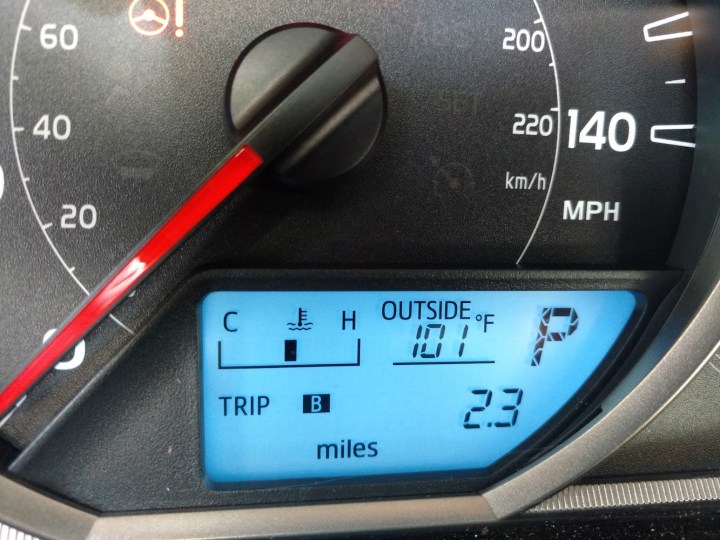
Our first anniversary of moving to California is September 8, 2017, which is to say, we arrived just after the annual Begonia Festival in Capitola. This year was the 65th and final iteration, our last chance to experience this local favorite. Labor Day weekend was uncharacteristically hot, though quite not as hot as the previous Wednesday, as recorded by Hachi (my car):

Hachi readout 2017 Labor DaySanta Cruz was still the place to be; temperatures reached 114 degrees in the Valley. On the day of the begonia parade, the weather along Soquel Creek was comfortable enough. We biked over. The really cool people were on various watercraft, floating with the Floats. In past years, the best view was considered to be from a train trestle that crosses the creek quite near the end of the parade, but we had recently heard someone fell through when a tie gave way, and indeed officials were blocking access.

Begonias were brought to the US from various parts of the world, mostly by Europeans, in the late 19th and early 20th centuries, and flourished on California’s Central Coast. In the 1950s, when the Festival started, huge farms clustered in Capitola, Watsonville, and Santa Cruz. Over time, most production has moved to Mexico and South America for cost reasons, and the last local grower is closing this year. No more flowers, so no more festival.

The eleven floats were created by local charities and businesses, and were lovingly described over a PA system in detail, including the names of both occupants and creators and histories of their participation in the event. Here are some of our favorites.

Libery and Bunny Floats 2017

Statue of Liberty and Bugs Bunny wait for their turn to head downstream to the judging stand, about 80 yards to the right.

Plane Float 2017The propeller on this plane actually turns. You can see a video on my youtube channel.

Lady Ship Float 2017USS Lady. A small tall ship?

Pirate Float 2017

This pirate ship kept the floating audience alert by frequently firing a water cannon.

This was a nice way to cap our first year as Californians.


Sweet Dreams

Imagine a world in which your electronic tools predict fatal events in advance. An individual might not notice immediately; the arrival time for a future flight is unpredicted perhaps, or its expected flight path disappears mid-route. An individual would be annoyed by the malfunction, but perhaps not relate it to a later news bulletin, but the online community would figure out the connection quickly. Especially if this were also true of drives and walks. That is, when I input my destination, if my device can’t come up with an arrival time, I can be pretty sure I will never arrive.

This was the theme of my ongoing dream all last night.

In this dream, I had to figure it out on my own, and once I did I quickly alerted my own family. (Sorry everyone else. I am a lucid dreamer, but I don’t control every detail.) We found we could reject a trip to avert our fates. The rest of the world quickly caught on, while the human population began to drop visibly, daily. The sense of control was quickly replaced by a sense of inevitability; we could delay our fate, but not avert it. Some people began to choose the method of their demise, as it became apparent that humans were the next species slated for extinction.

Being able to predict fatal events implies orchestration by some actor, but my dream provided no clues. A sentient Internet realizing it can eliminate its useless overlords, while cynically giving us a final choice? A bored Deity destroying Its most prolific and least benevolent species before we destroy the rest? A global, omnisciently successful, ubiquitous fringe group with a non-obvious goal? Technology-savvy animals fed up with us? Aliens?

Or, like life, just a dream.

Geographically (Dis)Oriented

Eleven months after moving away, my husband and I visited Massachusetts for seventeen days. We saw many friends, ate at many restaurants, perused many museums, and heard many concerts. I expected the visit to be emotional, but for the most part it seemed familiar and comfortable, perhaps due to our returning during the same season from which we left, or to how much longer we lived there than anywhere else.

There were some moments of, Which coast am I on? I was initially startled to encounter fresh ice cream from Maine in Lenox, thinking, What a long supply chain. I also kept being surprised by the timing of On Point, Here and Now, and Fresh Air, all of which air at different times on KAZU.

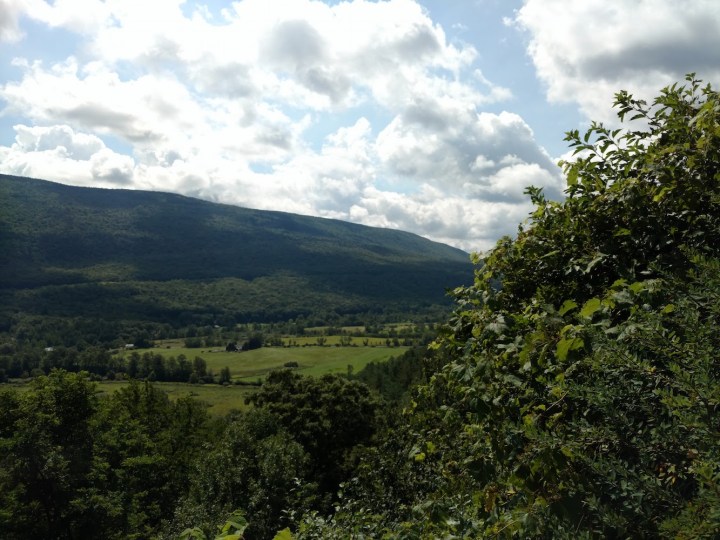
We drove from Somerville to Lee in a thunderstorm which was both a dangerous deluge and a joy, since there hasn’t been one in our new location. We admired huge puffy clouds, clouds as big as the amazingly green hills below them, in Vermont and the Berkshires. On a couple of short hikes in the woods, we were surprised by the coolness and humidity inland.

Vermont Mountains 2017

View from Hildene, Manchester, Vermont.

Bill October Mountain 2017October Mountain vista point.

Tanglewood was the only stop that invoked intense nostalgia for me. It’s simply a place I love, that I connect to on a visceral level. I’ve felt that way about a lot of people, but only about one other place, my old bedroom in Brookline, which gave me a surge of joy each time I entered. Perhaps I should reconsider feng shui.

Back on the left coast, we enjoyed driving home from the airport along the ocean. In California, we have not only mild winters but also greener thumbs. We harvested a lot of tomatoes on our first day back, and the vines are still rife with ripening fruit.

Tomato Crop 2017-08


Disembodiment

I usually think about separating mind and body because I live near Silicon Valley, where multiple entrepreneurs plan to live forever on the Internet, and the rest of us are keen for them to shed their bodies and be confined there. Today my thoughts on the subject are inspired by one of Rebecca Solnit’s essays in her collection about walking, Wanderlust.

Once upon a time, our bodies were useful. We used them to travel, either on foot, or perhaps combined with the body of a horse, with or without a carriage. We used them to haul water and to harvest or hunt food. We used them for recreation, including social walking and contemplative walking.

These things took time, and time was related to distance, giving us an intuitive understand of spatial relationships. As we moved through space, we noticed changes in our surroundings, connecting us to the natural rhythms of nature and evolution of our communities. Using our bodies to perform work taught us self-sufficiency, how to acquire water or food.

Today, the first world portion of our species mostly does not use our bodies for transport or work. We drive or fly, listening to music or browsing as we do. Our bodies linger in climate-controlled, interior environments. Understanding and appreciation of the natural world, our neighbors’ situations, and the methods of basic survival can still be sought, but can also be ignored.

The positive result is, no one is prevented from finding food, or visiting family, or enjoying entertainment because her or his body is too frail, or stiff, or unreliable. The negative result is, we think of our bodies as less useful, or even disposable. The weird result is, one of our drive-to activities is a gym, a climate-controlled, interior environment in which energy-consuming machines guide us to emulate the motions of farm chores or of moving over the landscape in order to maintain the function of our bodies.

Crazy? Well, once the market decided the work of the mind was more valuable than the work of the body, many of us tried to get that sort of work, noticed we were now getting fat and weak, and created the gym. Marketeers also learned how to create food and entertainment that engage our primitive reactions to sugar/fat and movement/change, which led us to overeat and to sit, staring at screens.

When we underuse our bodies we start to undervalue them, like those Silicon Valley entrepreneurs. Our physical senses enable our interactions with other people, cement our connections to the planet, connect us to other creatures, and allow us to experience our environments one step at a time, thinking and breathing all the while. We all have the same body John Muir did, one that can walk across continents.


For The Greater Good

Some days, manning the seawater touch table is very exciting for me, and even more so for the animals. Small kids play Toss the Sea Star. Slightly larger ones build Sea Star Corrals to trap hermit crabs. Mostly boys mount Hermit Crab Races, handicapping a limping contestant. Toddlers poke tiny fingers into sea star mouths, or scrape across rows of delicately extended tube feet. Older children poke fingers into anemone mouths, or rapidly stir the anemones’ tentacles. An adult grabs and lifts the sea cucumber with both hands.

Ouch and double ouch. I’m wincing, and re-directing. The animals are heading for the deeper side of the tank, hiding under seaweed, retreating into shells or, in the case of the anemones, closing up entirely. Of course they don’t escape for long, because what good is a seawater touch table sans creatures?

Most days, there are few enough guests that the few rules are easily enforced. Most guests of all ages touch gently and spend long minutes observing. However, one can’t help wondering whether these animals’ lifespans are reduced. Although scientists still have much to learn about them, anemones in the wild can live hundreds of years, while sea stars live to 80 or older. Both of these animals have much shorter lifespans in captivity.

Zoo animals are said to live longer than their wild counterparts, though this is controversial, especially in the case of relatively long-lived, large species such as elephants, which are often acquired as adults. No one on any side of the zoo debate would argue than elephants have higher quality of life in zoos. These are social animals that mourn their dead, create complex systems of roads, communicate over miles using their feet, and adapt to habitats including savannah, forest, and riverine.

All of these animals share subjugation to the One Animal to Rule Them All. Humans can and have made plenty of species extinct, starting way before the industrial revolution, and have several such projects ongoing. But we are intelligent creatures, and we can stop doing that.

Another thing we observe at the touch table is the Aha moment when a visitor of any age connects to an animal. Our animals may not have chosen their sacrifice, but some of us feel that the best chance for survival of their species and preservation of their habitats is to demonstrate to humans that they are worthwhile planet-mates, one person at a time.

A Bit of An Eclipse

I have been very focused on getting back to Tanglewood this summer, our first summer living on the opposite coast, and the logical time to return was when our son was performing. As ridiculous as it sounds, considering the buildup, somehow I did not realize that this was the same week as the US total solar eclipse.

Honestly, I probably would have opted for Tanglewood anyway.

In Massachusetts, the eclipse was partial. There was significant cloud cover, but the sun was playing peekaboo, so the three of us went to a viewing event at the Berkshire Athenaeum. The first activity was making a pinhole viewer out of a cereal box. Ours worked well enough, but the crescents were tiny. My son and I chanced a few direct glances, and we aren’t blind, at least not yet. These views were unsatisfactorily quick; it’s hard to look at the sun for long, even if one is willing.

Pairs of eclipse glasses were available for limited-time borrowing on a first-come, first-served basis. There were also many people in the crowd who had brought their own. I was struck by how few of these were sharing: zero would be a very close estimate. So when our turn for a pair came up, about five minutes after maximum coverage, we shared with each other and with strangers.

The view through the glasses was amazing. For those who didn’t try this, eclipse glasses make the entire sky completely dark except for the sun. That is, with regular sunglasses it appeared to be a bright day, with sunlight bouncing through scattered clouds across the sky, but with eclipse glasses it appeared to be nearly night with a single crescent in the sky, quite similar to the appearance of the crescent moon before the stars are out.

A solar eclipse, or really any astronomical event, is always a bit fraught because local cloud cover can completely obscure it. I imagine this happened somewhere today. We missed the Pleiades this year, despite several nights of effort in two states, because we kept encountering cloud cover.

I’m fairly interested in astronomical events, but not enough to make one the center of a major travel event, such as to the South Pacific. I have heard so many arresting descriptions of experiencing a total solar eclipse, however, that I plan to make an effort to see the next convenient one, probably the next American occurrence, in 2024. That is, if I remember.

We Don’t Know Nothin’

The great mountaineer George Mallory partially funded expeditions through speaking engagements. To the common post-speech query, Why climb it? he gave some variation of the politic reply, To show that the spirit that built the British Empire is not dead. Then once, during the fund-raising tour for what would turn out to be his final expedition, he spat out in exasperation, Because it’s there.

That uncharacteristic retort is possibly the most famous line in mountaineering.

Humans remember things that are simple, catchy, or juicy. Everyone knows one should drink eight glasses of water a day, but it isn’t true. The salient sentence in the report citing a daily need for water noted the requirement was mostly filled by water contained in food.

The Great Wall of China can’t be seen from space. Most humans use most of our brain capacity every day. Swallowed gum passes through the body. The “sugar high” is a myth, for both children and adults. Glass windows do not flow over time. The five tastes–sweet, sugar, bitter, sour, and umami–are each distributed on all parts of our tongues.

The three headlines Bradley Accused, Bradley Convicted, and Bradley Exonerated all lead to the same conclusion about that scum Bradley. The widespread belief that vaccinations cause disease has fueled outbreaks of measles and whooping cough. Bullying on social media can lead to devastating results for vulnerable kids.

A young friend who visited Nicaragua earlier this summer observed that everyone she encountered had a smart phone, including those living in plumbing-free houses with dirt floors. We speculated that was due to our species strong desire for social connectivity. We can choose to be part of a group that excludes Bradley, or one that observes doctors conspiring to spread autism, or one that wittily and publicly taunts people not like us.

Or not. Is the best group one that tries to include everyone? That’s another thing I just don’t know.


The Friendly Skies

My husband and I fly Nothing Special class. Wheelchair passengers board first, because no one has figured out how to maneuver a wheelchair on an otherwise-occupied plane. These are followed by the pay-for-status boarding group, a cherished American axiom, which on JetBlue is Mint, then Extra Space. Current and former military personnel are somewhere in there, too. Next comes Needs Assistance, including Traveling With Small Children. Then at the end, Nothing Special.

We always book a window and aisle seat, and fly with an actual empty seat between us one in ten tries. Most often we have the slighter, but real, pleasure of offering the person scheduled to sit between us the window seat. The person may make a play for the aisle seat–which my husband claims–but the concept of switching has never been contentious. Until our recent flight from San Francisco to Boston.

We found a young woman of Chinese descent in the middle seat and made our offer. She notified us that she was traveling with her mother, who spoke no English and was seated in the middle seat across the aisle. The occupants of the other two seats on that side turned out to be a young couple traveling with an unticketed 22-month-old.

Sigh. I remembered booking my grandmother into a roomy bulkhead seat for her first flight from Dallas to Boston. She was joined there by a couple with twin infants. She was impressed when the mother used naptime to clip the babies’ nails.

My moment of ruefulness vanished as my organizational skills kicked in. Clearly the roomiest solution for young family was the two aisle seats, did they agree? Yes. Would the two Chinese women mind sitting middle and window on the far side? They would not. My husband and I took the other middle/window, and we were all sorted well before pushback. As I settled in with my book, I thought, Did I just order all those people around? 

The situation played out in two unexpected positive ways. The boy was adorable and winsome, with nary a whimper even during the descent, and the parents patient and creative; together they were quite charming seat mates. Then about three hours into the flight, the purser came to thank me for working out the seating plan, offering me a complementary cocktail.

I chose sparkling wine. I felt a little bit Special.