Town Mouse

On July 5th, several co-volunteers were pleased to describe to me, the California newbie, the local Independence Day parades they had viewed, each of which I would characterize as “locals shuffling along.” One in particular is advertised as Shortest And Longest: shortest in number of participants and longest in time it takes to pass by.

Sounds boring to me! The Country Mice can have their quaint rites; I want world-class fireworks.

In San Francisco last Saturday. I gazed longingly at preparations near the Municipal Wharf, but it was not to be, so we went instead to San Jose. The Guadalupe River is no match for the Charles, Boston is known for spending millions on fireworks, and the music was recorded, so we weren’t planning to be impressed. Perhaps that is why everything about the experience was a pleasant surprise.

  • No need to arrive very early; there were good spots on the lawn an hour before the start time, 9:30.
  • We parked in my husband’s office building, but parking on the street would not have been an issue when we arrived at 6:00. We were able to have a leisurely dinner.
  • Our Scouting days being far behind us, we forgot to bring blankets or chairs, so we sat on the steps of a building across the street. Nearly empty when we arrived, those steps were never crowded. People on bicycles and rickshaws were dribbling in until almost the last moment.
  • No mosquitoes!
  • Afterwards, the streets were walkable, and it took us perhaps 15 minutes extra to reach the freeway, which was moving at speed.

Most important, the fireworks show was fantastic! It was comparable to Boston’s in the range of colors, shapes, and sounds, the variety of types, and the length, though sans cannon. Each year in Boston we see some incendiary technological advance, and we saw one in SJ: fireworks that exploded from a central point into eight separated quadrants, each of a different color.

We were closer than anyone could be in Boston, considering the distance from the river shore to the fireworks barge there. Using the star-gazer’s rule that the distance from thumb to pinkie tips on your outstretched arm subtends 20 degrees of the sky, I would say the diameter of the largest spheres covered 30 degrees of our field of view.

It was really loud. I had to cover my ears during the finale.

For me, the evening was a much-needed lift.  I am at no risk for hubris syndrome, as I am recently experiencing a seemingly endless series of humbling incidents.
Mirroring and Hubris

Mirroring is a neural process on which empathy may be based. It happens subconsciously. When we watch someone do an action, the brain areas we would use to do the same thing light up, even if we are motionless. It’s one of the many ways our brain is wired to do what more and more seems to me like its primary purpose: tightening our social bonds.

Consciously imitating others is another way we form social cement. If we laugh or shout when others do, we experience what they are feeling, which creates solidarity. In a hierarchical society, we tend to mimic the expressions and body language of our “superiors”, perhaps to show we are “on the team.” People who don’t react in this way may make others in their peer group uncomfortable, or make their bosses think they don’t share corporate goals.

In the workplace, this may relate to how hard it is to diversify, and why rules and incentives are needed to ensure fair results, and that is a rich direction to explore. But today I’m writing about “hubris syndrome”, which I read about in The Atlantic.

People who exercise extreme power over relatively long periods have measurable reduction in mirroring, as well as observable lack of imitation. They may exhibit loss of contact with reality, or take reckless actions; they are prone to stereotyping. Powerful people are less adept at seeing things from other’s viewpoints not because they don’t try, but because they can’t. If praise and fortune smile on you always, believing you deserve them becomes part of your brain wiring.

Legions of examples of clueless CEOs testifying in various venues about deplorable decisions spring to mind….

…as well as the current trend of the super-rich building enclaves for themselves and their pilots and maids to survive extreme civil unrest or the devastating consequences of climate change, instead of trying to reverse those trends for everyone.

Intriguingly, this power-based drop in cluefulness can happen to any of us in the short term. A big promotion or raise, making the winning score in a critical game, or successfully leading a group through a challenging decision can produce symptoms temporarily.

One way to avoid the power disconnect is to remember times during which you weren’t so powerful. Have you noticed how many powerful people misremember their pasts? It happens regularly to engineers who “hit” with a startup, and instantly forget all their previous misses. Another way to stay grounded is to have someone in your life who reminds you of your origins. In a sad world this would be a parent. In a happy world this would be a friend or partner who convinces you that sycophants aren’t serving you well, so you should take advice from people who aren’t that impressed by you.

In general, when you meet someone with a guiding vision that strikes you as illogical or illegal, decide whether you want to be swept along, and if not, leave. Convincing them otherwise won’t be an option.


I, Naturalist

bioblitz is an intense period of biological surveying in an attempt to record all the living species within a designated area. Groups of scientists, naturalists and volunteers conduct an intensive field study over a continuous time period. *

Marine biologists are having a weeklong bioblitz in California, and yesterday I participated in a group tidepool sampling. All of our pictures are collected at the site iNaturalist.org, which despite its leading lower case i is not an Apple trademark. Our Davenport bioblitz was an official project, but anyone can submit an observation of any living thing, or any evidence of a living thing, such as a shell. To contribute, simply enter an observation–usually a photograph–using something from the dropdown menu as species/taxon name, or your own placeholder name. Then in the description add details to help identify it.

Expert users use the data from iNaturalist for all sorts of studies and surveys. If your description interests anyone, within hours you will have a confirmation on the identity of your animal, plant, fungus, or alga. I’m not sure whether it works for microbes, but if you have a picture of some, try it!

You can also browse anyone’s data, because everything on iNaturalist is public. That’s sort of the point. It’s one of many citizen science projects now available. You can count frog calls or feeding birds or exoplanets, or play games to help map retinal neurons or unfold proteins. A lot of the game-like citizen science projects are collected on zooniverse.org, another fun site that has spawned more than 100 scientific papers.

Although I am contributing to the bioblitz on my own, it was useful to go with the group. I learned that to tidepool effectively takes a lot of time, much of it spent sitting or kneeling by the pool and examining it closely for tiny creatures, often waiting for them to move. A picture of a hermit crab, for example, is easier to to identify if its claws are extended, and most nudibranchs are too small to see from a standing or bent over position. As far as posting, if you see one octopus, that’s one observation, but if you see hundreds of mussels, its ok to post multiple observations as long as the pictures are taken at different locations.

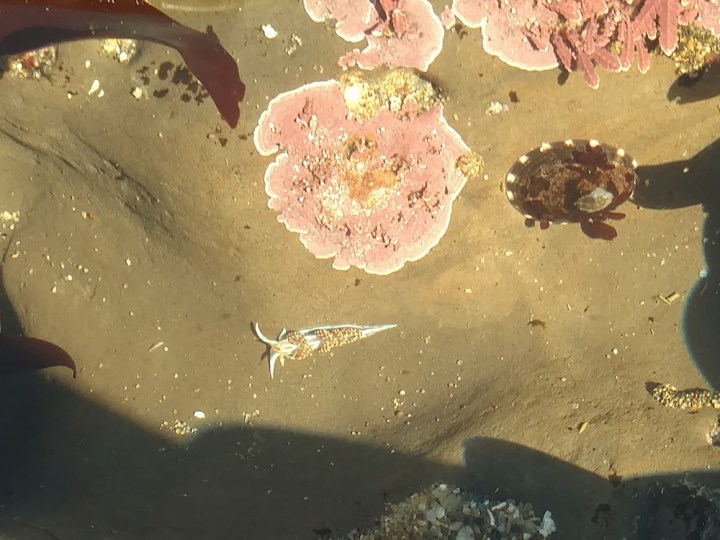
This is pink coralline algae with an oval limpet at the right and an inch-long nudibranch crawling right to left below. I submitted it three times, once for each of those three lifeforms.

limpet and nudibranch 2017 jun

Citizen science is a use of big data that benefits scientists and citizens. This week I was also contacted by a potential employer who found me on the web. As someone concerned about privacy who tries to maintain a low-profile online, I may need to reevaluate.

==================================================

* From Wikipedia.


A Dark Mood on a Bright Day

After a fallow two or so weeks, all five of our rosebushes have buds or blossoms or both. At least three of our tomato plants sport nascent green spheres. A common-but-unknown-to-me plant under our smoke tree snaked a winding 2-foot-long stem out to catch some rays for its flower. And why not? It’s 66 degrees out, clear and bright with a gentle breeze.

Nonetheless, the world feels mean.

People taunting and torturing the vulnerable isn’t new. Police and vigilantes murdering black people with impunity isn’t new. Congressional representatives trying to dilute or eliminate insurance for working people and giving the proceeds to billionaires isn’t new.  Even colleges replacing work-study programs and graduate student stipends with unpaid internships isn’t new.

Today’s new meanness emanates from port trucking companies.

It had already occurred to me that ordering small things a few at a time and having them shipped across the country or the world to my house in cardboard boxes with plastic shipping pillows potentially has a negative impact on air quality, solid waste disposal, nonproliferation of plastics, the well-being of local or regional businesses and job-seekers, traffic flow, pavement longevity, the status of nonmaterial values, and national self-restraint, to name a few. Which is not to say I never do it.

I also knew that employees of the obvious large shippers, those who deliver the items into my hands, whom I recognize and greet when they arrive, are under constant scrutiny and pressure. At least they are well-compensated, as figured on a yearly, though perhaps not an hourly, basis, unlike port truckers in California.

The ports of Los Angeles and Long Beach combined receive about 45% of US shipping container traffic. These huge ports are the biggest polluter in the LA area, so they have implemented a Green Port program imposing strict pollution controls on all entering vehicles, including container ships. Port truckers drive the containers from the ports to their first stop, often a rail yard or storage depot.

Port truckers used to be employees of port trucking companies, but to avoid the costs of running cleaner trucks, almost all those companies now exclusively employ contractors who sign a lease-to-own contract on their rigs. These contracts are abrogated for any missed payments, including for illness or a large repair bill, that is, for conditions that occur frequently. Companies repossess the truck, in which the owner-driver may have invested tens of thousands of dollars, for free, and then lease it to another driver. The drivers, in constant fear of imminent ruin, are easily victimized by other abuses, such as forcing them to violate daily time and distance limit laws.

Holy unintended consequences! This is a big problem for California, but workplace protections don’t apply to contractors, so it’s a problem looking for a solution.

Greed is clearly making a lot of people act mean, and that disturbs me.

I also feel some culpability. The woes of the world are wide, but the ones happening close to home and caused by some of our perhaps less savory habits combined with our best intentions are the ones that bother me most.

=================================================

If you like sources: https://www.usatoday.com/story/opinion/2017/06/20/rigged-system-rips-off-port-truckers-editorials-debates/103015290/


Woodies!

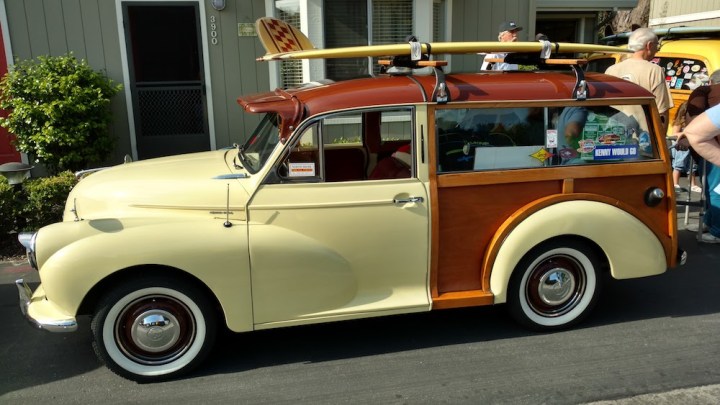
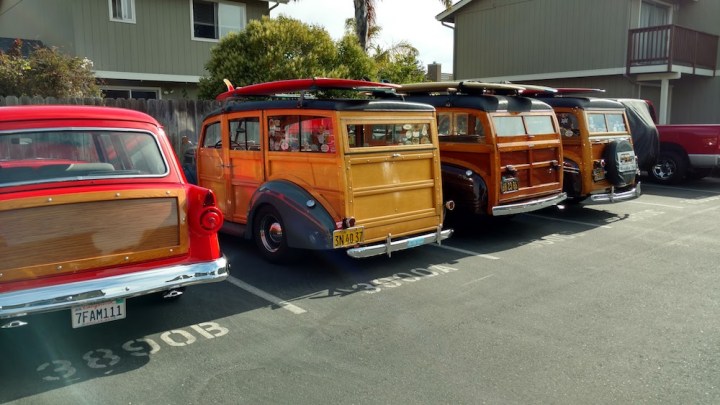
By mid-morning today, more than 30 woodies, together with the owners and their families, were gathered in our condo complex. Residents joined them for woodie viewing, as well as a large brunch and lots of chitchat. This is an annual gathering on the day before The Surf City classic, Woodies on the Wharf, … Northern California’s largest woodie show that features more than 200 stylish, pre-1952, wood-bodied cars* and started in 1993.

four woodies 2017

The oldest one I saw was built in 1938 (the yellow one in the picture above), with the preponderance dating from the late 40s and early 50s. All were meticulously cleaned, lovingly restored, and drivable. The social scene was vibrant as well, with old friends reconnecting from previous years, and kids at various levels of engagement roughly based on their ages. My next door neighbor’s father is a member; she grew up coming to this event and now brings her own family. The host lives most of the year in Hawaii, storing his car locally when he’s out-of-state.

Yellow and brown woodie 2017

Black woodie 2017

Many of the cars sported vintage surfboards on racks, and almost all had a collection of window stickers, including many from previous Woodies-on-the-Wharf, especially the 15- and 20-year anniversary milestones. Also common were stickers of surfboards, ocean themes, and woody culture: Got Wood?

three woodies 2017

I was struck by this collection of people clearly immersed in a pastime of only passing interest to me. They were friendly, eccentric, knowledgeable, opinionated, welcoming, humorous, intelligent, mostly middle-aged-and-white people. Just like folk dancers!

Grey Ford Surfboards Woodie

Lately I have been exposed to the concept that most people think folk dancing is a bit odd. Not that it hadn’t occurred to me before, but I notice it more here. Possibly that is because the folk dancing community–especially the Morris dancing community–isn’t as large here as in New England. Because we have observed that size disparity at the California Morris Ale and while dancing in SF and Berkeley, I think it is not due to the smaller population of SC, but rather to the greater remove from Merrie Olde England.

In any case, it was novel, even enjoyable, to be on the other side of the odd divide.

=================================================

* Description courtesy of santacruzwoodies.com.

Recycling Adventure

Today I took a tour of the Santa Cruz Resource Recovery Facility, where SC municipal recycling is sorted and baled. The purpose of the tour was to inform, and it did. The main message was, If you care about Earth, think more about Reduce and Reuse than Recycle. To avoid bringing the sorting facility to a halt–which happened three times during the 45-minute outdoor portion of our tour–remember, When in Doubt, Throw It Out.

SC is a small municipality. Maybe others would give a different message.

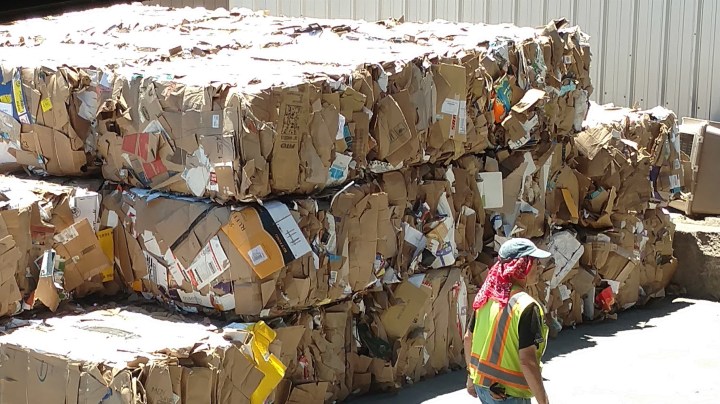
Long, flexible “tanglers”, which include wires, rope, cords, clothes hangers, and shipping wrappers, stop the line. Excess food waste, which is defined to be less than 80% clean, gums up the works. Pizza boxes with a slight faint stain, much less a glob of pizza grease, are verboten because their inclusion in a cardboard bale reduces its price. Cardboard is the second most lucrative recycled item.

Cardboard bales

The most lucrative recycled item is aluminum, or aluminium for those in the UK. Lucrative is the key term for recycling. If it can’t be sold, it won’t be recycled. The hot recycling items vary as trends and technologies change. The aluminum bales shown below, each between three and four feet tall and solid as a rock, currently sell for $2000 apiece.

Aluminum balesThe surprise news for plastics is, Ignore the Triangle. The triangle was originally designed to make recycling easier, but manufacturers have so many different types of each of the “numbers” that the hand-sorters don’t have time to read them. One scourge for recyclers is the dome container box, a clear box used for muffins or cupcakes, and many other items.  These are constructed from many different plastics, some of which are recyclable and some of which aren’t, so all are rejected.
The process matters, too. Another problem with the done container boxes is they are flattened early in the process, after which they become airborne and mix with the paper, contaminating the paper bales and reducing their resale value. This may be only an issue in locations in which the entire sorting operation occurs outdoors or inside a facility open to the elements.

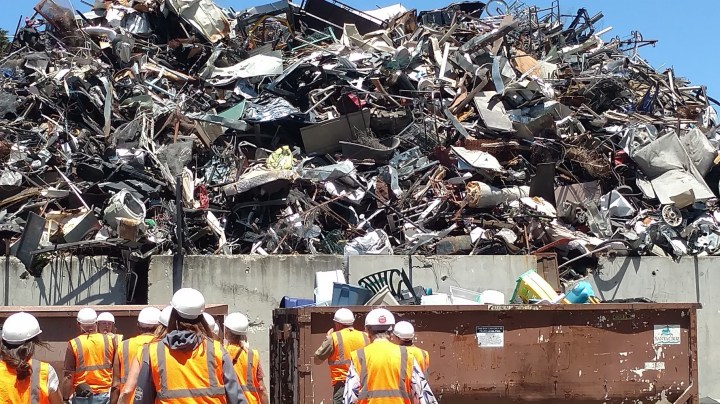
Scrap metal isn’t worth a lot, but our center accepts it from citizens who throw it into receptacles on the honor system. The picture show eight weeks of accumulation. You may be able to spot some dishonorable additions to the stream, such as a mattress. Every sixteen weeks, scrap metal is sorted and sold.

Scrap metal

Then there are Bits. Items that drop out of the process are sometimes ground into small bits, which end up in the landfill. Some bits are recyclable. Beer bottle caps are made of tin, which is valuable, but are too small for the conveyors and magnets to capture. If you want your tin caps to be recycled, put them into tin cans and crush those closed.

Never recycle containers that combine plastic and cardboard, such as broth or soy milk containers. The process can’t separate them into constituent parts. We saw one example of an office paper package which was a plastic outer case with a cardboard box inside. If you separate these, the cardboard is valuable, but in this case, they were glued together, making separation difficult. TJ’s coffee containers are not recyclable unless you want to go to the trouble of soaking them, in which case they devolve into cardboard and the unrecyclable liner. That’s more work than most people will do.

Leave the caps on your water bottles, though you must empty them to avoid their being rejected by weight. This is a rule change; the process now allows bottles, caps, and the little ring that joins the two to be recycled. Separate glass bottles from their metal lids so the two can be sorted into separate streams.

Speaking of sorting, there are a few videos of the visit on my youtube channel, Jody Griggs, including those amazing hand-sorters at work.

Musings on Utopia

Today I finished reading Kim Stanley Robinson’s trilogy Three Californias. Written in the 1980s and set in the 2060s, each book imagines a different future for Orange County. The first, which reads like a period piece, is the future after nuclear holocaust. After being bombed back to a low-technology state, the US is kept there by the other countries of the world, who felt it had gotten out of hand. The second, which reads like today’s news, is the future of greed and technology run amok. Most humans toil for enormous military and energy corporations, live media-saturated lives in tiny apartments stuck under freeways, race around in automated vehicles that occasionally crash spectacularly, and generate any needed emotional state from designer drugs administered via eyedropper. We are almost there.

In the third book, humans and governments join forces to dismantle corporations and create worldwide income ranges and company size limits, with energy, water, and land becoming common property. War disappears, apparently having been driven by multinational profit-making. Everyone has a fulfilling job, since economies are designed with the primary goal of full employment, and time to play-exercise; technology is both beautiful and enabling; people live in small clusters and know their neighbors; and, in contrast to the other two books, the main characters end up unhappy, having made poor personal choices. A truly terrible ending.

The point perhaps is that utopia is less a system than a process, and that human nature will preclude perfection or even happiness in many cases.

My husband and I enjoy each other’s company, spend time on hobbies we love, stay in contact with friends and family near and far, reside in a quiet complex, and are able to live within our means. Although there are some changes we would like, most of the time it’s our own little pocket utopia. Not only do most humans not live this way, our being able to do so may rely on that imbalance.

I read about a tribe of natives, one of many in California, who existed for seven thousand years without ruining their environment. Their lives were culturally rich, safe, and free from hunger.  Then the Europeans arrived. Since those natives were living in a form of utopia, one might think the intruders would adopt it. But their religious beliefs dictated that they were superior to heathens, and some of them were greedy.

The modern domination of superstition and greed over reason and altruism is why I am predicting a dystopian future for us, while living a utopian present.

=============================================

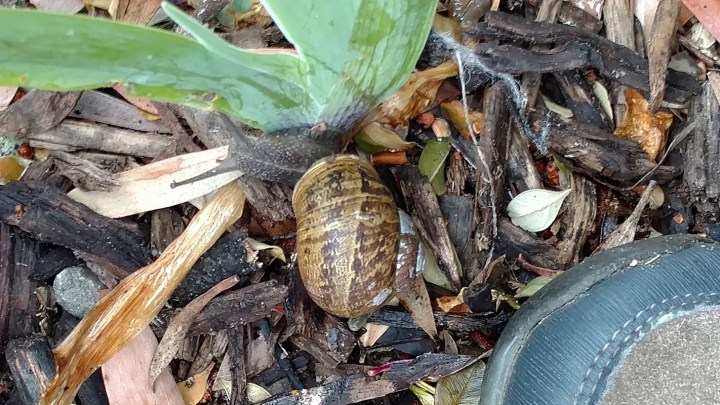
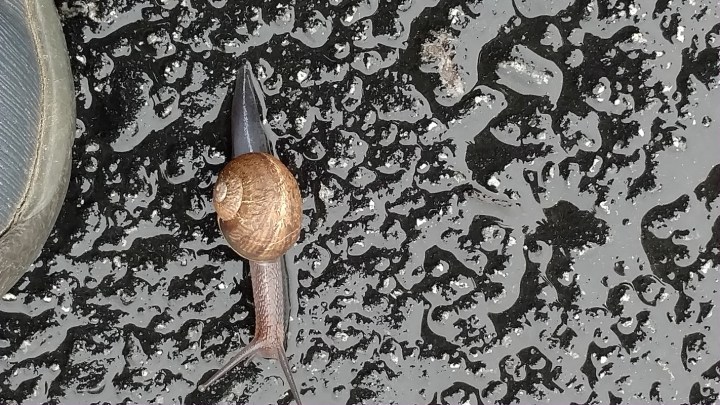
Californians are startled by June rain, even light rain of short duration. It brought out the snails. My toe is included for scale. I subsequently rescued the one on pavement.

large snail leaf 2017 June

small snail pavement


Butterflies and Bizarre Hobbies

My husband and I spent the past weekend in “the city”, which in this region means San Francisco rather than New York. I have no idea what people here call Los Angeles. Mostly no one refers to it. In any case, we were shantey singing on a boat on Saturday night and Morris dancing in Golden Gate Park on Sunday. We spent the night with a friend, who certainly knew we did such things but had not previously been exposed to us bedecked in kit. Her reaction reminded me that many people, including many of my friends, consider folk dancing and singing to be odd hobbies.

This behavior certainly is rare, since most people don’t partake. We are among partakers multiple times per week, so we perhaps don’t feel as odd as we should.

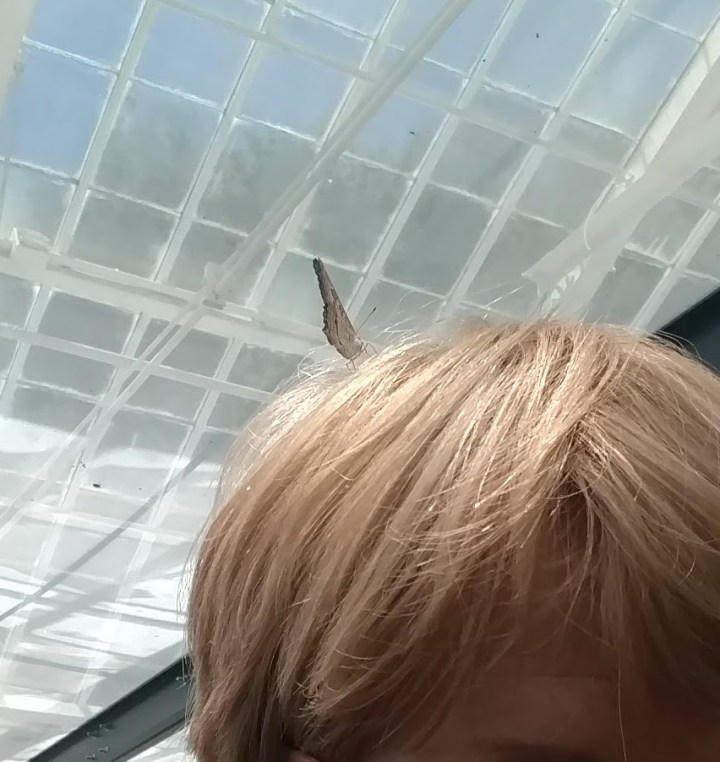
Our Sunday event was outside the Conservatory of Flowers, and in the spirit of, Who knows when I will pass this way again, I sneaked a visit in during one of the three sets. My lack of devotion is possibly why the Morris Ring disdains women dancers. The Conservatory is a greenhouse that includes a butterfly room. Almost the moment I walked in, I felt a butterfly on my head, and indulged in a rare selfie.

Butterfly on my head

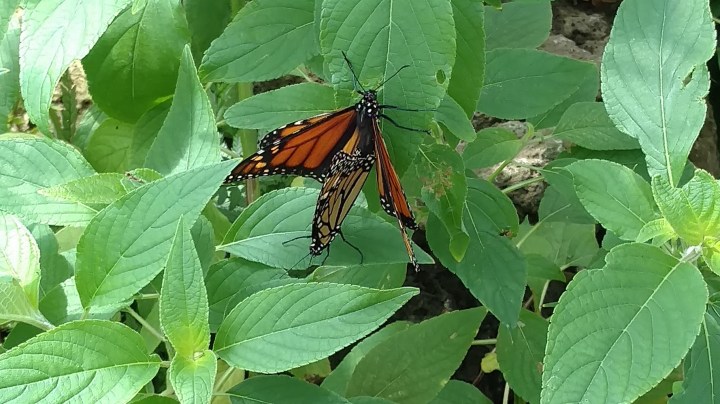
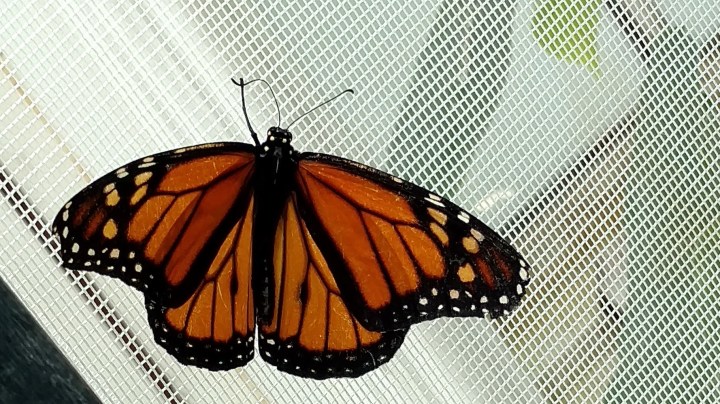
I was trying to capture a monarch moving its wings and didn’t realize there were two of them in this shot until I started to crop it. I wonder what they are doing?

Two MonarchsMany of the monarchs were pinned to the exit.
Monarch on screenThe other types of butterflies seemed fine cavorting among the plants.


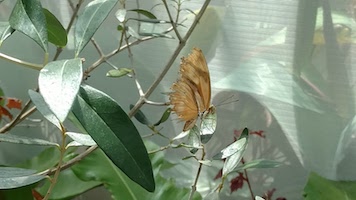
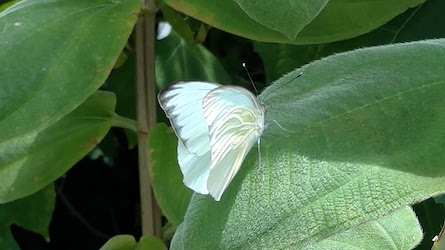
Striped butterfly   Orange butterfly flowers Sandy butterfly leaveswhite butterfly with veins

I hope you can see the vein-like structures in the wings of the last one. I could have found out what those structures are, or what those two butterflies were doing, as well as the names of all these butterflies, but I am feeling a bit of information overload these days. Perhaps all the learning curves associated with changes–new geographic location, docent work, condo board, loads of new acquaintances–is just a little too much for me to process. Or perhaps it is Age-Related. In any case, I absorbed sensations rather than facts during this visit.

My Life Without Pictures

After a weekend of excess, exercise was Job One this morning, and by the time I had completed my ablutions and scarfed down a bowl of cereal, it was almost time for the minus tide. To go or not to go? I had a mundane chore (laundry), an exciting chore (reply to a startling missive from the IRS), and a supportive chore (convince my insurance to help the woman whose car I hit) on the agenda, plus my husband wants me to get going on my new career as an options trader. But I haven’t been tide-pooling since early April, so I decided to squeeze it in.

Each month and day is still my first in California. That is, today is my first May 30, and this May has been my first May, as a resident of this long state. Monterey Bay is verdant with blooms of phytoplankton and dense kelp forests now, and there are lots of creatures feeding here, so I thought maybe the tidepools would be dense with creatures as well. Instead, they were brimming with seaweed. Next time, I will bring a stick to push the stuff aside and look under it.

The trip was worthwhile, though, because I saw more than a dozen harbor seals of various sizes–moms and kids?–stretched in a line at the far edge of the tide pool between the shore and the surf break, sunning themselves. I had binoculars, through which the seals seemed close enough to touch, so I observed them for a while. They have beautiful eyes and really awkward sleeping positions. I was afraid some of them were dead because they were perched so oddly, but then they moved. They are the opposite of graceful out of the water, but very cute.

Did I take some pictures? Well, yes. Did they come out? No. Too far.

I frequently watch people zooming their cell cameras, but when I try the same action on mine, it doesn’t zoom. I keep thinking, I need to figure this out, and then not remembering to do that. Later today, much later, when most chores were done or at least advanced, I finally remembered to get online and find out how to zoom mine. It’s really pretty easy, unsurprisingly. The seals inspired me, and I hope they will pose nearby again soon.

Movie Review: Force Majeure

I’ve had Force Majeure on my watch list since it was released in 2014. That is a longish list, and I consult it sporadically, so it wasn’t until this weekend that I realized it was available on Netflix. It was just as compelling as I expected, and much funnier.

I had forgotten how much I enjoy European movies. The dialog is very natural, requiring the viewer to figure out relationship dynamics. The shot-framing shows the filmmaker’s focus topic, including, in this case, long seconds of snowfall or empty hotel corridors. Subtlety abounds, both visual and dramatic; I’m sure if I watched it again, I would find things I missed. There is time to process events.

Spoiler alert: the titular cataclysm, an avalanche, is a pipsqueak, except in its effect on the vacationing family. This was almost a disappointment at the time, as I had a very American expectation of seeing some major CG effects. This particular avalanche was perfect for this movie, though, and I quickly grew to appreciate it.

American movies, which I also enjoy, tend to be tell-don’t-show, filled with closeups of the stars and slo-mo action shots, with all relationship ambiguities resolved and lots of just-in-time rescues. Don’t overthink it, just buckle up and enjoy.

There are exceptions: Boyhood is one.

Since the days of M.A.S.H., I have felt that a very good movie is better than any television show, and this movie certainly qualifies. Watching a carefully crafted movie, as opposed to a blockbuster, is just as satisfying to me as reading a carefully crafted novel. A TV series is often derivative, and even if it isn’t, it tends to sprawl.

I know there are exceptions to this as well.

The purpose of a watch list, in case you are wondering, is to avoid spending too much time trolling through screens, menus, and trailers trying to answer the question, What should we watch? For me, this is the most annoying first-world time-waster of the 21st century. I try very hard not to turn on the TV until I have a plan, but when the plan fails, I consult the list.