Humans Want to Eat Meat

I listened to a radio show today about faux meat, meat created either from plant matter or from animal cells multiplied in a test tube, then in both cases processed to have the texture, appearance, and taste of meat. “Meat” includes chicken and fish. Current technology can only create simulations of ground meat, and not cheaply.

Faux meat has the potential of being a very big business, but this show was mostly about the problems of real meat, all of which may be solved by faux meat, someday. These include the health problems associated with overeating meat; cruel treatment of the animals raised for food on non-organic farms; dangerous working conditions for employees of abattoirs and meat-processing facilities; negative environmental effects associated with large livestock-raising operations;  and the rise in demand for meat worldwide, which currently cannot be met.

Most of these problems could be solved today if we were all vegans or vegetarians, but humans want to eat meat. In the US, only 3.3% of adults fall into either of the above categories, and we are fairly typical. By far the largest portion of vegetarians in a country is in India, 40%.*

The US started a huge, uncontrolled experiment in the 1950s, when processed foods started to comprise a significant portion of our calories, and today we have the public unhealth one might expect. In 2016, according to a BMJ Open study quoted in the Atlantic, 57.9% of our calorie intake was from ultra-processed foods, which sound delicious:

Formulations of several ingredients which…include food substances not used in culinary preparations, in particular, flavors, colors, sweeteners, emulsifiers and other additives used to imitate sensorial qualities of unprocessed or minimally processed foods and their culinary preparations or to disguise undesirable qualities of the final product.

But isn’t creating test-tube meat the ultimate ultra-process? An even grander experiment awaits.

Meanwhile, while researching this topic I found a National Geographic article which credited the rise of agriculture with creating orthodontics. Humans with a hunter-gatherer diet have long jawbones, but the preponderance who now prefer starches and cooked foods have developed shorter jaws that are too small to fit all our teeth without medical intervention. In this we differ from all other mammals, who have straight teeth.

============================================================

* From Wikipedia: https://en.wikipedia.org/wiki/Vegetarianism_by_country.
 

Music and Discord

This weekend I attended a performance by Houston Grand Opera for the first time, and very much enjoyed their production of Mozart’s Abduction From the Seraglio. The runup to the evening, however, was pretty clunky.

We were running late, then doubled down by deviating from our planned route, but finally arrived at the correct entrance to our pre-paid parking garage. Unfortunately, the attendant did not recognize our pass. Three managers and one irate customer later we were admitted with apologies. Quotes of note:

Customer: I’ll pay the $10 if it makes this car move! 

Third manager, to employee: This is a pass for the Theater District Garage, and we are in the Theater District Garage.

The garage was enormous, serving several venues, and it wasn’t obvious where to park. There were signs for our venue, but all of them were blocked by either cones or persons waving us in a different direction. Finally we just parked and walked.

Inside the venue, we were welcomed warmly and directed to the proper escalator, then abandoned. Neither signs nor non-food employees were in evidence.

We had hoped to pre-purchase food for the first intermission, but we stood in the wrong line for so long we had to go search for our seats. There were no signs indicating which level of the lobby corresponded with which seating level, so we ended up riding an elevator to the upper balcony then walking very steep steps back down to the loge.

Once inside the auditorium, we found a few ushers, about two per level, some of whom tried to help. Two offered to change our seats to the orchestra, two more levels below, which they proposed as a major upgrade. When pressed for details about which seats were better, they weren’t sure. Quotes of note:

Usher 1: It’s really a matter of personal preference.

Usher 2: I’d choose the loge, myself.

We stuck with the loge, whose seats were bar stools with footrests. One of ours detached with a clank when feet were applied, requiring the occupant to kneel and screw it back on. Three-quarters through the overture, another clank rang through the section, and presumably someone else had dangling feet, since by then the house lights were down.

At the end of Act I, I charged for the lobby through the exit recommended by the usher to avoid stairs, clambered down three flights of stairs, raced through a lovely room filled with tables set with wine and food for pre-purchasers, was waved along to another level, and finally managed to secure a place in the salad line in time to avert starvation during the subsequent two acts.

I was sort of angry about these events.

Opera is the apotheosis of either western culture or western decadence, or perhaps both. As an opera-goer, I am accustomed to being handled very gently. Have I really become so thin-skinned that I can’t take a few hiccups with good grace? Was I confused by the cognitive dissonance of opera in Texas? Did I have reduced coping skills due to low blood sugar?

Probably the latter, and I should have heeded the warning. The next day I pierced a Scion with the trailer hitch of a rental truck three hours after I should have eaten lunch.


How I Acquired My Scar

The most prominent of the multiple scars acquired during my many decades of life is on the bridge of my nose. Although it is neither dark nor large, its location is such that most people notice it, especially clinicians, who question me closely about my personal safety.

Our family was camping in Yellowstone that summer. We had separate tents for the adults and our primary-school-aged sons, pitched a few few feet from the fire pit on either side. Everyone else was bedded down for the night. I had just finished stowing our food and cooking supplies in the back of our rented SUV. The woods were dark and quiet, the temperature balmy, the stars overhead like spilled glitter.

As I contentedly closed the hatch, I was suddenly struck hard on the bridge of my nose, a blow that drove me to the ground, where I fell on my hands and knees, screaming, blood pouring out of my face into the leaf litter. I was terrified, but the conversation in the tents on either side was pretty funny.

  • My husband yelled my name a few times, then our older son’s, and getting no response, started bashing around the tent, presumably struggling out of his sleeping bag and scrambling for pants.
  • Meanwhile, our sons had the following conversation, younger one first:
    • I think that’s Momma. 
    • No, that’s not Momma.
    • I’m pretty sure it’s Momma.
    • No, that can’t be Momma.

Meanwhile, I had stopped thinking I was going to die from blood loss and started to worry about dying from beasts drawn to the growing pool of blood. My husband finally emerged and examined me. Not having owned an SUV before, I had apparently grabbed an interior handle instead of the edge of the hatch, and brought the edge crashing down on myself.

Disappointing, to say the least.

The kids got dressed and we drove to the campsite office, which was deserted but had an emergency phone. Two EMTs arrived in an ambulance. They were unclear on the need for stitches, but united as to the impossibility of getting any at this late hour in the park. The nearest hospital was 200 miles away. The park clinic would open in the morning.

I decided we would go back to sleep and get to the clinic when it opened, which we did. The doctors there assured me that I had needed stitches, but that I had waited too long. The EMTs had not shared this possibility. I was distressed for months by my unsightly appearance, but I later became accustomed to it, as we humans often do.

I’ve had to repeat this story often over the years, so I am wondering, has it changed? If you heard it before and detect any embellishments, please let me know. It will mean at least one of us has altered a memory.

More Memory Musings

As it turns out, my husband and I have very different memories of our lives together. We differ on such fundamentals as How We Met. Each suspects the other’s memory is at fault, but we want to stay married, so it’s best not to overthink this. I’d read that married couples should never be seated together at formal dinners because they contradict each other’s stories, and now I understand.

In some cases, corroboration may be able to help. I have a friend whose elderly mother is re-imagining her entire life in surprising ways. My friend is able to reassure herself that her own memories are intact by comparing them to those of her siblings and her mother’s friends. When most of the participants remember something the same way, it is probably true.

Or is it? In a 2015 survey of registered Republicans*, over one-third remembered Muslims cheering in the streets of America on 9-11. Our willingness and ability to alter our memories is now manipulated on a global scale by everyone from advertisers to partisans. It would be easy to conclude that if so many people believe something, there must be some truth to it, but that would not be correct.

I credit technology for widening the scope of mass-memory-revising effects.

Back to individual memory alteration. I remember, or think I remember, these cases:

  • A woman who remembers her father reading a particular children’s book to her, including the voices he used for each character, later learns it was published after his death.
  • A woman visits her grandmother’s grave and learns she was born after the grandmother died, yet she remembers many details of their close relationship when she was a young child.
  • As part of a memory study, a college student records her reaction to the Challenger disaster during her freshman year, when it occurred, and again during her senior year. The accounts differ widely. She says, I know that is my handwriting, but I could not possibly have written it.

Why do we alter our memories? Perhaps because we can believe ourselves to be better people, living in a happier world. This is probably genetic. Living in a world that makes sense to us surely makes us more resilient, even if it isn’t real. Let’s not overthink it.

==================================

* http://www.publicpolicypolling.com/pdf/2015/GOPResults.pdf

May Morning, Santa Cruz Style

Merry May!

Monday we danced at our first May Morning as members of Seabright Morris. We started by the westside lighthouse around 6:00 am, which is to say, we slept at least an hour later than we would have on the east coast. The sun rises later because we are both five degrees of latitude farther south and more westerly within our time zone.

We danced in a closed parking lot on the inland side of the lighthouse, a disconcerting distance from the shore for a newbie Californian; when I see the ocean, I naturally gravitate toward it. We danced continuously until we could see the sun, three consecutive dances as it was behind mountains and then clouds for a few minutes after official sunrise. Good thing this is not the custom in Boston, where we sometimes don’t see the sun even by May Afternoon.

Nine of us ate breakfast downtown, then skirted the UCSC Mayday protest line to dance at the Waldorf School. Fifteen third graders donned bells and performed a lovely dance, ending with a “man down” who was revived by a maiden’s kiss, leading to a “team down,” to the chagrin of the maiden, who was selected from the audience. Kudos to the teacher and devisor, who is clearly fluent in this tradition.

Our last stand was outside the Bookshop Santa Cruz, a common stop for us; uncommonly, my husband and I didn’t buy anything. We engaged a few folks on the sidewalk there, including a Brit who seemed resigned to encountering Morris dancers so far from Devon. We finished with a crowd favorite, Parameter Setting, in which we use keyboards instead of sticks, necessitating a cleanup afterward.

This was a lovely, fun day with friends, yet notably different from the Boston version. Our first stand had twelve attendees, including the team, rather than 200. There was no English dancing, no Maypole, and no real singing, though my husband and I brought songbooks and managed to drag one song out of the group. I very much enjoyed the company and the dancing, but I keenly felt the lack of the preponderance of the traditions of the day.

I often find myself thinking about having two decades or so of life left–an arbitrary number, but certainly not implausible. For me it’s not the “bucket list,” it’s the experiences. Twenty more May Mornings. How shall I spend them?


Your Brain on Clicks

I just read The Shallows: What the Internet is Doing to Our Brains, by Nicholas Carr, which asserts that our tools change us. One example is the mechanical clock. Pre-Clock, people decided when to eat and sleep based on signals from their bodies. Post-Clock, most of us make those decisions based on the time, usually in order to fit into work schedules. For some of us, that change has led to eating habits and sleep deficits that damage our health.

That doesn’t make the Clock bad or less useful, and it’s certainly not at fault. The point is, all of our tools change us. Each new tool should be evaluated and used in a way that balances what we may lose with what we gain.

I didn’t like this book at first. The author is roughly my age, yet he allowed the World Wide Web (despite the title, he is talking about the Web) to turn him into an attention-challenged, jittery fellow who could hardly finish a paragraph, much less read a book. To research and write this book, he moved his entire family to a remote area of Colorado limited to dial-up access, which seemed a little pathetic. Just turn it off!

Happily, scatterbrain syndrome is reversible, and when he relearns analysis and synthesis, he finds some interesting stuff.

The part of us that the Internet is changing is our brains. Structural changes in the dorsolateral prefrontal cortex, the seat of short-term memory and decision-making, occurred in Internet novices after only five hours of browsing.

The good news is that our brains have essentially infinite long-term memory storage. Learn as many languages as you like, or the life cycle of every invertebrate in the tide pool, or a new song every day: your brain has the storage for that. The bad news is, not only is the short-term storage area much smaller, it impedes formation of long-term memory when it’s overloaded. And if your social media refresh chime is set for one minute, yours is way overloaded.

Long before Tim Berners-Lee, Martin Heidegger posited that calculative thinking, a way of observing something objectively and quantifying it, was rapidly replacing meditative thinking, a way of estimating the value and meaning of something. Our long-term memories should include connections between mind and body, and  experiences that shape our thinking. We should enhance our capacity for empathy and emotion, and recognize tasks that demand wisdom.

Take control back from your tool! Go ahead and check email, just do it when you aren’t doing something more important.

Neary Lagoon Nature Walk

Unlike a true lagoon, Neary Lagoon shares no water with the ocean at any time of year. I frequent both the Younger and Corcoran Lagoons, each of which is separated from the ocean by a sand berm that breaches occasionally during the “winter”.  I wonder how long I will live in California before I stop using quotation marks around that season? Neary Lagoon used to have brackish water, but the interconnecting wetlands were drained and built upon in the early twentieth century, so now it is a freshwater marsh.

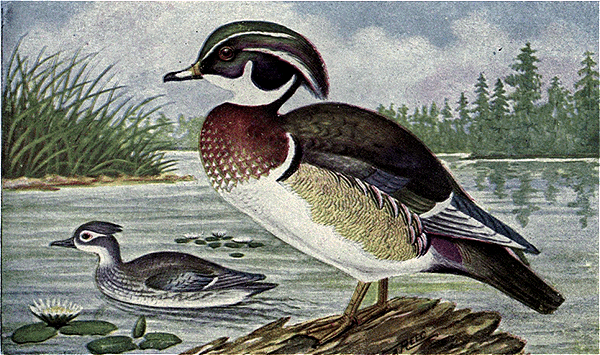
Our group was led by a guide from the local natural history museum, and most were interested in birds. Minutes after one woman opined, I hope we see a wood duck, we did. This was one of our last rainy mornings locally–no more rain until November, I hear–and I had not even extracted my phone, so this is a stock photo from Wikimedia Commons.

Reed-wood-duck

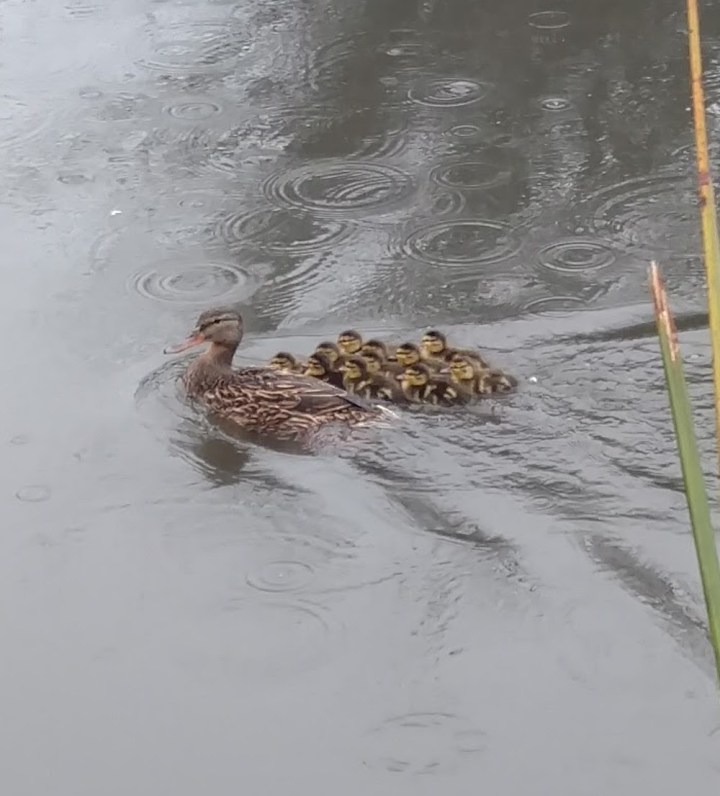
The live male looked almost carved, with precisely-shaped features and distinctly-outlined coloration. We also saw several mallards, both male and female, though our guide told us most of the females were nesting. In fact, we later spotted possibly the first brood of the year.

baby mallards

The babies swam in close formation except when the mother turned; then they collided like aggressive bumper car drivers as each frantically tried to follow as closely as possible. I learned that many male ducks, including both mallards and wood ducks, have distinctive, bright plumage only during breeding season. After that they molt and regrow with eclipse plumage, similar in coloring to that of the female ducks. In mallards, the only way to tell males from females then is by the beaks, which are yellow and orange respectively. Both sexes have orange feet.

We also saw American coots, who bob their heads when they paddle. They are rails, not ducks, and their feet have less webbing than duck feet, so coots can easily forage on land to supplement their pond diet. We observed both methods of eating.

mostly coots

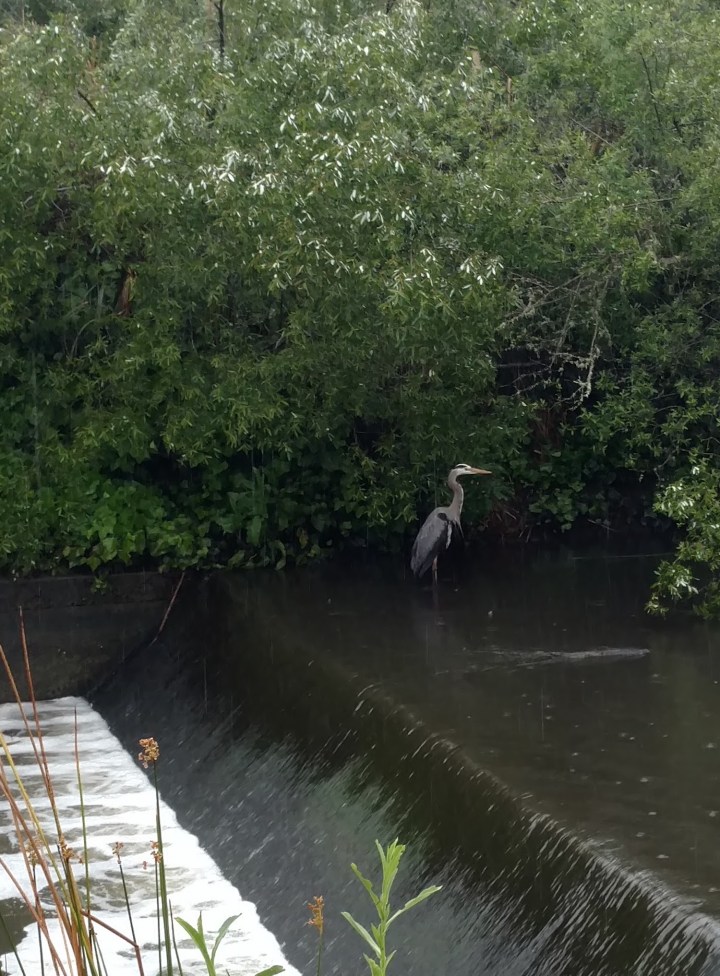
Neary Lagoon has some adaptations to cope with large volumes of rain. Most of our tour was on an apparent boardwalk, which seemed quite close to the surface of the water. That’s because it floats on pontoons when the water rises high enough. This mature group was sadly not interested in trying to tip the platform by all standing on one side, though the guide said she safely does that with school tours. Another adaptation is a weir and grate system that allows water to drain into the ocean. It was open, and as we observed it, a great blue heron landed there.

heron on weir

During most of this mile-long walk we could see houses, buildings, and even the local water purification plant, whose odor inspired us to pick up our pace. But in a few spots the boardwalk was the only evidence of human habitation.

The tour members were all fellow docents, many of whom knew each other, and there were some who chatted throughout and others who put space between themselves and the chatters. It’s hard to judge whether quiet contemplation of nature or human fellowship is more rejuvenating. Happily, both are available to most of us at least some of the time.

No Planet B

The title is from the tagline for tomorrow’s March for Science. Although Santa Cruz has one, my husband and I are going to San Jose for the Silicon Valley version, which ends at an outdoor exhibition of SV Comic Con.

I was reminded of the need for the march while listening to radio interview with Lori Garver, deputy administrator of NASA under President Obama. She was clearly proud of the extent to which the Obama administration promoted private industry in space, and concerned that the Trump administration is not doing that.

She stated that the US is a “capitalist country” in which the government should not “interfere” with potential profit centers for industry. Those are not the words of a scientist. The profit factor is what puts industry in direct opposition to science. Independent labs (rare in this country today) and government-funded research are the only venues for practicing true science, which is undirected and shared.

What profit is there from sending probes and rovers to explore uninhabited planets and moons? Eventual extractive industries or settlements on those sites are uncertain and far in the future. Yet we have learned a tremendous amount that could advance those goals eventually, and even more about planetary formation and characteristics. We’ve also learned a lot about propulsion, maneuvering, and landing.

Space flight discoveries are sometimes found to be useful on Earth. Not Teflon, which was actually invented before the Apollo program. But real examples include those shiny blankets for marathon runners and accident victims; winglets on the ends of airplane wings, which increase thrust and reduce drag; more efficient solar panels; essential fatty acids from human breast milk that are produced by algae, and now added to baby food; the air cells in Nike Airs; and precise lasers used in heart surgery, originally developed to monitor gases in our atmosphere.

In science, no one knows in advance whether any particular investigation could lead to commercial products, or what those might be. Industry always starts with a plan to develop a product it can sell. Does commercial product development ever benefit science? I would say no, just shareholders.

Which leads to another point: government-based research, unless classified, belongs to all people and is shared with all scientists. This is the great strength of science, as one person’s investigation gives someone else a different idea. One of the sad results of burgeoning university/industry collaboration is cutting off this information flow. Another is a storm of biased results; Science Friday today estimated 20% of juried articles contain false information.

A common question on the science news shows these days is, Why isn’t someone developing a new antibiotic? The reason is simple: the antibiotic humanity needs is one that will be used rarely, so microorganisms won’t develop resistance to it. It absolutely can’t be sold to Big Ag, or given to every schoolchild with a sniffle, or used in commercial toothpaste. So Big Pharma has no interest in developing it.

NIH could, if we were willing to fund it.


Who Am I, Exactly?

Currently I’m reading The Hidden Life of Trees by Peter Wohlleben, a collection of jaw-dropping facts about trees. I may blog about it some day, but I don’t think most of you would believe me. Today I am thinking about an ancient spruce in Sweden whose root was determined to be 9,550 years old.

The root of a tree is its most permanent part, and the closest thing it has to a brain in terms of centralized control, retention of learning, and coordinated communication with other plants and fungi. (I know, I just said you wouldn’t believe it.) This particular tree has been chopped down, or struck down, or eaten by insects, or otherwise reduced to stump level many, many times; its above-ground portion is much younger. But the root has been alive continuously.

Many trees are able to regrow from stumps, which leads to the question of identifying an individual tree. Is it the part we see, or the part underground? If it’s the combination, how does it decide which birthday to celebrate?

During docent training I studied the life cycle of the moon jelly, a shape shifter. The adults reproduce sexually. The larvae are microscopic, ciliated swimmers. After a few days they attach to something and become polyps, stems with tentacles on top, tiny but visible to the naked eye. Those can live for 25 years, and during that time they create colonies of clones.

At least once a year, each polyp’s upper body transforms into a stack of about 25 tentacled disks which break off one by one, swim away, and eventually grow into adult moon jellies. This is an animal that would be hard-pressed to identify its forebears. The population probably doesn’t have much trouble with the It’s all about me! attitude though.

As humans, most of us can identify our forebears, and point to pictures of ourselves stretching back at least to birth. But are they all the same person? Not in a literal sense, since we replace cells constantly. Even neurons in the brain, once thought to be unchanging in adults, now are believed to be replaceable.

Then there’s our microbiome. Each of us has about as many bacterial cells as human cells in our body, which comprise much less than half of the volume but much, much more than half of our genes: 30 to 500 times as much. These biota have a huge impact on our lives, controlling everything from our immune systems to our food cravings.

I read once about an adult man who developed pedophilia because of the location of a brain tumor. His predilection for it disappeared when the tumor was reduced by treatment and reappeared when it regrew. In this case a disease vector fundamentally altered his identity in a super-creepy way.

Have any of you ever been confronted with irrefutable proof that something you believe you experienced actually never happened? It’s startling. Perhaps this will happen more as the record-and-publish-everything generation ages. Or perhaps this generation will avoid confirmation or consistency bias since so much evidence is extant.

That seems unlikely.

No Straws, Please

I try to avoid arriving at airports early because it makes me feel like a chump. This dates from an incident thirty years ago when I observed a businessman board a full flight just in time to stow his bag and fasten his seatbelt before pushback. No waiting in line in the jetway, or standing in the aisle while every oddly-shaped package and grumpy baby is sorted. He seemed like a person whose time was valuable and well-managed. I strove to emulate him for years, with limited success.

My husband, on the other hand, loves waiting in the airport, where he can read, work, or browse uninterrupted while enjoying a coffee or beer.  His life is generally less stressful and more productive than mine.

Usually we compromise in such a way that no one has time to read and both of us have to wait. On our recent quick trip to New Jersey, though, we left for both airports early, and I ended up wandering around JFK for thirty minutes looking for unsweetened iced tea. I couldn’t find any in a disposable bottle, so I stopped at a small cafe with high-end brewed beverages served in cups with lids. Both of these container types are plastic, but this fact did not penetrate my consciousness during the search. However, when the server offered me a plastic straw, I declined.

I hang out with a lot of current and future marine biologists now, and all of them hate plastic straws. Straws are always in the top ten list of marine trash, but so are plastic bottles. I think straws incite the particular ire of ocean advocates because they are hard to recycle and seem unnecessary.  In any case, I reflexively reject them now.

My server, very competent but not especially friendly up to that point, was struck by this apparently odd request and became quite engaged. She had never heard that plastic straws cause problems for marine life, and was not aware that paper straws existed. She was an immediate convert, resolving to tell others about the problem and to seek paper straws for her shop.

It was gratifying. I should spend time at the airport more often.