Why is Traveling so Fraught?

Although there were no major issues, this recent trip was filled with Annoying Things to Deal With. One example is the Baggage Checking Dance. It goes like this:

  1. Airline decides to charge fees for checked bags.*
  2. Passengers decide to bring carry-on bags.
  3. Loading time skyrockets; overhead bins fill up during loading.
  4. Airline checks bags for no charge, either at gate (choice) or in jetway (no choice).

On both legs of this trip, I got no-choice jetway check of my rollaboard. I’m a frequent victim of this ploy because I prefer to sit near the front of the aircraft but decline to pay a premium for this privilege. By the time passengers like me are in the jetway, the first three seated groups–We Pay More, Need Assistance, and Brought Children–as well as rows infinity to 15 or so are seated, so we are the only passengers still clutching checkable luggage.

I could pay the same price and sit in the back of the plane, or pack a bag unsuitable for checking. This last is my husband’s ploy, so he lugs a bag not designed for air travel through the terminal and the security checkpoint. I hate lugging anything anywhere, and always check my bag when I can, for example, when I fly Southwest. What joy! I don’t have to limit my drink purchases to screwtop bottles, or cram my suitcase into the bathroom stall with me, or babysit my luggage under the watchful eye of TSA.

This dance happens on every full flight, that is, on every conveniently scheduled flight traveling between popular locations, that is, on every flight I am ever likely to take. So why not just pay to check bags? Theoretically we could afford it.

The reason is to resist our corporate overlords. Given the large proportion of Americans who struggle financially, often with poor or no health insurance; the regularity with which our elected officials neither receive the majority of votes nor represent popular opinion; and the ease with which influence and elections accrue to the highest bidder, enabled by the highest court, I no longer consider myself to have First World Problems. Now I think of them as Corporate Slave problems. We corporate slaves are fairly powerless, especially since many of us seem eager to empower our oppressors, but we can make small statements. I feel every cent I spend has the potential to be a mini-rebellion. Though my bag drags me down, its weight reminds me that I’m still fighting.

———————————–

* Key point: this is a (well-documented) profit-raising decision, not a cost-cutting decision.

Bytes in the Sky

I posted my blog from 33,000 feet yesterday, while flying from San Francisco to JFK. Being a person of a certain age, I find this wondrous.

The world wide web was invented in 1991, one year after I got married. It was fifteen more years before I gave away my hardcover set of Encyclopedia Brittanica, which I had purchased in 1983, viewing it as the apotheosis of collected knowledge, at least in a size suitable to a personal residence. The college-student couple to whom I Freecycled it planned to cut it into pieces for an art installation.

Today I can hardly imagine leafing through volumes to find mundane facts, such as the length of the Yellow River (3395 miles) or what do koalas eat (eucalyptus leaves, which you knew; did you know they sleep so much because those leaves are toxic?). Googling the river length resulted in a number on my screen. Googling the koala question gave me a paragraph, which included a reference to koala’s sleep habits, which led me to investigate further. The latter is closer to the experience of leafing through the encyclopedia, with pictures and headings catching your eye, distracting you in a productive way.

I don’t think we are distracted in productive ways very often online.

I do think combining online access with the real world can be productive. Docents often share pictures of our tide-pool finds or links to marine science articles electronically. Online meetings are great for the planet when they reduce the need to commute or fly. Without phone videos, I would not have seen the shark that stranded six blocks from my house* while we were in the air–although I would have much preferred to have seen it in person.

Obviously lots (most?) of the information on the web is incorrect, but so is the information in the real world. I hear people in the coastal redwood forest saying the seeds require fire to germinate, and parents at the Monarch migration site telling their children the butterflies fly from Mexico and back. These are factoids. To be fair, I also hear people say, I don’t know or I wonder.

Even bytes in the sky can’t change human nature, or can they? I have a book on hold that postulates we have been fundamentally changed by the interrupt-driven nature of our devices. It was written in 2010 though, so it may be obsolete.

——————————————————————————————-

* I can’t embed it. Google “shark on beach pleasure point”, or go to santacruzsentinel.com.

Working Gigs

On a radio program I heard recently, the gig economy of today was extolled as a chance for people to follow their dreams and explore more flexible work alternatives. I don’t think that’s true for most people.

I entered the gig economy in 2002, when I decided to end my 20-year engineering career. There was a high-tech slump, not the first I’d experienced, but this time it seemed I would be forced to lay off some perfectly competent staff, which I had managed to avoid up until then. So I negotiated a package for myself.

I had become disgruntled by high tech and its strange combination of verbal macho bravado and actual timid, crowd-following decisions. My own family of four was stressed, with two working parents constantly juggling responsibilities. The nation was still largely fact-oriented, but the twin evils of money-rules and branding were rising. I decided to step back and try to find work that was more flexible, more rewarding, and required less contact with corporate-think or marketing-speak.

From then until now I have lived the gig life. I have commuted a long distance to a work full-time at a large corporation as a contractor, completed project work on the web for employers I never met in person, spent significant time doing on-demand work in both public and for-profit education, owned a business for which I found gigs from both personal and job-matching websites, and worked with individuals in their homes.

While our family’s quality of life was, I hope, improved, this didn’t really work out for me either financially or in terms of being able to support myself when my husband retires. The only reason I could experiment with this, as it turns out, is my husband held a lucrative job, with family health insurance.

Many of today’s gig workers are millennials with college degrees forced to vie for zero-pay internships to work in their fields, or couples with children working second jobs to save for college, or elderly people checking groceries, or RV dwellers pulling merchandise for Amazon CamperForce. That is, they are people who have worked hard, and achieved goals, and yet find themselves with stressful jobs without sick leave, paid time off, or for those under 65, health care.

Universities and corporations are taking untoward advantage of the gig economy to cut costs or increase profits. Corporate marketing departments and capitalism cheerleaders are working overtime to get the population to accept this as the new norm. Trumpsters got the political-institutions-are-systematically-destroying-opportunities-for-the-middle-class part right. Too bad they don’t seem to realize that these institutions are bankrolled by the wealthy class to demonize the real solution, fairer distribution of income and wealth. Don’t take my word for it; check any income/wealth distribution versus household prosperity graph.

Or, get busy finding your next gig.

California Cars

I have no time to blog suddenly, but I do have time to take pictures, so I’m sharing some pictures of cars today. Cars last forever in this climate, and there are plenty of cars I don’t have pictures of that are quite common: type I VW Beetles and first generation Mustangs, for instance. If you don’t believe cars can last that long, check out this 60-something-year-old beaut that lives in our own condo complex.

BW Classic Car

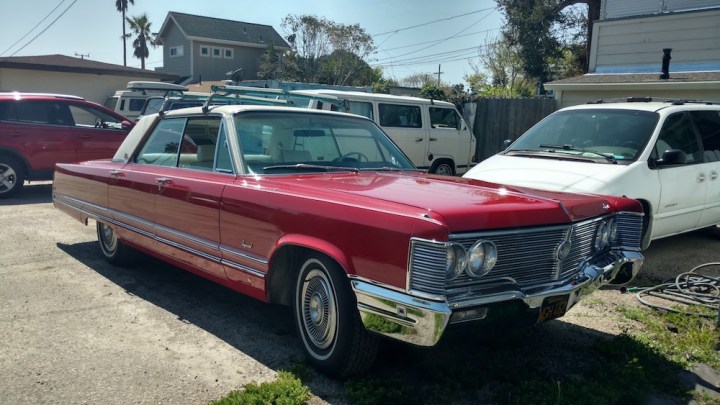
One of our recent visitors came from the east coast to visit two people in Santa Cruz. As it turns out, we live four blocks apart, so I went with him to meet the neighbors. Their next-door neighbor just bought this red car. I remember a similar car, really long, made of steel, tank-like, driven by one of my friends in Massachusetts in the 80s. It was old then. A lot of people I know really like cars from America’s golden age of autos.

Red Imperial

We commonly see, and usually also hear, very old trucks that remind me of the snaggletooth truck in the movie Cars. I happened on an example while walking through the neighborhood, though since it was parked, I can’t comment on the engine noise. This one is not a perfect example of the type since it’s jacked up. Usually we see the ones that are on their last wheels, as it were, but still chugging along.

snaggletooth truck

I also know some people who love Vanagons. Those are almost as popular here as Rav4s are in New England. When I took this picture, there was another, nearly identical one parked 20 yards away–same color.

Vanagon

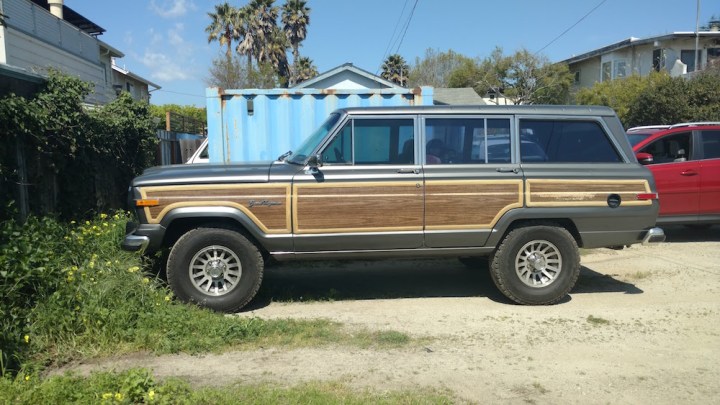
What would a collection of classic cars be without a Woody? The Minivan of yesteryear, at least according to the Austin Lounge Lizards.

Woody

There are some great vehicles here that I did not get pictures of. One is a sort of dune buggy thing that people drive on the regular streets, a completely open vehicle sort of like this. This is a web picture, credit to i.ebayimg.com

1

Then there are the motorcycles. So many motorcycles. They are sacred in California; it is completely legal for them to drive between two lanes of moving cars, and they do so not only to avoid traffic slowdowns, but also at full speed on the highways. One quickly learns to stay centered in one’s lane and to look between lanes before changing.

Humor, Memory, and Truth

I just completed Gerald Durrell’s delightful memoir, My Family and Other Animals, from which I will share an excerpt. The setting is Corfu in the 1930s, at a private villa, several hours into a large house party involving excessive food and drink. Dodo is a female dog in estrus who sneaked out of confinement into the garden, only to be confronted by a pack of eager suitors.

Dodo galloped into the crowded drawing-room, screaming for help, and hot on her heels came the panting, snarling, barging wave of dogs. [The three resident male dogs…] were horrified by the scene. If anyone was going to seduce Dodo, they felt, it was going to be one of them, not some scrawny village pariah. They hurled themselves with gusto upon Dodo’s pursuers, and in a moment the room was a mass of fighting, snarling dogs and leaping hysterical guests trying to avoid being bitten. 

Most of the people in the room try to climb onto the furniture. Some lob sofa cushions at the dogs, with the result that clouds of feathers now drift over the melee. Others spray soda siphons at the dogs, or empty glasses of wine onto them. Finally, one man retrieves a significantly-sized water container from the kitchen and raises it over his head.

The guests fled in all directions, but they were not quick enough. The polished, glittering mass of water curved through the air and hit the floor, to burst up again and then curve and break like a tidal wave over the room. It had the most disastrous results as far as the nearest guests were concerned, but it had the most startling and instantaneous effect on the dogs. Frightened by the boom and swish of water, they let go of each other and fled out into the night, leaving behind them a scene of carnage that was breathtaking. The room looked like a hen-roost that had been hit by a cyclone; our friends milled about, damp and feather-encrusted; feathers had settled on the lamps and the acrid smell of burning filled the room. 

Reading this made me wonder if I would be a better writer with this sort of material, though almost immediately I decided I am happier without four wet dogs and a roomful of burning feathers to deal with. Then it hit me: maybe the author made this up. Although this memoir is classified under Zoology in the library, because these personal vignettes are interspersed with observations from nature, I already know the author took some liberties. For example, his most famous sibling, Lawrence Durrell, is depicted as unmarried and living with the family at this time, whereas in fact he was married and living in a separate location in Corfu.

One conclusion: Writing–and probably a lot of other portions of life–can be elevated by imagination. One question: Why doesn’t this clear example of fiction masquerading as fact annoy me as the alternative facts in the news do?

  • Perhaps because it reads as a story told by a friend, and why should a great story have to be true? Stories teach, amuse, and engage us by appealing to universal truths, not specific ones. At the end of this particular story, the hostess calmly asks her sons to distribute towels and urges the guests onto the veranda for more food and drink, with Dodo firmly tucked under her arm. I admire her fortitude, though doubt I could emulate it.
  • Partly because it is someone’s memory, and memory is a tenuous thing. I don’t know if any of my readers still believe the model of memory as a digital recording device, but numerous studies have debunked that. To review a memory is to change it; prompts close to the formation of a traumatic memory change it; emotions, experiences, disease, and aging change it.
  • Mostly because this story doesn’t enrich anyone or harm anyone. If you aren’t sure what I mean, just use your imagination.

Spring Medley

The weather is clear and sunny and 62˚. Flowers and bees abound. I finally got my bike repaired and went on two short rides this week. I’ve also spend time on the final project, due last Saturday, and the final presentation, due this Saturday, for my docent course. Mostly, though, I’ve been working on our taxes.

With a move, 3 jobs in two states, and a primary residence sale, we were planning to have someone else do them, and we paid for private advice last fall and again in February. But as the rest of you may know, when someone else does your taxes you still have to figure out all the numbers and put them into categories for that person. Finding the numbers is the main work, so it only made sense for me to put the numbers directly into the tax program, which I had to purchase anyway for my mother’s and son’s taxes. I had the accountant review it and look for improvements, then I incorporated those and finished it myself, with a couple of calls to the program vendor, H&R Block. During the second call, the representative–who had already answered a question and found an issue–said of my remaining question, I’ve never done this before and it sounds like you know more about it than I do. Maybe my new job should be tax preparer. Next year.

Today while I was putting up the groceries, I heard a Splat. I looked down and saw two pieces of broken plastic at my feet. I picked them up. I examined them. I did not recognize them. I started to return to the groceries, but thought, These must have come from something. I took a walk, and found that my 128-ounce bottle of laundry detergent had fallen from the chair under the dining table and split its cap, and was pouring a perfect circle of liquid onto the floor. Such a classic math problem!–but instead of calculating r of t, I grabbed all the towels hanging by the hot tub and used them to clean it up. This is what I get for not Stowing Things Properly. First rule of sailing. Yes, well, I aspire to sail more.

Quote of the day, a paraphrase of Socrates from Plato’s dialogs, by Rebecca Newberger Goldstein: The mantle of glorified greatness belongs to no society by right or by might, or by revered tradition…Exceptionalism has to be earned again and again, generation after generation, by citizens committed, together, to the endlessly hard work of sustaining a polity that strives to serve the good of all.

Ladies and Gentlemen

The Ringling Brothers and Barnum & Bailey Circus® is on its final tour now, and it’s all on the East Coast, so I am going to miss it. I am feeling nostalgic. Our family attended for several years when our boys were young, then we didn’t. We had plenty of other events to attend, plays, symphonies, Red Sox games,  Scooper Bowl…we lost track of the circus. I got a good-for-life ticket for each boy at birth and didn’t even redeem the second one, which survived the move.

I love the glitter and glitz. Ringling Brothers (RB) is unabashedly big, with bright, swirling lights, sequins and feathers, eye-catching color patterns, hundreds of costumed human and animal performers, all genres of snazzy music, and giant machines. Leading the audience through it all is the ringmaster, always with three names, all but one a man, infallibly able to make my heart pound with his “Greatest Show on Earth!” I believe.

Many of the performers are in families who pass on their skills. The acrobats who squeeze through tiny rings can do so because if you start training at a young enough age, the human body will have the flexibility of a salamander. I have seen tightrope walkers, human-pyramid-formers, people hanging onto spinning ropes by their teeth, unicyclers, even jumprope squads. Some families specialize in training animals, from dogs to tigers, and I don’t mean “Sit” and “Stay”.

All of the acts I saw were gasp-inducing, big thrill events. None of this Big Apple Circus stuff, where a few pigs run in a circle, or someone on a single trapeze shows as much aptitude as half the kids in the playground during school recess. These folks were risk-takers who had pride in perfecting leading-edge feats, and RB under Kenneth Feld had the resources to support them.

Losing the elephants was a big financial blow for RB, and I resent the animal rights people for effecting it. I’ve read a lot about wild animals, and I think that being an elephant in a circus is much better than being one in a zoo: cognitively challenging enrichment is central to the life, and you have more friends to hold on to. If you’re thinking of the movie Dumbo, in which the clowns were drunks and the trainers beat their charges–how Disney movies have changed!–I submit that in my lifetime, RB never was that circus.

As a musician, I especially love the circus band. Talk about a challenging gig! The cymbals must crash when the lion leaps through the ring of fire; the drumroll must resolve to”ta-da!” when the human cannonball lands on the target; the falling tone must end in “splat!” when the last clown jumps from the burning house and bursts through the safety net. The circus musicians and their conductor always have to be in synch with physics and happenstance, sometimes in three rings at once. No sheet music is of any help whatsoever.

I even remember RB’s Clown College, though it closed years ago. If you could demonstrate aptitude for clown college, tuition was free, and for the sort of clown whose act could capture the attention of a big arena audience, RB had a job waiting. The school was created due to career clowns being hard to replace in the 1960s. It closed after 29 years because clowning had moved back into the mainstream of the performing arts, in part due to the school and its graduates, of whom Bill Irwin is my personal favorite.

We still have small, politically correct circuses, and the cautiously animal-free, sexually charged Cirque du Soleil, and maybe some other faint echoes of the Big Top. I haven’t been in a while, but never being able to go again is somehow different.


California Vignettes

Walking on our nearby beach on Monday, March 13th, as the tide rolls out. The temperature is over 70. The place is packed. Thirty surfers float expectantly near the surf break, which is closer than usual. There are swimmers and boogie boarders, kids and dogs, sun-bathers and beach joggers, tide poolers and water-gazers. Three slender young women strolling in front of me are wearing approximately nothing; a harbinger of the summer?

As usual, the only spots open at Whole Foods are labeled Compact, so I nudge my Compact SUV into one of them. To my right is a Toyota 4Runner. To my left is a pickup truck. No one has trouble fitting into the spots, or getting in or out.

Driving home from Whole Foods I see a bank of fog traveling toward me from the ocean. It is moving fast. Houses nearby are unaffected, houses two blocks ahead are a little blurry, and houses four blocks ahead are hard to discern. Soon I am engulfed. Three hours later, we see a sky full of stars over the hot tub.

During my last trip to the nearby redwood forest, I learn that banana slugs have more teeth than a great white shark, in absolute numbers. Redwoods are too tannic for insects to survive underneath them, so banana slugs are the primary detritivores there. The ranger spends time talking to us about them, with the help of an excellent photo on his cellphone.

Waiting to turn left onto East Cliff from 38th is a full-sized pickup with a tall man driving and a tall collie in the passenger seat. Their heads are at about the same height, and both are silently watching the road, waiting patiently to turn. I don’t notice if the dog is wearing a seatbelt. Walking by, I see a woman riding a bicycle. There is a yellow and blue macaw perched in the center of the handlebar.

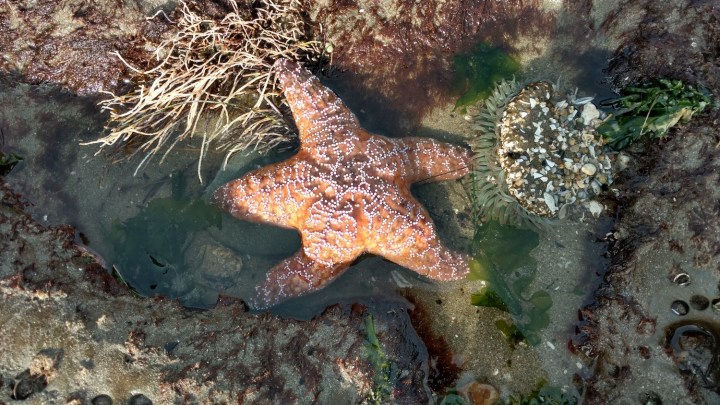
After almost an hour of tidepooling, I am rewarded by the sight of a largish ochre star, perhaps seven inches in diameter. Other than that is was pretty much anemones and hermit crabs, not that I don’t enjoy seeing those. I have recently realized that, just as a forest hunter needs to be aware of the wind direction, I have to position myself with respect to the sun. My shadow looming over a tide pool ensures every creature will hide.

Ochre Star March 2017


Fish in the Sea

The discovery center for which I will soon be a docent has a mission of educational outreach, but visiting it is not like going to school. Central to our training is the realization that visitors aren’t compelled to be there, and we want them to feel happy and respected so they will stay. (Are you thinking, even prisoners should feel happy and be respected? This is the USA, folks, not Sweden.) Since climate change is a controversial topic for some, we get very specific training on how to frame the issue. The volunteers have an escape hatch, too: handing off to a staff member.

I have gotten pushback from acquaintances who think this approach shows a lack of backbone. Certainly the scientists in the marine lab we represent are ardent supporters of anthropogenic climate change, as in, Humans Caused This. Diluting that message appears to veer from science into marketing, something science-oriented volunteer-types generally aren’t big fans of.

As it turns out, things that seem like a Big Deal when you are listening to Comedy Central or browsing the web just aren’t as fraught when real people are face-to-face. During my Docent-in-Training day, I spent two hours on the volunteer side of the always-busy touch table. Consistently, people on the volunteer side of the table said, sea star, and people on the guest side said, starfish. No guest said, Why are you calling the starfish a sea star? No volunteer said, Scientists classify fish as vertebrates, and these are not vertebrates–though we would have said that had someone asked.

That is, people on both sides of this issue coexisted peacefully, while the volunteers consistently presented accurate scientific information. It’s true the star-name controversy isn’t something Republicans are energizing their base about, but plenty of people at, for example, my mom’s nursing home, including, for example, my mom, really feel starfish is a great word that did not need to change. Many of these people also insist that the indistinguishable rock in the Kuiper belt known as Pluto is a planet.

The good news is, people who say starfish can learn to differentiate between marine invertebrates and chordate fish, just as most Pluto fans can accurately identify the real planets. Similarly, those who don’t believe humans cause climate change can still understand how it is affecting oceans and marine organisms.

People in that latter group are actually more likely to believe humans can fix problems, which is really where we need to be focused. Those of you who see big fauna extinctions as a prerequisite for the Second Coming may disagree, but no one will argue with you at the discovery center.

Too Much Mustard

Consumers in the First World today have a lot of choices. Mustard is one example. In a single store visit, I may be faced by yellow, spicy brown, honey, dijon, whole grain, hot, beer, stone-ground, creole, Chinese, English, German, horseradish, sriracha, and balsamic mustards, each in different size or type of package, some organic. Mustard is only one item on my shopping list.

I don’t shop at the Simpsons’ Monstromart, “where shopping is a baffling ordeal.” But I have become a satisficer, someone who makes a sufficiently satisfying choice when an optimal solution is impossible. I am actually pretty good at satisficing, because I quickly get bored and frustrated by extended choosing.  Worst Stay-Home Night Ever: spending 30 minutes looking at trailers on XOD with no decision. That’s when I take a book and go to bed.

If I do get caught up in evaluating excessive choices, I feel confused and disgruntled thereafter. Having more choices often leads people to either avoid choosing entirely or to later regret the choice. Did I really get the best one? I bet another one was better. 

A cornucopia of information can confuse and distract us, too, and just as excessive consumer goods have not made us more satisfied, excessive information has not made us smarter. That is to say, contrary to predictions, the Internet has not made us smarter. Every fact, factoid, and opinion possible can be found there, all piled together like an interior shot from Hoarding: Buried Alive. Deliberately-producing ignorance is not only an art form but also a field of academic study, agnotology.

The poster child for agnotologists predates the Internet. In response to conclusive studies linking smoking and cancer in 1952, Big Tobacco hatched a plan of obfuscation, falsely promising real research into the cancer link, actually funding research into other diseases (such as Mad Cow disease) to capture medical headlines, questioning conclusions, casting doubt on scientific methodology, and ultimately disparaging the issue as Old News. Decades of avoidable fatalities resulted.

Unfortunately, satisficing doesn’t work for facts, which need to be real, not just sufficient, and are often uncomfortable rather than satisfactory. When I have to choose among a long list of 401k options, I hire a professional. Similarly, I’m getting my facts from trusted journalistic sources, those with a proven track record.

===========================================

Material in this blog credited to:

Financial Times Magazine, The Problem with Facts, by Tim Hartford, March 8, 2017.

The Paradox of Choice, by Barry Schwartz.