Termite Exile

My husband and I are in a hotel this weekend because our condo complex is being tented for termites. We don’t seem to have termites, but tenting happens every ten years, and we timed it just right. At least the tents are jolly.

termite-tenting

I’ve been spending a  lot of my exile at the Seymour Center. I spent one morning on the job as a docent-in-training. It was very confidence-building, as the public mostly seems to ask quite basic questions. There’s always the chance of meeting the ten-year-old who did a project on marine snow, but by the time I met that kid, I was happy to have a more in-depth conversation. Since we had two school classes visiting, I was mostly needed at the touch table, which has a level reachable by children and a lower level where the animals can rest. It appeared to have a training effect, with even the slow-moving sea stars aiming for the depths as soon as they were released; I tried to re-direct the kids to algae-petting to give the creatures a break. Can one empathize with invertebrates?

A few weeks ago when my younger son was visiting, we saw about 30 sea lions off the end of the wharf, forming a relatively quiescent clump on the surface of the water. During wharf training I learned that this behavior is called rafting. The animals cluster together, each with a fin, nose, or tail on one or more others, and most of them sleep, while one or two serve as lookouts. On a sunny day, given blubber, I imagine it would be as cozy as snuggling in bed is for us.

We have a resident pod of orcas in Monterey Bay, which would be keeping me out of the water if I already wasn’t staying out due to 1. white sharks and 2. cold water. As on land you can avoid being eaten by the bear if you can outrun one person, in this water the plethora of surfers may protect the rest of us. “Killer whale” is apparently a mistranslation of “Whale killer”, which makes much more sense. Orcas are apex predators which hunt in packs, choose food opportunistically, and modify their hunting strategies for the prey and the conditions.

The entire region feels like it’s already a period piece, since the nature-haters now in charge are gunning for the EPA in general and the Bay Area in particular. Sometimes it seems they would gladly tent the entire planet if there were profit or control to be gained. Of course humans are part of the planet too, but a lot–most?–people really don’t seem to understand that.


By Any Other Name

I should be looking for work, but no one has taken my library card away yet and somehow I just keep reading. Today I finished Trevor Noah’s Born a Crime, the story of his life as a child and young adult before he found his calling as a comedian. It is as entertaining as one would expect and surprisingly informative.  It is also the story of his mother, who has to be one of the most interesting human beings on the planet, not least because she survived a murder attempt in a way unexplainable by science (a miracle?).

Apartheid was much more complex and crafty than I realized, a patchwork of human categories based on color, circumstance, parents, happenstance, and language, each with its own privileges, and many with the possibility of promotion/demotion: one could even be re-categorized from white to colored or black. It was an ideal system for reducing the likelihood of significant opposition.

The book has some interesting ideas I am musing about. One, the idea that one’s name is one’s destiny, inspired the title of this blog. In South Africa, the two given names of most people were a tribal name and a colonial name. The tribal names had meanings, and Noah writes that often these names seemed descriptive in adults: a fellow named No Worries will be the opposite of a striver, while Be Afraid is mean.

Our older son attended a Lakota-style summer camp for years, in which the boys were given a native name that was meant to be descriptive, though I do not know how it was chosen. If names do affect our life choices, choosing a descriptive name when one’s character is more evident makes sense, though it could still be a burden for someone truly seeking to change later.

Of course, people often live up (0r down) to their nicknames, or to early stereotyping within the family. Even if the stereotype is positive, for example, if everyone thinks you’re the smart one, this sort of stereotyping is often fraught, engendering pressure to achieve or else a sense of fraudulence.

European style names have meanings also, but often we don’t know what they are, and perhaps that is for the best, at least while we are young. My given names mean “new arrival” and “light”, according to Google.

Noah’s two years as a street hustler–payday loans and music pirating–leads to the concept that effort and gain aren’t always linked. Street hustling is a lot of work that doesn’t leave a person with much to build a future on. A more accessible example might be Internet browsing versus reading a book; processing the same number of words for each could have quite different results. This is not a comparison of time spent, but of effort expended. Choosing to spend some of our time relaxing is beneficial, quite different from expending effort for naught.

The last idea that caught my attention, harder to apply but worth pondering, is, Dive in! If you fail or are rejected, you have an answer. If you don’t try, the question–Was it right for me?–will forever be an open one.

SFS and MTT

Tech-like abbreviations are pervasive here, even outside the tech industry, and the two in the title refer to the San Francisco Symphony and its conductor, Michael Tilson Thomas. My husband and I heard them perform in Davies Symphony Hall Saturday, from the portion of the Terrace seating that wraps around the orchestra. We were directly behind the second violins, slightly above the conductor’s line-of-sight, adding a new twist to the joy of hearing a live performance of a world-class orchestra playing in perfect synchrony, something we hadn’t done in a record seven months.

From that vantage point, the action in the percussion section was pretty distracting. The 21st-century piece included extensive use of the musical whip, which I only remember hearing in the Boston Pops chestnut Sleigh Ride. The first few times the tam tam was used, one fellow stroked it on one side with what looked like a metal scribe, while at the same time another guy facing away from the instrument tapped it at thigh level behind himself, with a soft-headed mallet held in his extended right arm. The vibraphone was both struck and bowed, including simultaneous bowing on both the front and the back by one musician wielding two bows; the bow was oriented vertically and drawn across the end of the bar.

There was a three-sided scaffolding of at least 30 hanging tuned gongs, a few more lying on a waist-level platform, and a collection of mallets in various sizes, one of which had a head that looked like a small American football. One lucky musician got to stand in the middle of this structure scrutinizing the music, occasionally choosing a mallet and a gong and giving one or two quick strikes. I was observing him a lot, and felt I could rarely discern the results. My hearing? Terrace acoustics?

The orchestral star of the first piece–the soloist was a violinist–was a cimbalom, an orchestral version of our folk friend, the hammered dulcimer. We had not realized one could play a hammered dulcimer while reading music.* The virtuosity of this fellow was impressive: in his hands, this instrument had expressive and dynamic ranges that challenge those of the violin. No key signature was left behind.

I think one appeal of percussionists is that they play the instruments of childhood–the triangle, the xylophone, the drums–for good money in beautiful venues. The triangle is my special favorite, perhaps because the orchestral version so closely resembles the one found in elementary school music rooms. Seeing a fellow wearing a tuxedo and holding a triangle sends a shiver of anticipation down my spine, especially at such close quarters. He was good too, striking it, stroking it, varying the pace, working all three angles. And he was doubling tambourine! Dream Job.

======================================

* JK, hammered-dulcimer-playing friends!

The Noise of Time

The title of this blog is borrowed from the latest Julian Barnes book, a historically-informed fiction about the composer Shostakovich during the Stalin and Khrushchev regimes, written as a stream of consciousness. I loved this book. Anyone interested in Shostakovich in particular, or in artists struggling to express themselves under the scrutiny of tyrants, would also enjoy it.

For years reviled as a sellout, Shostakovich has in this century been revived and celebrated as a survivor. Barnes vividly imagines how personal and wearing that struggle may have been. In the book, Shostakovich considers his options: defying authority (and likely getting shot); complying, by writing forgettable, state-sanctioned music; going into exile, abandoning his friends and family to their fates; or committing suicide, the only true escape. These considerations aren’t organized, or rational, or systematic; they whirl through his brain, surfacing and subsuming, surprising him at ordinary times, mixing in with daily life. There is no moment of decision. Ultimately he simply lives, writing the music he can in an age of irony, yet never succumbing to cynicism. Deciding to live feels like an act of cowardice, or rather a series of acts of cowardice, and it takes a surprising amount to courage to be this sort of a coward. By living, Shostakovich was able to shape his own legacy through his music.

This book reminded me of Oriana Fallaci’s novelized biography of Alexandros Panagoulis, A Man. Panagoulis was overtly, overflowingly, outrageously courageous in his fight against tyranny in Greece, defying authority at every turn, even in prison and under torture. He refused to accept any reality controlled by his oppressors by insisting on his ability to act freely, including writing poetry on the walls of his cell in blood and refusing multiple amnesty offers. Killed at age 36 by a car accident that conveniently ended an extensive corruption investigation just before presentation of key evidence which was then lost, his legacy has been shaped by writers, Fallaci most prominently.

Also related is the graphic novel and later movie, V for Vendetta. Set in a near-future UK led by an increasingly Fascist government, this work features a protagonist who defies authority overtly, but in disguise. He stages public events ranging from co-opting a national news program to assassinations and bombings, each carried out with artistic panache. Although depicted as a victim seeking revenge not only for himself but for all the regime’s victims, the result of his mayhem is to embolden others to defy the government. This often ends tragically for individuals, but the People ultimately prevail. Our protagonist does not survive, but his legacy is triumphant and ubiquitous.

Paraphrasing Julian Barnes, I wish for us all to prevail in whatever way we can, with courage or cowardice, in the light or the shadows, during the noise of our time, until again we can hear the whisper of history.

Mourning Dove

I really like birds. I especially like mourning doves, mostly because they are one of the few birds I can reliably identify by both sight and sound. Bird guidebooks are fantastic when you have the book and the bird side-by-side, but often I don’t, and later there is always a question I can’t answer: Was the tail ringed? Was the beak straight or curved? Were there stripes on the head? A page filled with birds so similar, yet not the same, and names so different. Was it a whimbrel, a curlew, a godwit?

While I say I like birds, I am certainly not a birder, because any birder worth her salt would be easily able to answer those questions. Last week I looked at a site of a birder couple who recently traveled to Antarctica and posted 1000 of their 7000 photos, mostly of birds, all tagged with both common and scientific names. Whether because of my struggles with identifying birds, my seeming inability to memorize scientific names, or my phobia of excessive digital photos,  I found this compendium staggering.

Back to mourning doves, whose coo is often likened to a lament, though I find it tranquil and comforting. Mourning doves are monogamous for the most part, and extremely fecund, breeding up to six times per year in warmer climates. They eat mostly seeds, berries, and an occasional snail, and are able to drink brackish water.

Most of the world’s population is in North America, home of 350 million.  They are also the most popular game bird on our continent, with 20 million shot each year. I am even less a hunter than I am a birder, but on investigation I found that hunters like them because they fly fast–a challenge–and can be shot with a smallish–easier to carry–gun.  Hunting is allowed but regulated (for the time being) in most states.

Whether you like to watch mourning birds or shoot them, find them boring or comforting, think of them as pests or assets, we can perhaps agree that they are thriving now. They are on my mind because I’m trying not to think of all the creatures that may be threatened by the current proposals to gut the Endangered Species Act. It’s all about “land use,” sponsors say, yet the US doesn’t set aside much land: of all states, only Alaska has set aside more than 25% and only California, Wyoming, and Florida more than 10%*. “Set aside” includes lands with any level of protection at all, often combined with commercial uses, including extraction.

This month I also learned that many people support dumping coal mining debris into streams. Finding commonality with the 46.4% who voted for Trump feels harder than identifying birds sometimes.

================================

  • Based on this chart, which for some reason I can’t get WordPress to turn into a link: https://gapanalysis.usgs.gov/padus/protected-areas-stats/

Dancing Day


Usually I do a lot of blogging in my head before I actually write, but this month I find my head is filled with competing demands. My online work is back online, but I’m still in catch-up mode. Docent training is fascinating, but requires as much time as any other college course. Taxes are a looming nightmare of data gathering, involving two states and two real estate transactions. We’re even getting a handful of visitors from the snow states. I want to blog, though, so I’m just going to write about yesterday, Seabright Morris’ Winter Day of Dance.

This was my first public appearance as a Morris dancer. I had a lot of fun and only dropped my stick once out of six times doing the spin-toss move. Here I am in our Border kit, looking like a plump bird. Well, we aim to entertain and amuse.

jo-border-kit-2017

It was a sunny day and fairly warm, especially when dancing in such a voluminous costume. Our small team had a good turnout, including our oldest member, who is 84 and very sharp, a living testimony to the healthful aspects of folk dancing. Everyone wasn’t needed for every dance so I had an opportunity to add to my Youtube collection.

We met at 11:00 and danced until 3:00 or so. This wasn’t really four straight hours of dancing. There were two teams, so we took turns, and walked to different sites, and chatted with each other and with watchers, and took a short lunch break. Nonetheless, my body was ready for our pub break when it came. The pub was Rosie McCann’s, which was meaningful to my husband and me because The Star of the County Down was our wedding waltz. For those of you thinking, that’s not normally a waltz, that’s true, but it can be.

Cool fact: Morris dancing is mentioned three times in Don Quixote.

After an early dinner, some of us went on to an evening contra dance. This dance had a charming, rare feature: Too Few Women. That never happens on the East Coast. I danced the entire first half without stopping. The band was talented and creative and there was another rare treat, a contra medley. As long as I don’t stop moving, the energy keeps flowing, but when break time arrived, I wilted. We decided to go home and hit the hot tub. Sorry, Extra Men.

Alternative Data

I’m not often disposed to take online surveys, but when I received a survey from The Atlantic on how large corporations are perceived by the public, I was intrigued. Why was this magazine polling its readers about large corporations?

The Atlantic got its start in the mid-1800s as a literary magazine, with Emerson and Longfellow among its founders, but has morphed into a political and cultural magazine that tries to present a balance of topics from the right and the left and to position itself as a feisty maverick. It’s hardly the New Yorker–the nonword snuck has sneaked in more than once, and one “writer” touted discarding the object pronoun whom–but to the extent that one can trust a nonhuman entity to do its best to be accurate, I do. Or did.

If you are over 50, you may remember a time when corporations served four stakeholders: employees, community, customers, and shareholders. Hard though it is for you younger folk to believe, many large corporations actually tried to compensate their employees fairly, contribute to the well-being of their communities, and deal honestly with their customers. Then in the 1980s, corporate focus moved to shareholder value to the exclusion of all other considerations. Now most people instinctively mistrust large corporations, with good cause.

The questions on this survey concerned the perceived trustworthiness of a specific list of very large banks and investment houses and their leaders, and how much they care about people and local communities. My answers ranged from low/little to none/not at all. That is, until my survey was interrupted by this:

survey-message

Really? I think it meant to say, We are trying to confirm a pre-determined assumption, which you are not doing, so we are going to eliminate your input.

Last month I learned about alternative facts. This month, I have seen alternative data.

Wish You Were Here?

I’m not missing winter weather at all. I know some people–I’m even related to one–who feel the year would be incomplete without winter, but I am not, as it turns out, among those. I am perfectly content without winter.

I am missing a few things. Top of the list would be my friends and neighbors. Although technology makes it easy to keep up, and to some extent I do, casual outings, last minute symphony tickets, and serendipitous encounters in Griggs Park are just over. We are starting to make some friends here, but we are not at the level we were in Massachusetts, and possibly never will be. Nor would I want to in any sense replace my friends from there.

I miss my children a little. They had already launched, and I feel close to both, and we stay in contact, and they were here for the holidays. But I do feel the expanse of the continent between us. Neither will be popping in for a weekend unexpectedly.

I’ve missed the BSO all season, and am missing Tanglewood in advance. We have a Santa Cruz symphony, but it is not the BSO, although Yuja Wang will be soloing next performance. We are looking forward to hearing the San Francisco Symphony in Davies Hall for the first time in February, with tickets behind the violin section, but it will never be a subway ride away. I have been mooning over the Tanglewood schedule. TW may not be unique, but it is very special, and I don’t know if we will be there at all this year.

I miss Speedpass. There’s only one Mobil station in Santa Cruz, and it doesn’t accept Speedpass. Considering my professed disdain for corporations, I should be overjoyed to be rid of Exxon-Mobil, which is not even one of the palatable ones. But I confess, I am enamored of the swipe.

I miss Wegman’s, more than I would have thought possible. I have to go to so many grocery stores now, and still I can’t find everything I need*. Wegman’s had it all, plus catering, plus the people who worked there were super nice. I don’t even like the place I get my prescriptions filled here.

My husband shared a story about a woman who remembered her late grandmother lovingly for decades, until she visited the woman’s grave and realized her grandmother had died before she was born. I recently read a similar story of a woman who remembered details of her father reading a certain children’s classic to her, then found out it hadn’t been written until after his death. So maybe I don’t actually miss any of this? Life is but a dream.

  • One example: There is just no dried cilantro in California. It doesn’t exist. Bill brought some back when he was in Massachusetts in December.

Dissonance

Last night there was apparent snow on the hot tub cover and in the corners of the yard. It was very coarse, and on closer inspection, we suspect it was quite small hail. There had been a loud storm earlier that evening. We had an amusing conversation between seeing and investigating, centered on how snow could occur at an ambient temperature of 46 degrees. Engineers experience dissonance when evidence and facts collide, though to our credit we did not deny either.

I was jarred when I learned of the Patriots fan who used the hotel fire alarm to roust the Steelers in the wee hours of the morning before the AFC championship game. Beer and dares were involved. The general idea may have been inspired by the team, which has been Crossing the Line since 1982 (check out Snowplowgate). On the other hand, yourteamcheats.com rates the Patriots near average. Now I am wondering whether the entire sport–all sports?–everything?–is/are tainted.

Today my husband and I switched cars so I could take his to the shop, since I am still unable to work (day 12). Happily it was sunny as I tooled down Route 1 in my yellow Mustang convertible. Me driving a muscle car is definitely dissonance. It’s like driving in bed, because the seat cocoons you firmly in place, and like driving a (large, responsive) go-cart, because the engine makes a nice vrooming noise. Other Mustangs check you out. I felt an unaccustomed compulsion to set the pace for everyone (don’t worry dear, I didn’t).

F. Scott Fitzgerald’s quote, There are no second acts in American lives,  may mean something completely different than I thought it did. In a three-act play, the first act sets the scene, the second introduces struggle and conflict, and the third brings resolution. In the quote, Fitzgerald may be positing that Americans skip Act II. We like to move directly from getting married to living happily ever after. We don’t like the part where we struggle to accommodate each other through compromise, listening, and change.

From the book I mentioned in my last blog, Mistakes Were Made, I was surprised to learn of the dissonance between the pain humans feel and the pain we imagine others feeling. In experiments, when one person strikes another and the victim is allowed to deliver an equal response, the second strike is harder, even when the subject is trying to comply. That’s why fistfights escalate. If someone betrays you and you seek revenge, your response will likely be out of proportion. That explains escalating custody and settlement battles. When someone is rude to me, I’m not proud to say that I often want to be rude back. Much safer to think, That person must be having a tough day, and avoid escalation.


Deep Sea Canyon

I’m discombobulated recently. My work site has been down for 11 days. It’s raining a lot here–turns out California has weather after all. Trump was inaugurated on Friday, then the next day his press secretary instructed the US press in the proper use of Newspeak. I experienced the Women’s March only vicariously, through many friends and my husband. I’ve been watching a lot of football, a sport with family connections for me that’s now more guilt-inducing than shopping at Walmart. So today I’m going to center myself by thinking about Monterey Bay and the MB Submarine Canyon.

The Monterey Bay National Marine Sanctuary is a seething cauldron of sea life, including over 2500 species of invertebrates, 500 species of fish, 200 types of shorebirds, 25 species of cetaceans, 6 species of seals and sea lions, and the region’s most iconic representative, the recovering-but-still-endangered sea otter. The sanctuary is centered on Monterey Bay, which stretches about 22 miles between Santa Cruz and Monterey. When the fog and clouds allow, you can see the entire bay from many vantage points. What you can’t see is the Canyon.

Just off Moss Landing, near the center of the bay’s coast, is the head of a submarine canyon twice as deep and as third as long as the Grand Canyon, the largest offshore canyon in North America. It extends 60 miles west to its mouth, reaching a depth of over 2 miles. Its origins are a bit of a mystery, but current thinking is it was created 250 miles south about 25 million years ago, and is migrating north at 1.5 inches per year. It continues to be altered by water, weather, and seismic events.

The canyon and the wildlife are interrelated. One example: During certain times of the year, prevailing northwest winds push surface water seaward, and deep water rises–upwells–to replace it. Much of this deep water comes from the canyon, so it is both very cold and packed with nutrients and minerals which have accumulated at the bottom. These feed phytoplankton, the unicellular plants at the base of the food web of the ocean that also provide at least 50% of Earth’s atmospheric oxygen.

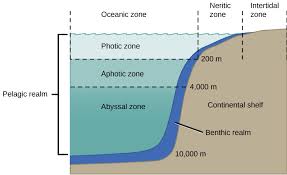
Marine habitats around Monterey Bay include tidepools, estuaries, rocky shores, kelp forests, and all the living zones of the ocean you see in this figure*; pelagic creatures move in the open sea, while benthic creatures live on the sea floor.

oceanzones

There is a large marine science community here, studying all aspects of marine biology, chemistry, and geology, and the proximity of the canyon is a draw. As one fellow pointed out to my docent class, he can spend a long day operating a remotely-controlled submersible in very deep water in the canyon then eat dinner at home, while East-coast scientists looking to experiment in similar depths start with a two-day boat ride.

Sixty percent of the Earth’s surface is deep sea, yet we know very little about it. Some animals, such as whales and sea elephants, spend significant time near the surface or on land, but their deep-sea habits are still mysterious to us. New technology for tracking and observation is helping us to learn not just cool facts, but helpful ones. Examples: Elephant seals spend two to eight months each year diving in the open ocean, and can dive to greater depths and for longer than most whales.  The California sheephead grows to a certain size as a female, then changes sex and grows more; fisherman trying helpfully to limit their catch to the “big ones” were exterminating the breeding males. A sound at a decibel level that would be acceptable in your living room, broadcast underwater from California, can easily be heard in Japan, so it’s unsurprising that human noises have been observed to disorient fish, many of which communicate and identify food and predators by sound.

* http://archive.cnx.org/contents/cbe4eb5b-ce12-49a3-a449-a1aa75fb6a88@3/aquatic-and-marine-biomes