I Make Mistakes

I feel endlessly wafted about, thinking our species genius, idiotic, and everything in-between. This week I’m reading Mistakes Were Made (But Not By Me) by Tavris and Aronson, and I am beached on the idiocy shore.

First example: Brad cheated on an exam in a weak moment, so over time he will justify that behavior with various rationalizations: Cheating is not that uncommon; Failing the test would have derailed my career. Jack resisted cheating, so he will think, Cheating is wrong; No one should have a credential not honestly achieved. Best friends who agreed cheating was undesirable but minor the day before the test, they will now forever view each other as sanctimonious/unethical.

Such minor decisions can send us on vectors that harden as we age.

Why can’t the aftermath be, I cheated, but I’m not proud of it, and don’t plan to do it again? Or, I didn’t cheat, but I felt the temptation, and I won’t condemn someone for a moment of weakness? Sometimes it is. My faith in humankind was buoyed by a recent conversation with a friend during which she took the self-corrective high road twice without my having mentioned this book.

Our brains evolved this way for several reasons, but the end result is that we like to think that we are good, and we reinforce that thought regardless of evidence, and often by deciding the “other” is bad.

Knowing this can be useful. If someone doesn’t like you, for example, the key is to get that person to do a favor for you. Ask the person to loan you his umbrella so you can go to the car to get yours, or to give you a lift home after the PTA meeting since he drives by your house anyway. Later the person will think, I did something nice for that jerk, and I’m not an idiot, so he must not really be a jerk.

Ben Franklin tried this. By borrowing a book, he turned a colleague who refused to speak to him into a lifelong friend.

Just as we like people we are nice to, we dislike people we are mean to. Join in a bullying session, even reluctantly, and you may end up blaming the victim. Why did she put herself into that situation? Why didn’t she fight back more? She deserves what happened. I’m not a mean person. Forgiveness by the victim not only won’t reverse the loathing, it will reinforce it.

This explains so many evil characters in literature and television.

A similar phenomenon involves escalating bad behavior. Most of you have heard about the experiment in which subjects administered electric shocks to strangers, starting with mild shocks but continuing even when the shocks were apparently excruciating. Mindless obedience is part of it, but so is our locked-in brain state. Cheating can lead to embezzlement, flirting can lead to adultery, and, yes, marijuana can lead to heroin. Once you think of yourself as a short-cutter, free-lover, or drug-user, you can reinforce that.

This explains why people with everything to lose do dumb things that we find out about only when they reach the arrest/accidental death/scandal sheet headline level, and lose everything.

None of us has to be subject to our self-aggrandizing internal dialogs. We just have to recognize the resultant deteriorating behavior. We have to be able to say, What am I doing? This makes no sense! I should stop.

I personally feel my outlook and mannerisms have changed a lot since I was in my twenties. I hope it is due to observation of my effect on others, rather than ratcheting rationalization. Anyone who has known me the entire time, feel free to weigh in.
Rethinking Conversation

We are meeting a lot of new people here, and we commonly ask, and sometimes are asked, questions such as, What do you do?  While reading a biography of Patrick O’Brian, I realized that personal questions are considered rude by some people. Not too many, in this age of sharing nude selfies and tweeting scathing retorts, but a few.

I had to review some scenes from novels set in the nineteenth century to remind myself of how question-free conversations start. One commonly comments on a shared experience:  I love the band tonight! I lived in Boston until recently, and the mandolin player reminds me of someone I knew there. While that comment invites the followup question, Why did you move?, a nineteenth-century conversationalist might reply, I’m glad you found some music you enjoy here, because you may be missing the winter weather.

Impersonal questions are not rude, but are unnecessary. Examples such as Can you give me directions to Manderley? How was your flight? and Did you see the stationmaster I mentioned, the one with the fabulous mustache? could also be rephrased as, I trust I am heading toward Manderley; I hope your flight was uneventful;. and The stationmaster there is quite a colorful character. To not require answers of one’s conversational partners seems to be a form of respect. It could make the relationship more relaxed, allowing each person to reveal information, or not.

Having a conversation without questions seems wittier, and feels like a game to me. I am looking forward to playing it.

My docent training will cover in depth the communication form Interpretation, which I recognize, though I did not realize it was a subject of academic study, with its own National Association. Intepretation, as you  may well know, is a way of conveying information that is audience-based. It is not teaching; curriculum-driven learning cannot be be conveyed via interpretation. It’s also not entertainment, and while it is flexible, there are goals. We will be learning how to convey scientifically sound information to non-captive audiences in encounters ranging from moments to complete presentations, in ways that are appropriate for the audience’s mood, mindset, and background. Most intriguingly, this involves varying the content as well as the communication method. I feel interpretation could be also useful in more personal interactions, particularly for conversations in which one person is agitated, or some difficult news must be conveyed.

Both of these epiphanies happened yesterday, five days after Epiphany. Today I am a little tongue-tied, overanalyzing my speech.

Ban-Banning

From the Boston Globe: A new law in Michigan will prohibit local governments from banning, regulating or imposing fees on the use of plastic bags and other containers. … It’s not a ban on plastic bags — it’s a ban on banning plastic bags. … The new public act prohibits local ordinances from ‘‘regulating the use, disposition, or sale of, prohibiting or restricting, or imposing any fee, charge, or tax on certain containers,’’ including plastic bags, as well as cups, bottles and other forms of packaging.

Michigan is in the news this month, but three other states–Arizona, Idaho, and Missouri– already have a similar law. This interests me, because I don’t see a reason for such a law.

The reason to ban or charge for plastic use is obviously the impact plastics have on the planet. Most of the plastics we use now will literally never decompose, because most bacteria, our primary decomposers, won’t eat them. Over long periods of time, many plastics will degrade, but mostly into tiny pieces of plastic toxin, that are then eaten by sea creatures, who, if they survive, may themselves be eaten by animals higher up the food chain, including the plastic-creators. Living near the shore, instances of the negative effects of plastic on marine life are readily observed. Maybe that’s why the great state of California was the first to pass a state-wide ban on plastic bags.

Plastic is amazingly versatile, and cost-benefit analysis, which rarely considers post-use results, usually finds plastic superior to other substances. It reduces food waste by keeping our food fresh longer, uses less petroleum to manufacture than heavier container alternatives require to transport, greatly reduces disease and infection in medical environments because it is disposed of rather than sanitized, and has broadened the efficacy and availability of everything from eye glasses to air travel.

Since plastic is not going anywhere soon, and since it persists, it only makes sense to not use it when possible. Lots of people don’t realize this, and in a logic-based world (some other instance of the multiverse), this would be a simple matter of public education. People have trouble visualizing large-scale effects, such as the massive amount of junk we throw out, but if they knew, they might act differently. For  example: 60,000 plastic water bottles are discarded every minute in the US.*

So why ban the bans?  I have no theories.

===============================================================

*That is a current, conservative-assumption-based figure which I computed myself after an inordinate amount of web research. Thanks to the drastic downsizing of the US government over the past 2 decades, it is nearly impossible to find objective info; I trust neither the Water Bottlers Association nor banthebottle.com. I long for a reliable .gov source manned by phlegmatic, career civil servants.


Thrills Real, Vicarious, and Gone Wrong

On New Year’s Eve, we went to the boardwalk and rode on the two open roller coasters and the bumper cars. I like amusement park and water park rides so long as they aren’t too tall and don’t turn me upside-down. My husband and our younger son, my companions that day, go for extreme rides, not that we have those in Santa Cruz. They also like horror movies.

So my husband was happy to find that Las Vegas, where we celebrated our 26th wedding anniversary this past weekend, has three of the four tallest thrill rides in the world. (They were the tallest three until China built a taller one in 2012, a good example of the way America became less great during the Obama years.) All are on top of the Stratosphere tower, above the indoor observation deck at 108 stories. That’s where I stayed, curled up on a sofa that was really not sufficiently far from the alarmingly prow-shaped windows. I ventured up the stairs at one point, realized the upper observation desk was al fresco, and retreated.

My husband rode all three rides. There’s Big Shot, a 160-foot spike that shoots riders up at 45 mph then lets them drop. There’s Scream X,  which “catapults” victims 27 feet over the edge, facing out, then lets them hang there; my husband nabbed the front seat. Then there’s Insanity, a variation on the hanging chairs that spin: these are heftier chairs and they aren’t attached by chains, which is good because they also spin 64 feet over the edge, at 40 mph.

He decided not to go for the bungee-like Sky Jump–too expensive.

Happily, I was back on terra firma when I read that Insanity froze in 2005, leaving the riders hanging from the chairs for 90 minutes. Visions of this kept me up much of the night, remembering the time I was stranded for 15 minutes or so on the chain chairs at Six Flags New England, probably around 15 feet above the ground. The ride stopped spinning, but didn’t lower. It was the strangest psychological experience I have ever had: I had to work very hard to master an overwhelming urge to release my seat restraint (easily done, on this tame ride) and jump down. I desperately wanted out, and I had to reason with myself continuously to stay relatively calm. As I remember, I was more disturbed by being confined than by the height, though I was very aware I was dangling when the ride wasn’t moving.

I haven’t ridden a swing-type ride since.

Triclosan Factoids


My 2017 resolution is No Factoids. Norman Mailer coined the word, and defined it as a falsehood that is believed to be true after publication or repetition. I prefer Bradford Veley’s definition, though: A nugget of truthiness nestled in a swirl of rumors, often with a sweet coating. I’m resolved to neither propagate nor accept factoids.

Fact (a true piece of information): Triclosan is an antibacterial agent found in Colgate Total toothpaste.

This toothpaste changed the lives of our family when we discovered it, especially that of my nephew, who was living with us at the time. When he arrived at the start of sixth grade, his teeth were demineralized and one unerupted adult tooth was rogue in his gums. These deficits were eventually corrected, but he still had poor dentist reports and frequent cavities, which made his aunt unhappy with him.

Our family switched to Colgate Total after our dentist started handing it out. Soon, my nephew was getting the oral exam results the rest of us did, even with relatively sporadic use. After several surprisingly short cleaning appointments, I permanently reduced my own brushing and flossing frequency, with no apparent ill effect.

I visited my west coast dentist for the first time on November 22, and he gave me a sample of Crest. After confirming that it did not contain triclosan, I threw it away without even recycling the box. I was offended. Why wouldn’t he offer his patients the most advanced toothpaste?  I didn’t think about it again until the relative calm between Christmas and New Year’s, at which point I decided to investigate.

If you had asked me about Total last fall, I would have said that it included the first major toothpaste breakthrough since fluoride, nearly 50 years ago; that no other toothpaste had the ingredient because it was still patented; and that some dentists were predicting it would reduce or remove the need for cleanings.

These are factoids. Triclosan wasn’t a new, patented discovery, just newly applied to toothpaste. It was acclaimed by some and shunned by others due to controversy, including fear it might disrupt the microbial balance in the mouth. Recently it was banned from uses in surgical and household cleaning by the FDA due to possible hormonal effects. It may be bad for aquatic organisms when it eventually ends up in the environment. The closest thing to a triclosan fact in my memory was how well it performed in oral health studies: the FDA still permits it for use in toothpaste because the benefits outweigh the costs.

I don’t know where I got the factoids in the first place, but I do know they were reinforced in my mind by repetition over the years, and also by the anecdotal evidence of my experience. This was a great lesson for me in how people can be convinced something is true when it isn’t.

Now I need to replace factoids with facts. I will ask my dentist. I will research some place other than the web, where the publicly available drug information is simple, and therefore incomplete. But facts exist, and I know I can find them. Zero Tolerance for factoids!

================================================================

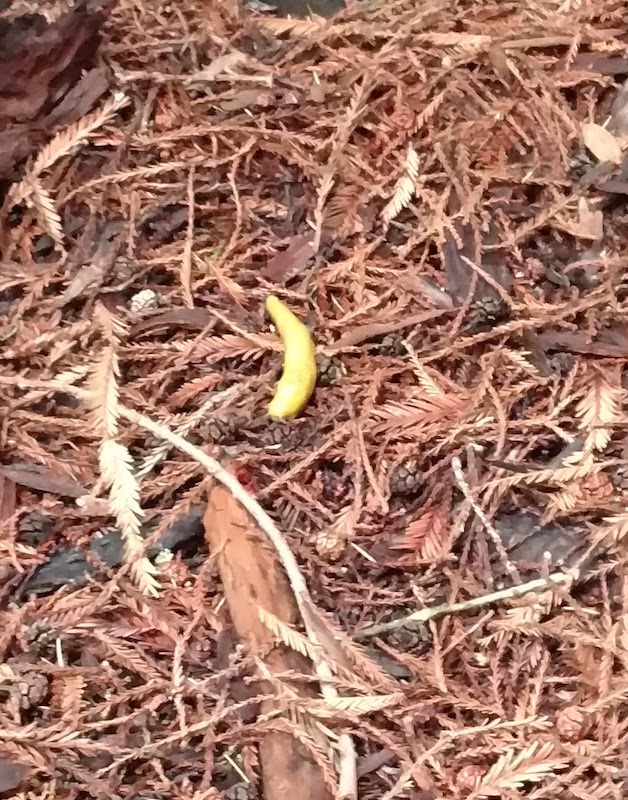
News flash: During the last week of 2016, I finally saw a banana slug in the wild!

first-banana-slug

When the Ants Come Marching In

We first noticed a handful of tiny ants in the kitchen one morning about ten days ago, and we wiped them up. These were very tiny ants, ants that just crumple into pieces with a swipe of a sponge. It was a little annoying, but not a Big Deal.

That was a classic case of thinking you know what you are doing when you don’t. The first ants were scouts, and the masses followed. As it happened, the first morning of my husband’s recent business trip was the day I awoke to hundreds of ants in the kitchen. Really, it was quite a shocking number of ants.

Disposal of those ants took a while, and was not the most fun thing I ever did before breakfast. Afterward, I Sought Knowledge, and to so, I used email and Google. I learned that ant invasions are a common winter phenomenon in California, and that I had plenty of ant-fighting substances already on hand, including vinegar, baby powder, and peppermint soap.

A commenter on one site noted that these safe-seeming substances kill the ants quite viciously, describing their painful, torturous deaths in some detail. I had thought of myself as a tree-hugger, but now I am exposed as the dominant predator I was born to be. I want all the ants in my house to die, and soon. If ants want to live, they can stay outside.

As with everything in my life except the recent election, I feel this could have been much worse. The ant problem has almost disappeared, though our vigilance remains high.

Most of my life happened in the pre-Internet era–it’s true, kids–yet the Internet is now my primary source for work, shopping, banking, email, simple fact checking, and blogging. Yet I would fundamentally characterize it as a vast repository and disseminator of mostly false information. Well, maybe mostly pornography, but a lot of false information, including information that has been created to mislead a targeted group.

At its inception, many predicted the Internet would make the world more connected in a positive, generous, post-racial, Teach-the-World-to-Sing sort of way, and would spread democracy and freedom. Instead it increases the reach of hate groups, spreads misinformation and greed, and provides how-tos for would-be criminals and terrorists. As quickly as I can learn to create ant genocide, someone else can learn, well, use your imagination. It’s a lot scarier than ants in the kitchen.

What Would the Lorax Do?

This week (it’s still raining, not that I don’t read when it’s sunny) I’ve been reading a collection of essays by William Kittredge, who grew up on a ranch in eastern Oregon and now lives in Montana, and writes about land use and culture in the western US. His main idea seemed to be that methods of agriculture used in the US since World War II, and perhaps for most of the 20th century, are deleterious, in that their costs outweigh their benefits.

Although the claim surprised me, I didn’t have to think about it very long to come up with my own examples. Nitrogen fertilizer brought us a worldwide population explosion, then coastal dead zones than are now starting to encircle continents. Antibiotic use in animals seems to be increasing the number of resistant pathogens for humans, and manure lake runoff poisons water and air. Nature’s pesticide, Bt, has been engineered into some GMO plants in an “always on” fashion, allowing plant pests to develop immunity, which Nature avoided for eons by having plants only produce Bt for short spurts as needed. GMO plants are clones, hundreds of square miles of clones, monoculture, a mega potato famine waiting to happen.

Kittredge mostly writes about destruction of habitat. Changing swampland, forests, prairies, estuaries, deserts, and low- and high-altitude meadows to farmland has consequences for wildlife, water supply, soil productivity, and human health. He feels that in his lifetime–he was born in the 1930s–the West has become significantly less diverse and beautiful, due to practices in ranching, farming, and mining.

While it’s easy to say that what humans do is maximize growth and profit over sustainability and long-term health, we haven’t always done so, and not all of us always make that choice, so I have been thinking about what might be the difference now. I think it is what the Once-ler would term, Biggering. Many things seem to be global now, yet decisions made locally, on a small scale, are more accurate and more responsive than those made on a large scale. Think about making a choice for your local school, as opposed to having the school board choose. If you get involved when your children are young, you will still be tweaking the process five or ten years on. There will be a learning curve, and possibly an evolution in priorities, and you will be discussing the nuances the entire time.

Sounds good, but of course Kittredge’s family was managing their ranch devotedly for three generations, and they managed it out of existence. Looking at the big picture is important, too. It didn’t occur to any one rancher than if they all drained the swamps and dammed the streams there would be no more wading birds or fish, and the absence of these species would lead to irreversible changes. Perhaps one person could do those things with relative impunity, but everyone did them.

So here’s a blog that’s more like my normal, daily thinking, that is, circular and inconclusive. Life is complicated, and answers aren’t obvious. Those of us who are willing to try to navigate that will, I hope, continue to do so. Like the Lorax, we can speak for the trees. Or the children. Or the community. For wildlife, the dispossessed, science, democracy, civil discourse. For coral reefs, music and art, reasoning, education, voting rights, police restraint, and darkness at night.

I left off the emotions, did you notice? Choose something concrete, something you can delve into.


It’s Raining, So I’m Reading

I just finished reading a delightful novel I am pleased to recommend: The Husband’s Secret, by Liane Moriarty. The book is laugh-out-loud funny, yet treats some quite serious events. I especially enjoyed the difference between how each of the main characters (all women) thinks of herself and how others view her. My mental images of the characters kept changing until I could resolve all these facets, which ultimately combine into intricately detailed and complex characterizations, fictional people who seem very real.

Two of the main characters are in the child-raising time of their lives, while a third is a widow with a grown son and grandson. I came to like all three of them. While the jacket review cites one husband’s secret as the source of the title, there are many secrets in this book, which has some aspects of a mystery (an unsolved homicide is one of them). The reactions of the characters to the revelations of the secrets are interesting at first, and then evolve, and precipitate events that intermesh the characters’ lives in unexpected but plausible ways.

For me, the ending of a novel is the most important part. Many writers claim their characters dictate the plot, but I think the author has a role in it, and I don’t enjoy a book with an ending that is wrong for the character. A good ending can be sad, just not inconsistent. The last Anne Tyler book I read was Ladder of Days, because I strongly disagreed with the ending. I was caught up in the book, then felt betrayed at the end, and furious. I had been a fan up until then, but felt I could no longer trust Anne, and did not want to repeat the experience. Plenty of people disagree with me on this, by the way.

In any case, there were situations to resolve in The Husband’s Secret, and I had some ideas of how they might be resolved while reading. I was mostly wrong, but I was delighted by the resolutions, which I thought made sense and were clever. Then there is an Epilogue that is like having double dessert, because it not only tells us what happens to the characters in the future, it describes what would have happened to them in some other future if events had turned out differently. Regrets and second-guessing are futile; you simply can’t know what would have happened had you done something differently.

This is my first Liane Moriarty book. I hope she will not turn out to be another John Irving. I loved The World According to Garp, so I read about six more of his books, and none came close to being as good. He used many of the same components in each book, but did not achieve synergy, an aspect of writing that I suspect cannot be taught.

Planning, Verbosely

I have been thinking a lot about planning lately, and also learning to write longer sentences, so I am going to combine those in this blog, hoping that it won’t be too annoying, that somehow I will still be able to make a point, and engage you, the reader.

The winter of 2014-2015, the all-time snowiest winter for  Boston since records have been kept, with a total of 108.6 inches of snow, snow lining the sidewalk over my head, snow in the back yard up to the deck, snow burying benches in the park, snow that destroyed our snow blower the first week, was a wakeup call for my husband and me. We had started to think about retirement as a background task, and we knew we wanted to live somewhere with milder weather, weather that didn’t assault you when you opened the door, but instead is comforting, welcoming, and inviting; and now we knew we needed that weather before it was time to retire. We settled on Santa Cruz very quickly and started on the planning process, for which the major components were him finding a bicoastal job; me getting the house appraised and ready to sell; selling our house; purchasing another, including long-distance house-hunting; settling our (college-age) children in year-round housing of their own; downsizing with minimal trash generation; and orchestrating the move of what was left.

There were plenty of sub-tasks too, of varying degrees of triviality, and one of them was my hair, which I treat as a palette of a sort, varying its color and style over the years with impunity, since modern hair color is strengthening and hair grows back. Having decided to move to California, it followed–by the logic of someone who is not a Californian–that I should become a blonde, or at least blondish, and with the help of my wonderful hairdresser Niamh, this goal was achieved gradually, over a 12-month period, to my complete satisfaction, and even duplicated, for the most part, once since I’ve lived on the West Coast.

Then the second time I blew it: a year of work gone, in less than one hour, for which I blame myself, because I asked for a slight change, then accepted the advice of someone I assumed knew what she was doing, but the first time she must have just gotten lucky, because her advice the second time was wrong, and I think about that every time I look in the mirror. I’m not just annoyed, perturbed, disappointed, and petulant, I feel it is a blight on the entire move, a personal failure, not of course the only thing about the move that didn’t go perfectly but somehow the major thing, even though it happened 10 weeks after we got here.

Why is this bothering me so much? I’m picturing the Christmas photos not-as-I-want them, new people I meet getting the wrong first impression, people who haven’t known me long thinking of me as flaky, people I have known for a while thinking (perhaps happily) that despite the move, it’s still the same old me. Reading this, one might think I would spend the money to reverse it, but I know that this is ridiculous, a minor adjustment in my appearance, not a serious problem; I know that I absolutely should not be obsessing about it, that I should accept this fate gracefully, that this is a character test.

After all, it’s nearly certain that I will face a greater trial. Heck, a challenging work deadline would be a greater trial than this.


Fantastic Beasts, Easily Found

On Thanksgiving, my husband and I went to see Fantastic Beasts and Where to Find Them, which was a pleasant-enough diversion, though we aren’t sure we endorse Anthony Lane’s adoring review in the New Yorker. I would rather write more about the fantastic beasts of California, and my continuing attempts to get more involved with them.

Some of you may remember that we had a “pet” rabbit on Griggs Road this year, a rabbit living under the tree in our front yard that became inured to our presence, hardly flinching when we walked by while it was nibbling our grass. I think the new owners dubbed it “Hoppy.” We now have a “pet” hummingbird on Bramble Lane. I think it is an Anna’s hummingbird, and probably a female since it is relatively drab. She seems unperturbed by one of us standing under the tree, observing her at a distance of 4 feet or so. She sits in a low tree and sings, or rather chirrups–almost a tuneful buzz–for long minutes. At other times she preens herself, frequently flicking her extraordinary tongue. I had thought hummingbirds only used the high-speed flapping to hover, but that is how she always flies, with a whirr like a balsa-wood plane’s rubber band unwinding, except it never stops. Sometime she flies straight up 20 or 30 feet into the air and just hovers in place, which looks to be glorious fun.

Most of the animals here are marine animals and sea birds. I have previously written about the tidepool animals nearby and the sea lions at the wharf, as well as some of the animals I spotted during my otter project surveys. During the last couple of weeks I have visited the Monterey Bay Aquarium and also the Seymour Marine Discovery Center, and as you would expect, found animals both places. Unexpectedly, many of them were wild animals.

The Monterey Bay Aquarium is a nice aquarium, similar to the New England Aquarium. I’m not sure it’s larger, but it seems so because it is spread out and has both indoor and outdoor displays, taking advantage of its home climate. Outdoors there are multi-level decks with binoculars and telescopes available for viewing Monterey Bay itself. The day we went there were sea lions, sea otters, seals, brown pelicans, white pelicans, egrets, cormorants, and even humpback whales, who had entered the bay to feed. We could see all of these animals much more clearly than from any previous sightings, and even had docents to answer questions.

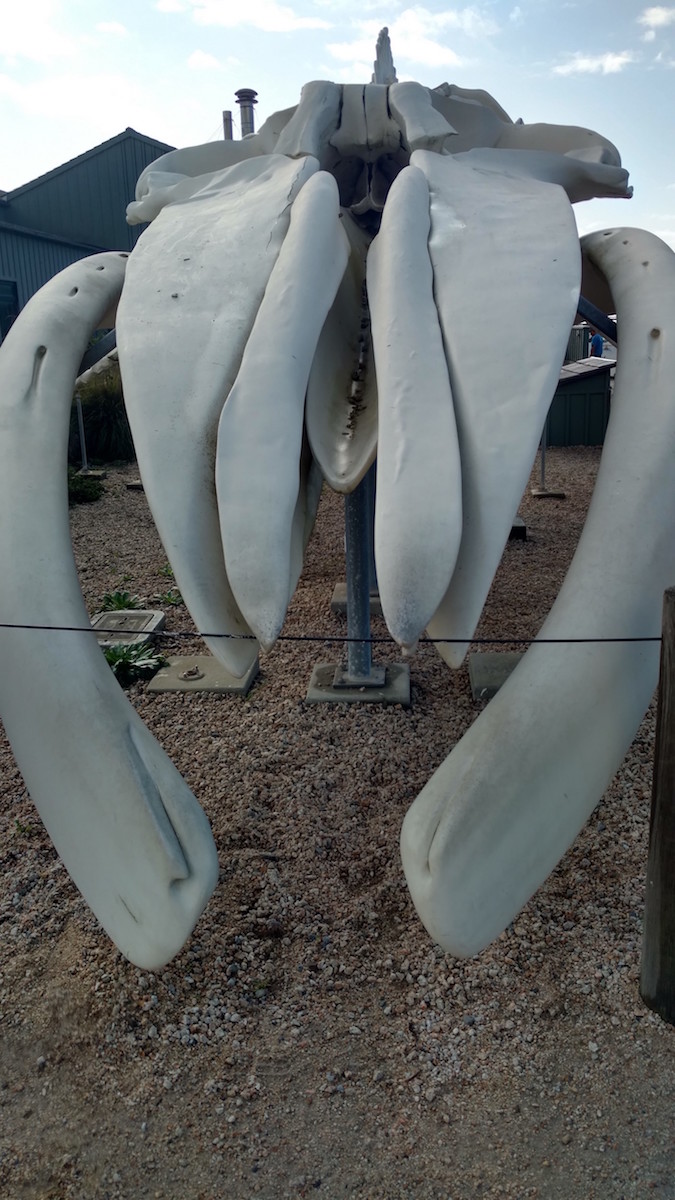
The Seymour Marine Discovery Center is adjunct to UCSC, located on the remote, oceanside portion of campus, where the bay meets the ocean. Its charter is to explain the role of scientific research in the understanding and conservation of oceans. It is small, with some live animals to view and touch as well as lots of hands-on science displays. It also has an extensive outdoor portion; during the outside tour we saw an otter and a pod of dolphins. There are two whale skeletons, one of a blue whale, which looks like an insect from the front view: bluewhale-skeleton-front-small

I was there to interview, successfully as it turns out, for a docent position. There are eleven weeks of training, every Wednesday and Saturday starting the second week of January, then a year’s commitment to a half-day shift every other week. I am pretty excited about this work, which involves a serious educational component and is also more social than any of my previous volunteer work, since docents  work in volunteer teams and interact with the public.

We went to see the Monarchs again this weekend, but viewing wasn’t very good because the weather was 55 degrees (cold for butterflies) and raining on and off. On the way home, though, we were rewarded by a rainbow practically arching over our house. We could see the rainbow’s end in the ocean, and my husband is pretty sure he got a glimpse of a pot of gold just under the surface. rainbows-end