Alternate Universe

Magazines appear to be the most sluggish items to forward through the mail, and I received my November Harper’s just a few days before Thanksgiving. It included several articles analyzing the campaign, all clearly assuming (though not stating) that Hillary would win. Reading it in the aftermath was like reading Nostradamus predicting an alternate universe in which Bernie Sanders was elected.

The main article’s analysis of why the US  is not in this alternate universe, together with the supporting evidence in various articles in this issue, seems crucially important for us to understand as we move into the Trump era, and is the topic of this blog, which has significant quotations and paraphrasing from this magazine. If you are tired of the political stuff, and I don’t blame you, skip this edition.

The centerpiece is the cover story by Thomas Frank, who carefully catalogs the campaign by our professional, Ivy-League-heavy media, the “prestige press,” together with the political establishment, including the DNC , to discredit Sanders. When for the first time in modern memory a left-wing Democrat seemed to have a chance at the nomination, the press piled on to stop him.

Most of us won’t be surprised to hear that the media is not liberal-biased, but why would it intervene to derail the campaign of a popular, scandal-free nominee? Frank postulates that the professional class of reporters and pundits sees itself as part of a “meritocratic elite,” peers of the well-educated power brokers who work in “government, academia, Wall Street, medicine, and Silicon Valley.” Clearly the Democratic party has in the last four decades become the party of this class.

To the power elites, Bernie Sanders represented not progressivism but “atavism, a regression to the time when demagogues in rumpled jackets pandered to vulgar public prejudices against banks and capitalists and foreign factory owners. Ugh.” To preserve the status quo, the press, perhaps more instinctively than calculatedly, joined forces with the political elites to redefine legitimacy in a way that excluded Sanders and his ideas.

A lot of this reporting stooped to pure falsehood. Here are a few of the story lines, followed by my comments.

  • “Americans are more anxious about terrorism than income inequality.” I think we got the answer to that on November 8th.
  • The repeal of Glass-Steagall “had nothing to do with the 2008 financial crisis.” That is very much an ongoing discussion, with plenty of serious economists positing a causal relationship.
  • The idea that there is a “billionaire class” systematically supporting conservative causes is ridiculous. Books have been written chronicling, decrying, and exalting this effort which, among other accomplishments, completely reconfigured precinct maps after the 2010 census. In the same issue of Harper’s, an article on Medicare casually references “the right’s thirty-year crusade to change the conversation” as common knowledge.
  • The TARP bailout helped Wall Street banks, which were in “upheaval” after the financial crisis, while limiting “the collateral damage that Main Street suffered.” Yet all affected Wall Street banks are flourishing today, while average Americans lost trillions in household wealth and were plunged into a recession.
  • When Bill Clinton was president, “America was tough on crime, … welfare was being reformed,” and free trade was welcomed. This may actually be true, but these three efforts arguably led to our high and racially-skewed prison populations, increased income inequality, and exit of jobs and wealth, hardly results to extol.

The aspirations of the elites for the country seem sadly contrasted with their personal ambitions, focusing on incremental gains and compromise, both amply demonstrated during the Obama years: the No, We Can’t approach. The press seemed outraged by Sanders’ sweeping, “unrealistic” plans. Moving away from the herd-think, Jeffrey Sachs, Columbia economist, chided his peers:

It’s been decades since the United States had a progressive economic strategy, and mainstream economists have forgotten what one can deliver. In fact, Sander’s recipes are supported by overwhelming evidence–notably from countries that already follow the policies he advocates. On health care, growth and income inequality, Sanders wins the policy debate hands down.

I think it could be reasonably argued, and Frank does so argue, that the overwhelming support for Hillary during the primaries by Democratic elected officials including Obama as well as the DNC would be a situation ripe for reportorial investigation. Why were all “these players determined … to make this deeply unpopular woman the nominee, regardless of the consequences”?  In another article in this issue, author Chris Offutt, a Kentuckian now residing in Mississippi via Montana, points out that “white-working-class rage played a role in … the Sanders” revolution, implying those votes could have been with Sanders instead of Trump. That is, if the power elite were looking to win the election, they could have supported a candidate with wider appeal.

Are my husband and I part of the power elite? We don’t feel very powerful! We are skeptical toward banks, capitalism, and foreign factory owners. On the other hand, we and our offspring pursue chattering class jobs and have been sheltered (so far) from economic vicissitude by the relatively high earnings of these jobs and the concomitant ability to save and invest. So are the power elite our enemies? If people like us join the working class voters next time, could we end up with a visionary leader? Or should we consider our situation an anomaly, and simply hope for regression to the mean? After reading the November issue of Harper’s, I’m not sure I know where the mean actually is, or should be.
Am I Awake?

Last night I dreamed that I was being fired from my job at IBM. A group from there, led by a woman, showed up at my house on a weekend afternoon to search for items I might have taken and to reclaim their property and proprietary information.

I woke shortly after this dream and remembered it vividly. It was clearly a dream–I was in pajamas while the people were there and couldn’t seem to find my clothes, and among the things they confiscated was a shriveled human arm. Yet I found myself torn on the answer to the question, Do I work for IBM? I thought it unlikely, yet I could easily recall a black binder, a desk, and even a problem I was struggling with. I finally settled on the answer No because there was no day during the past two weeks during which I could have worked there.

Why did this confuse me? Perhaps I had an earlier dream that included all those details that were altering my ability to determine reality. Even though I did not consciously remember that dream, it was lodged somewhere in my brain. On this fragile scaffolding of dreams and surmises about dreaming I will now reach for some conclusions.

If I am so easily confused by reality based on a dream, why haven’t I been drawn off by the massive campaign to make the country more conservative over the past few decades? (If you don’t know what I mean by this, read at least a review of  “Dark Money” by Jane Mayer.) Two answers: One is, I have been; I believe I have became more disdainful of government and slower to recognize corporate malfeasance, though in a comparative rather than a superlative way. The second answer is more complex, and has to do with seeking information from multiple sources; being able to differentiate between journalism and faux journalism and science and faux science; and being skeptical of anyone who tells me to do something that will make him or her wealthier.

I am very grateful for having both the education and the leisure to be this way. That I could easily have turned out the opposite is clearly true, and frankly horrifying.

Postscript: From the New Yorker I would like to recommend: http://www.newyorker.com/magazine/2016/11/21/aftermath-sixteen-writers-on-trumps-america

Soothing Insomnia

I am a chronic insomniac, though the condition is not acute. Each night I settle down with a question: When will I fall asleep? This question has long stopped being fraught, and now when the answer turns out to be, Not soon, I calmly choose another option. I rarely find time during the day to meditate or do breathing exercises, so those are often a choice, though truly mindful meditation is a wakeful practice. I have a number of slightly boring word games I play in my head and some sleep-inducing self-dialogs. Occasionally I will indulge in an estimation, or work on an invention I have in-progress in my mind.

There are rules, and the first is no light. I stay prone in the dark, preserving my rhodopsin and minimizing the strain on my heart. For sleeplessness due to an assault of worries, or night terrors, or swirling to-do lists, I could certainly understand why one might wish to lose oneself in a book. But I put those demons to rest years ago, and they rarely visit. My insomnia is just a little time alone with myself, soothing or even enjoyable.

Even if I fall asleep quickly, I may wake in the wee hours and not immediately return to sleep. As first-world humans have recently rediscovered, bi-modal sleep was the norm for, let’s say all of human existence, by which I mean up to the Industrial Revolution, that unsavory event that brought us anthropogenic climate change, overpopulation, unequal wealth distribution, and dissociation with the natural world, including a sleep pattern to benefit our corporate overlords. But I digress. When I lie awake between my first and second sleeps, I feel commonality with many colonial-era worthies, such as Benjamin Franklin, as well as unnamed workers and native peoples stretching back so far that thinking about them eventually makes me sleepy again. When my husband’s intersleep period coincides, wee hours become we hours.

My insomnia is not new. I rarely slept well before any first day of school (too exciting!). My father shared some of his sleepless-hour-passing techniques, making me wonder whether the predilection is heritable. Thinking about this, I realized that most situations in which I find myself have existed or been building for long periods, including living in the world of President Trump. For decades, income inequality and inequality of opportunity have grown dramatically in the US, and those of us least affected did not concern ourselves with this as we could have. So here we are.

Frankly Partisan

Today is the Day After, and I need to vent.

The Night Of, I heard my husband pull into the driveway and ran out to commiserate. We had evening fog, which is a little unusual; morning fog is common. My mind immediately invoked the mists of Mordor, foul emanations spreading across the earth, heralding the growing strength of Evil.

What other nightmares have now come to life?

The gory streaks of Red states invoke the Red Wedding, a day of unexpected disaster. Hillary supporters, like the Starks, are devastated by the results, some totally destroyed, some reduced to roaming revenants. In an instant,  they crash from leadership to impotence, a trusting family of high moral standards destroyed by skulduggery.

Trump is the pre-Christmas Grinch, the one who thinks Christmas is mostly about presents, that people of faith and love will waiver when deprived of material things, and that the weak (Max) are created for the powerful to exploit.

Trump has taken the voices of 59 million people as surely as  Ursula took Ariel’s. The voices of women, especially young women, are most critically affected.

Soon we will see what life is like with Milo Minderbinder as president. He seemed funny,  until he wasn’t, an unabashed capitalist willing to sell his country to the highest bidder. When there is money to be made, even causing a friend’s death is not a deterrent.

Cruella de Vil, a wealthy woman who loves to flaunt her possessions and who takes what she wants, unhindered by moral considerations or personal connections, has apparently been made flesh as a man. Puppies should hide.

Or perhaps Trump is more like Barabas, motivated by money as well as vengeance against perceived enemies, a long list. Barabas is strategic, dishonest, power-hungry, and irreligious. A pitiless manipulator who greedily guards his gains. Some would defend him, noting he is at least honest about his own motives.

At the end of the day, though, I fear we are left with Cthulhu, who sleeps until it’s time to swallow the world’s soul. Ruthless, he was originally described in indecipherable prose, and speaks an unintelligible language.


Girls are Just Girls…

…Not potential US presidents.

My first reaction to the election: half of the country is on my side. It’s not winner-take-all. We will fight. Anyone want to help form the new country Calowash? Or Orewashia, or Washorca, those work too. Let’s take the left ocean and run.

My second reaction: pray for the health of your new oldest-ever elected president, Donald Trump. Believe it or not, Mike Pence is worse, especially when it comes to the Supreme Court.

My third reaction: Bayes’ Theorem, or rather its application, has failed us. Nate and friends are surely scrutinizing their priors for this polling cycle. Note to pollsters: Consumer polling “Trumps” political polling.

My fourth reaction: I understand. When the US economy tanked in 2008, I was perfectly happy to let the too-big-to-fail banks and brokerage firms Fail, and disappointed Obama did not. After decades during which Bush and yes, Obama, ignored working folk to focus on the stock market, I congratulate that cohort on taking down the establishment. Though I’m not sure you (addressing the cohort) aren’t voting against your own interests. Clearly you did not believe the conclusions of “What’s the Matter with Kansas,” so  now we will all live them.

I choose to believe that most of the Trump voters’ values aren’t his, ie objectification of women, racism, cheating your employees and contractors, dissing Gold Star families,  and filing for bankruptcy. However, I may keep my distance until I’m sure.

Congratulations to all of you who are thrilled. If I am also thrilled, or even sanguine,  a couple of years from now, I will ask your forgiveness. Sorry to take the “long” view, but that’s what us history-reading, science-oriented types do.

To my sons and their friends: It’s a great time to go to graduate school overseas!

A Taste for Texting

A character in Neal Stephenson’s latest book, “Seveneves”, opines that the focus on small, personal, technology, handheld or wearable, designed to connect, entertain, locate, monitor, guide, and engage individuals has overwhelmingly consumed the energies, investments, research, and focus of scientific communities, technology corporations, political stakeholders, and consumers and their advocates, resulting in a relative lack of resources and energy devoted to solving or even studying “big tech”, which is literally big: space exploration, bridges and highways, energy infrastructure and power distribution, mass transportation, and pollution and waste control. The fictional future of Earth he creates in the book is the opposite, because of an existential threat to humanity.

I believe this could be true. I like to imagine a world in which humans look out, or up, not down at our hands; are inspired to seek solutions for really big problems, rather than finding them intractable; and freely volunteer our time and talents to solutions that benefit many, rather than to those that enrich ourselves. That this sounds utopian and unrealistic to most Millennials I have no doubt, but some Boomers may remember when many, perhaps most, Americans trusted science and were inspired by the moon landing of 1969, or felt confident that using public policy to spread fairness, as in the Civil Rights Act of 1964, was both right and effective. As a lifelong science and history reader, I feel I have a good grasp of how things work in the world, and that I can sort sound ideas from spurious ones. I can hear the counter-arguments now, but for my part I would say if you haven’t availed yourself of basic education, exposed yourself to multiple sources and opinions, and validated your results through reasoning and empiricism, you may not be sorting accurately.

Having said all that, I will now confess that I really like texting. I feel it allows me to experience events, most recently the World Series, with friends and family who aren’t nearby. I started texting when our sons were in high school, because it was the best way to keep in touch– they could reply to a text without obviously displaying a tether to home. We still text, and they also introduced me to Snapchat, essentially text for photos. The great advantage of that app is it doesn’t save the photo, so you can say, Hey, look at this! without adding to your (burgeoning) photo gallery.

Socializing with friends and family is a source of personal satisfaction, but not a world-saver. Maybe it can fortify us for the larger accomplishments. Or maybe I have completely undermined my initial argument.

What Might Be Missing

Like many men his age, my husband has red-green color blindness. I was reminded of this recently when we were configuring our router and my role was to report the colors of the indicator lights. Like many people our age, he also has some missing frequencies in his hearing range; he can’t hear the chittering of our hummingbirds at all, while it seems nearly constant to me.

I feel strange when I look at lights he can’t see or hear birds he can’t hear. Then I started to think, if he’s missing some perceptions, I could be, too.

I took a hearing test at http://www.freemosquitoringtone.org; I could hear the examples from 200 Hz through 12kHz, but not below or above those. (The quiet hissing sound means you can’t hear it.) I was startled when I got to the level that showed the moving bar with “no” sound, that is, sound I couldn’t hear, and I spent some time adjusting my computer, to no avail. Evidence: there are sounds I cannot hear!

But what are they? Certainly some teen ringtones, and since those are patterned after bugs, then probably also some bugs. I’ve never been able to hear dog whistles, even as a child, which made me think about animals, and so I looked up animal hearing range by species–wow. Some animals hear quite different ranges. I’ve often wondered if human noises bother animals, and now I know many animals can hear sounds we can’t. Can we make noises we can’t hear? I’m guessing we can, or our machines can, and probably do.

For many of us, especially those of us trying to minimize our impact on nature, how odd to think we could be doing something we don’t even know about.

Another thing I uncovered: Even plants can hear to some extent, though that’s not something that has been well-researched to date. We observe effects on animals often, but I imagine we have no idea how we are affecting plants.

Of course, the visible spectrum also varies by species, with creatures that can see in the ultraviolet (insects and spiders) or the infrared (snakes). Birds can see many more colors than we do in what humans call the visible spectrum, I’m guessing because of their eye or brain configurations.

Neuronal processing isn’t the only way the brain affects perception. Think about how much more interesting a painting or a symphony is when you have studied it. Even listening to a pre-concert talk or getting guided tour headphones in the art gallery can make those listening and seeing experiences more meaningful and memorable. Whatever our physical constraints on perception, we can all use mindfulness to enrich our experiences. My husband may not hear the hummingbird, but he can look up and see it.

Vote-Swapping

I traded my vote! Since California will definitely go to Hillary and the Colorado presidential race is close, I agreed to register a protest vote for a Coloradan in return for her voting for Hillary. There’s an App for that: Never Trump. My vote buddy would like to write in Bernie, but I can’t do that in California, so we agreed I would vote for her second choice, Gary Johnson. I mailed my ballot in this weekend.

The entrepreneur who came up with this app, Amit Kumar, is convinced that a Trump victory would be an existential threat to the US. I am convinced it would be an existential threat to our retirement account. Yes, I am confessing to voting my narrow financial interests, and it’s not making me feel proud. Yes, there are other reasons one might vote as I did, but this is not a political blog.

Everyone in California can choose to vote by mail. The state also allowed people to register through October 24 this year. I’ve heard voting in person is a bit of a social event here, and I hope to get a first-hand account from my husband on November 8. For me though, the at-home ballot was worthwhile because there are so many choices.

To help me vote on 7 candidate races, 17 state ballot initiatives, and 4 county ballot initiatives, I received a 222-page book from the State of California and a 64-page book from Santa Cruz County. I studied on and off for about 3 weeks, talked to some people I know personally and to some advocates I encountered, and marked my practice ballot as I made each decision.

Several of the initiatives overlap, and 2 are completely at odds, necessitating a two-by-two Punnett square explaining how the laws will be affected by each of the 4 possible combinations of outcomes. Some seem to stress socio-economic divides, such as the local transportation measure pitting bus riders against car commuters. Others highlight the corporate-individual chasm, such as the statewide anti-smoking proposal.

Since my decisions are made and my vote is awa’, as the Scots might say, I can’t change my mind based on anything that happens this week. Probably that’s an good thing. I can stop paying attention, stop feeling like I need to be informed so I can vote. It’s odd to think that a lot of people never worry about that, but maybe they just don’t have time for it.


My Privacy Policy

Often I have an idea for a blog that I reject because I fear someone I describe would be identifiable, and I am opposed to putting people on the Internet unasked. You may have noticed that I never use names, even my husband’s , but I also don’t want to describe someone, especially not someone who is a member of a small group. It may seem like paranoia; it’s not as if my blog is any sort of a platform for exposure. I don’t think one can overstate the reach of our corporate overlords in mining our data, though.

Some of the more surprising data mining exploits are well known: naming a celebrity undergoing a secret hospital procedure, locating and confronting anonymous posters, and my favorite, the teen whose father found out she was pregnant because Target started sending her maternity product incentives.

Recently I heard a radio interview updating us on Facebook’s new tracking abilities. Since FB requires everyone to sign up with their real names–and most comply–it can gather data on people anywhere on the Internet, even if they aren’t logged on to FB. FB isn’t hiding this ability; in fact, it was disclosed in one of those privacy policy updates no one reads. (And how could we? You may remember the Carnegie Mellon study a few years ago estimating the average person would need 76 8-hour days each year to read them all.) The purpose of the data collection is for targeted ads, and FB offers advertisers amazing granularity. Want to reach people who keep chickens, have exactly 7 credit cards, and traveled to Africa during the past 12 months? No problem!

Of course, those archives know all of the revealing things the collective-we have been doing: viewing extreme porn, inquiring about odd disease symptoms, reading bomb-making instructions, googling friends, family, and strangers, subscribing to racist or sexist joke sites, researching tax avoidance, and posting nude photos of ourselves. We are our own worst enemies when it comes to Internet privacy, and we not only seem unable to resist airing all our dirty laundry, but also don’t use very secure password practices.

The EU restricts the use, storage, sharing, and collecting of personal data, including address and image, and enforces those laws, but in the US there is no demand for this. If I were on FB, I would be much more worried about what it had stored about me than I am about the NSA tracking my phone calls. Government here has been shrinking for decades while corporations have dramatically broadened their reach, but many Americans still disdain public policy solutions. Nothing much smaller than a government will ever be able to rein this in. FB could send us a new privacy policy tomorrow announcing it would make all our data available to foreign governments, and that wouldn’t be illegal.

I’d like to end by recommending two books: Weapons of Math Destruction by Cathy O’Neil and Dragnet Nation by Julia Angwin. The latter even has some hints on how to avoid surveillance, though I doubt many of you will be wrapping your cell phones in foil.

Postscript: I am really enjoying watching the World Series, mostly because of The Cubbies! (sorry, Indians fans), but also because so many people in the stands are wearing heavy coats, and knit hats, and gloves. I have not seen those items here.

Fantastic Beasts: Some Photos

The recent movie trailer on TV has me thinking about my wildlife encounters in California. It’s not completely new to me, since there are plenty of wild animals in Brookline: we’ve seen coyote, fox, turkey, deer, skunk, opossum, goose, chipmunk, squirrel, mouse, hawk, rabbit, and numerous songbirds. One difference is that I saw most of those animals only occasionally, and one-at-a-time. Another is that those animals are very familiar to me, and the animals I see now are less so. A third difference is many of the animals here are sought by tourists, whereas not so many people go to Massachusetts to view animals.

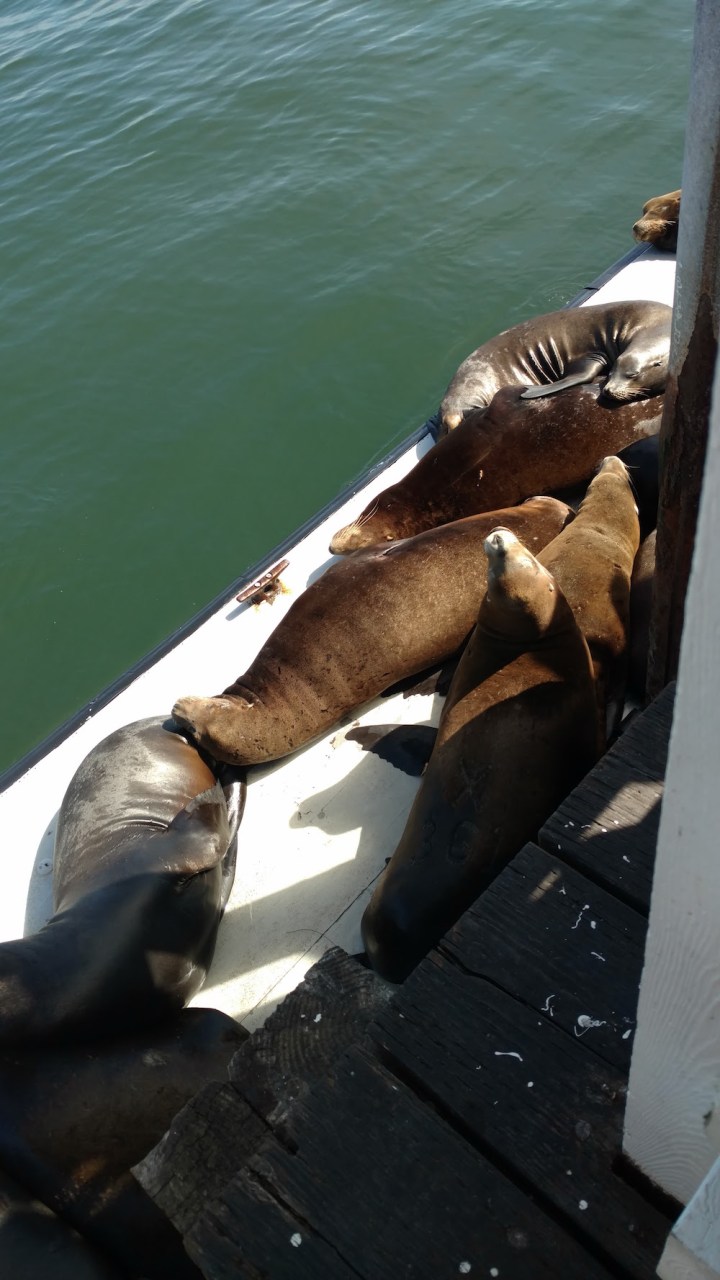
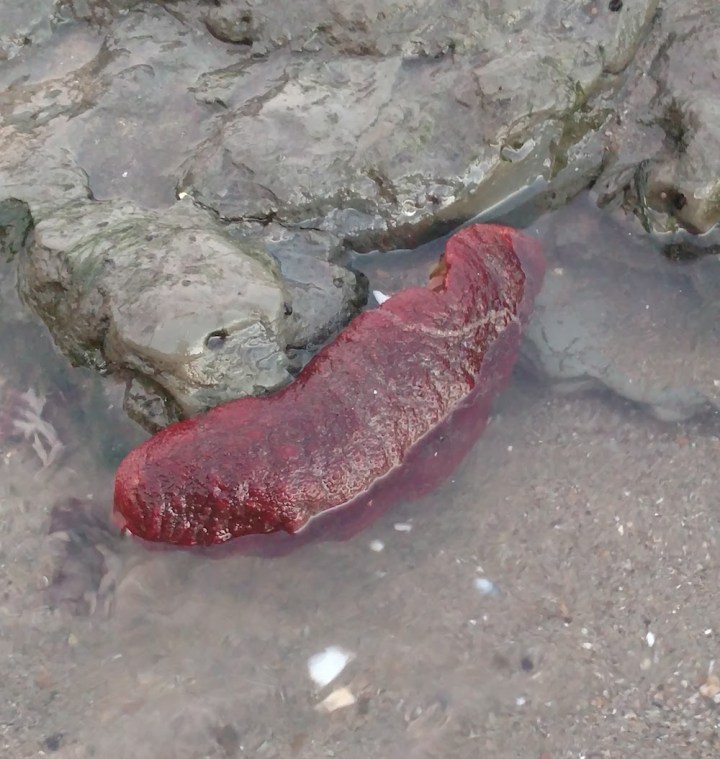
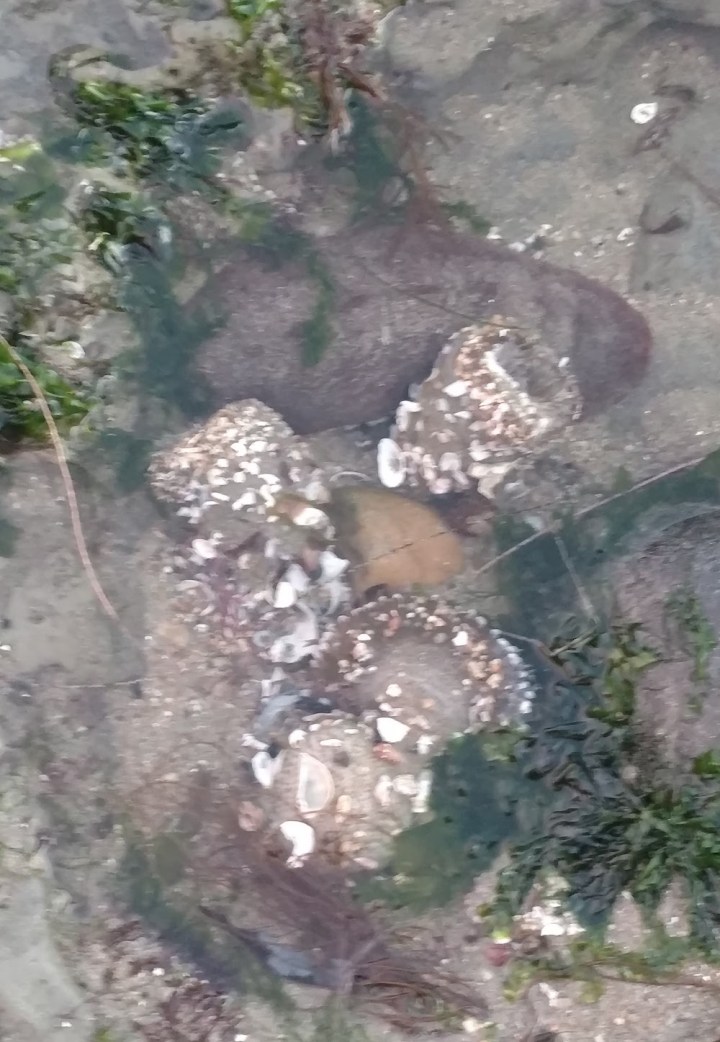
The animal that first drew us here is the sea lion, and our original goal was to live near the sea lion enclaves in west SC. Here’s a shot I took when I toured the SC wharf, the longest wooden wharf in the US, during the 150th anniversary celebration. There’s also a video of these animals on my youtube channel, Jody Griggs.  sealions-wharf-tour Instead of being neighbors of the sea lions, we ended up by the tide pools. These are the most common animals in the tidepool as far as I can tell. Are they anemones? maybe-anemonesI think this is a chiton, though my husband is skeptical. maybe-chitonThere are at least 4 animals in this photo. I have a video of them moving on my youtube channel, although the movement is hard to see. pacific-tidepool-animalsWhile I was at the tidepool taking these pictures, I also saw this bird. I see a lot of egrets in the swamps, but I’m not sure if this is one. It’s similar. Sorry the shot is so blurry.white-wading-birdThere are lots of great wading birds and water birds here; we see pelicans and cormorants every time we go to the beach. We see gulls every day, everywhere.
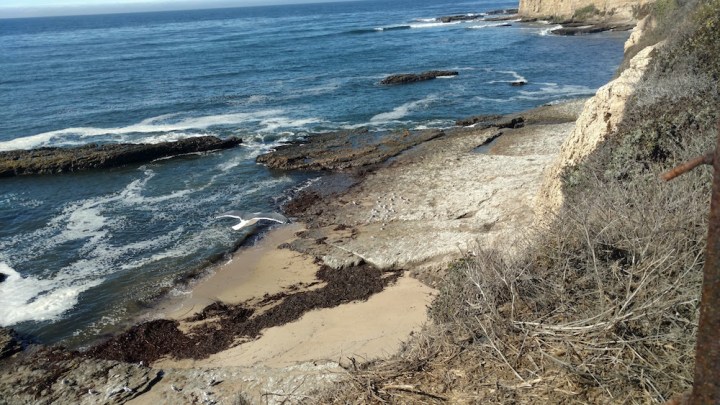
My new volunteer work is with The Otter Project (TOP), and though our main work is to document human uses of marine protected areas, on my first day I saw my second sea otter–we had seen one swimming in Monterey Bay near our house–and the spouts and backs of migrating whales. This shot is from one of the cliffs I survey; notice the airborne bird is below me. The cliffs are bigger on the ocean, as compared to the bay.cliff-and-gull

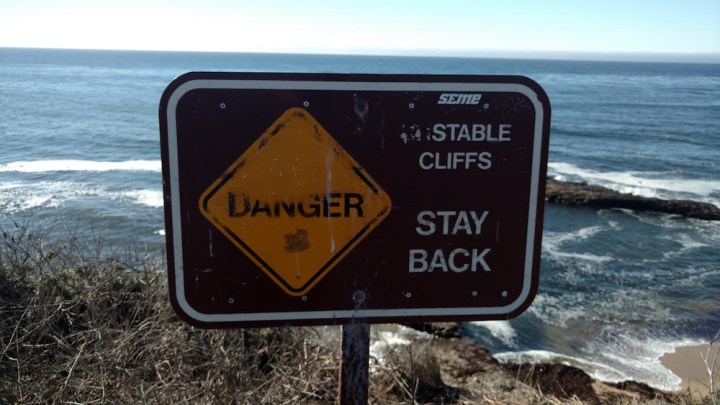
When I took that shot, I was just on the wrong side of this sign. cliff-sign

I think it is supposed to say UNstable.

Even though our nearby shoreline faces south, we get a sideways view of the sunset during at least some times of the year. That is definitely not our house. sunset-october-2016